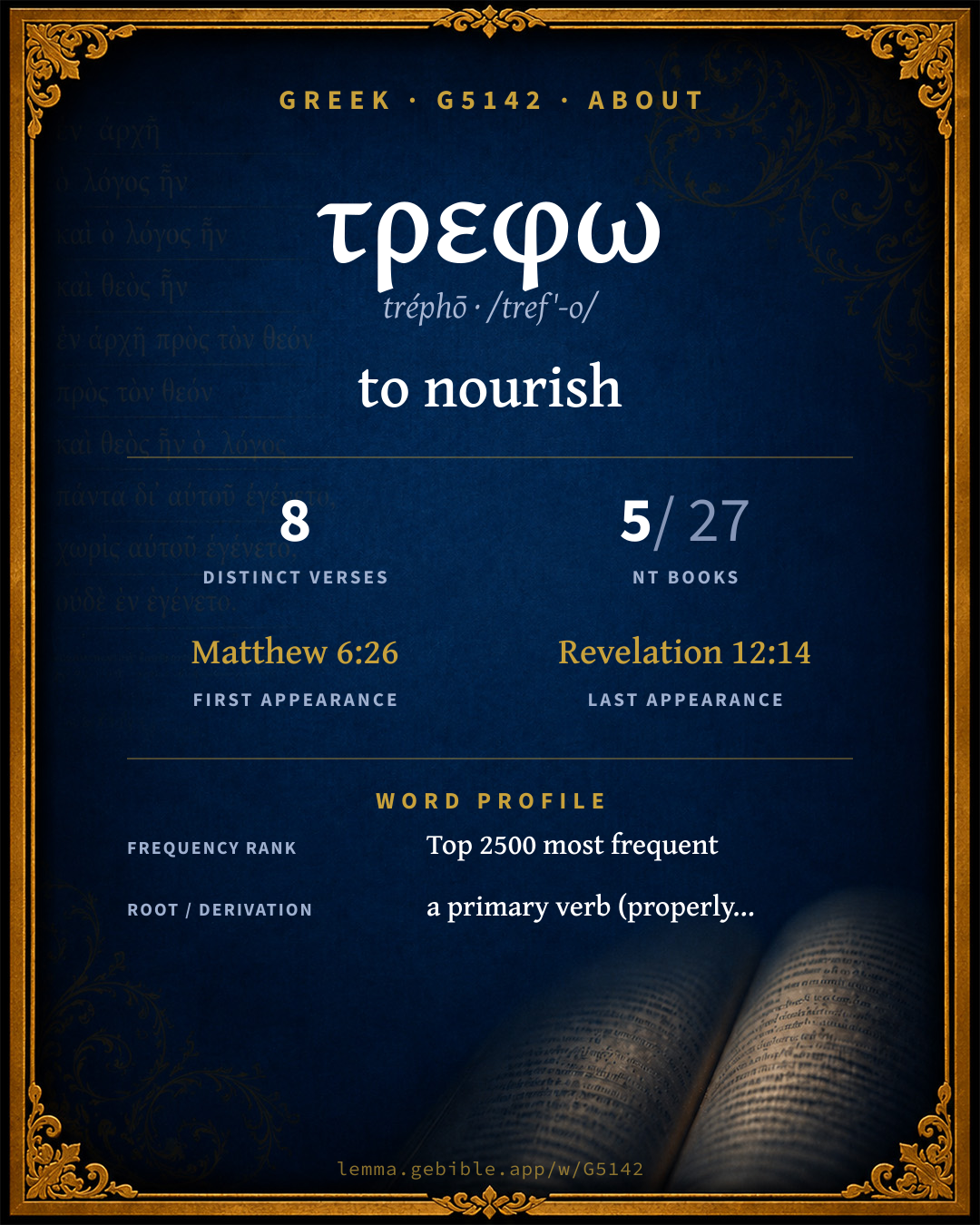
τρέφω
to nourish
‘to nourish’ is one of 4 main senses fuller range ↓
Full lexicon entry — Thayer's Greek Lexicon
From Thayer's Greek Lexicon
Where this word appears
See every Aorist-tense verb in the Greek New Testament →
Grammar key — what these labels mean
Part of speech
- Verb
- An action or state-of-being word.
Tense
- Present
- Ongoing or general action in present time (imperfective aspect).
- Aorist
- Action viewed as a simple whole, without regard to duration — often past (perfective aspect).
Voice
- Active
- The subject performs the action.
- Passive
- The subject receives the action.
Mood
- Indicative
- States a fact or asks a factual question (the mood of reality).
- Infinitive
- A verbal noun (“to write”), unmarked for person or number.
Person
- 3rd person
- The one spoken about (“he / she / it / they”).
- 1st person
- The speaker (“I / we”).
- 2nd person
- The one addressed (“you”).
Number
- Singular
- One.
- Plural
- More than one.
1 verse where G5142 appears in the Present tense in the Book of Luke. Filtered view — show all forms. Click any verse to open its interlinear word-by-word view. Verse text shown in the World English Bible for context — . Each verse’s Greek form is shown with its reference; the English is not keyword-highlighted, since the data carries no word-level English alignment. Use “Compare translations” on any verse to read it across multiple English versions. This concordance covers the Greek New Testament; Septuagint (Greek Old Testament) occurrences of this word are not indexed here.
Luke
About this entry
At a glance — auto-summarized from this page’s data, not written by a person. Every figure links to its source below. This summary describes the numbers; it doesn’t interpret them.
τρεφω — transliterated tréphō — is a Greek word carrying the sense “to nourish.” Its lexical range runs to 4 senses. The Greek New Testament uses it across 8 verses — uncommon. More than a quarter of its appearances fall in Matthew. It first appears in Matthew 6:26. See the sense tree, 8-verse concordance, and the renderings breakdown below.
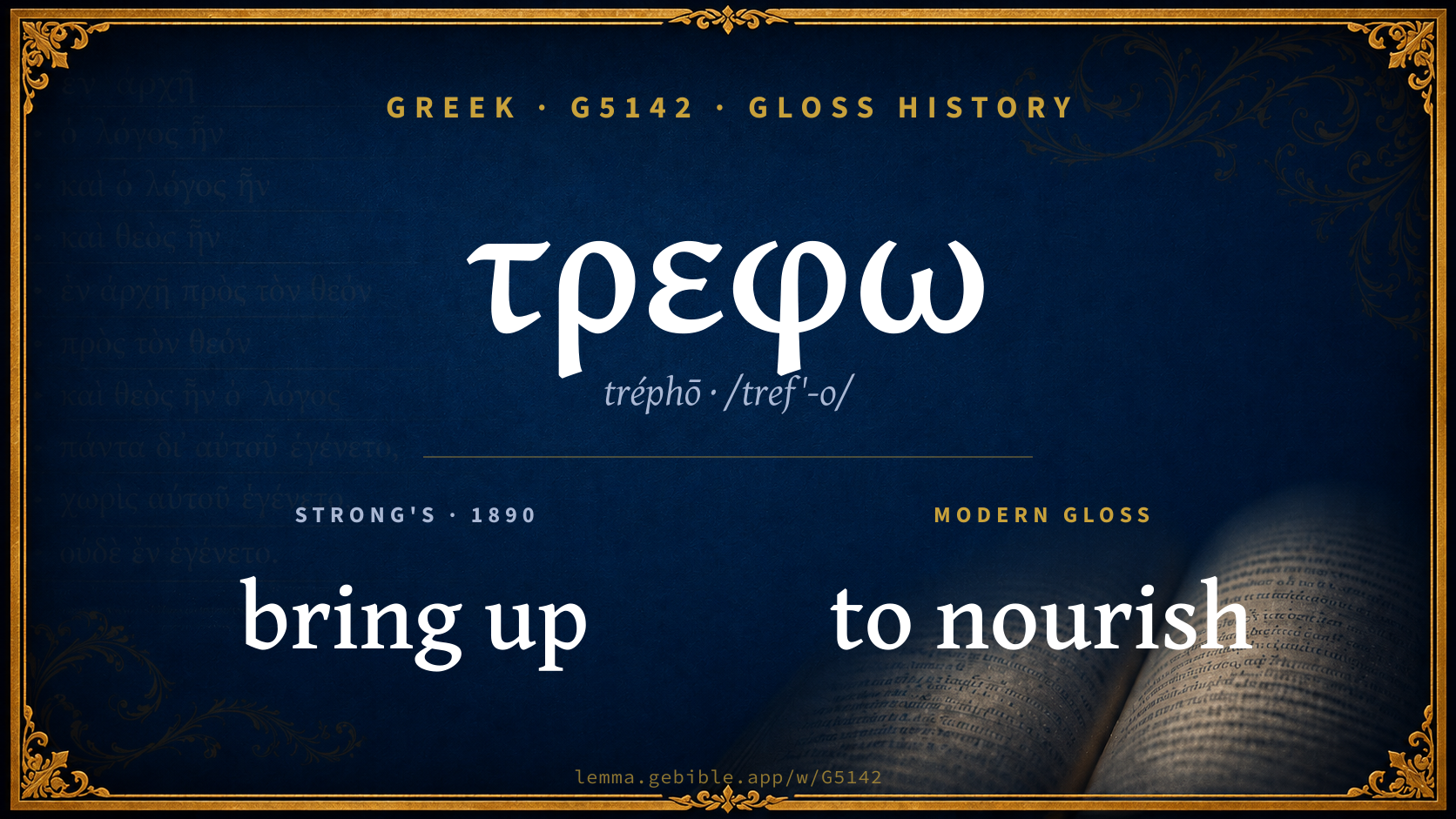
Gloss history
Strong's 1890 vs modern scholarship
About this word
Strong's G5142 catalogs a Greek word from the Greek New Testament.
These counts are not copied from any lexicon or concordance. They are computed here, from the morphology-tagged Greek New Testament. What Lemma adds →
- 8
- distinct verses
- The word appears in 8 distinct verses.
- 5 / 27
- NT books
- The word appears in 5 of 27 New Testament books.
- #1,240
- by frequency
- Top 2500 most frequent Greek words (rank 1,240 of 5,347 Greek words by occurrence).
View all 8 occurrences in the concordance →
Most concentrated in
- Matthew 2 verses 25%
- Luke 2 verses 25%
- Revelation 2 verses 25%
By section of the New Testament
By traditional corpus
Conventional, traditional groupings — biblical authorship is debated, so this is a traditional corpus grouping, not an authorship claim. Some books belong to more than one corpus (Luke is in both the Gospels and the Lukan corpus, and so on), so these shares overlap and need not total 100%. Each figure is a share of the word’s 8 distinct verses.
- Gospels 4 verses · 50%
- Lukan (Luke–Acts) 3 verses · 38%
- Johannine 2 verses · 25%
- Revelation 2 verses · 25%
- General (Catholic) Epistles 1 verse · 13%
How translations render this word
Counts come from each version’s own published word-to-Strong’s tagging or interlinear alignment — an approximate guide to how each version renders this word, not a word-level alignment the data otherwise carries. Because each total is that version’s own tagged count, the per-version totals vary from one another and need not match the appearance or distinct-verse counts above. These counts may also differ from a printed concordance because Lemma counts each distinctly tagged rendering and does not collapse phrase taggings into a single head-word total. This is a fixed set of word-tagged versions (KJV, ASV, BSB, ULT) and does not change with the reading translation you choose elsewhere. Each version’s license is shown beside its name below (and on Sources).
- King James Version: Feedeth 2×
- American Standard Version: Feedeth 2×
- Berean Standard Bible: Feeds 2×
- unfoldingWord Literal Text: Feeds 2×
King James Version Public Domain
Renders G5142 across 8 tagged occurrences — most commonly:
Plus 6 renderings that appear only once — usually multi-word phrases or single function words the recovered tagging swept in, not distinct renderings.
American Standard Version Public Domain
Renders G5142 across 8 tagged occurrences — most commonly:
Plus 6 renderings that appear only once — usually multi-word phrases or single function words the recovered tagging swept in, not distinct renderings.
Berean Standard Bible Public Domain
Renders G5142 across 9 tagged occurrences — most commonly:
Plus 7 renderings that appear only once — usually multi-word phrases or single function words the recovered tagging swept in, not distinct renderings.
unfoldingWord Literal Text CC BY-SA 4.0
Renders G5142 across 11 tagged occurrences — most commonly:
Plus 9 renderings that appear only once — usually multi-word phrases or single function words the recovered tagging swept in, not distinct renderings.
Senses in Thayer's
The 4 senses Thayer's distinguishes for this word, in lexicon order (not ranked by frequency or importance). The full entry — with sub-senses — is in the Lexicon Entry tab.
- to nourish, support
- feed
- to give suck, to fatten
- to bring up, nurture
Word origin
Origin: a primary verb (properly, threpho
A primary verb (properly θρέφω threphō but perhaps strengthened from the base of G5157 through the idea of convolution ); properly to stiffen that is fatten (by implication to cherish [with food etc.] pamper rear ): - bring up feed nourish.
— Strong’s Exhaustive Concordance (1890), public domain.
Forms in the corpus
The 7 distinct written forms G5142 takes in the Greek New Testament, most frequent first — each parse links to that tense’s occurrences in the concordance.
| Form | Parsing | Example | Uses |
|---|---|---|---|
| τρέφει tréphei | Verb, Present, Active, Indicative, 3rd person, Singular | Matthew 6:26 | 2 |
| τρέφεσθαι tréphesthai | Verb, Present, Passive, Infinitive | Acts 12:20 | 1 |
| τρέφεται tréphetai | Verb, Present, Passive, Indicative, 3rd person, Singular | Revelation 12:14 | 1 |
| τρέφουσιν tréphousin | Verb, Present, Active, Indicative, 3rd person, Singular | Revelation 12:6 | 1 |
| ἐθρέψαμεν ethrépsamen | Verb, Aorist, Active, Indicative, 1st person, Plural | Matthew 25:37 | 1 |
| ἐθρέψατε ethrépsate | Verb, Aorist, Active, Indicative, 2nd person, Plural | James 5:5 | 1 |
| ἔθρεψαν éthrepsan | Verb, Aorist, Active, Indicative, 3rd person, Plural | Luke 23:29 | 1 |
Same root — word family
Other Thayer's entries built from the same root as G5142, grouped by Strong’s listed origin. These share a root / origin per the lexicon — not necessarily a shared meaning. Each links to that word’s own entry.
Derived from this word
- θρεμμα thrémma G2353 flock
- θρομβος thrómbos G2361 blood clot
- τροφη trophḗ G5160 food
- τροφος trophós G5162 nurse
Compare all same-root words → Showing 4 of 5 — not the complete family. They share a root, not necessarily a meaning.
Septuagint usage
The same Greek word τρεφω appears 11 times in the Greek Old Testament (Septuagint), across 11 verses in 8 books.
- 11
- LXX occurrences
- Tagged occurrences of this Greek word in the Septuagint.
- 11
- verses
- Distinct Septuagint verses containing this word.
- 8 / 39
- OT books
- The word appears in 8 of the 39 Old Testament books.
Sample Septuagint occurrences
- Genesis 6:19 τρέφω
- Numbers 6:5 τρέφω
- Deuteronomy 32:18 τρέφω
- 1 Kings 18:13 τρέφω
- Esther 4:8 τρέφω
- Proverbs 25:21 τρέφω
- Isaiah 7:21 τρέφω
- Jeremiah 26:21 τρέφω
Septuagint occurrences (same lexeme)
Every verse where the same Strong’s number (G5142) appears in the Greek Septuagint. Verse text shown in the World English Bible for context; the Greek form is the matched word — the English is not keyword-highlighted.
- Genesis 6:19 τρέφω Of every living thing of all flesh, you shall bring two of every sort into the ark, to keep them alive with you. They shall be male and female.
- Genesis 6:20 τρέφω Of the birds after their kind, of the cattle after their kind, of every creeping thing of the ground after its kind, two of every sort shall come to you, to keep them alive.
- Genesis 48:15 τρέφω He blessed Joseph, and said, "The God before whom my fathers Abraham and Isaac did walk, the God who has fed me all my life long to this day,
- Numbers 6:5 τρέφω "All the days of his vow of separation there shall no razor come on his head, until the days are fulfilled, in which he separates himself to Yahweh. He shall be holy. He shall let the locks of the hair of his head grow long.
- Deuteronomy 32:18 τρέφω Of the Rock that became your father, you are unmindful, Have forgotten God who gave you birth.
- 1 Kings 18:13 τρέφω Wasn't it told my lord what I did when Jezebel killed the prophets of Yahweh, how I hid one hundred men of Yahweh's prophets by fifty in a cave, and fed them with bread and water?
- Esther 4:8 τρέφω Also he gave him the copy of the writing of the decree that was given out in Shushan to destroy them, to show it to Esther, and to declare it to her, and to charge her that she should go in to the king, to make supplication to him, and to make request before him, for her people.
- Proverbs 25:21 τρέφω If your enemy is hungry, give him food to eat; If he is thirsty, give him water to drink:
- Isaiah 7:21 τρέφω It shall happen in that day that a man shall keep alive a young cow, and two sheep;
- Isaiah 33:18 τρέφω Your heart shall muse on the terror: Where is he who counted, where is he who weighed [the tribute]? where is he who counted the towers?
- Jeremiah 26:21 τρέφω and when Jehoiakim the king, with all his mighty-men, and all the princes, heard his words, the king sought to put him to death; but when Uriah heard it, he was afraid, and fled, and went into Egypt:
These are occurrences of the same Greek lexeme (G5142) in the Septuagint — not a translation of any one Hebrew word. The store carries no word-level Hebrew↔Greek alignment, so no Hebrew original is asserted here. Counts come from the recovered LXX Strong's tagging — high-frequency vocabulary is well covered, while rare or late forms may be untagged — so they reflect tagged occurrences and may slightly undercount.