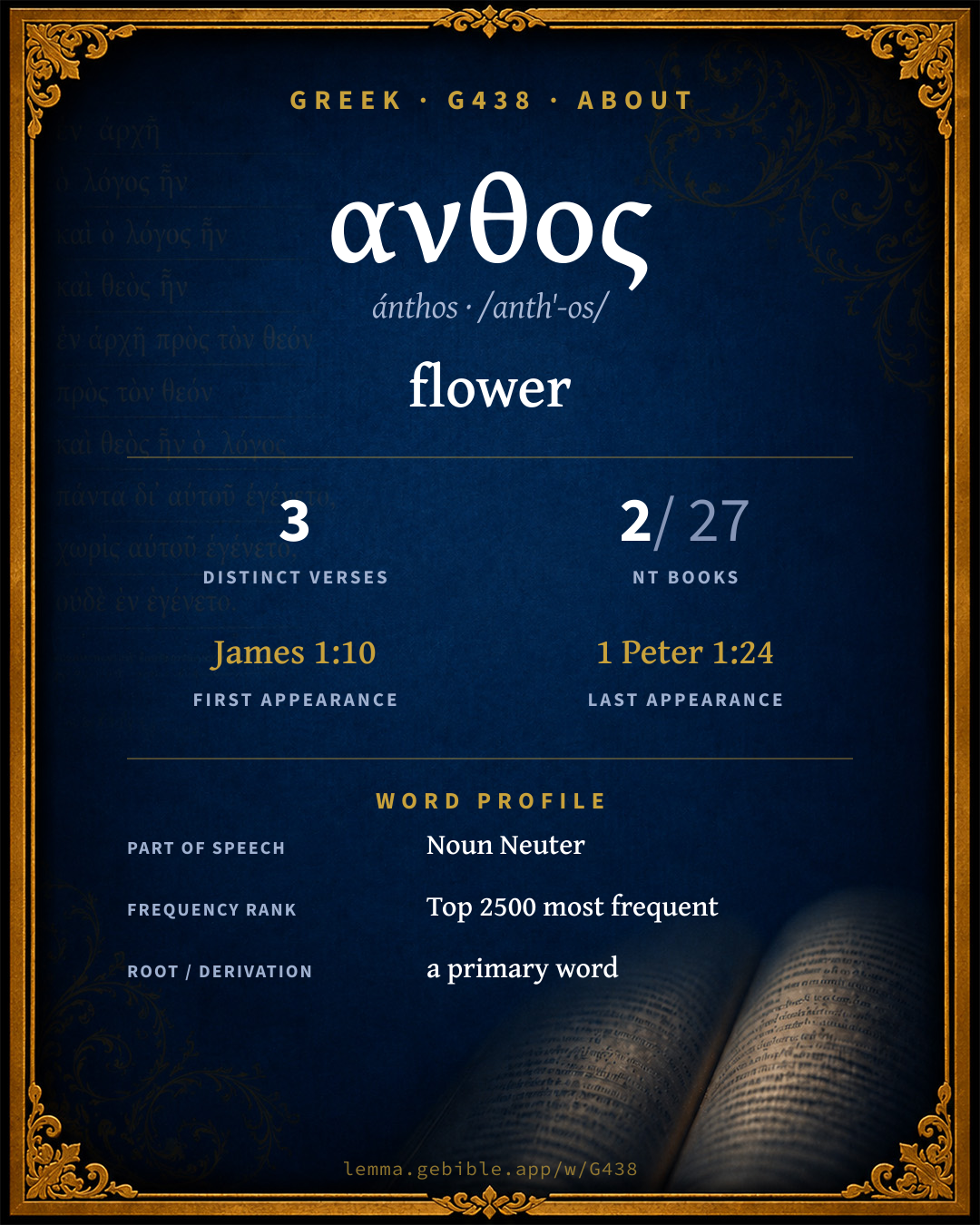
ἄνθος
flower
Full lexicon entry — Thayer's Greek Lexicon
From Thayer's Greek Lexicon
Where this word appears
Grammar key — what these labels mean
Part of speech
- Noun
- A naming word — a person, place, thing, or idea.
Case
- Nominative
- The case of the subject (and the predicate nominative).
Gender
- Neuter
- Grammatically neuter.
Number
- Singular
- One.
Every verse where G438 appears in the Book of 1 Peter — 1 distinct verse. Click any verse to open its interlinear word-by-word view. Verse text shown in the World English Bible for context — . Each verse’s Greek form is shown with its reference; the English is not keyword-highlighted, since the data carries no word-level English alignment. Use “Compare translations” on any verse to read it across multiple English versions. This concordance covers the Greek New Testament; Septuagint (Greek Old Testament) occurrences of this word are not indexed here.
1 Peter
About this entry
At a glance — auto-summarized from this page’s data, not written by a person. Every figure links to its source below. This summary describes the numbers; it doesn’t interpret them.
“flower” is the headline sense of the Greek noun ανθος (ánthos). With only 3 verses it sits in the long tail of Greek New Testament vocabulary. It clusters heavily in James, which alone accounts for 67% of its uses. Scripture first uses it in James 1:10. The sections below give every sense, occurrence, and version rendering.
Gloss history
Strong's 1890 vs modern scholarship
About this word
Strong's G438 catalogs a Greek word from the Greek New Testament.
These counts are not copied from any lexicon or concordance. They are computed here, from the morphology-tagged Greek New Testament. What Lemma adds →
- 3
- distinct verses
- The word appears in 3 distinct verses.
- 2 / 27
- NT books
- The word appears in 2 of 27 New Testament books.
- #1,877
- by frequency
- Top 2500 most frequent Greek words (rank 1,877 of 5,347 Greek words by occurrence).
View all 3 occurrences in the concordance →
By traditional corpus
Conventional, traditional groupings — biblical authorship is debated, so this is a traditional corpus grouping, not an authorship claim. Some books belong to more than one corpus (Luke is in both the Gospels and the Lukan corpus, and so on), so these shares overlap and need not total 100%. Each figure is a share of the word’s 3 distinct verses.
- General (Catholic) Epistles 3 verses · 100%
How translations render this word
Counts come from each version’s own published word-to-Strong’s tagging or interlinear alignment — an approximate guide to how each version renders this word, not a word-level alignment the data otherwise carries. Because each total is that version’s own tagged count, the per-version totals vary from one another and need not match the appearance or distinct-verse counts above. These counts may also differ from a printed concordance because Lemma counts each distinctly tagged rendering and does not collapse phrase taggings into a single head-word total. This is a fixed set of word-tagged versions (KJV, ASV, BSB, ULT) and does not change with the reading translation you choose elsewhere. Each version’s license is shown beside its name below (and on Sources).
- King James Version: Flower 4×
- American Standard Version: Flower 4×
- Berean Standard Bible: Flower 2×, Flowers 2×
- unfoldingWord Literal Text: Flower 4×
King James Version Public Domain
Renders G438 across 4 tagged occurrences — most commonly:
American Standard Version Public Domain
Renders G438 across 4 tagged occurrences — most commonly:
Berean Standard Bible Public Domain
Renders G438 across 4 tagged occurrences — most commonly:
unfoldingWord Literal Text CC BY-SA 4.0
Renders G438 across 4 tagged occurrences — most commonly:
Senses in Thayer's
The 1 sense Thayer's distinguishes for this word, in lexicon order (not ranked by frequency or importance). The full entry — with sub-senses — is in the Lexicon Entry tab.
- a flower
Word origin
Origin: a primary word
A primary word; a blossom : - flower.
— Strong’s Exhaustive Concordance (1890), public domain.
Septuagint usage
The same Greek word ανθος appears 20 times in the Greek Old Testament (Septuagint), across 19 verses in 8 books.
- 20
- LXX occurrences
- Tagged occurrences of this Greek word in the Septuagint.
- 19
- verses
- Distinct Septuagint verses containing this word.
- 8 / 39
- OT books
- The word appears in 8 of the 39 Old Testament books.
Sample Septuagint occurrences
- Exodus 28:14 ἄνθος
- Numbers 17:23 ἄνθος
- Job 14:2 ἄνθος
- Psalms 102:15 ἄνθος
- Song of Solomon 2:1 ἄνθος
- Isaiah 5:24 ἄνθος
- Ezekiel 19:10 ἄνθος
- Zephaniah 2:2 ἄνθος
Septuagint occurrences (same lexeme)
Every verse where the same Strong’s number (G438) appears in the Greek Septuagint. Verse text shown in the World English Bible for context; the Greek form is the matched word — the English is not keyword-highlighted.
- Exodus 28:14 ἄνθος and two chains of pure gold; you make them like cords shall, of braided work: and you shall put the braided chains on the settings.
- Exodus 30:23 ἄνθος "Also take fine spices: of liquid myrrh, five hundred shekels; and of fragrant cinnamon half as much, even two hundred and fifty; and of fragrant cane, two hundred and fifty;
- Numbers 17:23 ἄνθος
- Job 14:2 ἄνθος He comes forth like a flower, and is cut down. He also flees like a shadow, and doesn't continue.
- Job 15:30 ἄνθος He shall not depart out of darkness; The flame shall dry up his branches, By the breath of God's mouth shall he go away.
- Job 15:33 ἄνθος He shall shake off his unripe grape as the vine, And shall cast off his flower as the olive tree.
- Psalms 102:15 ἄνθος So the nations will fear the name of Yahweh; All the kings of the earth your glory.
- Song of Solomon 2:1 ἄνθος I am a rose of Sharon, A lily of the valleys.
- Song of Solomon 2:12 ἄνθος The flowers appear on the earth; The time of the singing has come, And the voice of the turtle-dove is heard in our land.
- Isaiah 5:24 ἄνθος Therefore as the tongue of fire devours the stubble, And as the dry grass sinks down in the flame, So their root shall be as rottenness, And their blossom shall go up as dust; Because they have rejected the law of Yahweh of Hosts, And despised the word of the Holy One of Israel.
- Isaiah 11:1 ἄνθος There shall come forth a shoot out of the stock of Jesse, and a branch out of his roots shall bear fruit.
- Isaiah 18:5 ἄνθος For before the harvest, when the blossom is over, and the flower becomes a ripening grape, he will cut off the sprigs with pruning-hooks, and the spreading branches will he take away [and] cut down.
- Isaiah 28:1 ἄνθος Woe to the crown of pride of the drunkards of Ephraim, and to the fading flower of his glorious beauty, which is on the head of the fat valley of those who are overcome with wine!
- Isaiah 28:4 ἄνθος and the fading flower of his glorious beauty, which is on the head of the fat valley, shall be as the first-ripe fig before the summer; which when he who looks on it sees, while it is yet in his hand he eats it up.
- Isaiah 40:6 ἄνθος The voice of one saying, Cry. One said, What shall I cry? All flesh is grass, and all the glory of it is as the flower of the field.
- Isaiah 40:7 ἄνθος The grass withers, the flower fades, because the breath of Yahweh blows on it; surely the people is grass.
- Isaiah 61:11 ἄνθος For as the earth brings forth its bud, and as the garden causes the things that are sown in it to spring forth; so the Lord Yahweh will cause righteousness and praise to spring forth before all the nations.
- Ezekiel 19:10 ἄνθος Your mother was like a vine, in your blood, planted by the waters: it was fruitful and full of branches by reason of many waters.
- Zephaniah 2:2 ἄνθος before the appointed time when the day passes as the chaff, before the fierce anger of Yahweh comes on you, before the day of Yahweh's anger comes on you.
These are occurrences of the same Greek lexeme (G438) in the Septuagint — not a translation of any one Hebrew word. The store carries no word-level Hebrew↔Greek alignment, so no Hebrew original is asserted here. Counts come from the recovered LXX Strong's tagging — high-frequency vocabulary is well covered, while rare or late forms may be untagged — so they reflect tagged occurrences and may slightly undercount.