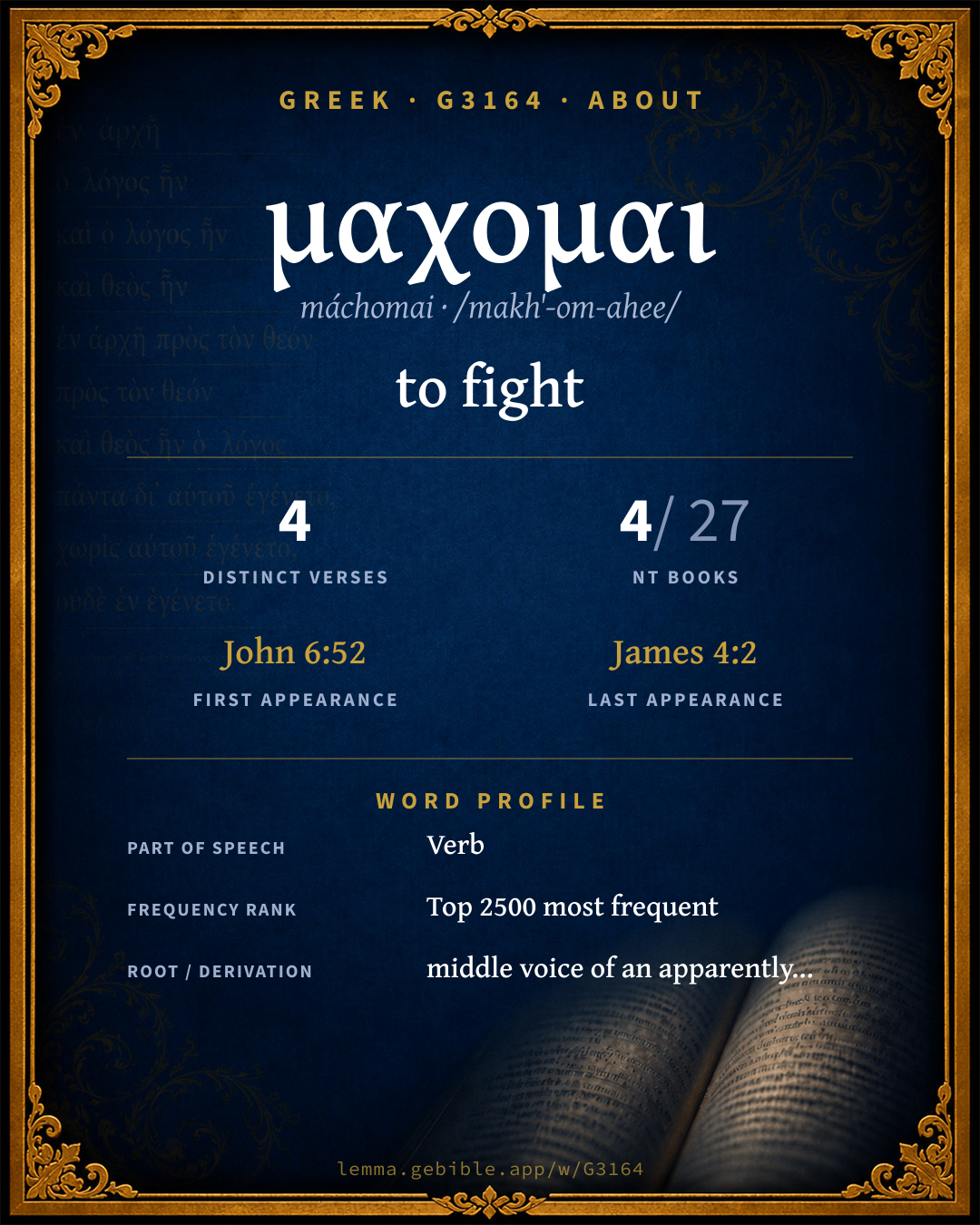
μάχομαι
to fight
‘to fight’ is one of 3 main senses fuller range ↓
Full lexicon entry — Thayer's Greek Lexicon
From Thayer's Greek Lexicon
Where this word appears
Grammar key — what these labels mean
Part of speech
- Verb
- An action or state-of-being word.
Tense
- Imperfect
- Continuous or repeated action in past time (“was writing”).
- Present
- Ongoing or general action in present time (imperfective aspect).
Voice
- Middle or Passive deponent
- Middle/passive in form but active in meaning.
Mood
- Indicative
- States a fact or asks a factual question (the mood of reality).
- Infinitive
- A verbal noun (“to write”), unmarked for person or number.
- Participle
- A verbal adjective (“writing,” “having written”).
Case
- Dative
- The case of the indirect object, means, or location — “to / for / with / in.”
Person
- 3rd person
- The one spoken about (“he / she / it / they”).
- 2nd person
- The one addressed (“you”).
Gender
- Masculine
- Grammatically masculine.
Number
- Plural
- More than one.
Every verse where G3164 appears in the Book of 2 Timothy — 1 distinct verse. Click any verse to open its interlinear word-by-word view. Verse text shown in the World English Bible for context — . Each verse’s Greek form is shown with its reference; the English is not keyword-highlighted, since the data carries no word-level English alignment. Use “Compare translations” on any verse to read it across multiple English versions. This concordance covers the Greek New Testament; Septuagint (Greek Old Testament) occurrences of this word are not indexed here.
2 Timothy
About this entry
At a glance — auto-summarized from this page’s data, not written by a person. Every figure links to its source below. This summary describes the numbers; it doesn’t interpret them.
“to fight” is the headline sense of the Greek verb μαχομαι (máchomai). It is rare — just 4 verses in the entire Greek New Testament. More than a quarter of its appearances fall in John. First canonically at John 6:52, it enters the text early. Catalogued under 3 senses, its meaning is not single-sense. The sections below give every sense, occurrence, and version rendering.
Gloss history
Strong's 1890 vs modern scholarship
About this word
Strong's G3164 catalogs a Greek word from the Greek New Testament.
These counts are not copied from any lexicon or concordance. They are computed here, from the morphology-tagged Greek New Testament. What Lemma adds →
- 4
- distinct verses
- The word appears in 4 distinct verses.
- 4 / 27
- NT books
- The word appears in 4 of 27 New Testament books.
- #1,877
- by frequency
- Top 2500 most frequent Greek words (rank 1,877 of 5,347 Greek words by occurrence).
View all 4 occurrences in the concordance →
By section of the New Testament
By traditional corpus
Conventional, traditional groupings — biblical authorship is debated, so this is a traditional corpus grouping, not an authorship claim. Some books belong to more than one corpus (Luke is in both the Gospels and the Lukan corpus, and so on), so these shares overlap and need not total 100%. Each figure is a share of the word’s 4 distinct verses.
- Gospels 1 verse · 25%
- Lukan (Luke–Acts) 1 verse · 25%
- Johannine 1 verse · 25%
- Pauline corpus 1 verse · 25%
- General (Catholic) Epistles 1 verse · 25%
How translations render this word
Counts come from each version’s own published word-to-Strong’s tagging or interlinear alignment — an approximate guide to how each version renders this word, not a word-level alignment the data otherwise carries. Because each total is that version’s own tagged count, the per-version totals vary from one another and need not match the appearance or distinct-verse counts above. These counts may also differ from a printed concordance because Lemma counts each distinctly tagged rendering and does not collapse phrase taggings into a single head-word total. This is a fixed set of word-tagged versions (KJV, ASV, BSB, ULT) and does not change with the reading translation you choose elsewhere. Each version’s license is shown beside its name below (and on Sources).
- King James Version: Strive 1×, Strove 1×, They strove 1×
- American Standard Version: Strive 1×, Strove 1×, They strove 1×
- Berean Standard Bible: Be quarrelsome 1×, Began to argue 1×, Were fighting 1×
- unfoldingWord Literal Text: Battle 1×, Began to argue 1×, They were quarreling 1×
King James Version Public Domain
Renders G3164 across 4 tagged occurrences — most commonly:
American Standard Version Public Domain
Renders G3164 across 4 tagged occurrences — most commonly:
Berean Standard Bible Public Domain
Renders G3164 across 4 tagged occurrences — most commonly:
unfoldingWord Literal Text CC BY-SA 4.0
Renders G3164 across 4 tagged occurrences — most commonly:
Senses in Thayer's
The 3 senses Thayer's distinguishes for this word, in lexicon order (not ranked by frequency or importance). The full entry — with sub-senses — is in the Lexicon Entry tab.
- of armed combatants, or those who engage in a hand to hand struggle
- of those who engage in a war of words, to quarrel, wrangle, dispute
- of those who contend at law for property and privileges
Word origin
Origin: middle voice of an apparently root word
Middle voice of an apparently primary verb; to war that is (figuratively) to quarrel dispute : - fight strive.
— Strong’s Exhaustive Concordance (1890), public domain.
Forms in the corpus
The 4 distinct written forms G3164 takes in the Greek New Testament, most frequent first — each parse links to that tense’s occurrences in the concordance.
| Form | Parsing | Example | Uses |
|---|---|---|---|
| μάχεσθαι máchesthai | Verb, Present, Middle or Passive deponent, Infinitive | 2 Timothy 2:24 | 1 |
| μάχεσθε máchesthe | Verb, Present, Middle or Passive deponent, Indicative, 2nd person, Plural | James 4:2 | 1 |
| μαχομένοις machoménois | Verb, Present, Middle or Passive deponent, Participle, Dative, Plural, Masculine | Acts 7:26 | 1 |
| Ἐμάχοντο Emáchonto | Verb, Imperfect, Middle or Passive deponent, Indicative, 3rd person, Plural | John 6:52 | 1 |
Same root — word family
Other Thayer's entries built from the same root as G3164, grouped by Strong’s listed origin. These share a root / origin per the lexicon — not necessarily a shared meaning. Each links to that word’s own entry.
Derived from this word
Proper names from this root
People and places named from this root — a name, not an additional meaning of the word.
Compare all same-root words → 1 of the same-root words is a proper name (a person or place). They share a root, not necessarily a meaning.
Septuagint usage
The same Greek word μαχομαι appears 21 times in the Greek Old Testament (Septuagint), across 20 verses in 13 books.
- 21
- LXX occurrences
- Tagged occurrences of this Greek word in the Septuagint.
- 20
- verses
- Distinct Septuagint verses containing this word.
- 13 / 39
- OT books
- The word appears in 13 of the 39 Old Testament books.
Sample Septuagint occurrences
- Genesis 26:20 μάχομαι
- Exodus 21:22 μάχομαι
- Leviticus 24:10 μάχομαι
- Deuteronomy 25:11 μάχομαι
- Joshua 9:18 μάχομαι
- Judges 11:25 μάχομαι
- 2 Samuel 14:6 μάχομαι
- 2 Kings 3:23 μάχομαι
- 2 Chronicles 27:5 μάχομαι
- Ezra 15:7 μάχομαι
- Song of Solomon 1:6 μάχομαι
- Isaiah 27:8 μάχομαι
Septuagint occurrences (same lexeme)
Every verse where the same Strong’s number (G3164) appears in the Greek Septuagint. Verse text shown in the World English Bible for context; the Greek form is the matched word — the English is not keyword-highlighted.
- Genesis 26:20 μάχομαι The herdsmen of Gerar argued with Isaac's herdsmen, saying, "The water is ours." He called the name of the well Esek, because they contended with him.
- Genesis 26:22 μάχομαι He left that place, and dug another well. They didn't argue over that one. He called it Rehoboth. He said, "For now Yahweh has made room for us, and we will be fruitful in the land."
- Genesis 31:36 μάχομαι Jacob was angry, and argued with Laban. Jacob answered Laban, "What is my trespass? What is my sin, that you have hotly pursued after me?
- Exodus 21:22 μάχομαι "If men fight and hurt a pregnant woman so that she gives birth prematurely, and yet no harm follows, he shall be surely fined as much as the woman's husband demands and the judges allow.
- Leviticus 24:10 μάχομαι The son of an Israelite woman, whose father was an Egyptian, went out among the children of Israel; and the son of the Israelite woman and a man of Israel strove together in the camp.
- Deuteronomy 25:11 μάχομαι When men strive together one with another, and the wife of the one draws near to deliver her husband out of the hand of him who strikes him, and puts forth her hand, and takes him by the secrets;
- Joshua 9:18 μάχομαι The children of Israel didn't strike them, because the princes of the congregation had sworn to them by Yahweh, the God of Israel. All the congregation murmured against the princes.
- Joshua 16:7 μαχω and it went down from Janoah to Ataroth, and to Naarah, and reached to Jericho, and went out at the Jordan.
- Judges 11:25 μάχομαι Now are you anything better than Balak the son of Zippor, king of Moab? did he ever strive against Israel, or did he ever fight against them?
- 2 Samuel 14:6 μάχομαι Your handmaid had two sons, and they two strove together in the field, and there was none to part them, but the one struck the other, and killed him.
- 2 Kings 3:23 μάχομαι and they said, This is blood; the kings are surely destroyed, and they have struck each man his fellow: now therefore, Moab, to the spoil.
- 2 Chronicles 27:5 μάχομαι He fought also with the king of the children of Ammon, and prevailed against them. The children of Ammon gave him the same year one hundred talents of silver, and ten thousand measures of wheat, and ten thousand of barley. So much did the children of Ammon render to him, in the second year also, and in the third.
- Ezra 15:7 μάχομαι
- Ezra 23:11 μάχομαι
- Ezra 23:17 μάχομαι
- Ezra 23:25 μάχομαι
- Song of Solomon 1:6 μάχομαι Don't stare at me because I am dark, Because the sun has scorched me. My mother's sons were angry with me. They made me keeper of the vineyards. I haven't kept my own vineyard.
- Isaiah 27:8 μάχομαι In measure, when you send them away, you do contend with them; he has removed [them] with his rough blast in the day of the east wind.
- Isaiah 28:20 μάχομαι For the bed is shorter than that a man can stretch himself on it; and the covering narrower than that he can wrap himself in it.
- Jeremiah 40:5 μάχομαι Now while he was not yet gone back, Go back then, [said he], to Gedaliah the son of Ahikam, the son of Shaphan, whom the king of Babylon has made governor over the cities of Judah, and dwell with him among the people; or go wherever it seems right to you to go. So the captain of the guard gave him food and a present, and let him go.
These are occurrences of the same Greek lexeme (G3164) in the Septuagint — not a translation of any one Hebrew word. The store carries no word-level Hebrew↔Greek alignment, so no Hebrew original is asserted here. Counts come from the recovered LXX Strong's tagging — high-frequency vocabulary is well covered, while rare or late forms may be untagged — so they reflect tagged occurrences and may slightly undercount.