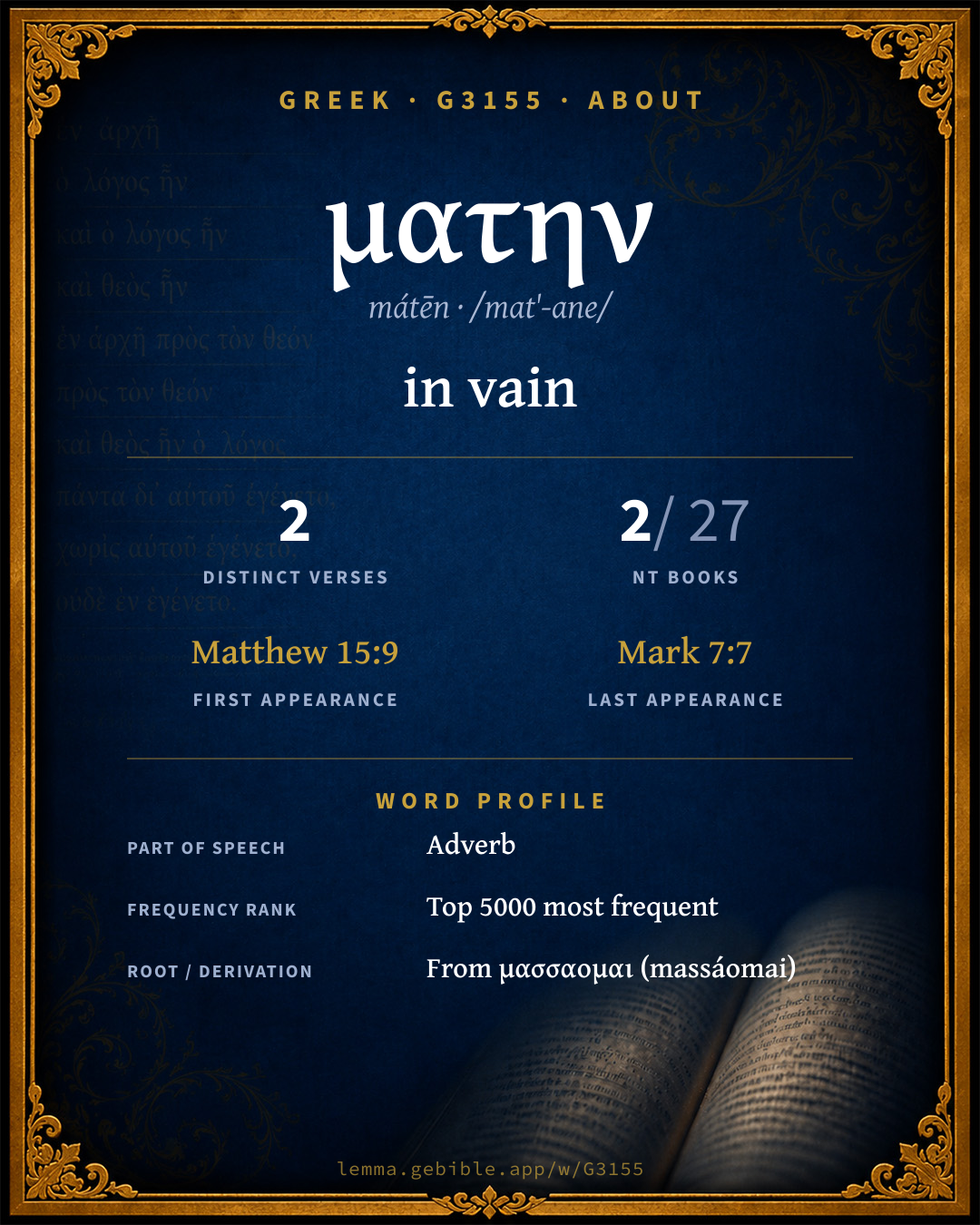
μάτην
in vain
Full lexicon entry — Thayer's Greek Lexicon
From Thayer's Greek Lexicon
Where this word appears
Grammar key — what these labels mean
Part of speech
- Adverb
- A word that modifies a verb, adjective, or other adverb.
Every verse where G3155 appears — 2 distinct verses across 2 books. Click any verse to open its interlinear word-by-word view. Verse text shown in the World English Bible for context — . Each verse’s Greek form is shown with its reference; the English is not keyword-highlighted, since the data carries no word-level English alignment. Use “Compare translations” on any verse to read it across multiple English versions. This concordance covers the Greek New Testament; Septuagint (Greek Old Testament) occurrences of this word are not indexed here.
Matthew 1 verse
Mark 1 verse
About this entry
At a glance — auto-summarized from this page’s data, not written by a person. Every figure links to its source below. This summary describes the numbers; it doesn’t interpret them.
At its core, ματην (mátēn) means “in vain.” It occurs a mere 2 verses across Scripture. The word gravitates to Matthew (50%), then Mark. Scripture first uses it in Matthew 15:9. It clusters with μασσαομαι, μαστιξ and μαστος under a shared root. Dig into 2-verse concordance and the renderings breakdown below.
Gloss history
Strong's 1890 vs modern scholarship
About this word
Strong's G3155 catalogs a Greek word from the Greek New Testament.
These counts are not copied from any lexicon or concordance. They are computed here, from the morphology-tagged Greek New Testament. What Lemma adds →
- 2
- distinct verses
- The word appears in 2 distinct verses.
- 2 / 27
- NT books
- The word appears in 2 of 27 New Testament books.
- #2,678
- by frequency
- Top 5000 most frequent Greek words (rank 2,678 of 5,347 Greek words by occurrence).
View all 2 occurrences in the concordance →
By traditional corpus
Conventional, traditional groupings — biblical authorship is debated, so this is a traditional corpus grouping, not an authorship claim. Some books belong to more than one corpus (Luke is in both the Gospels and the Lukan corpus, and so on), so these shares overlap and need not total 100%. Each figure is a share of the word’s 2 distinct verses.
- Gospels 2 verses · 100%
How translations render this word
Counts come from each version’s own published word-to-Strong’s tagging or interlinear alignment — an approximate guide to how each version renders this word, not a word-level alignment the data otherwise carries. Because each total is that version’s own tagged count, the per-version totals vary from one another and need not match the appearance or distinct-verse counts above. These counts may also differ from a printed concordance because Lemma counts each distinctly tagged rendering and does not collapse phrase taggings into a single head-word total. This is a fixed set of word-tagged versions (KJV, ASV, BSB, ULT) and does not change with the reading translation you choose elsewhere. Each version’s license is shown beside its name below (and on Sources).
- King James Version: Vain 2×
- American Standard Version: Vain 2×
- Berean Standard Bible: Vain 2×
- unfoldingWord Literal Text: Vain 2×
King James Version Public Domain
Renders G3155 across 2 tagged occurrences — most commonly:
American Standard Version Public Domain
Renders G3155 across 2 tagged occurrences — most commonly:
Berean Standard Bible Public Domain
Renders G3155 across 2 tagged occurrences — most commonly:
unfoldingWord Literal Text CC BY-SA 4.0
Renders G3155 across 2 tagged occurrences — most commonly:
Senses in Thayer's
The 1 sense Thayer's distinguishes for this word, in lexicon order (not ranked by frequency or importance). The full entry — with sub-senses — is in the Lexicon Entry tab.
- in vain, fruitlessly
Word origin
Derived from μασσαομαι (massáomai) (G3145) — to chew.
Accusative case of a derivative of the base of G3145 (through the idea of tentative manipulation that is unsuccessful search or else of punishment ); folly that is (adverbially) to no purpose : - in vain.
— Strong’s Exhaustive Concordance (1890), public domain.
Same root — word family
Other Thayer's entries built from the same root as G3155, grouped by Strong’s listed origin. These share a root / origin per the lexicon — not necessarily a shared meaning. Each links to that word’s own entry.
Derives from
Shares the same root
Derived from this word
Compare all same-root words → Showing 4 of 6 — not the complete family. They share a root, not necessarily a meaning.
Septuagint usage
The same Greek word ματην appears 20 times in the Greek Old Testament (Septuagint), across 19 verses in 7 books.
- 20
- LXX occurrences
- Tagged occurrences of this Greek word in the Septuagint.
- 19
- verses
- Distinct Septuagint verses containing this word.
- 7 / 39
- OT books
- The word appears in 7 of the 39 Old Testament books.
Sample Septuagint occurrences
- 1 Kings 20:20 μάτην
- Psalms 34:7 μάτην
- Proverbs 3:30 μάτην
- Isaiah 27:3 μάτην
- Jeremiah 2:30 μάτην
- Ezekiel 14:23 μάτην
- Daniel 11:24 μάτην
Septuagint occurrences (same lexeme)
Every verse where the same Strong’s number (G3155) appears in the Greek Septuagint. Verse text shown in the World English Bible for context; the Greek form is the matched word — the English is not keyword-highlighted.
- 1 Kings 20:20 μάτην They killed everyone his man; and the Syrians fled, and Israel pursued them: and Ben Hadad the king of Syria escaped on a horse with horsemen.
- Psalms 34:7 μάτην The angel of Yahweh encamps round about those who fear him, And delivers them.
- Psalms 38:7 μάτην For my loins are filled with burning. There is no soundness in my flesh.
- Psalms 38:12 μάτην They also who seek after my life lay snares. Those who seek my hurt speak mischievous things, And meditate deceits all day long.
- Psalms 40:7 μάτην Then I said, "Behold, I have come. It is written about me in the book in the scroll.
- Psalms 62:10 μάτην Don't trust in oppression. Don't become vain in robbery. If riches increase, Don't set your heart on them.
- Psalms 126:1 μάτην When Yahweh brought back those who returned to Zion, We were like those who dream.
- Psalms 126:2 μάτην Then our mouth was filled with laughter, And our tongue with singing. Then they said among the nations, "Yahweh has done great things for them."
- Proverbs 3:30 μάτην Don't strive with a man without cause, If he has done you no harm.
- Isaiah 27:3 μάτην I Yahweh am its keeper; I will water it every moment: lest any hurt it, I will keep it night and day.
- Isaiah 28:17 μάτην I will make justice the line, and righteousness the plummet; and the hail shall sweep away the refuge of lies, and the waters shall overflow the hiding-place.
- Isaiah 29:13 μάτην The Lord said, Because this people draw near [to me], and with their mouth and with their lips to honor me, but have removed their heart far from me, and their fear of me is a commandment of men which has been taught [them];
- Isaiah 30:4 μάτην For their princes are at Zoan, and their ambassadors are come to Hanes.
- Isaiah 41:29 μάτην Behold, all of them, their works are vanity [and] nothing; their molten images are wind and confusion.
- Jeremiah 2:30 μάτην In vain have I struck your children; they received no correction: your own sword has devoured your prophets, like a destroying lion.
- Jeremiah 4:30 μάτην You, when you are made desolate, what will you do? Though you clothe yourself with scarlet, though you deck you with ornaments of gold, though you enlarge your eyes with paint, in vain do you make yourself beautiful; [your] lovers despise you, they seek your life.
- Jeremiah 8:8 μάτην How do you say, We are wise, and the law of Yahweh is with us? But, behold, the false pen of the scribes has worked falsely.
- Ezekiel 14:23 μάτην They shall comfort you, when you see their way and their doings; and you shall know that I have not done without cause all that I have done in it, says the Lord Yahweh.
- Daniel 11:24 μάτην In time of security shall he come even on the fattest places of the province; and he shall do that which his fathers have not done, nor his fathers' fathers; he shall scatter among them prey, and spoil, and substance: yes, he shall devise his devices against the strongholds, even for a time.
These are occurrences of the same Greek lexeme (G3155) in the Septuagint — not a translation of any one Hebrew word. The store carries no word-level Hebrew↔Greek alignment, so no Hebrew original is asserted here. Counts come from the recovered LXX Strong's tagging — high-frequency vocabulary is well covered, while rare or late forms may be untagged — so they reflect tagged occurrences and may slightly undercount.