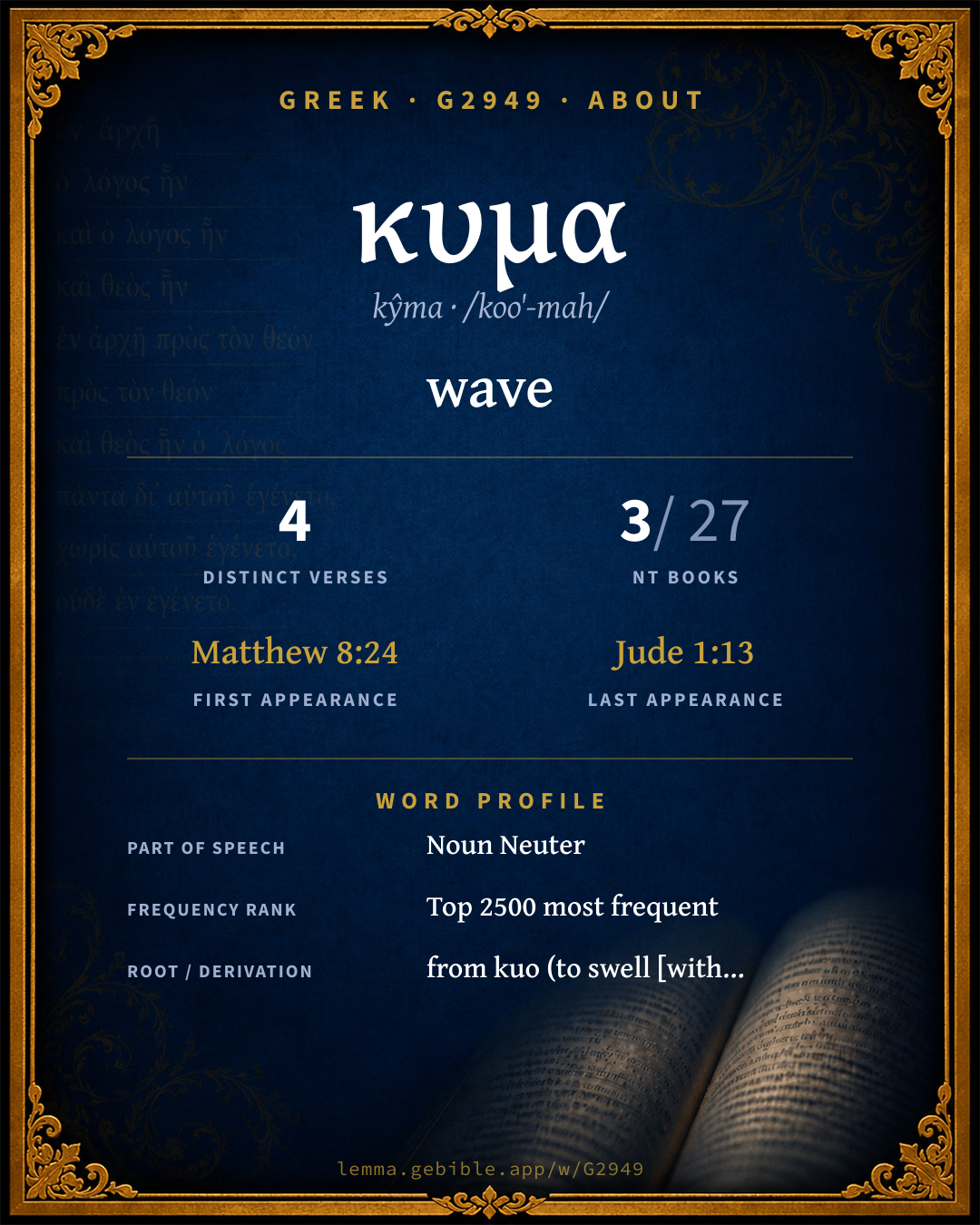
κῦμα
wave
Full lexicon entry — Thayer's Greek Lexicon
From Thayer's Greek Lexicon
Where this word appears
Grammar key — what these labels mean
Part of speech
- Noun
- A naming word — a person, place, thing, or idea.
Case
- Genitive
- The case of source, possession, or “of” — answers “whose / from what.”
- Nominative
- The case of the subject (and the predicate nominative).
Gender
- Neuter
- Grammatically neuter.
Number
- Plural
- More than one.
Every verse where G2949 appears in the Book of Mark — 1 distinct verse. Click any verse to open its interlinear word-by-word view. Verse text shown in the World English Bible for context — . Each verse’s Greek form is shown with its reference; the English is not keyword-highlighted, since the data carries no word-level English alignment. Use “Compare translations” on any verse to read it across multiple English versions. This concordance covers the Greek New Testament; Septuagint (Greek Old Testament) occurrences of this word are not indexed here.
Mark
About this entry
At a glance — auto-summarized from this page’s data, not written by a person. Every figure links to its source below. This summary describes the numbers; it doesn’t interpret them.
“wave” is the headline sense of the Greek noun κυμα (kŷma). A scarce word — 4 verses in all of the Greek New Testament. More than half of its appearances fall in Matthew. First canonically at Matthew 8:24, it enters the text early. It shares a root with κυλιοω, κυμβαλον and κυπτω. See the sense tree, 4-verse concordance, and the renderings breakdown below.
Gloss history
Strong's 1890 vs modern scholarship
About this word
Strong's G2949 catalogs a Greek word from the Greek New Testament.
These counts are not copied from any lexicon or concordance. They are computed here, from the morphology-tagged Greek New Testament. What Lemma adds →
- 4
- distinct verses
- The word appears in 4 distinct verses.
- 3 / 27
- NT books
- The word appears in 3 of 27 New Testament books.
- #1,877
- by frequency
- Top 2500 most frequent Greek words (rank 1,877 of 5,347 Greek words by occurrence).
View all 4 occurrences in the concordance →
By section of the New Testament
By traditional corpus
Conventional, traditional groupings — biblical authorship is debated, so this is a traditional corpus grouping, not an authorship claim. Some books belong to more than one corpus (Luke is in both the Gospels and the Lukan corpus, and so on), so these shares overlap and need not total 100%. Each figure is a share of the word’s 4 distinct verses.
- Gospels 3 verses · 75%
- General (Catholic) Epistles 1 verse · 25%
How translations render this word
Counts come from each version’s own published word-to-Strong’s tagging or interlinear alignment — an approximate guide to how each version renders this word, not a word-level alignment the data otherwise carries. Because each total is that version’s own tagged count, the per-version totals vary from one another and need not match the appearance or distinct-verse counts above. These counts may also differ from a printed concordance because Lemma counts each distinctly tagged rendering and does not collapse phrase taggings into a single head-word total. This is a fixed set of word-tagged versions (KJV, ASV, BSB, ULT) and does not change with the reading translation you choose elsewhere. Each version’s license is shown beside its name below (and on Sources).
- King James Version: Waves 5×
- American Standard Version: Waves 5×
- Berean Standard Bible: Waves 5×
- unfoldingWord Literal Text: Waves 4×
King James Version Public Domain
Renders G2949 across 5 tagged occurrences — most commonly:
American Standard Version Public Domain
Renders G2949 across 5 tagged occurrences — most commonly:
Berean Standard Bible Public Domain
Renders G2949 across 5 tagged occurrences — most commonly:
unfoldingWord Literal Text CC BY-SA 4.0
Renders G2949 across 4 tagged occurrences — most commonly:
Senses in Thayer's
The 1 sense Thayer's distinguishes for this word, in lexicon order (not ranked by frequency or importance). The full entry — with sub-senses — is in the Lexicon Entry tab.
- a wave (swell) esp. of the sea or of a lake
Word origin
Origin: from kuo (to swell [with young], i.e bend, curve)
From κύω kuō (to swell [with young] that is bend curve ); a billow (as bursting or toppling ): - wave.
— Strong’s Exhaustive Concordance (1890), public domain.
Forms in the corpus
The 2 distinct written forms G2949 takes in the Greek New Testament, most frequent first — each parse links to that case’s occurrences in the concordance.
| Form | Parsing | Example | Uses |
|---|---|---|---|
| κυμάτων kymátōn | Noun, Genitive, Plural, Neuter | Matthew 8:24 | 2 |
| κύματα kýmata | Noun, Nominative, Plural, Neuter | Mark 4:37 | 2 |
Same root — word family
Other Thayer's entries built from the same root as G2949, grouped by Strong’s listed origin. These share a root / origin per the lexicon — not necessarily a shared meaning. Each links to that word’s own entry.
Derived from this word
Compare all same-root words → They share a root, not necessarily a meaning.
Septuagint usage
The same Greek word κυμα appears 17 times in the Greek Old Testament (Septuagint), across 17 verses in 8 books.
- 17
- LXX occurrences
- Tagged occurrences of this Greek word in the Septuagint.
- 17
- verses
- Distinct Septuagint verses containing this word.
- 8 / 39
- OT books
- The word appears in 8 of the 39 Old Testament books.
Sample Septuagint occurrences
- Exodus 15:8 κῦμα
- Job 6:15 κῦμα
- Psalms 41:8 κῦμα
- Isaiah 48:18 κῦμα
- Jeremiah 5:22 κῦμα
- Ezekiel 26:3 κῦμα
- Jonah 2:4 κῦμα
- Zechariah 10:11 κῦμα
Septuagint occurrences (same lexeme)
Every verse where the same Strong’s number (G2949) appears in the Greek Septuagint. Verse text shown in the World English Bible for context; the Greek form is the matched word — the English is not keyword-highlighted.
- Exodus 15:8 κῦμα With the blast of your nostrils the waters were piled up. The floods stood upright as a heap. The deeps were congealed in the heart of the sea.
- Job 6:15 κῦμα My brothers have dealt deceitfully as a brook, As the channel of brooks that pass away;
- Job 11:16 κῦμα For you shall forget your misery; You shall remember it as waters that are passed away,
- Job 38:11 κῦμα And said, 'Here you may come, but no further; Here shall your proud waves be stayed?'
- Psalms 41:8 κῦμα "An evil disease," they say, "has afflicted him. Now that he lies he shall rise up no more."
- Psalms 64:8 κῦμα Their own tongues shall ruin them. All who see them will shake their heads.
- Psalms 88:10 κῦμα Do you show wonders to the dead? Do the dead rise up and praise you? Selah.
- Psalms 106:25 κῦμα But murmured in their tents, And didn't listen to Yahweh's voice.
- Psalms 106:29 κῦμα Thus they provoked him to anger with their deeds. The plague broke in on them.
- Isaiah 48:18 κῦμα Oh that you had listened to my commandments! then had your peace been as a river, and your righteousness as the waves of the sea:
- Isaiah 51:15 κῦμα For I am Yahweh your God, who stirs up the sea, so that the waves of it roar: Yahweh of Hosts is his name.
- Jeremiah 5:22 κῦμα Don't you fear me? says Yahweh: won't you tremble at my presence, who have placed the sand for the bound of the sea, by a perpetual decree, that it can't pass it? and though the waves of it toss themselves, yet they can't prevail; though they roar, yet they can't pass over it.
- Jeremiah 28:42 κῦμα
- Jeremiah 38:36 κῦμα
- Ezekiel 26:3 κῦμα therefore thus says the Lord Yahweh, Behold, I am against you, Tyre, and will cause many nations to come up against you, as the sea causes its waves to come up.
- Jonah 2:4 κῦμα I said, 'I have been banished from your sight; Yet I will look again toward your holy temple.'
- Zechariah 10:11 κῦμα He will pass through the sea of affliction, And will strike the waves in the sea, And all the depths of the Nile will dry up; And the pride of Assyria will be brought down, And the scepter of Egypt will depart.
These are occurrences of the same Greek lexeme (G2949) in the Septuagint — not a translation of any one Hebrew word. The store carries no word-level Hebrew↔Greek alignment, so no Hebrew original is asserted here. Counts come from the recovered LXX Strong's tagging — high-frequency vocabulary is well covered, while rare or late forms may be untagged — so they reflect tagged occurrences and may slightly undercount.