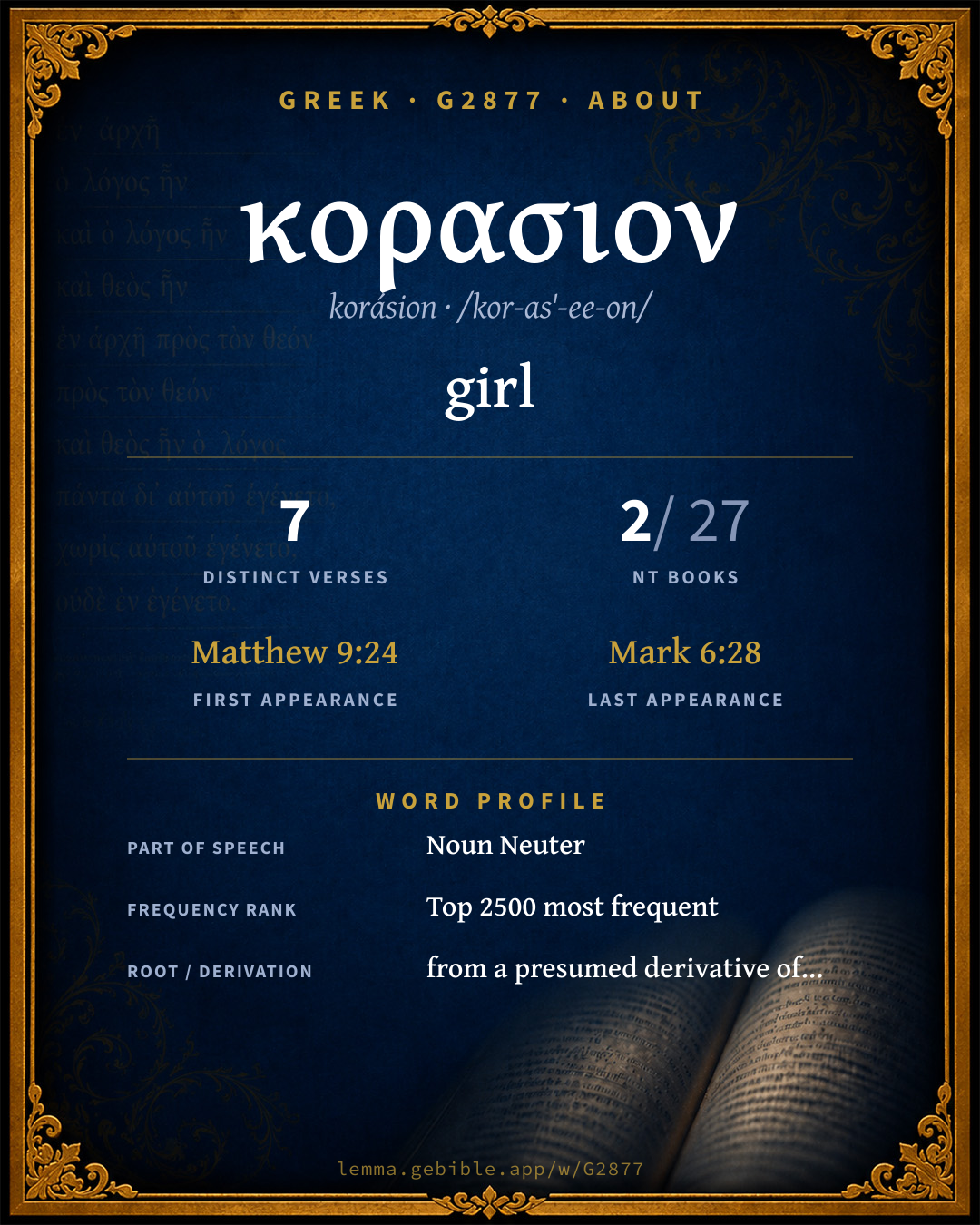
κοράσιον
girl
Full lexicon entry — Thayer's Greek Lexicon
From Thayer's Greek Lexicon
Where this word appears
See every Nominative-case word in the Greek New Testament →
Grammar key — what these labels mean
Part of speech
- Noun
- A naming word — a person, place, thing, or idea.
Case
- Nominative
- The case of the subject (and the predicate nominative).
- Dative
- The case of the indirect object, means, or location — “to / for / with / in.”
Gender
- Neuter
- Grammatically neuter.
Number
- Singular
- One.
5 distinct verses where G2877 appears in the Nominative case, across 2 books. Filtered view — show all forms. Click any verse to open its interlinear word-by-word view. Verse text shown in the World English Bible for context — . Each verse’s Greek form is shown with its reference; the English is not keyword-highlighted, since the data carries no word-level English alignment. Use “Compare translations” on any verse to read it across multiple English versions. This concordance covers the Greek New Testament; Septuagint (Greek Old Testament) occurrences of this word are not indexed here.
Matthew 2 verses
Mark 3 verses
- Mark 5:41 κοράσιον n nom sg neut Taking the child by the hand, he said to her, "Talitha cumi;" which means, being interpreted, "Girl, I tell you, get up."
- Mark 5:42 κοράσιον n nom sg neut Immediately the girl rose up, and walked, for she was twelve years old. They were amazed with great amazement.
- Mark 6:28 κορασίῳ κοράσιον n dat sg neut n nom sg neut and brought his head on a platter, and gave it to the young lady; and the young lady gave it to her mother.
About this entry
At a glance — auto-summarized from this page’s data, not written by a person. Every figure links to its source below. This summary describes the numbers; it doesn’t interpret them.
The Greek noun κορασιον centers on the idea of “girl.” The word gravitates to Mark (57%), then Matthew. It appears 7 verses across 2 books of the Greek New Testament, among its uncommon vocabulary. Debuting at Matthew 9:24, it then recurs through the corpus. Where the King James Version says “damsel,” newer translations reach for “girl” (Berean Standard Bible); the renderings breakdown has the detail. Dig into 7-verse concordance and the renderings breakdown below.
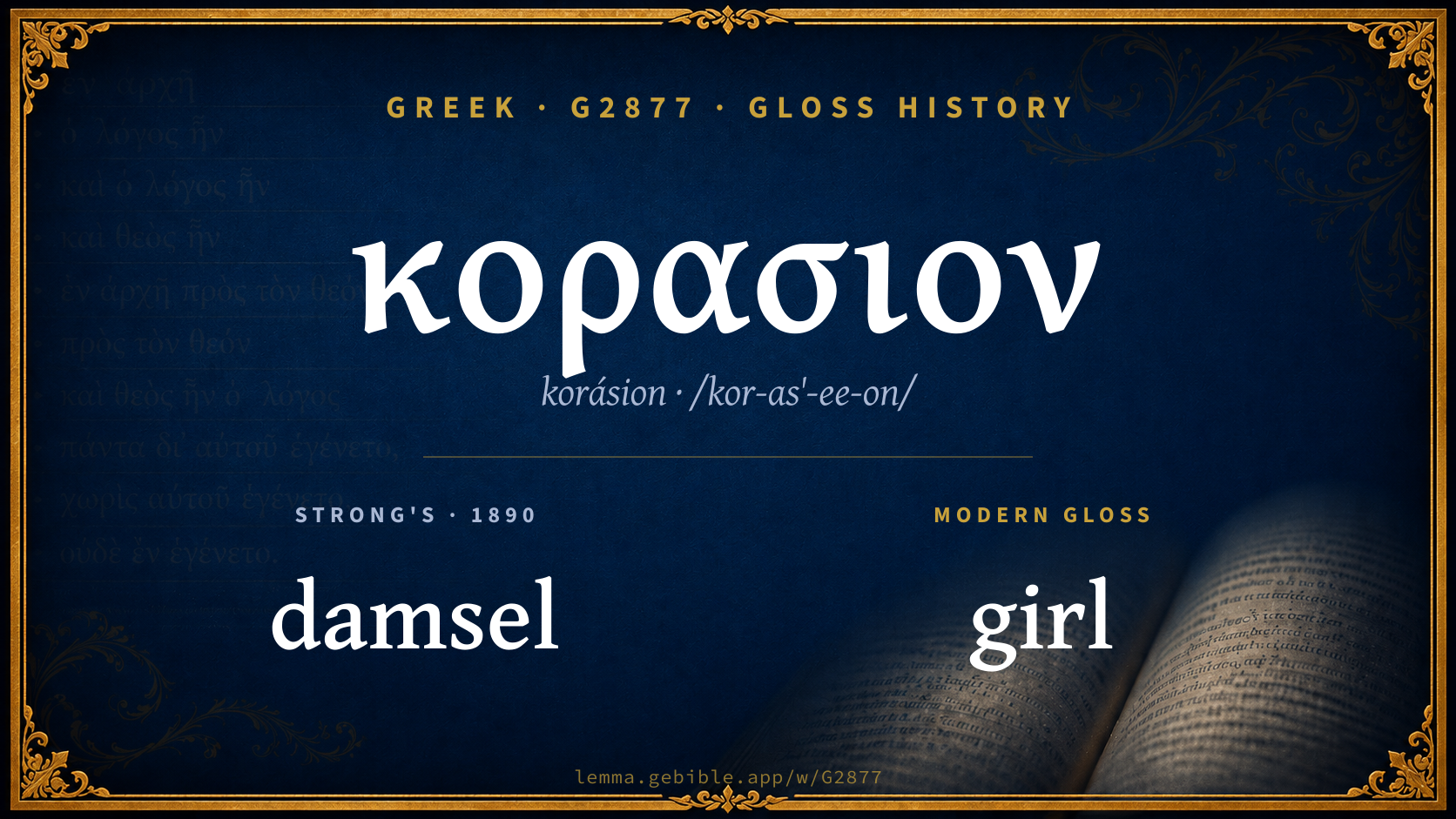
Gloss history
Strong's 1890 vs modern scholarship
About this word
Strong's G2877 catalogs a Greek word from the Greek New Testament.
These counts are not copied from any lexicon or concordance. They are computed here, from the morphology-tagged Greek New Testament. What Lemma adds →
- 7
- distinct verses
- The word appears in 7 distinct verses.
- 2 / 27
- NT books
- The word appears in 2 of 27 New Testament books.
- #1,240
- by frequency
- Top 2500 most frequent Greek words (rank 1,240 of 5,347 Greek words by occurrence).
View all 7 occurrences in the concordance →
By traditional corpus
Conventional, traditional groupings — biblical authorship is debated, so this is a traditional corpus grouping, not an authorship claim. Some books belong to more than one corpus (Luke is in both the Gospels and the Lukan corpus, and so on), so these shares overlap and need not total 100%. Each figure is a share of the word’s 7 distinct verses.
- Gospels 7 verses · 100%
How translations render this word
Counts come from each version’s own published word-to-Strong’s tagging or interlinear alignment — an approximate guide to how each version renders this word, not a word-level alignment the data otherwise carries. Because each total is that version’s own tagged count, the per-version totals vary from one another and need not match the appearance or distinct-verse counts above. These counts may also differ from a printed concordance because Lemma counts each distinctly tagged rendering and does not collapse phrase taggings into a single head-word total. This is a fixed set of word-tagged versions (KJV, ASV, BSB, ULT) and does not change with the reading translation you choose elsewhere. Each version’s license is shown beside its name below (and on Sources).
- King James Version: Damsel 6×, Maid 2×
- American Standard Version: Damsel 8×
- Berean Standard Bible: Girl 5×
- unfoldingWord Literal Text: Girl 6×, Little girl 2×
King James Version Public Domain
Renders G2877 across 8 tagged occurrences — most commonly:
American Standard Version Public Domain
Renders G2877 across 8 tagged occurrences — most commonly:
Berean Standard Bible Public Domain
Renders G2877 across 6 tagged occurrences — most commonly:
Plus 1 rendering that appears only once — usually multi-word phrases or single function words the recovered tagging swept in, not distinct renderings. Not rendered by a distinct English word in 2 further occurrences.
unfoldingWord Literal Text CC BY-SA 4.0
Renders G2877 across 8 tagged occurrences — most commonly:
Senses in Thayer's
The 1 sense Thayer's distinguishes for this word, in lexicon order (not ranked by frequency or importance). The full entry — with sub-senses — is in the Lexicon Entry tab.
- a girl, damsel, maiden
Word origin
Origin: from a presumed derivative of kore (a maiden)
Neuter of a presumed derivative of κόρη korē (a maiden ); a (little) girl : - damsel maid.
— Strong’s Exhaustive Concordance (1890), public domain.
Forms in the corpus
The 2 distinct written forms G2877 takes in the Greek New Testament, most frequent first — each parse links to that case’s occurrences in the concordance.
| Form | Parsing | Example | Uses |
|---|---|---|---|
| κοράσιον korásion | Noun, Nominative, Singular, Neuter | Matthew 9:24 | 5 |
| κορασίῳ korasíō | Noun, Dative, Singular, Neuter | Matthew 14:11 | 3 |
Septuagint usage
The same Greek word κορασιον appears 18 times in the Greek Old Testament (Septuagint), across 17 verses in 6 books.
- 18
- LXX occurrences
- Tagged occurrences of this Greek word in the Septuagint.
- 17
- verses
- Distinct Septuagint verses containing this word.
- 6 / 39
- OT books
- The word appears in 6 of the 39 Old Testament books.
Sample Septuagint occurrences
- Ruth 2:8 κοράσιον
- 1 Samuel 9:11 κοράσιον
- 1 Kings 12:24 κοράσιον
- Esther 2:2 κοράσιον
- Joel 4:3 κοράσιον
- Zechariah 8:5 κοράσιον
Septuagint occurrences (same lexeme)
Every verse where the same Strong’s number (G2877) appears in the Greek Septuagint. Verse text shown in the World English Bible for context; the Greek form is the matched word — the English is not keyword-highlighted.
- Ruth 2:8 κοράσιον Then said Boaz to Ruth, Don't you hear, my daughter? Don't go to glean in another field, neither pass from hence, but abide here fast by my maidens.
- Ruth 2:22 κοράσιον Naomi said to Ruth her daughter-in-law, It is good, my daughter, that you go out with his maidens, and that they not meet you in any other field.
- Ruth 2:23 κοράσιον So she kept fast by the maidens of Boaz, to glean to the end of barley harvest and of wheat harvest; and she lived with her mother-in-law.
- Ruth 3:2 κοράσιον Now isn't Boaz our kinsman, with whose maidens you were? Behold, he winnows barley tonight in the threshing floor.
- 1 Samuel 9:11 κοράσιον As they went up the ascent to the city, they found young maidens going out to draw water, and said to them, Is the seer here?
- 1 Samuel 9:12 κοράσιον They answered them, and said, He is; behold, [he is] before you: make haste now, for he is come today into the city; for the people have a sacrifice today in the high place:
- 1 Samuel 20:30 κοράσιον Then Saul's anger was kindled against Jonathan, and he said to him, You son of a perverse rebellious woman, don't I know that you have chosen the son of Jesse to your own shame, and to the shame of your mother's nakedness?
- 1 Samuel 25:42 κοράσιον Abigail hurried, and arose, and rode on a donkey, with five ladies of hers who followed her; and she went after the messengers of David, and became his wife.
- 1 Kings 12:24 κοράσιον Thus says Yahweh, You shall not go up, nor fight against your brothers the children of Israel: return every man to his house; for this thing is of me. So they listened to the word of Yahweh, and returned and went their way, according to the word of Yahweh.
- Esther 2:2 κοράσιον Then said the king's servants who ministered to him, Let there be beautiful young virgins sought for the king:
- Esther 2:3 κοράσιον and let the king appoint officers in all the provinces of his kingdom, that they may gather together all the beautiful young virgins to Shushan the palace, to the house of the women, to the custody of Hegai the king's chamberlain, keeper of the women; and let their things for purification be given them;
- Esther 2:7 κοράσιον He brought up Hadassah, who is, Esther, his uncle's daughter: for she had neither father nor mother, and the maiden was fair and beautiful; and when her father and mother were dead, Mordecai took her for his own daughter.
- Esther 2:8 κοράσιον So it happened, when the king's commandment and his decree was heard, and when many maidens were gathered together to Shushan the palace, to the custody of Hegai, that Esther was taken into the king's house, to the custody of Hegai, keeper of the women.
- Esther 2:9 κοράσιον The maiden pleased him, and she obtained kindness of him; and he speedily gave her things for her purification, with her portions, and the seven maidens who were meet to be given her out of the king's house: and he removed her and her maidens to the best place of the house of the women.
- Esther 2:12 κοράσιον Now when the turn of every maiden was come to go in to king Ahasuerus, after it had been done to her as prescribed for the women twelve months (for so were the days of their purification accomplished, [to wit], six months with oil of myrrh, and six months with sweet odors and with the things for the purifying of the women),
- Joel 4:3 κοράσιον
- Zechariah 8:5 κοράσιον The streets of the city will be full of boys and girls playing in its streets."
These are occurrences of the same Greek lexeme (G2877) in the Septuagint — not a translation of any one Hebrew word. The store carries no word-level Hebrew↔Greek alignment, so no Hebrew original is asserted here. Counts come from the recovered LXX Strong's tagging — high-frequency vocabulary is well covered, while rare or late forms may be untagged — so they reflect tagged occurrences and may slightly undercount.