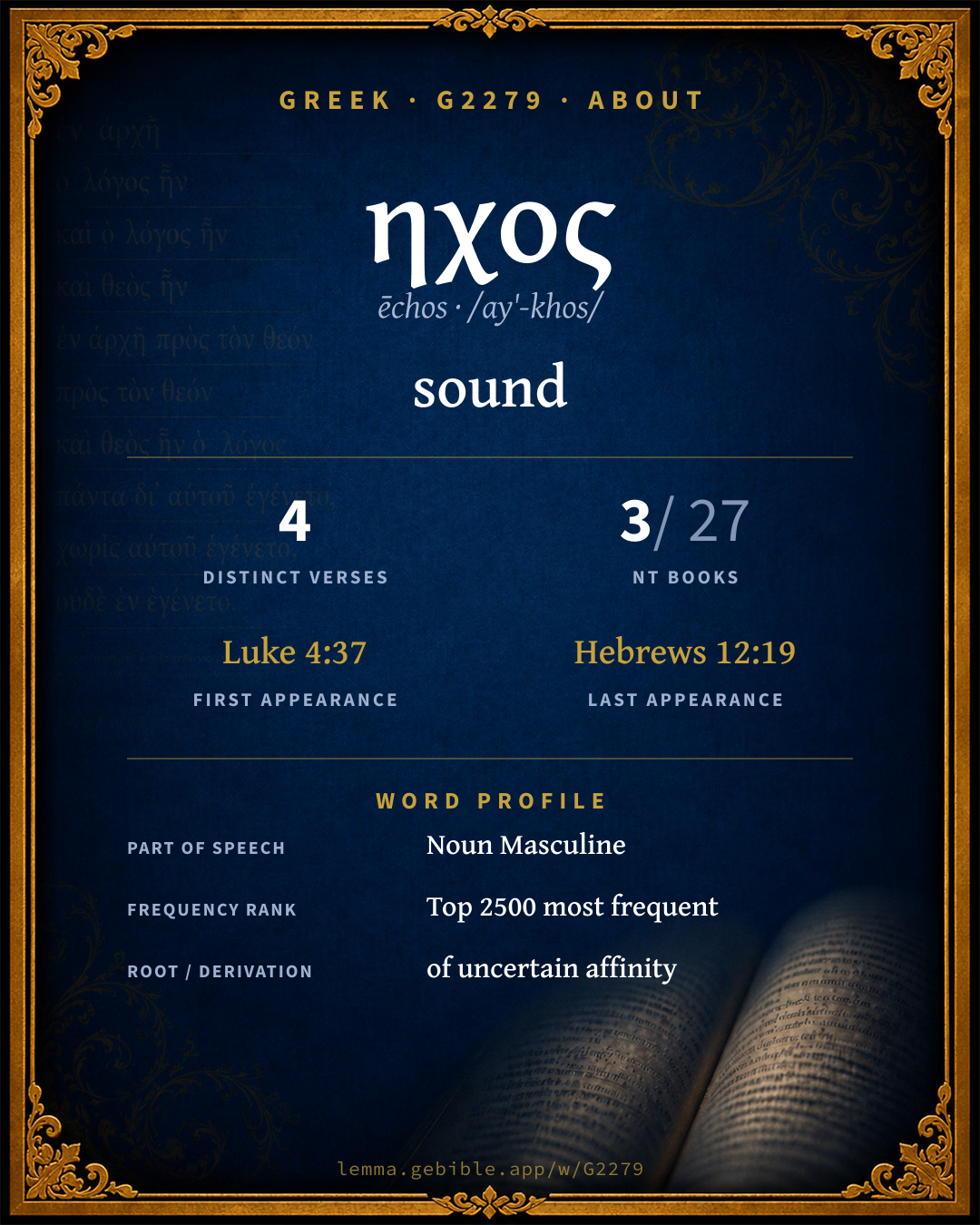
ἦχος
sound
‘sound’ is one of 2 main senses fuller range ↓
Full lexicon entry — Thayer's Greek Lexicon
From Thayer's Greek Lexicon
Where this word appears
See every Nominative-case word in the Greek New Testament →
Grammar key — what these labels mean
Part of speech
- Noun
- A naming word — a person, place, thing, or idea.
Case
- Nominative
- The case of the subject (and the predicate nominative).
- Dative
- The case of the indirect object, means, or location — “to / for / with / in.”
- Genitive
- The case of source, possession, or “of” — answers “whose / from what.”
Gender
- Masculine
- Grammatically masculine.
- Neuter
- Grammatically neuter.
Number
- Singular
- One.
1 distinct verse where G2279 appears in the Genitive case, across 1 book. Filtered view — show all forms. Click any verse to open its interlinear word-by-word view. Verse text shown in the World English Bible for context — . Each verse’s Greek form is shown with its reference; the English is not keyword-highlighted, since the data carries no word-level English alignment. Use “Compare translations” on any verse to read it across multiple English versions. This concordance covers the Greek New Testament; Septuagint (Greek Old Testament) occurrences of this word are not indexed here.
Luke 1 verse
About this entry
At a glance — auto-summarized from this page’s data, not written by a person. Every figure links to its source below. This summary describes the numbers; it doesn’t interpret them.
ηχος — transliterated ēchos — is a Greek noun carrying the sense “sound.” A scarce word — 4 verses in all of the Greek New Testament. More than half of its appearances fall in Luke. It first appears in Luke 4:37. Its lexical range runs to 2 senses. Each statement above links to its evidence; the full detail follows below.
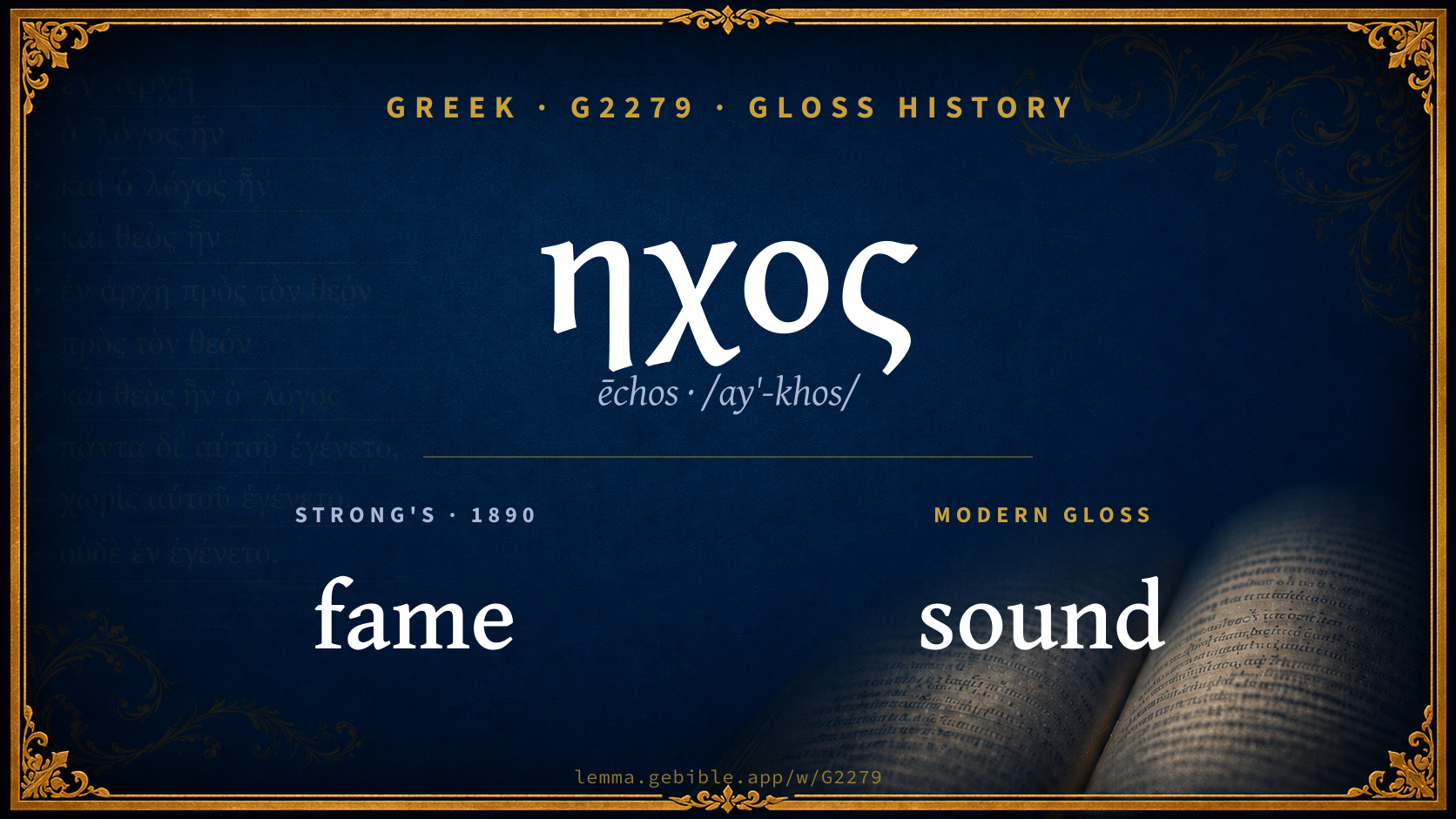
Gloss history
Strong's 1890 vs modern scholarship
About this word
Strong's G2279 catalogs a Greek word from the Greek New Testament.
These counts are not copied from any lexicon or concordance. They are computed here, from the morphology-tagged Greek New Testament. What Lemma adds →
- 4
- distinct verses
- The word appears in 4 distinct verses.
- 3 / 27
- NT books
- The word appears in 3 of 27 New Testament books.
- #1,877
- by frequency
- Top 2500 most frequent Greek words (rank 1,877 of 5,347 Greek words by occurrence).
View all 4 occurrences in the concordance →
By section of the New Testament
By traditional corpus
Conventional, traditional groupings — biblical authorship is debated, so this is a traditional corpus grouping, not an authorship claim. Some books belong to more than one corpus (Luke is in both the Gospels and the Lukan corpus, and so on), so these shares overlap and need not total 100%. Each figure is a share of the word’s 4 distinct verses.
- Lukan (Luke–Acts) 3 verses · 75%
- Gospels 2 verses · 50%
- Hebrews 1 verse · 25%
How translations render this word
Counts come from each version’s own published word-to-Strong’s tagging or interlinear alignment — an approximate guide to how each version renders this word, not a word-level alignment the data otherwise carries. Because each total is that version’s own tagged count, the per-version totals vary from one another and need not match the appearance or distinct-verse counts above. These counts may also differ from a printed concordance because Lemma counts each distinctly tagged rendering and does not collapse phrase taggings into a single head-word total. This is a fixed set of word-tagged versions (KJV, ASV, BSB, ULT) and does not change with the reading translation you choose elsewhere. Each version’s license is shown beside its name below (and on Sources).
- King James Version: Sound 2×
- American Standard Version: Sound 2×
- Berean Standard Bible: Blast 1×, News 1×, Roaring 1×
- unfoldingWord Literal Text: Sound 2×
King James Version Public Domain
Renders G2279 across 3 tagged occurrences — most commonly:
Plus 1 rendering that appears only once — usually multi-word phrases or single function words the recovered tagging swept in, not distinct renderings.
American Standard Version Public Domain
Renders G2279 across 3 tagged occurrences — most commonly:
Plus 1 rendering that appears only once — usually multi-word phrases or single function words the recovered tagging swept in, not distinct renderings.
Berean Standard Bible Public Domain
Renders G2279 across 4 tagged occurrences — most commonly:
unfoldingWord Literal Text CC BY-SA 4.0
Renders G2279 across 4 tagged occurrences — most commonly:
Plus 2 renderings that appear only once — usually multi-word phrases or single function words the recovered tagging swept in, not distinct renderings.
Senses in Thayer's
The 2 senses Thayer's distinguishes for this word, in lexicon order (not ranked by frequency or importance). The full entry — with sub-senses — is in the Lexicon Entry tab.
- spoken of the roar of the sea waves
- rumour, report
Word origin
Origin: of uncertain affinity
Of uncertain affinity; a loud or confused noise (echo) that is roar ; figuratively a rumor : - fame sound.
— Strong’s Exhaustive Concordance (1890), public domain.
Forms in the corpus
The 3 distinct written forms G2279 takes in the Greek New Testament, most frequent first — each parse links to that case’s occurrences in the concordance.
| Form | Parsing | Example | Uses |
|---|---|---|---|
| ἦχος ē̂chos | Noun, Nominative, Singular, Masculine | Luke 4:37 | 2 |
| ἤχους ḗchous | Noun, Genitive, Singular, Neuter | Luke 21:25 | 1 |
| ἤχῳ ḗchō | Noun, Dative, Singular, Masculine | Hebrews 12:19 | 1 |
Same root — word family
Other Thayer's entries built from the same root as G2279, grouped by Strong’s listed origin. These share a root / origin per the lexicon — not necessarily a shared meaning. Each links to that word’s own entry.
Derived from this word
Compare all same-root words → They share a root, not necessarily a meaning.
Septuagint usage
The same Greek word ηχος appears 17 times in the Greek Old Testament (Septuagint), across 17 verses in 8 books.
- 17
- LXX occurrences
- Tagged occurrences of this Greek word in the Septuagint.
- 17
- verses
- Distinct Septuagint verses containing this word.
- 8 / 39
- OT books
- The word appears in 8 of the 39 Old Testament books.
Sample Septuagint occurrences
- 1 Samuel 4:15 ἦχος
- Psalms 9:7 ἦχος
- Proverbs 11:15 ἦχος
- Isaiah 13:21 ἦχος
- Jeremiah 28:16 ἦχος
- Daniel 3:7 ἤχος
- Joel 4:14 ἦχος
- Amos 5:23 ἦχος
Septuagint occurrences (same lexeme)
Every verse where the same Strong’s number (G2279) appears in the Greek Septuagint. Verse text shown in the World English Bible for context; the Greek form is the matched word — the English is not keyword-highlighted.
- 1 Samuel 4:15 ἦχος Now Eli was ninety-eight years old; and his eyes were set, so that he could not see.
- 1 Samuel 14:19 ἦχος It happened, while Saul talked to the priest, that the tumult that was in the camp of the Philistines went on and increased: and Saul said to the priest, Withdraw your hand.
- Psalms 9:7 ἦχος But Yahweh reigns forever. He has prepared his throne for judgment.
- Psalms 41:5 ἦχος My enemies speak evil against me: "When will he die, and his name perish?"
- Psalms 64:8 ἦχος Their own tongues shall ruin them. All who see them will shake their heads.
- Psalms 76:17 ἦχος
- Psalms 150:3 ἦχος Praise him with the sounding of the trumpet! Praise him with harp and lyre!
- Proverbs 11:15 ἦχος He who is collateral for a stranger will suffer for it, But he who refuses pledges of collateral is secure.
- Isaiah 13:21 ἦχος But wild animals of the desert shall lie there; and their houses shall be full of doleful creatures; and ostriches shall dwell there, and wild goats shall dance there.
- Jeremiah 28:16 ἦχος Therefore thus says Yahweh, Behold, I will send you away from off the surface of the earth: this year you shall die, because you have spoken rebellion against Yahweh.
- Jeremiah 28:42 ἦχος
- Jeremiah 29:3 ἦχος by the hand of Elasah the son of Shaphan, and Gemariah the son of Hilkiah, (whom Zedekiah king of Judah sent to Babylon to Nebuchadnezzar king of Babylon), saying,
- Daniel 3:7 ἤχος Therefore at that time, when all the peoples heard the sound of the horn, flute, zither, lyre, harp, pipe, and all kinds of music, all the peoples, the nations, and the languages, fell down and worshiped the golden image that Nebuchadnezzar the king had set up.
- Daniel 3:10 ἤχος You, O king, have made a decree, that every man that shall hear the sound of the horn, flute, zither, lyre, harp, pipe, and all kinds of music, shall fall down and worship the golden image;
- Daniel 3:15 ἤχος Now if you are ready whenever you hear the sound of the horn, flute, zither, lyre, harp, pipe, and all kinds of music to you fall down and worship the image which I have made, [well]: but if you don't worship, you shall be cast the same hour into the midst of a burning fiery furnace; and who is that god that shall deliver you out of my hands?
- Joel 4:14 ἦχος
- Amos 5:23 ἦχος Take away from me the noise of your songs! I will not listen to the music of your harps.
These are occurrences of the same Greek lexeme (G2279) in the Septuagint — not a translation of any one Hebrew word. The store carries no word-level Hebrew↔Greek alignment, so no Hebrew original is asserted here. Counts come from the recovered LXX Strong's tagging — high-frequency vocabulary is well covered, while rare or late forms may be untagged — so they reflect tagged occurrences and may slightly undercount.