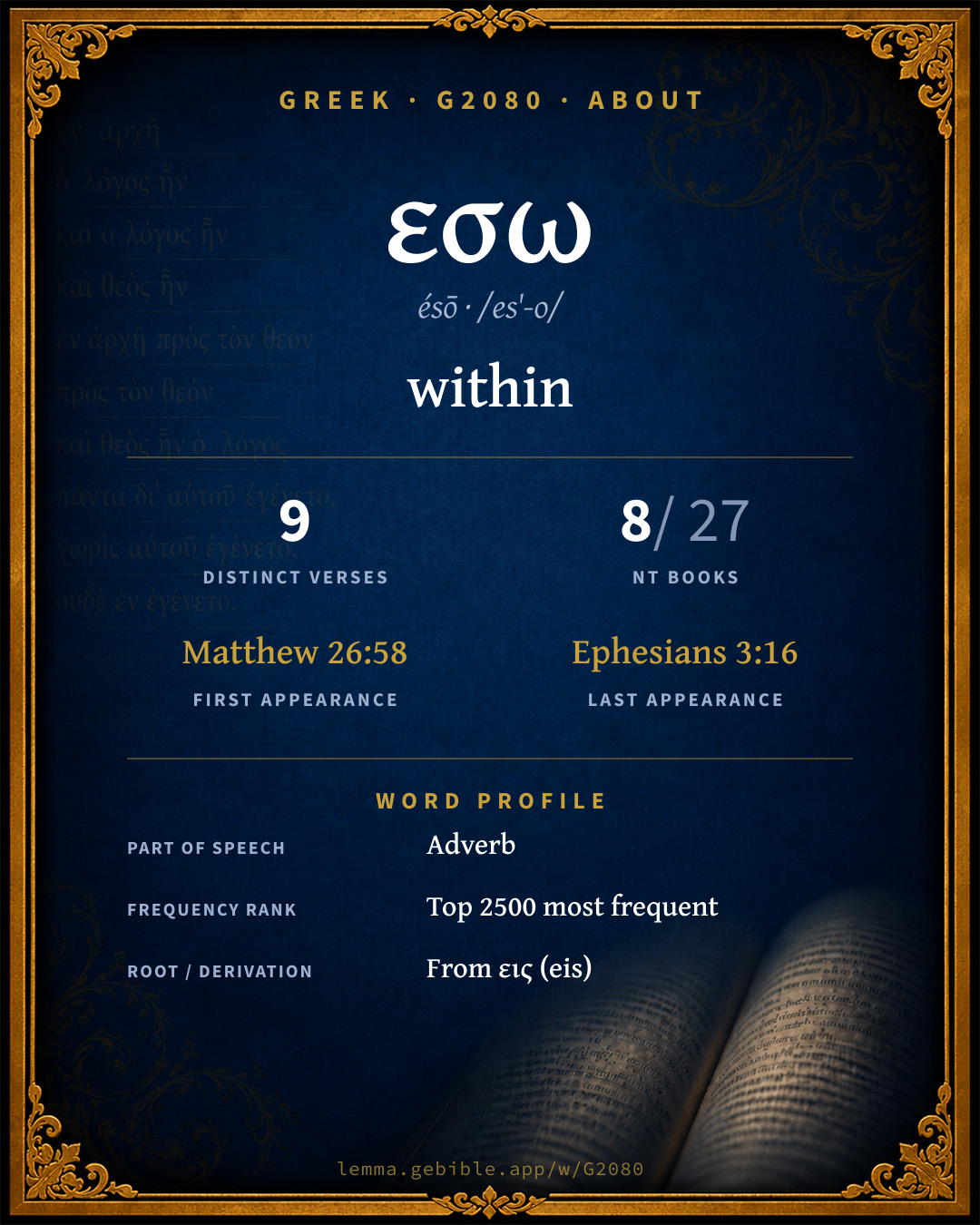
ἔσω
within
‘within’ is one of 2 main senses fuller range ↓
Full lexicon entry — Thayer's Greek Lexicon
From Thayer's Greek Lexicon
Where this word appears
Grammar key — what these labels mean
Part of speech
- Adverb
- A word that modifies a verb, adjective, or other adverb.
Every verse where G2080 appears in the Book of Acts — 1 distinct verse. Click any verse to open its interlinear word-by-word view. Verse text shown in the World English Bible for context — . Each verse’s Greek form is shown with its reference; the English is not keyword-highlighted, since the data carries no word-level English alignment. Use “Compare translations” on any verse to read it across multiple English versions. This concordance covers the Greek New Testament; Septuagint (Greek Old Testament) occurrences of this word are not indexed here.
Acts
About this entry
At a glance — auto-summarized from this page’s data, not written by a person. Every figure links to its source below. This summary describes the numbers; it doesn’t interpret them.
εσω — transliterated ésō — is a Greek verb carrying the sense “within.” It first appears in Matthew 26:58. The Greek New Testament uses it across 9 verses — uncommon. Its lexical range runs to 2 senses. From the same root come εις, εισαγω and εισακουω. Each statement above links to its evidence; the full detail follows below.
Gloss history
Strong's 1890 vs modern scholarship
About this word
Strong's G2080 catalogs a Greek word from the Greek New Testament.
These counts are not copied from any lexicon or concordance. They are computed here, from the morphology-tagged Greek New Testament. What Lemma adds →
- 9
- distinct verses
- The word appears in 9 distinct verses.
- 8 / 27
- NT books
- The word appears in 8 of 27 New Testament books.
- #1,140
- by frequency
- Top 2500 most frequent Greek words (rank 1,140 of 5,347 Greek words by occurrence).
View all 9 occurrences in the concordance →
By section of the New Testament
By traditional corpus
Conventional, traditional groupings — biblical authorship is debated, so this is a traditional corpus grouping, not an authorship claim. Some books belong to more than one corpus (Luke is in both the Gospels and the Lukan corpus, and so on), so these shares overlap and need not total 100%. Each figure is a share of the word’s 9 distinct verses.
- Gospels 4 verses · 44%
- Pauline corpus 4 verses · 44%
- Lukan (Luke–Acts) 1 verse · 11%
- Johannine 1 verse · 11%
How translations render this word
Counts come from each version’s own published word-to-Strong’s tagging or interlinear alignment — an approximate guide to how each version renders this word, not a word-level alignment the data otherwise carries. Because each total is that version’s own tagged count, the per-version totals vary from one another and need not match the appearance or distinct-verse counts above. These counts may also differ from a printed concordance because Lemma counts each distinctly tagged rendering and does not collapse phrase taggings into a single head-word total. This is a fixed set of word-tagged versions (KJV, ASV, BSB, ULT) and does not change with the reading translation you choose elsewhere. Each version’s license is shown beside its name below (and on Sources).
- King James Version: Into 2×, Within 2×
- American Standard Version: Within 5×, Inward 2×
- Berean Standard Bible: Inner 3×, Inside 3×, Into 2×
- unfoldingWord Literal Text: Inside 6×, Inner 3×
King James Version Public Domain
Renders G2080 across 8 tagged occurrences — most commonly:
Plus 4 renderings that appear only once — usually multi-word phrases or single function words the recovered tagging swept in, not distinct renderings.
American Standard Version Public Domain
Renders G2080 across 8 tagged occurrences — most commonly:
Plus 1 rendering that appears only once — usually multi-word phrases or single function words the recovered tagging swept in, not distinct renderings.
Berean Standard Bible Public Domain
Renders G2080 across 9 tagged occurrences — most commonly:
Plus 1 rendering that appears only once — usually multi-word phrases or single function words the recovered tagging swept in, not distinct renderings.
unfoldingWord Literal Text CC BY-SA 4.0
Renders G2080 across 10 tagged occurrences — most commonly:
Plus 1 rendering that appears only once — usually multi-word phrases or single function words the recovered tagging swept in, not distinct renderings.
Senses in Thayer's
The 2 senses Thayer's distinguishes for this word, in lexicon order (not ranked by frequency or importance). The full entry — with sub-senses — is in the Lexicon Entry tab.
- to within, into
- within
Word origin
Derived from εις (eis) (G1519) — into.
From G1519 ; inside (as preposition or adjective): - (with-) in (-ner -to -ward).
— Strong’s Exhaustive Concordance (1890), public domain.
Same root — word family
Other Thayer's entries built from the same root as G2080, grouped by Strong’s listed origin. These share a root / origin per the lexicon — not necessarily a shared meaning. Each links to that word’s own entry.
Derives from
Shares the same root
- εισαγω eiságō G1521 to bring in
- εισακουω eisakoúō G1522 to obey
- εισδεχομαι eisdéchomai G1523 to receive
- εισειμι eíseimi G1524 to go in
- εισερχομαι eisérchomai G1525 to enter
- εισκαλεω eiskaléō G1528 to invite
- εισοδος eísodos G1529 entrance
- εισπηδαω eispēdáō G1530 to rush in
- εισπορευομαι eisporeúomai G1531 to enter
- ειστρεχω eistréchō G1532 to run in
- εισφερω eisphérō G1533 to bring in
- εν en G1722 in
- εσοπτρον ésoptron G2072 mirror
- σκυβαλον skýbalon G4657 refuse
Derived from this word
Compare all same-root words → Showing 4 of 18 — not the complete family. They share a root, not necessarily a meaning.
Septuagint usage
The same Greek word εσω appears 13 times in the Greek Old Testament (Septuagint), across 13 verses in 8 books.
- 13
- LXX occurrences
- Tagged occurrences of this Greek word in the Septuagint.
- 13
- verses
- Distinct Septuagint verses containing this word.
- 8 / 39
- OT books
- The word appears in 8 of the 39 Old Testament books.
Sample Septuagint occurrences
- Genesis 39:11 ἔσω
- Leviticus 10:18 ἔσω
- Numbers 3:10 ἔσω
- 1 Kings 6:15 ἔσω
- 2 Kings 7:11 ἔσω
- 2 Chronicles 4:4 ἔσω
- Job 1:10 ἔσω
- Ezekiel 9:6 ἔσω
Septuagint occurrences (same lexeme)
Every verse where the same Strong’s number (G2080) appears in the Greek Septuagint. Verse text shown in the World English Bible for context; the Greek form is the matched word — the English is not keyword-highlighted.
- Genesis 39:11 ἔσω It happened about this time, that he went into the house to do his work, and there were none of the men of the house inside.
- Leviticus 10:18 ἔσω Behold, its blood was not brought into the inner part of the sanctuary: you certainly should have eaten it in the sanctuary, as I commanded."
- Leviticus 16:12 ἔσω He shall take a censer full of coals of fire from off the altar before Yahweh, and two handfuls of sweet incense beaten small, and bring it within the veil:
- Leviticus 16:15 ἔσω "Then he shall kill the goat of the sin offering, that is for the people, and bring his blood within the veil, and do with his blood as he did with the blood of the bull, and sprinkle it on the mercy seat, and before the mercy seat:
- Numbers 3:10 ἔσω You shall appoint Aaron and his sons, and they shall keep their priesthood. The stranger who comes near shall be put to death."
- 1 Kings 6:15 ἔσω He built the walls of the house within with boards of cedar: from the floor of the house to the walls of the ceiling, he covered them on the inside with wood; and he covered the floor of the house with boards of fir.
- 1 Kings 7:22 ἔσω On the top of the pillars was lily-work: so was the work of the pillars finished.
- 2 Kings 7:11 ἔσω He called the porters; and they told it to the king's household within.
- 2 Chronicles 4:4 ἔσω It stood on twelve oxen, three looking toward the north, and three looking toward the west, and three looking toward the south, and three looking toward the east: and the sea was set on them above, and all their hinder parts were inward.
- 2 Chronicles 29:16 ἔσω The priests went in to the inner part of the house of Yahweh, to cleanse it, and brought out all the uncleanness that they found in the temple of Yahweh into the court of the house of Yahweh. The Levites took it, to carry it out abroad to the brook Kidron.
- 2 Chronicles 29:18 ἔσω Then they went in to Hezekiah the king within [the palace], and said, We have cleansed all the house of Yahweh, and the altar of burnt offering, with all the vessels of it, and the table of show bread, with all the vessels of it.
- Job 1:10 ἔσω Haven't you made a hedge around him, and around his house, and around all that he has, on every side? You have blessed the work of his hands, and his substance is increased in the land.
- Ezekiel 9:6 ἔσω kill utterly the old man, the young man and the virgin, and little children and women; but don't come near any man on whom is the mark: and begin at my sanctuary. Then they began at the old men that were before the house.
These are occurrences of the same Greek lexeme (G2080) in the Septuagint — not a translation of any one Hebrew word. The store carries no word-level Hebrew↔Greek alignment, so no Hebrew original is asserted here. Counts come from the recovered LXX Strong's tagging — high-frequency vocabulary is well covered, while rare or late forms may be untagged — so they reflect tagged occurrences and may slightly undercount.