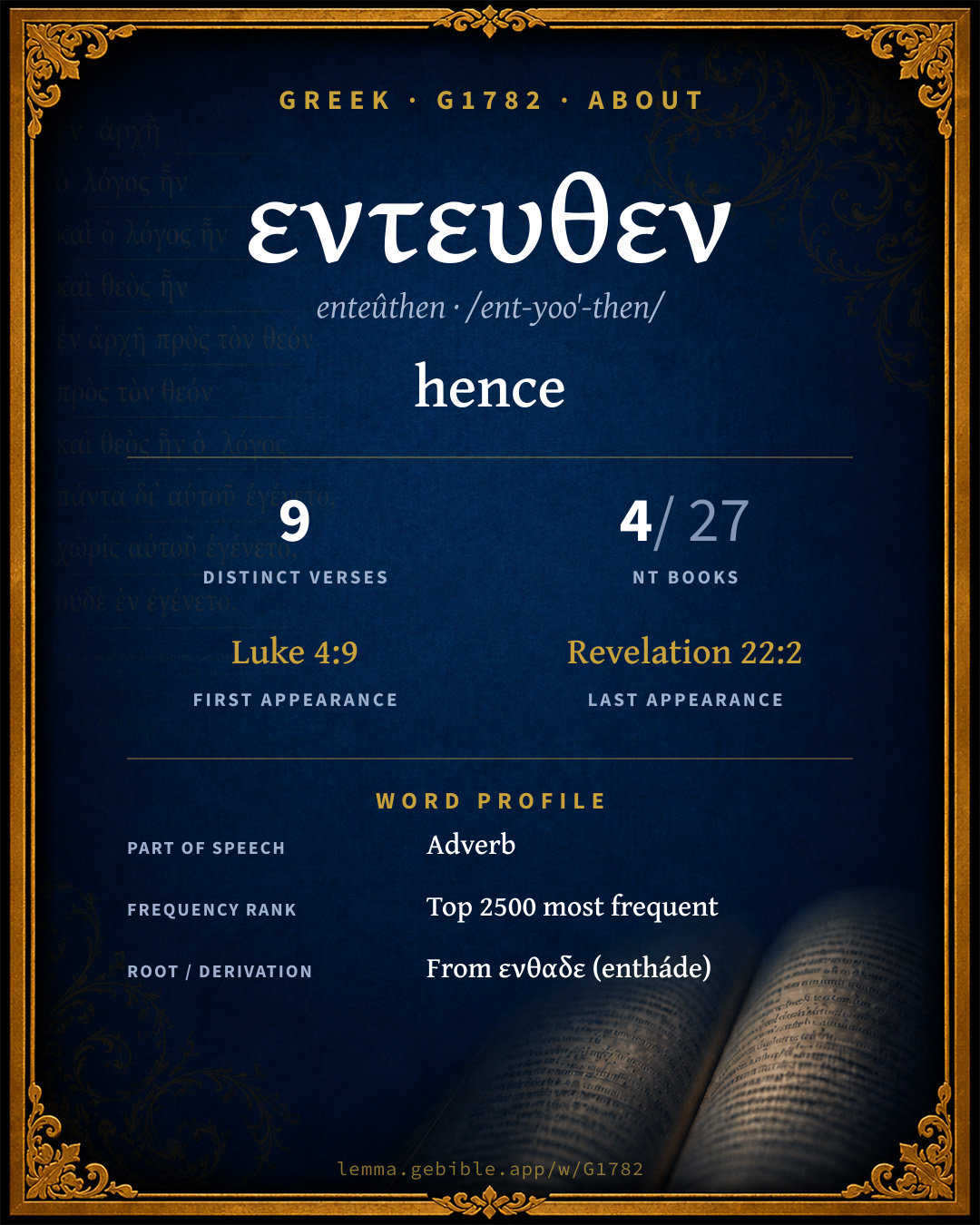
ἐντεύθεν
hence
‘hence’ is one of 2 main senses fuller range ↓
Full lexicon entry — Thayer's Greek Lexicon
From Thayer's Greek Lexicon
Where this word appears
Grammar key — what these labels mean
Part of speech
- Adverb
- A word that modifies a verb, adjective, or other adverb.
Every verse where G1782 appears in the Book of Revelation — 1 distinct verse. Click any verse to open its interlinear word-by-word view. Verse text shown in the World English Bible for context — . Each verse’s Greek form is shown with its reference; the English is not keyword-highlighted, since the data carries no word-level English alignment. Use “Compare translations” on any verse to read it across multiple English versions. This concordance covers the Greek New Testament; Septuagint (Greek Old Testament) occurrences of this word are not indexed here.
Revelation
About this entry
At a glance — auto-summarized from this page’s data, not written by a person. Every figure links to its source below. This summary describes the numbers; it doesn’t interpret them.
The Greek verb εντευθεν centers on the idea of “hence.” John dominates its distribution — 5 of 9 verses. Spanning 9 verses in 4 books, it ranks among the uncommon words of the Greek New Testament. Its earliest occurrence is Luke 4:9. Lexicons map it across 2 senses. For the data behind this summary, explore the sense tree and the renderings breakdown below.
Gloss history
Strong's 1890 vs modern scholarship
About this word
Strong's G1782 catalogs a Greek word from the Greek New Testament.
These counts are not copied from any lexicon or concordance. They are computed here, from the morphology-tagged Greek New Testament. What Lemma adds →
- 9
- distinct verses
- The word appears in 9 distinct verses.
- 4 / 27
- NT books
- The word appears in 4 of 27 New Testament books.
- #1,056
- by frequency
- Top 2500 most frequent Greek words (rank 1,056 of 5,347 Greek words by occurrence).
View all 9 occurrences in the concordance →
By section of the New Testament
By traditional corpus
Conventional, traditional groupings — biblical authorship is debated, so this is a traditional corpus grouping, not an authorship claim. Some books belong to more than one corpus (Luke is in both the Gospels and the Lukan corpus, and so on), so these shares overlap and need not total 100%. Each figure is a share of the word’s 9 distinct verses.
- Gospels 7 verses · 78%
- Johannine 6 verses · 67%
- Lukan (Luke–Acts) 2 verses · 22%
- General (Catholic) Epistles 1 verse · 11%
- Revelation 1 verse · 11%
How translations render this word
Counts come from each version’s own published word-to-Strong’s tagging or interlinear alignment — an approximate guide to how each version renders this word, not a word-level alignment the data otherwise carries. Because each total is that version’s own tagged count, the per-version totals vary from one another and need not match the appearance or distinct-verse counts above. These counts may also differ from a printed concordance because Lemma counts each distinctly tagged rendering and does not collapse phrase taggings into a single head-word total. This is a fixed set of word-tagged versions (KJV, ASV, BSB, ULT) and does not change with the reading translation you choose elsewhere. Each version’s license is shown beside its name below (and on Sources).
- King James Version: Hence 9×
- American Standard Version: Hence 9×
- Berean Standard Bible: Here 4×
- unfoldingWord Literal Text: Here 4×, Side 3×
King James Version Public Domain
Renders G1782 across 10 tagged occurrences — most commonly:
Plus 1 rendering that appears only once — usually multi-word phrases or single function words the recovered tagging swept in, not distinct renderings. Not rendered by a distinct English word in 3 further occurrences.
American Standard Version Public Domain
Renders G1782 across 13 tagged occurrences — most commonly:
Plus 4 renderings that appear only once — usually multi-word phrases or single function words the recovered tagging swept in, not distinct renderings.
Berean Standard Bible Public Domain
Renders G1782 across 8 tagged occurrences — most commonly:
Plus 4 renderings that appear only once — usually multi-word phrases or single function words the recovered tagging swept in, not distinct renderings. Not rendered by a distinct English word in 2 further occurrences.
unfoldingWord Literal Text CC BY-SA 4.0
Renders G1782 across 11 tagged occurrences — most commonly:
Plus 4 renderings that appear only once — usually multi-word phrases or single function words the recovered tagging swept in, not distinct renderings.
Senses in Thayer's
The 2 senses Thayer's distinguishes for this word, in lexicon order (not ranked by frequency or importance). The full entry — with sub-senses — is in the Lexicon Entry tab.
- from this place, hence
- on the one side and on the other, on each side
Word origin
Derived from ενθαδε (entháde) (G1759) — here.
From the same as G1759 ; hence (literally or figuratively); (repeated) on both sides : - (from) hence on either side.
— Strong’s Exhaustive Concordance (1890), public domain.
Septuagint usage
The same Greek word εντευθεν appears 25 times in the Greek Old Testament (Septuagint), across 20 verses in 10 books.
- 25
- LXX occurrences
- Tagged occurrences of this Greek word in the Septuagint.
- 20
- verses
- Distinct Septuagint verses containing this word.
- 10 / 39
- OT books
- The word appears in 10 of the 39 Old Testament books.
Sample Septuagint occurrences
- Genesis 37:17 ἐντεῦθεν
- Exodus 11:1 ἐντεῦθεν
- Numbers 11:31 ἐντεῦθεν
- Deuteronomy 9:12 ἐντεῦθεν
- Joshua 8:22 ἐντεῦθεν
- Judges 6:18 ἐντεῦθεν
- Ruth 2:8 ἐντεῦθεν
- 2 Samuel 2:13 ἐντεῦθεν
- 1 Kings 17:3 ἐντεῦθεν
- Jeremiah 2:37 ἐντεῦθεν
Septuagint occurrences (same lexeme)
Every verse where the same Strong’s number (G1782) appears in the Greek Septuagint. Verse text shown in the World English Bible for context; the Greek form is the matched word — the English is not keyword-highlighted.
- Genesis 37:17 ἐντεῦθεν The man said, "They have left here, for I heard them say, 'Let us go to Dothan.'" Joseph went after his brothers, and found them in Dothan.
- Genesis 42:15 ἐντεῦθεν Hereby you shall be tested. By the life of Pharaoh you shall not go forth from here, unless your youngest brother come here.
- Genesis 50:25 ἐντεῦθεν Joseph took an oath of the children of Israel, saying, "God will surely visit you, and you shall carry up my bones from here."
- Exodus 11:1 ἐντεῦθεν Yahweh said to Moses, "Yet one plague more will I bring on Pharaoh, and on Egypt; afterwards he will let you go. When he lets you go, he will surely thrust you out altogether.
- Exodus 13:3 ἐντεῦθεν Moses said to the people, "Remember this day, in which you came out from Egypt, out of the house of bondage; for by strength of hand Yahweh brought you out from this place. No leavened bread shall be eaten.
- Exodus 13:19 ἐντεῦθεν Moses took the bones of Joseph with him, for he had made the children of Israel swear, saying, "God will surely visit you, and you shall carry up my bones away from here with you."
- Exodus 17:12 ἐντεῦθεν But Moses' hands were heavy; and they took a stone, and put it under him, and he sat on it. Aaron and Hur held up his hands, the one on the one side, and the other on the other side. His hands were steady until sunset.
- Exodus 32:7 ἐντεῦθεν Yahweh spoke to Moses, "Go, get down; for your people, who you brought up out of the land of Egypt, have corrupted themselves!
- Exodus 33:1 ἐντεῦθεν Yahweh spoke to Moses, "Depart, go up from here, you and the people that you have brought up out of the land of Egypt, to the land of which I swore to Abraham, to Isaac, and to Jacob, saying, 'I will give it to your seed.'
- Exodus 33:15 ἐντεῦθεν He said to him, "If your presence doesn't go with me, don't carry us up from here.
- Numbers 11:31 ἐντεῦθεν There went forth a wind from Yahweh, and brought quails from the sea, and let them fall by the camp, about a day's journey on this side, and a day's journey on the other side, round about the camp, and about two cubits above the surface of the earth.
- Numbers 22:24 ἐντεῦθεν Then the angel of Yahweh stood in a narrow path between the vineyards, a wall being on this side, and a wall on that side.
- Deuteronomy 9:12 ἐντεῦθεν Yahweh said to me, Arise, get you down quickly from hence; for your people whom you have brought forth out of Egypt have corrupted themselves; they have quickly turned aside out of the way which I commanded them; they have made them a molten image.
- Joshua 8:22 ἐντεῦθεν The others came forth out of the city against them; so they were in the midst of Israel, some on this side, and some on that side: and they struck them, so that they let none of them remain or escape.
- Judges 6:18 ἐντεῦθεν Please don't go away, until I come to you, and bring out my present, and lay it before you. He said, I will wait until you come again.
- Ruth 2:8 ἐντεῦθεν Then said Boaz to Ruth, Don't you hear, my daughter? Don't go to glean in another field, neither pass from hence, but abide here fast by my maidens.
- 2 Samuel 2:13 ἐντεῦθεν Joab the son of Zeruiah, and the servants of David, went out, and met them by the pool of Gibeon; and they sat down, the one on the one side of the pool, and the other on the other side of the pool.
- 1 Kings 17:3 ἐντεῦθεν Get you hence, and turn you eastward, and hide yourself by the brook Cherith, that is before the Jordan.
- Jeremiah 2:37 ἐντεῦθεν From there also shall you go forth, with your hands on your head: for Yahweh has rejected those in whom you trust, and you shall not prosper with them.
- Jeremiah 45:10 ἐντεῦθεν
These are occurrences of the same Greek lexeme (G1782) in the Septuagint — not a translation of any one Hebrew word. The store carries no word-level Hebrew↔Greek alignment, so no Hebrew original is asserted here. Counts come from the recovered LXX Strong's tagging — high-frequency vocabulary is well covered, while rare or late forms may be untagged — so they reflect tagged occurrences and may slightly undercount.