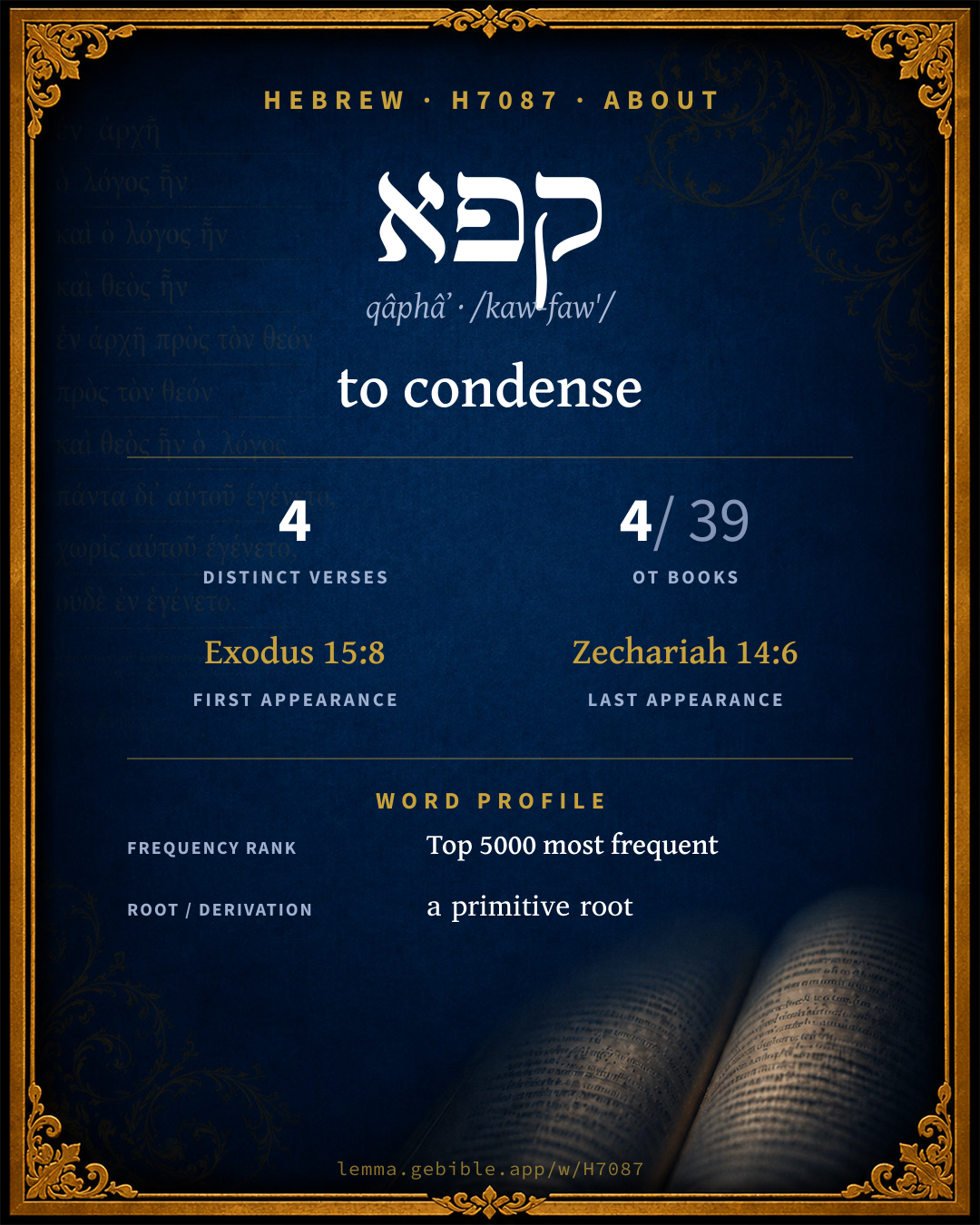
קָפָא
to condense
‘to condense’ is one of 2 main senses fuller range ↓
Full lexicon entry — Brown-Driver-Briggs (BDB)
From Brown-Driver-Briggs (BDB)
Where this word appears
See every Qal verb in the Hebrew Bible →
Grammar key — what these labels mean
Part of speech
- Verb
- An action or state-of-being word.
Noun type
- Common
- A common noun — a general class of person, place, or thing (“king,” “city,” “water”), not a specific name.
Stem
- Qal
- The basic, simple active stem — the plain form of the verb (“he wrote”). Here: ‘the deeps were condensed’
- Hiphil
- The causative active stem (“he caused / brought about”).
Form
- Participle Active
- A verbal adjective expressing ongoing or characteristic action (“writing / one who writes”).
- Imperfect
- An incomplete, ongoing, or future action (“he will / would write”).
- Perfect
- A completed action or state — Hebrew marks aspect (completeness) more than strict tense (“he wrote”).
State
- Absolute
- The independent form of a noun, not bound to a following word.
Person
- 2nd Person
- The one addressed (“you”).
- 3rd Person
- The one spoken about (“he / she / it / they”).
Gender
- Masculine
- Grammatically masculine.
- Common
- Either gender — not distinguished for this form.
Number
- Singular
- One.
- Plural
- More than one (in Hebrew, generally three or more).
Grammatical forms
- Noun, Common, Masculine, Singular, Absolute 1 time (20%)
- Verb, Qal, Participle Active, Masculine, Plural, Absolute 1 time (20%)
- Verb, Hiphil, Imperfect, 2nd Person, Masculine, Singular 1 time (20%)
- Verb, Qal, Imperfect, 3rd Person, Masculine, Plural 1 time (20%)
- Verb, Qal, Perfect, 3rd Person, Common, Plural 1 time (20%)
Parsed forms decoded from the imported morphology (morphhb / Westminster Leningrad Codex — WLC text public domain, morphhb tagging CC BY 4.0), counted across 5 parsed occurrences — not distinct verses.
Every verse where H7087 appears — 4 distinct verses across 4 books. Click any verse to open its interlinear word-by-word view. Verse text shown in the World English Bible for context — . Each verse’s Hebrew form is shown with its reference; the English is not keyword-highlighted, since the data carries no word-level English alignment. Use “Compare translations” on any verse to read it across multiple English versions. This concordance covers the Hebrew Bible; Septuagint (Greek Old Testament) occurrences are not indexed here.
Exodus 1 verse
Job 1 verse
Zephaniah 1 verse
Zechariah 1 verse
About this entry
At a glance — auto-summarized from this page’s data, not written by a person. Every figure links to its source below. This summary describes the numbers; it doesn’t interpret them.
קפא — transliterated qâphâʼ — is a Hebrew word carrying the sense “to condense.” The Hebrew Bible uses it only 4 verses. More than a quarter of its appearances fall in Exodus. Its earliest occurrence is Exodus 15:8. The lexicon spreads it across several senses; see its full sense range. Each statement above links to its evidence; the full detail follows below.
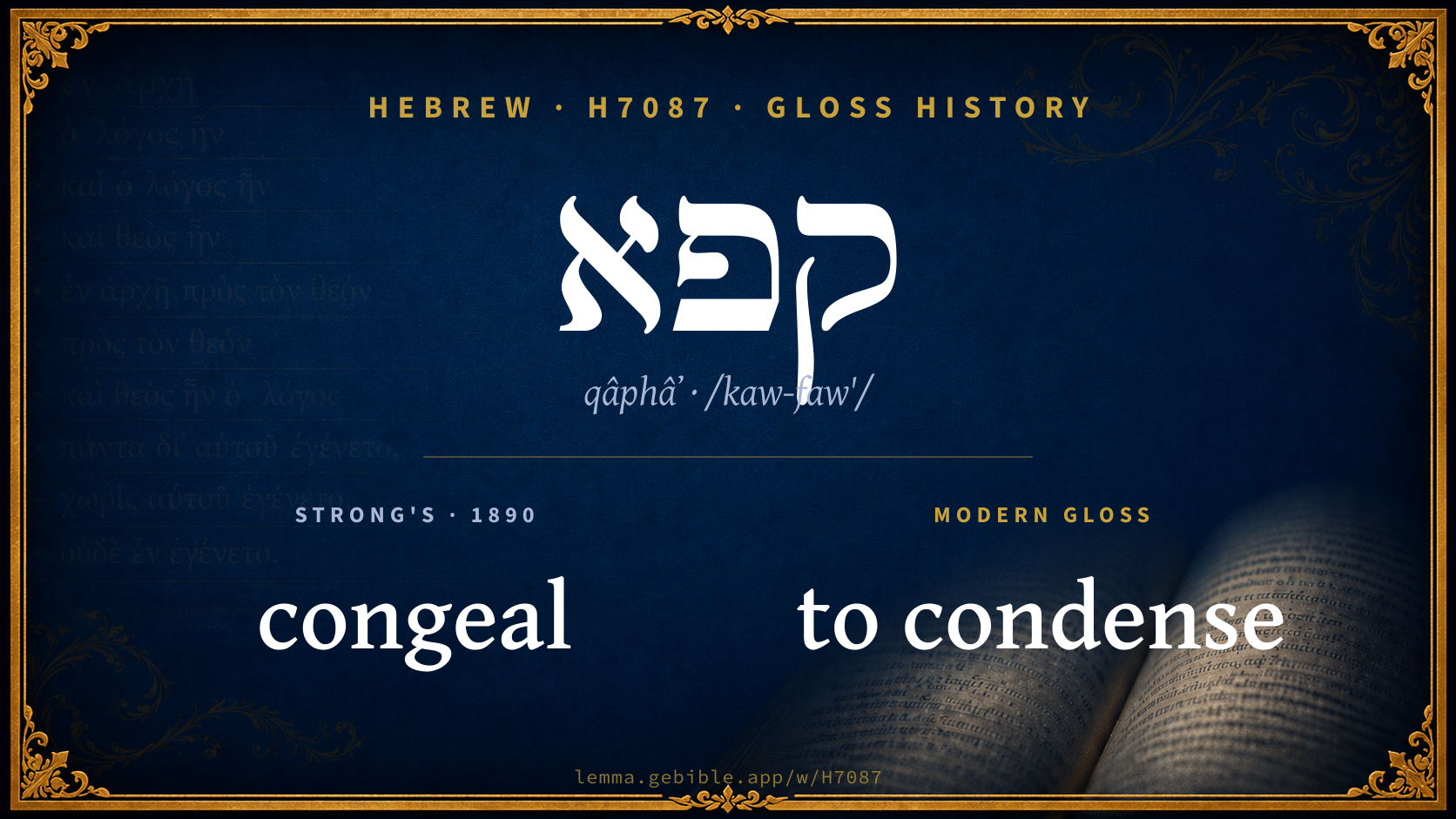
Gloss history
Strong's 1890 vs modern scholarship
About this word
Strong's H7087 catalogs a Hebrew word from the Hebrew Old Testament.
These counts are not copied from any lexicon or concordance. They are computed here, from the morphology-tagged Hebrew Old Testament. What Lemma adds →
- 4
- distinct verses
- The word appears in 4 distinct verses.
- 4 / 39
- OT books
- The word appears in 4 of 39 Old Testament books.
- #3,337
- by frequency
- Top 5000 most frequent Hebrew words (rank 3,337 of 8,640 Hebrew words by occurrence).
View all 4 occurrences in the concordance →
By section of the Old Testament
By traditional corpus
Conventional, traditional groupings — biblical authorship is debated, so this is a traditional corpus grouping, not an authorship claim. Each share is this word’s portion of its verses in that division of the Hebrew canon. Each figure is a share of the word’s 4 distinct verses.
- Prophets (Nevi'im) 2 verses · 50%
- Torah (Pentateuch) 1 verse · 25%
- Writings (Ketuvim) 1 verse · 25%
How translations render this word
Counts come from each version’s own published word-to-Strong’s tagging or interlinear alignment — an approximate guide to how each version renders this word, not a word-level alignment the data otherwise carries. Because each total is that version’s own tagged count, the per-version totals vary from one another and need not match the appearance or distinct-verse counts above. These counts may also differ from a printed concordance because Lemma counts each distinctly tagged rendering and does not collapse phrase taggings into a single head-word total. This is a fixed set of word-tagged versions (KJV, ASV, BSB, ULT) and does not change with the reading translation you choose elsewhere. Each version’s license is shown beside its name below (and on Sources).
BDB lists this Strong’s number as 2 distinct words (homographs). Each count above pools all of them and is not split by sense — see the Senses section below. A low-frequency rendering may belong to a different one of those words, not the primary meaning.
- King James Version†: Are settled 1×, Curdled 1×, Dark 1×
- American Standard Version†: Are settled 1×, Curdled 1×, Ones shall withdraw themselves 1×
- Berean Standard Bible†: Congealed 1×, Curdle me 1×, Or frost 1×
- unfoldingWord Literal Text†: Caused me to curdle 1×, Or frost either 1×, Thickened 1×
King James Version Public Domain
Renders H7087 across 4† tagged occurrences — most commonly:
Not rendered by a distinct English word in 1 further occurrence.
American Standard Version Public Domain
Renders H7087 across 4† tagged occurrences — most commonly:
Berean Standard Bible Public Domain
Renders H7087 across 4† tagged occurrences — most commonly:
unfoldingWord Literal Text CC BY-SA 4.0
Renders H7087 across 4† tagged occurrences — most commonly:
Senses in the full BDB
Hebrew verbs can shift meaning by stem (binyan): Qal is the basic action, Niphal is often passive or reflexive, Piel often intensifies or makes it factitive, and Hiphil is typically causative. The senses below are grouped under the stem BDB assigns to each.
What do BDB’s symbols mean?
BDB uses these scholarly abbreviations:
| Symbol | Meaning |
|---|---|
| 𝔊 | the Septuagint (the ancient Greek translation, LXX) |
| 𝔙 | the Vulgate (the Latin translation) |
| 𝔖 | the Syriac version (the Peshitta) |
| 𝔗 | the Targum (the Aramaic translation) |
| ψ | the Psalms |
| √ | root (the underlying root or stem) |
| ‖ | parallel passage (a synonymous or contrasted parallel) |
| † | the dagger: every passage where the word occurs is cited |
The 2 senses and sub-senses the full Brown-Driver-Briggs lexicon distinguishes for this word, in lexicon order (not ranked by frequency), with BDB’s own verbatim wording and sub-sense lettering. Shown in Hebrew script with BDB’s own scholarly abbreviations. The condensed entry is in the Lexicon Entry tab. See also the Forms in the corpus table below.
קפא I thicken, condense, congeal
Qal
- the deeps were condensed, became firm walls
Hiphil
- . didst thou not curdle me like cheese
קפא II congelation
Senses from the full Brown-Driver-Briggs lexicon (Brown, Driver, Briggs; Oxford 1906 — public domain), digitized via Sefaria, supplemented by the OpenScriptures HebrewLexicon (CC BY 4.0). Full attribution on Sources.
Word origin
[ קָפָא ] vb. thicken, condense, congeal
קִפָּאוֹן n.[m.] congelation;— Zc 14:6 Qr
— Brown-Driver-Briggs (Oxford 1906, public domain), digitized via Sefaria, supplemented by the OpenScriptures HebrewLexicon (CC BY 4.0). See Sources.
Origin: a primitive root
Jastrow Dictionary
A second Hebrew/Aramaic lexicon for comparison, covering Aramaic and post-biblical (Talmudic, Targumic, Midrashic) usage that the biblical-Hebrew BDB does not. Matched by lemma rather than by Strong’s number, so a lemma may carry more than one Jastrow headword (shown separately below), and the entries cover usage well beyond the Bible.
קָפָא
- v. קפי
קַפָּא I
- (κάππα) the letter kappa (k′) as numeral, twenty. Lam. R. to I, 1 רבתי (חד בר נש), v. דּוֹקְיָיא; Y. Maas. Sh. IV, 55ᵇ bot. [read:] מני עשרין … ק׳ דוקייא count twenty beams in thy house (counting upwards and downwards until you arrive at twenty), and thou shalt find thy father’s savings, kappa dokia (twenty beams; oneirocritical play on Cappadocia; v. Gen. R. s. 68).
קַפָּא II
- (קפף)
- 1. trunk, vine, v. קוֹפָא II.—
- *2. (v. קוֹפָא II, 1) pole, beam. Ber. 56ᵇ, v. דִּיקָא. Ib. זיל חזי ק׳ דריש עשרה וכ׳ go and examine the beam which heads the number ten, and you shall find (in number eleven) &c.; v., however, preced.
קַפָּא III
- (or קָפָא) name of a worm in herbs which causes disease of the bowels; (oth. opin.) a poisonous substance in vegetables. Pes. 115ᵇ צריך לשקועיה … משום ק׳ you must dip the bitter herb into the ḥăroseth to counteract the effect of the ḳappa. Ib. לא … וק׳ מריחא מיית it is not necessary to dip it, for the ḳ. dies from the smell (of the ḥăroseth). Ib. 116ᵃ, v. חַמָּא.—Tosef. Ter. VII, 11 Ar., v. קַפָּה.
קְפֵי
- , to float, be on top. Targ. II Kings VI, 6 (h. text ויצף). Targ. Y. Ex. XV, 8.—Succ. 53ᵃ ק׳ תהומא וכ׳ the waters of the deep came on top and threatened to flood the world; Macc. 11ᵃ. Ḥull. 26ᵇ איידי דמיא … ק׳ מלעיל because water is heavier, it rests below, and the fruit floats on top. Ib. 111ᵇ דמא … דכבדא ק׳ the blood of flesh sinks, that of the liver floats. Erub. 53ᵇ ותִיקְפֵּי עלת וכ׳ Ms. M. (ed. ותתקפו, Rashi ותתקפי, v. Rabb. D. S. a. l.), v. עַלַּת; a. e.—2) to coagulate, curdle. Targ. O. Ex. XV, 8.—Ḥull. 93ᵇ מִיקְפָּא קָפֵי the blood coagulates, opp. דייב.
- 1. to cause to float. Ḥag. 16ᵇ אַקְפּוּ ידייכו let your hands float (rest lightly on the head of the sacrifice). Sabb. 128ᵇ דמַקְפְּיָא נפשה (or דמְקַפְּיָא Pa.) she (the hen) makes herself float (raises her feet and spreads her wings, so that you have to carry her instead of making her walk).
- 2. to overflow; to be flooded. Kidd. 72ᵃ א׳ פירא דכוורי וכ׳ Ar. (ed. בכוורי) a fish pond overflowed on the Sabbath, and they went and caught fish &c. B. Mets. 12ᵇ דא׳ אגמא בכוורי (Rashi a. Ar. דאַקְפָּאִי; Ms. R. 2 קְפָאִי; Ms. R. 1 אכפאי, corr. acc.) when a meadow was flooded with fish (the flood carrying fish over the meadow).
- 3. to cause coagulation. Ḥull. 120ᵃ כיון דאַקְפֵּיה וכ׳ since he took pains to make the blood thick (by boiling), he proved that he had his mind on it.
- to float, v. supra.
A Dictionary of the Targumim, the Talmud Babli and Yerushalmi, and the Midrashic Literature (Marcus Jastrow; London, Luzac, 1903) — Public Domain. Digitized via Sefaria. Digitized via Sefaria. Full attribution on Sources.
Forms in the corpus
The 5 distinct written forms H7087 takes in the Hebrew Bible, most frequent first — each parse links to that stem’s occurrences in the concordance. Hebrew forms include their vowel points and cantillation, so a single lemma takes many written forms.
| Form | Parsing | Example | Uses |
|---|---|---|---|
| הַ/קֹּֽפְאִים֙ | Verb, Qal, Participle Active, Masculine, Plural, Absolute | Zephaniah 1:12 | 1 |
| וְ/קִפָּאֽוֹן | Noun, Common, Masculine, Singular, Absolute | Zechariah 14:6 | 1 |
| יקפאו/ן | Verb, Qal, Imperfect, 3rd Person, Masculine, Plural | Zechariah 14:6 | 1 |
| קָֽפְא֥וּ | Verb, Qal, Perfect, 3rd Person, Common, Plural | Exodus 15:8 | 1 |
| תַּקְפִּיאֵֽ/נִי | Verb, Hiphil, Imperfect, 2nd Person, Masculine, Singular | Job 10:10 | 1 |
Septuagint verse parallels
This word appears in 4 verses that also exist in the Greek Old Testament (Septuagint), out of the 4 Hebrew verses it occurs in. You can read those verses in Greek by switching the Old Testament edition to the Septuagint.
Read these verses in the Septuagint
This is a verse-level parallel only — the same verses exist in both the Hebrew and Greek Old Testaments. No word-level Hebrew↔Greek correspondence is claimed: the data carries no such alignment, so no Greek word is shown as this Hebrew word’s translation. Coverage is not total — the Septuagint omits the deuterocanon and renumbers the Psalms, so some Hebrew verses have no direct Greek parallel.