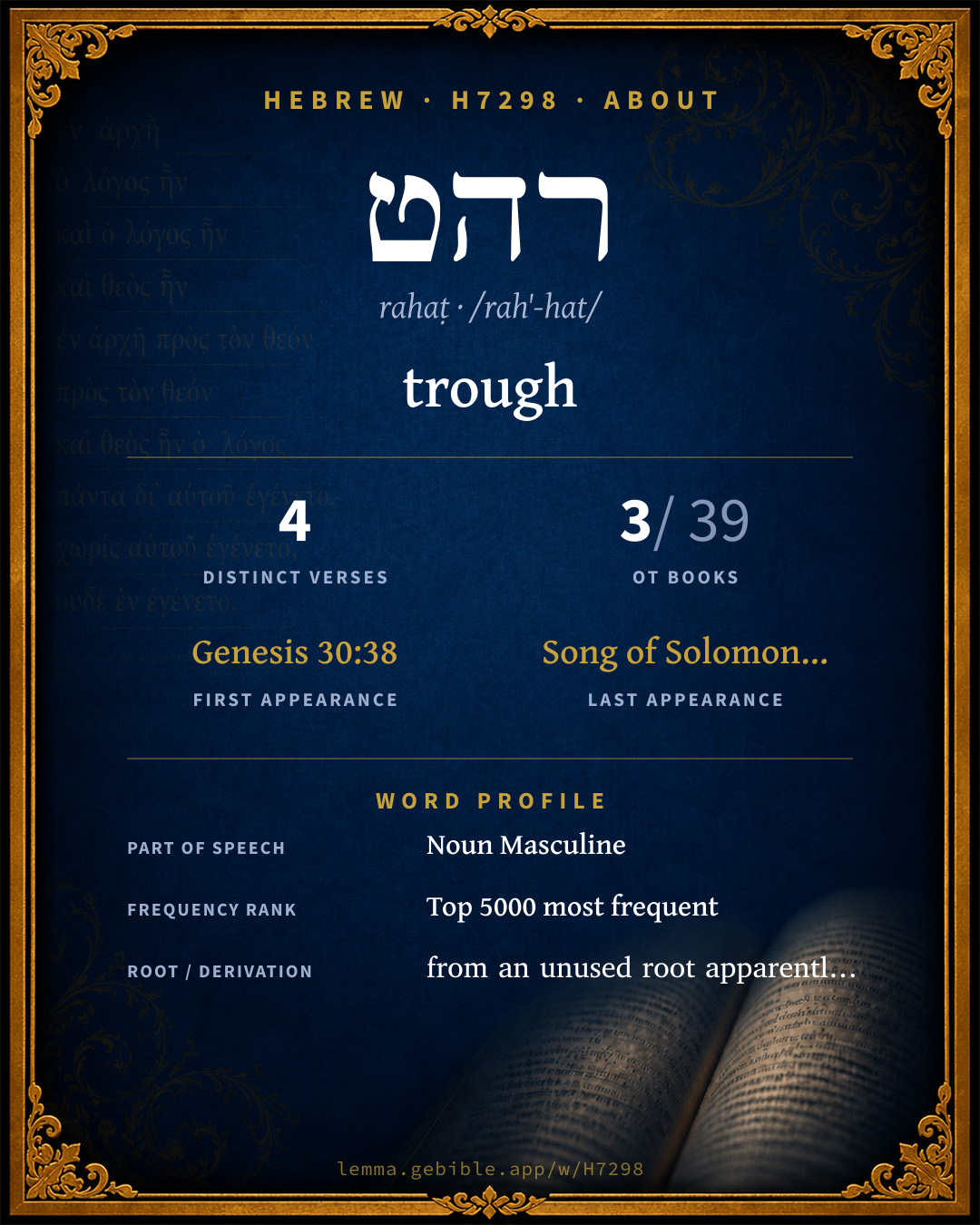
רַ֫הַט
trough
‘trough’ is one of 2 main senses fuller range ↓
Full lexicon entry — Brown-Driver-Briggs (BDB)
From Brown-Driver-Briggs (BDB)
Where this word appears
Grammar key — what these labels mean
Noun type
- Common
- A common noun — a general class of person, place, or thing (“king,” “city,” “water”), not a specific name.
State
- Absolute
- The independent form of a noun, not bound to a following word.
Gender
- Masculine
- Grammatically masculine.
Number
- Plural
- More than one (in Hebrew, generally three or more).
Every verse where H7298 appears — 4 distinct verses across 3 books. Click any verse to open its interlinear word-by-word view. Verse text shown in the World English Bible for context — . Each verse’s Hebrew form is shown with its reference; the English is not keyword-highlighted, since the data carries no word-level English alignment. Use “Compare translations” on any verse to read it across multiple English versions. This concordance covers the Hebrew Bible; Septuagint (Greek Old Testament) occurrences are not indexed here.
Genesis 2 verses
- Genesis 30:38 בָּ/רֳהָטִ֖ים prep det + n c mp He set the rods which he had peeled opposite the flocks in the gutters in the watering-troughs where the flocks came to drink. They conceived when they came to drink.
- Genesis 30:41 בָּ/רֳהָטִ֑ים prep det + n c mp It happened, whenever the stronger of the flock conceived, that Jacob laid the rods before the eyes of the flock in the gutters, that they might conceive among the rods;
Exodus 1 verse
Song of Solomon 1 verse
About this entry
At a glance — auto-summarized from this page’s data, not written by a person. Every figure links to its source below. This summary describes the numbers; it doesn’t interpret them.
“trough” is the headline sense of the Hebrew noun רהט (rahaṭ). It occurs a mere 4 verses across Scripture. More than half of its appearances fall in Genesis. Scripture first uses it in Genesis 30:38. Catalogued under 2 senses, its meaning is not single-sense. The sections below give every sense, occurrence, and version rendering.
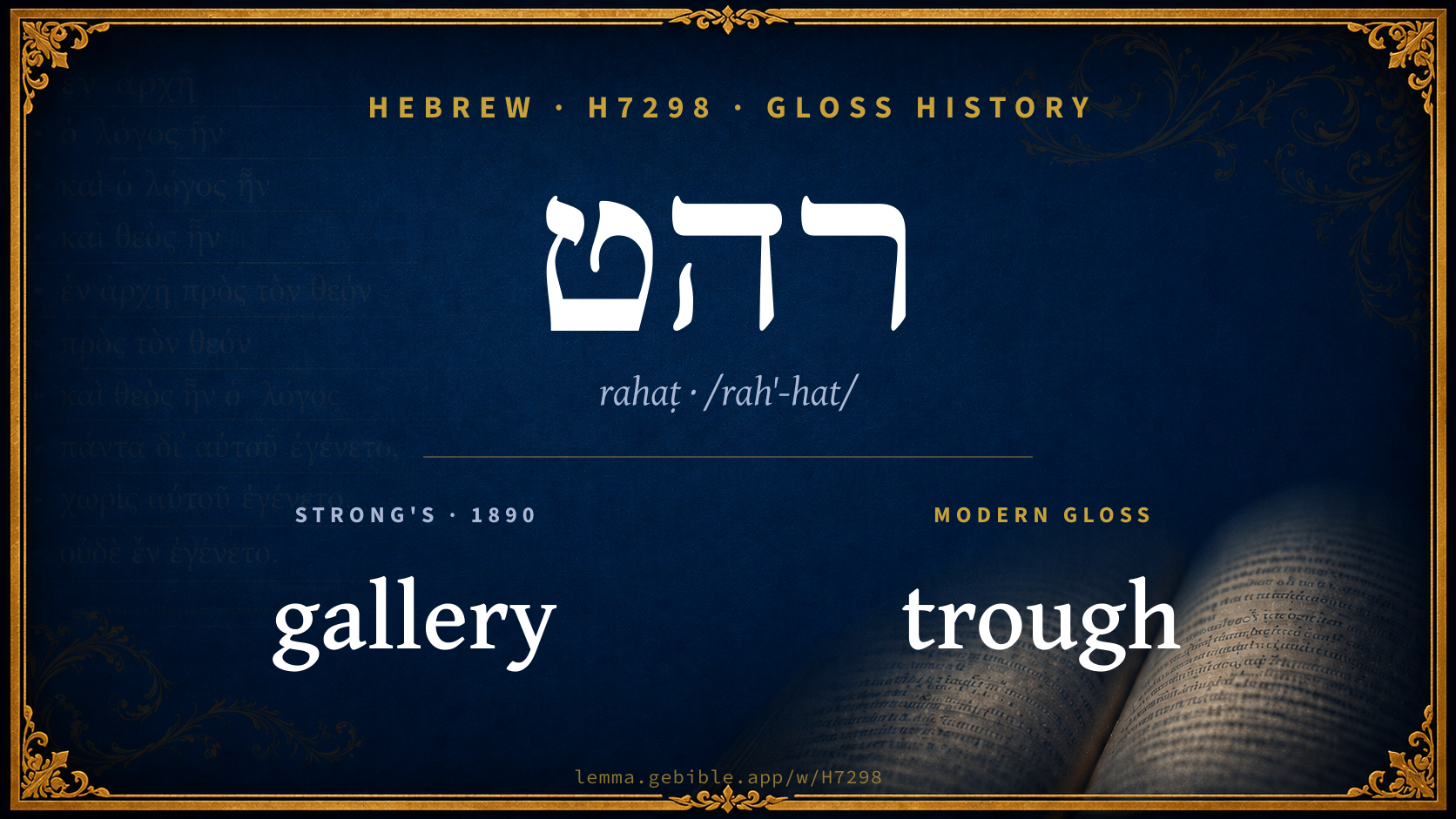
Gloss history
Strong's 1890 vs modern scholarship
About this word
Strong's H7298 catalogs a Hebrew word from the Hebrew Old Testament.
These counts are not copied from any lexicon or concordance. They are computed here, from the morphology-tagged Hebrew Old Testament. What Lemma adds →
- 4
- distinct verses
- The word appears in 4 distinct verses.
- 3 / 39
- OT books
- The word appears in 3 of 39 Old Testament books.
- #3,696
- by frequency
- Top 5000 most frequent Hebrew words (rank 3,696 of 8,640 Hebrew words by occurrence).
View all 4 occurrences in the concordance →
Most concentrated in
- Genesis 2 verses 50%
- Exodus 1 verse 25%
- Song of Solomon 1 verse 25%
By section of the Old Testament
By traditional corpus
Conventional, traditional groupings — biblical authorship is debated, so this is a traditional corpus grouping, not an authorship claim. Each share is this word’s portion of its verses in that division of the Hebrew canon. Each figure is a share of the word’s 4 distinct verses.
- Torah (Pentateuch) 3 verses · 75%
- Writings (Ketuvim) 1 verse · 25%
How translations render this word
Counts come from each version’s own published word-to-Strong’s tagging or interlinear alignment — an approximate guide to how each version renders this word, not a word-level alignment the data otherwise carries. Because each total is that version’s own tagged count, the per-version totals vary from one another and need not match the appearance or distinct-verse counts above. These counts may also differ from a printed concordance because Lemma counts each distinctly tagged rendering and does not collapse phrase taggings into a single head-word total. This is a fixed set of word-tagged versions (KJV, ASV, BSB, ULT) and does not change with the reading translation you choose elsewhere. Each version’s license is shown beside its name below (and on Sources).
BDB lists this Strong’s number as 2 distinct words (homographs). Each count above pools all of them and is not split by sense — see the Senses section below. A low-frequency rendering may belong to a different one of those words, not the primary meaning.
- King James Version†: Gutters 2×
- American Standard Version†: Gutters 2×
- Berean Standard Bible†: Troughs 2×
- unfoldingWord Literal Text†: Troughs 3×
King James Version Public Domain
Renders H7298 across 4† tagged occurrences — most commonly:
Plus 2 renderings that appear only once — usually multi-word phrases or single function words the recovered tagging swept in, not distinct renderings.
American Standard Version Public Domain
Renders H7298 across 4† tagged occurrences — most commonly:
Plus 2 renderings that appear only once — usually multi-word phrases or single function words the recovered tagging swept in, not distinct renderings.
Berean Standard Bible Public Domain
Renders H7298 across 3† tagged occurrences — most commonly:
Plus 1 rendering that appears only once — usually multi-word phrases or single function words the recovered tagging swept in, not distinct renderings. Not rendered by a distinct English word in 1 further occurrence.
unfoldingWord Literal Text CC BY-SA 4.0
Renders H7298 across 4† tagged occurrences — most commonly:
Plus 1 rendering that appears only once — usually multi-word phrases or single function words the recovered tagging swept in, not distinct renderings.
Senses in the full BDB
What do BDB’s symbols mean?
BDB uses these scholarly abbreviations:
| Symbol | Meaning |
|---|---|
| 𝔊 | the Septuagint (the ancient Greek translation, LXX) |
| 𝔙 | the Vulgate (the Latin translation) |
| 𝔖 | the Syriac version (the Peshitta) |
| 𝔗 | the Targum (the Aramaic translation) |
| ψ | the Psalms |
| √ | root (the underlying root or stem) |
| ‖ | parallel passage (a synonymous or contrasted parallel) |
| † | the dagger: every passage where the word occurs is cited |
The 0 senses and sub-senses the full Brown-Driver-Briggs lexicon distinguishes for this word, in lexicon order (not ranked by frequency), with BDB’s own verbatim wording and sub-sense lettering. Shown in Hebrew script with BDB’s own scholarly abbreviations. The condensed entry is in the Lexicon Entry tab. See also the Forms in the corpus table below.
רהט I trough, collected
רהט II lock, flowing
Senses from the full Brown-Driver-Briggs lexicon (Brown, Driver, Briggs; Oxford 1906 — public domain), digitized via Sefaria, supplemented by the OpenScriptures HebrewLexicon (CC BY 4.0). Full attribution on Sources.
Word origin
I. [ רַ֫הַט ] n.[m.] trough (where water is collected ?);—for watering cattle
II. [ רַ֫הַט ] n.[m.] dub., lock of hair (?fr. flowing down);—pl. Ct 7:6.
— Brown-Driver-Briggs (Oxford 1906, public domain), digitized via Sefaria, supplemented by the OpenScriptures HebrewLexicon (CC BY 4.0). See Sources.
Origin: from an unused root apparently meaning to hollow out
Jastrow Dictionary
A second Hebrew/Aramaic lexicon for comparison, covering Aramaic and post-biblical (Talmudic, Targumic, Midrashic) usage that the biblical-Hebrew BDB does not. Matched by lemma rather than by Strong’s number, so a lemma may carry more than one Jastrow headword (shown separately below), and the entries cover usage well beyond the Bible.
רָהַט
- (= דוּץ) to run. —Part. pass. רָהוּט; pl. רְהוּטִים hurried, running. Cant. R. to I, 17 (ref. to ורהיטנו ib.) מקום שהכהנים ר׳ בברותים the place where the priests ran (at service) was laid out with cypresses (ref. to I Kings VI, 15). e.g. 1 Kings 6:15
- (denom. of רָהִיט) to lay rafters. Ib. למדה תורה … מקרה … ומַרְהִיט בברותים the text (Cant. l. c.) teaches a practical lesson that man should use cedars for roofing and cypresses for the rafters.
רְהַט
- , to run, be swift. Targ. Job IX, 25 (of a bird). Targ. Gen. XVIII, 7. Targ. II Sam. XVIII, 23; a. fr.—M. Kat. 9ᵇ רָהֲטָא, v. טַבְלָא I. Erub. 51ᵃ top והוא דכי רָהֵיט וכ׳ provided he may reach the root of the tree (before the Sabbath begins) by running. Ber. 6ᵇ מצוה למִרְהַט it is right to run. Ib. אנא נמי רְהִיטְנָא I run likewise. Sabb. 94ᵃ רהיט תלתא וכ׳ he ran three parasangs on foot. Ib. 32ᵃ ועיזי רְהִיטָן (not ריהטן) the goats run, v. חִגְּרָא; Yalk. Gen. 31 רְהִיטֵי. Y. Shek. V, end, 49ᵇ רגלייא דלא רָהֲטָן וכ׳ may the (my) feet that failed to run to give alms, be broken; a. fr.
- to cause to run, hasten. Targ. O. Gen. XLI, 14.
רַהַט
- , pl. רְהָטִים, רְהָטִין(b. h.; preced.) [runners,]
- 1. gutters of the watering trough. Lev. R. s. 31; Cant. R. to VII, 6 (ref. to אסור ברהטים, ib.) זה משה … שנגזר … בר׳ של מי מריבה that is Moses … concerning whom it was decreed that he should not enter the land; and why? Because of the troughs of the waters of Meribah (Num. XX, 13). e.g. Numbers 20:13
- 2. (= רהיטים) rafters, roofing. Ib. זה מלך … שאסר … משרה שכינתו בתוך ישראל בר׳ (strike out של אבינו יעקב) that is the king of kings … who bound himself by an oath that he will allow his Presence to dwell in Israel under roofing (in the Temple); Lev. R. l. c. משרה שכינתו בתוך רהיטין של יעקב (strike out אבינו) under Jacob’s roof.
- 3. running. Ib. בזכותו … אל הבקר רץ וכ׳ for the sake of Araham of whom it is written (Gen. XVIII, 7), ‘and Abraham ran &c.’; Cant. R. l. c.—[ e.g. Genesis 18:7
- 4. (b. h.) shavings; trnsf. curls. Cant. l. c.]
A Dictionary of the Targumim, the Talmud Babli and Yerushalmi, and the Midrashic Literature (Marcus Jastrow; London, Luzac, 1903) — Public Domain. Digitized via Sefaria. Digitized via Sefaria. Full attribution on Sources.
Forms in the corpus
The 4 distinct written forms H7298 takes in the Hebrew Bible, most frequent first — each parse links to that state’s occurrences in the concordance. Hebrew forms include their vowel points and cantillation, so a single lemma takes many written forms.
| Form | Parsing | Example | Uses |
|---|---|---|---|
| בָּ/רְהָטִֽים | Noun, Common, Masculine, Plural, Absolute | Song of Solomon 7:5 | 1 |
| בָּ/רֳהָטִ֑ים | Noun, Common, Masculine, Plural, Absolute | Genesis 30:41 | 1 |
| בָּ/רֳהָטִ֖ים | Noun, Common, Masculine, Plural, Absolute | Genesis 30:38 | 1 |
| הָ֣/רְהָטִ֔ים | Noun, Common, Masculine, Plural, Absolute | Exodus 2:16 | 1 |
Same root — word family
Other BDB entries built from the same root as H7298, grouped by Strong’s listed origin. These share a root / origin per the lexicon — not necessarily a shared meaning. Each links to that word’s own entry.
Derived from this word
Compare all same-root words → They share a root, not necessarily a meaning.
Septuagint verse parallels
This word appears in 4 verses that also exist in the Greek Old Testament (Septuagint), out of the 4 Hebrew verses it occurs in. You can read those verses in Greek by switching the Old Testament edition to the Septuagint.
Read these verses in the Septuagint
This is a verse-level parallel only — the same verses exist in both the Hebrew and Greek Old Testaments. No word-level Hebrew↔Greek correspondence is claimed: the data carries no such alignment, so no Greek word is shown as this Hebrew word’s translation. Coverage is not total — the Septuagint omits the deuterocanon and renumbers the Psalms, so some Hebrew verses have no direct Greek parallel.