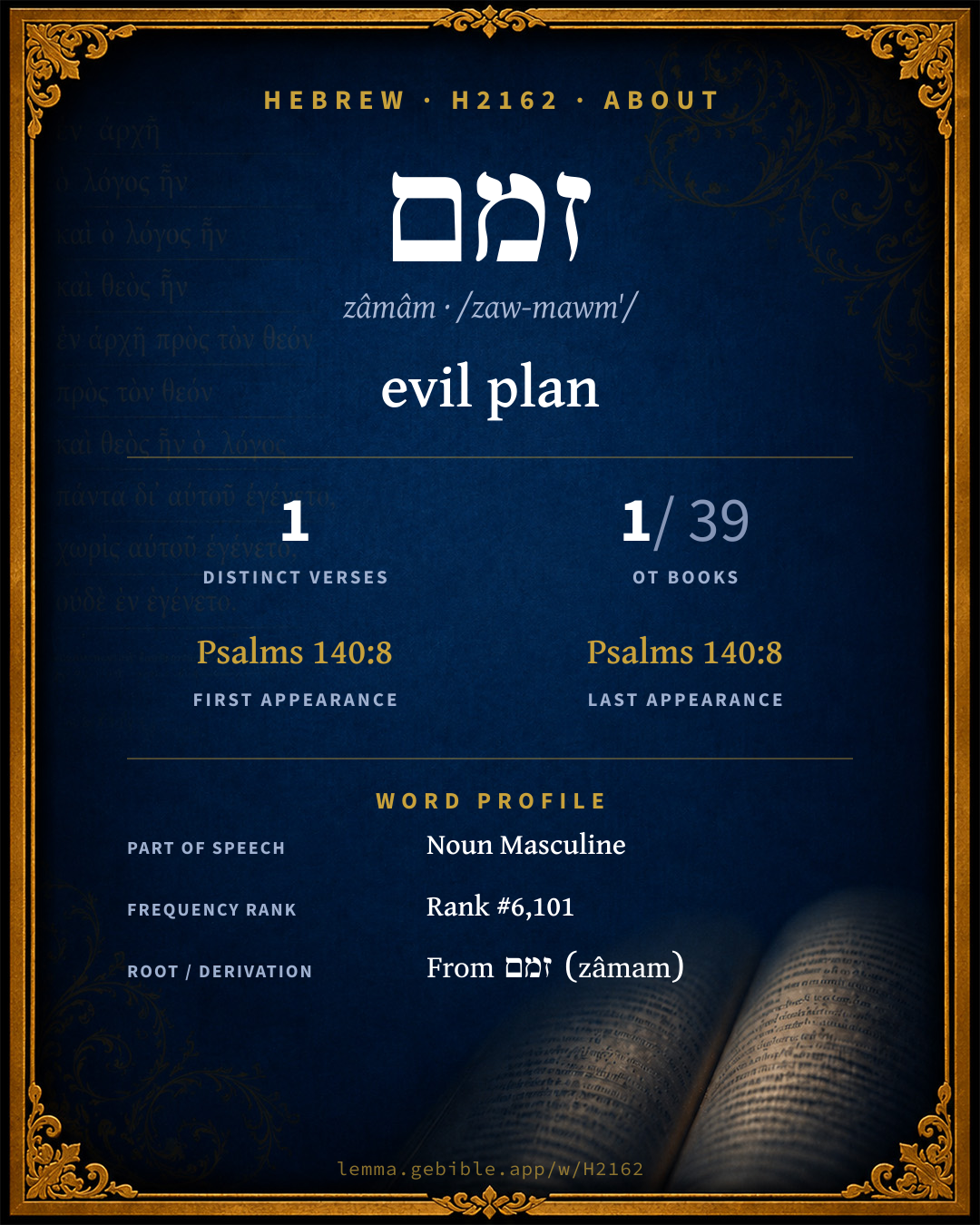
זָמָם
evil plan
Full lexicon entry — Brown-Driver-Briggs (BDB)
From Brown-Driver-Briggs (BDB)
Where this word appears
Grammar key — what these labels mean
Part of speech
- Noun
- A naming word — a person, place, thing, or idea.
Noun type
- Common
- A common noun — a general class of person, place, or thing (“king,” “city,” “water”), not a specific name.
State
- Construct
- A noun bound to a following noun in a possessive / “of” relationship (the construct chain).
Gender
- Masculine
- Grammatically masculine.
Number
- Singular
- One.
Every verse where H2162 appears — 1 distinct verse across 1 book. Click any verse to open its interlinear word-by-word view. Verse text shown in the World English Bible for context — . Each verse’s Hebrew form is shown with its reference; the English is not keyword-highlighted, since the data carries no word-level English alignment. Use “Compare translations” on any verse to read it across multiple English versions. This concordance covers the Hebrew Bible; Septuagint (Greek Old Testament) occurrences are not indexed here.
Psalms 1 verse
About this entry
At a glance — auto-summarized from this page’s data, not written by a person. Every figure links to its source below. This summary describes the numbers; it doesn’t interpret them.
זמם — transliterated zâmâm — is a Hebrew noun carrying the sense “evil plan.” A scarce word — 1 verse in all of the Hebrew Bible. More than three-quarters of its appearances fall in Psalms. Scripture uses it exactly once, at Psalms 140:8. Related forms include זמם, זמה and מזמה. See the sense tree, 1-verse concordance, and the renderings breakdown below.
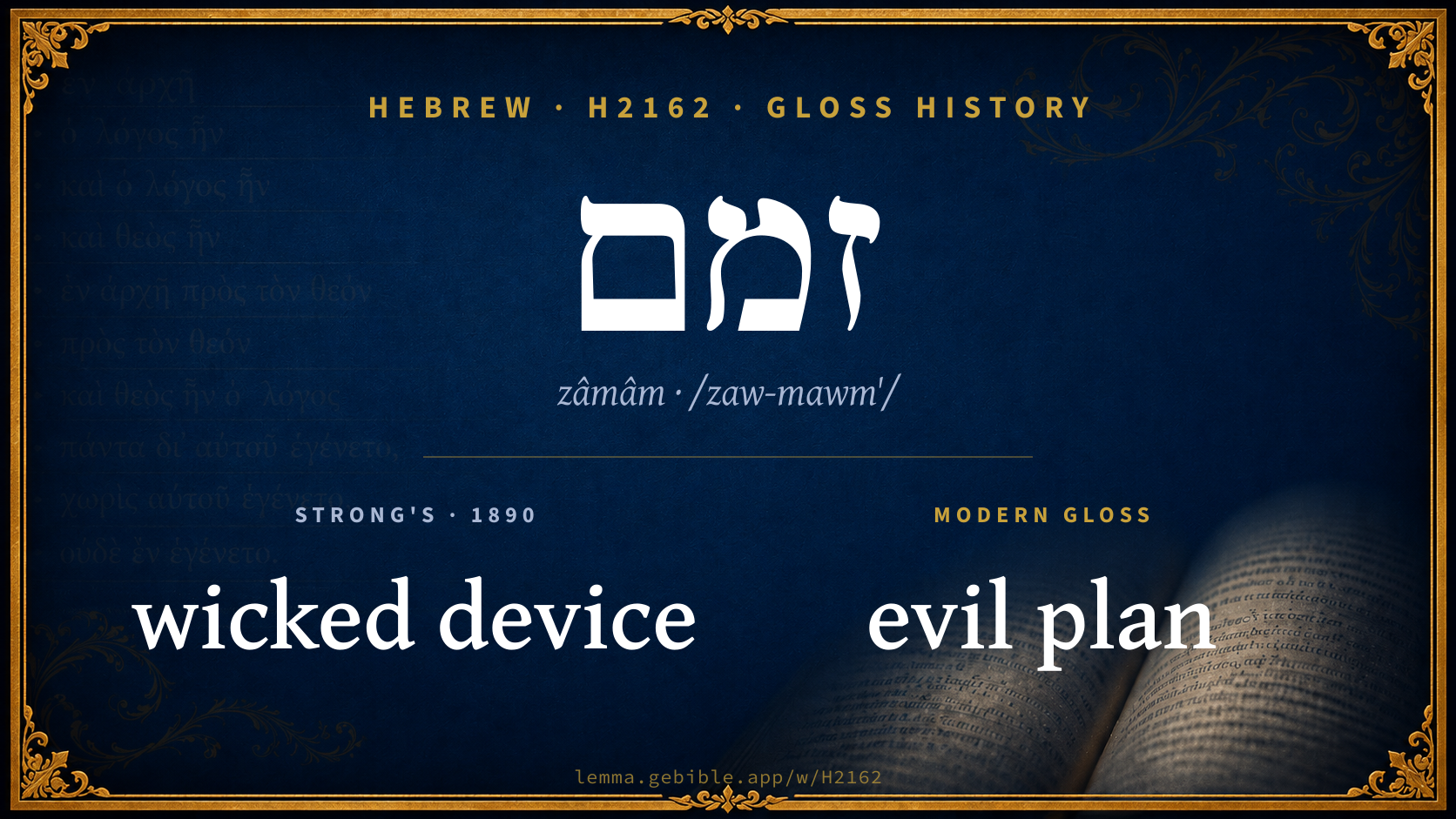
Gloss history
Strong's 1890 vs modern scholarship
About this word
Strong's H2162 catalogs a Hebrew word from the Hebrew Old Testament.
These counts are not copied from any lexicon or concordance. They are computed here, from the morphology-tagged Hebrew Old Testament. What Lemma adds →
- 1
- distinct verses
- The word appears in 1 distinct verse.
- 1 / 39
- OT books
- The word appears in 1 of 39 Old Testament books.
- #6,101
- by frequency
- Rank #6,101 (rank 6,101 of 8,640 Hebrew words by occurrence).
View all 1 occurrence in the concordance →
Most concentrated in
- Psalms 1 verse 100%
By section of the Old Testament
By traditional corpus
Conventional, traditional groupings — biblical authorship is debated, so this is a traditional corpus grouping, not an authorship claim. Each share is this word’s portion of its verses in that division of the Hebrew canon. Each figure is a share of the word’s 1 distinct verse.
- Writings (Ketuvim) 1 verse · 100%
How translations render this word
Counts come from each version’s own published word-to-Strong’s tagging or interlinear alignment — an approximate guide to how each version renders this word, not a word-level alignment the data otherwise carries. Because each total is that version’s own tagged count, the per-version totals vary from one another and need not match the appearance or distinct-verse counts above. These counts may also differ from a printed concordance because Lemma counts each distinctly tagged rendering and does not collapse phrase taggings into a single head-word total. This is a fixed set of word-tagged versions (KJV, ASV, BSB, ULT) and does not change with the reading translation you choose elsewhere. Each version’s license is shown beside its name below (and on Sources).
- King James Version: Wicked device 1×
- American Standard Version: Evil device 1×
- Berean Standard Bible: Evil plans 1×
- unfoldingWord Literal Text: Plot 1×
King James Version Public Domain
Renders H2162 across 1 tagged occurrence — most commonly:
American Standard Version Public Domain
Renders H2162 across 1 tagged occurrence — most commonly:
Berean Standard Bible Public Domain
Renders H2162 across 1 tagged occurrence — most commonly:
unfoldingWord Literal Text CC BY-SA 4.0
Renders H2162 across 1 tagged occurrence — most commonly:
Senses in BDB
The 1 sense BDB distinguishes for this word, in lexicon order (not ranked by frequency or importance). The full entry — with sub-senses — is in the Lexicon Entry tab.
- wicked device, evil plan
Word origin
[ זָמָם ] n.[m.] plan, device (bad sense), only ψ 140:9
— Brown-Driver-Briggs (Oxford 1906, public domain), digitized via Sefaria, supplemented by the OpenScriptures HebrewLexicon (CC BY 4.0). See Sources.
Derived from זמם (zâmam) (H2161) — to devise.
Jastrow Dictionary
A second Hebrew/Aramaic lexicon for comparison, covering Aramaic and post-biblical (Talmudic, Targumic, Midrashic) usage that the biblical-Hebrew BDB does not. Matched by lemma rather than by Strong’s number, so a lemma may carry more than one Jastrow headword (shown separately below), and the entries cover usage well beyond the Bible.
זָמַם I
- to mumble; to meditate, plan (mostly in an evil sense, cmp. דִּבָּה).—Part. זוֹמֵם planning evil, esp. (with ref. to Deut. XIX, 19) a) giving false testimony, amenable to the law of retaliation; b) rebutting witness. Tosef. Macc. I, 1 עד ז׳ a witness convicted of false testimony; a. fr.—Fem. זוֹמֶמֶת (sub. עדות). Macc. I, 9 נמצאת אחת מהן ז׳ if one evidence (of one set of witnesses) has been disproved; a. e.—Pl. זוֹמְמִין, זוֹמְמִים. Ib. 4 אין אלו ז׳ they do not come under the law of retaliation. Ib. נעשים ז׳ are declared amenable to the law &c.; a. fr.—Tosef. ib. I, 10 זוֹמְמֵיהֶן those witnesses on whose evidence they had been declared guilty of false testimony. Y. ib. I, beg. 31ᵃ זוֹמְמָיו those who witnessed falsely against him. Tosef. Snh. VIII, 2 העדים וזוממיהן וזוֹמְמֵי זוממיהן the original witnesses and their refuters, and the refuters of their refuters; a. fr. e.g. Deuteronomy 19:19
- to make a person a זוֹמֵם, to refute witnesses by testifying to an alibi, to rebut. Macc. I, 5 if other witnesses came again והֵזֵימּוּם and rebutted them. Keth. 20ᵃ, v. כָּחַשׁ; a. fr. Macc. I, 4 (5ᵃ) שיזימו Bab. ed., read שיזומו, v. infra.
- to be refuted, to be declared liable to the law of retaliation. Snh. 10ᵃ פלוני … והוּזַמּוּ if witnesses declared, This man did &c., and were declared guilty &c. Macc. 3ᵃ הוּזַמְּנוּ וכ׳ we have been convicted &c. before that certain court, and made to pay. Ib. I, 4 עד שיִזּוֹמּוּ את עצמן (Ar. בעצמן, Bab. ed. שיזימו corr. acc.) unless an alibi is established against their own persons (not an alibi of any of the alleged actors in the case). Ib. 5ᵇ עד שיזומו שניהם unless both of them are refuted; a. fr.
- to rebut. Part. מְזַמֵּם, pl. מְזַמְּמִין, contr. מְזַמִּים. Y. ib. I, 31ᵇ top.—Part. pass. מְזוּמָּם one accused by false witnesses. Snh. VI, 2 אם היה יודע שהוא מ׳ if he knew that he was innocent.
- 1. to be refuted &c., v. Hof. Y. Macc. I, beg. 31ᵃ נִזְדַּמְּמוּ = נִיזוֹמּוּ.
- 2. to be mumbled. Gen. R. s. 81, beg. (ref. to זמות, Prov. XXX, 32) אם נִזְדַּמְּמוּ אחריך דברים וכ׳ (Yalk. Prov. 964 נִזְמְמוּ Nif.) if thou hast been slandered, put thy hand to thy mouth; v. זָמַם II.—Denom. זְמָם I. e.g. Proverbs 30:32
זָמַם II
- (cmp. צמם) to tie up, to muzzle (b. h. חָסַם). Ber. 63ᵇ (ref. to זמות, Prov. XXX, 32, v. preced. w.) אם ז׳ וכ׳ if he muzzles his mouth (is ashamed to ask his teacher), he will have to put his hand to the mouth (when he in turn is asked). Ter. IX, 3 לא זוֹמֵם he does not muzzle his animal (complies with the law, Deut. XXV, 4); a. e.—Part. pass. זָמוּם, f. זְמוּמָה; pl. זְמוּמִים, זְמוּמוֹת muzzled, prevented from grazing. Gen. R. s. 41. Pesik. R. s. 3. Gen. R. s. 59, end; a. e.—Denom. זְמָם II. e.g. Proverbs 30:32
זְמַם
- , tomuzzle. Targ. Y. II, Gen. XIII, 7.
- same. Targ. Y. Deut. XXV, 4.
זָמַם III
- to be filthy, v. זוּם.
*זְמַם III
- , Ithpe. אִתְזְמֵים (cmp. דמם) to be confounded. Targ. Is. XXIX, 9 אִתְזְמִימוּ (ed. Wil. אִדְזַמִימוּ fr. דמם; absent in ed. Lag.; h. text השתעשעו, rendered by אשתגישו a. our w., of which one is a gloss). [For אדז׳ cmp. הִדַּקִּי s. v. דְּקַק.]
זְמָם I
- (זָמַם I) false testimony. Macc. 2ᵇ בגניבתו ולא בזְמָמוֹ ‘one is sold for theft’ (Ex. XXII, 2), but not for false testimony (which might eventually have caused the sale of the alleged thief); Y. Sot. III, end, 19ᵇ; Tosef. Macc. I, 1 בזְמֵימוֹ. e.g. Exodus 22:2
זְמָם II
- (זָמַם II) muzzle (v. זְמוּם). Gen. R. s. 81 (play on זמות, Prov. XXX, 32, v. זָמַם I) אם חשבת … נוח לך ליתן ז׳ וכ׳ if thou hast planned to do a good deed …, it would have been better for thee to put a muzzle on thy mouth. Gen. R. s. 75 (ref. to זממו, Ps. CXL, 9) עשה לו ז׳ וכ׳ put a bit to Esaw (Rome); … ומהו ז׳ וכ׳ and what is the bit (to check Rome’s power) &c.?; Meg. 6ᵃ bot. זְמָמוֹ אל תפק וכ׳ ‘do not loosen his bit’ (Ps. l. c.), that means Germania &c.—Pl. זְמָמִים, v. זְמוּם. e.g. Proverbs 30:32
זְמַם ²
- , also the camel’s ring or staff through the nose and the basket fastened thereto. Targ. Is. XXXVII, 29. Targ. Ps. XXXII, 9; a. fr.—Sabb. 107ᵃ, v. אִיכּוּ. Ib. 111ᵇ, sq. קיטרא דקטרי בז׳ the loop which is made to fasten the camel’s basket to the ring; קיטרא דז׳ גופיה the (permanent) knot in the bit itself; v. אִיסְטְרִידָא.
A Dictionary of the Targumim, the Talmud Babli and Yerushalmi, and the Midrashic Literature (Marcus Jastrow; London, Luzac, 1903) — Public Domain. Digitized via Sefaria. Digitized via Sefaria. Full attribution on Sources.
Same root — word family
Other BDB entries built from the same root as H2162, grouped by Strong’s listed origin. These share a root / origin per the lexicon — not necessarily a shared meaning. Each links to that word’s own entry.
Derives from
Shares the same root
Proper names from this root
People and places named from this root — a name, not an additional meaning of the word.
Compare all same-root words → Showing 4 of 5 — not the complete family. 1 of the same-root words is a proper name (a person or place). They share a root, not necessarily a meaning.
Septuagint verse parallels
This word appears in 1 verse that also exists in the Greek Old Testament (Septuagint), out of the 1 Hebrew verse it occurs in. You can read those verses in Greek by switching the Old Testament edition to the Septuagint.
Read these verses in the Septuagint
This is a verse-level parallel only — the same verses exist in both the Hebrew and Greek Old Testaments. No word-level Hebrew↔Greek correspondence is claimed: the data carries no such alignment, so no Greek word is shown as this Hebrew word’s translation. Coverage is not total — the Septuagint omits the deuterocanon and renumbers the Psalms, so some Hebrew verses have no direct Greek parallel.