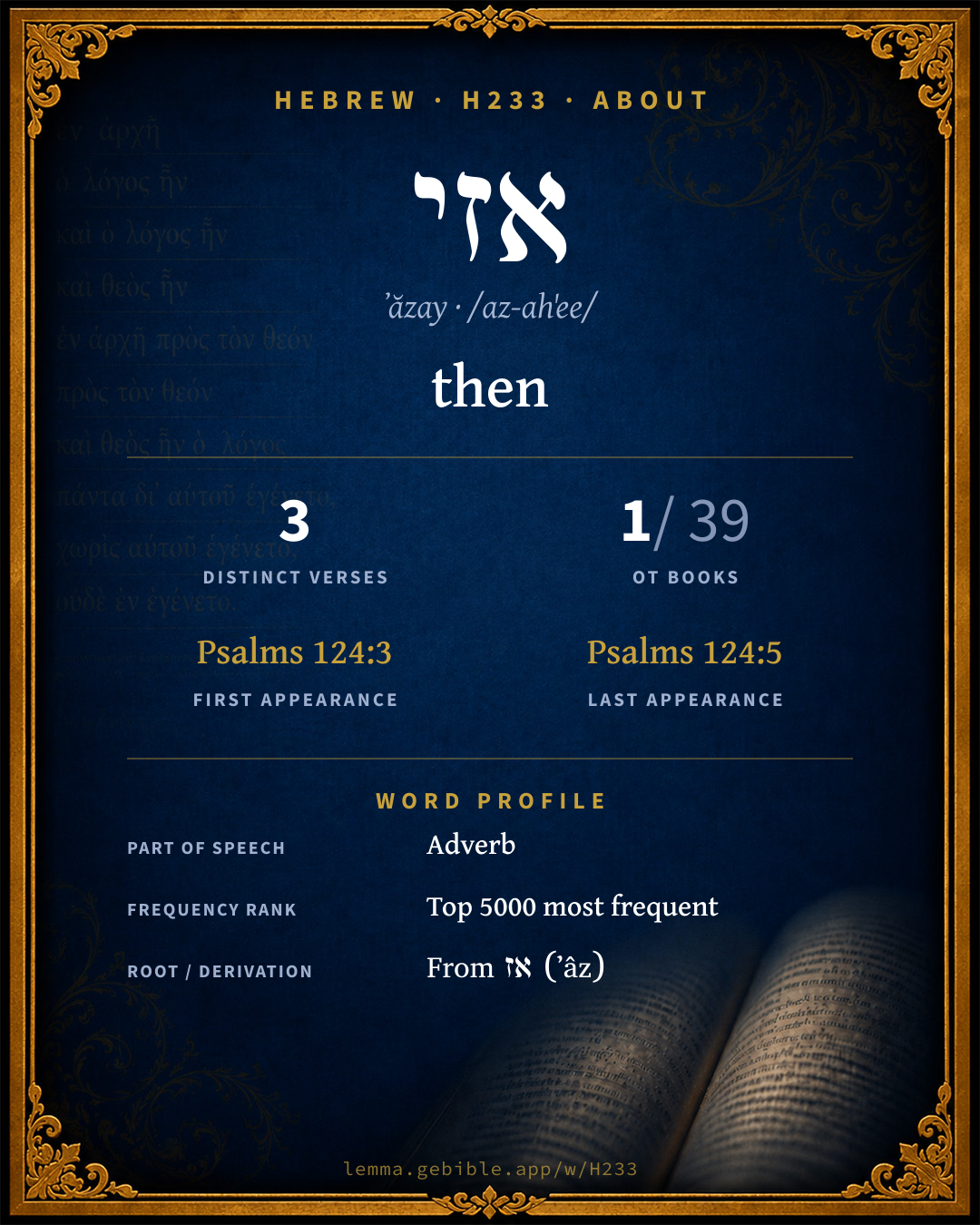
אֲזַי
then
Full lexicon entry — Brown-Driver-Briggs (BDB)
From Brown-Driver-Briggs (BDB)
Where this word appears
Grammar key — what these labels mean
Part of speech
- Adverb
- A word that modifies a verb, adjective, or other adverb.
Every verse where H233 appears — 3 distinct verses across 1 book. Click any verse to open its interlinear word-by-word view. Verse text shown in the World English Bible for context — . Each verse’s Hebrew form is shown with its reference; the English is not keyword-highlighted, since the data carries no word-level English alignment. Use “Compare translations” on any verse to read it across multiple English versions. This concordance covers the Hebrew Bible; Septuagint (Greek Old Testament) occurrences are not indexed here.
Psalms 3 verses
About this entry
At a glance — auto-summarized from this page’s data, not written by a person. Every figure links to its source below. This summary describes the numbers; it doesn’t interpret them.
אזי (ʼăzay) is a Hebrew verb most often rendered “then.” It occurs a mere 3 verses across Scripture. Psalms dominates its distribution — 3 of 3 verses. Debuting at Psalms 124:3, it then recurs through the corpus. For the data behind this summary, explore the sense tree and the renderings breakdown below.
Gloss history
Strong's 1890 vs modern scholarship
About this word
Strong's H233 catalogs a Hebrew word from the Hebrew Old Testament.
These counts are not copied from any lexicon or concordance. They are computed here, from the morphology-tagged Hebrew Old Testament. What Lemma adds →
- 3
- distinct verses
- The word appears in 3 distinct verses.
- 1 / 39
- OT books
- The word appears in 1 of 39 Old Testament books.
- #4,179
- by frequency
- Top 5000 most frequent Hebrew words (rank 4,179 of 8,640 Hebrew words by occurrence).
View all 3 occurrences in the concordance →
Most concentrated in
- Psalms 3 verses 100%
By section of the Old Testament
By traditional corpus
Conventional, traditional groupings — biblical authorship is debated, so this is a traditional corpus grouping, not an authorship claim. Each share is this word’s portion of its verses in that division of the Hebrew canon. Each figure is a share of the word’s 3 distinct verses.
- Writings (Ketuvim) 3 verses · 100%
How translations render this word
Counts come from each version’s own published word-to-Strong’s tagging or interlinear alignment — an approximate guide to how each version renders this word, not a word-level alignment the data otherwise carries. Because each total is that version’s own tagged count, the per-version totals vary from one another and need not match the appearance or distinct-verse counts above. These counts may also differ from a printed concordance because Lemma counts each distinctly tagged rendering and does not collapse phrase taggings into a single head-word total. This is a fixed set of word-tagged versions (KJV, ASV, BSB, ULT) and does not change with the reading translation you choose elsewhere. Each version’s license is shown beside its name below (and on Sources).
BDB lists this Strong’s number as 2 distinct words (homographs). Each count above pools all of them and is not split by sense — see the Senses section below. A low-frequency rendering may belong to a different one of those words, not the primary meaning.
- King James Version†: Then 3×
- American Standard Version†: Then 3×
- Berean Standard Bible†: Then 3×
- unfoldingWord Literal Text†: Then 3×
King James Version Public Domain
Renders H233 across 3† tagged occurrences — most commonly:
American Standard Version Public Domain
Renders H233 across 3† tagged occurrences — most commonly:
Berean Standard Bible Public Domain
Renders H233 across 3† tagged occurrences — most commonly:
unfoldingWord Literal Text CC BY-SA 4.0
Renders H233 across 3† tagged occurrences — most commonly:
Senses in the full BDB
What do BDB’s symbols mean?
BDB uses these scholarly abbreviations:
| Symbol | Meaning |
|---|---|
| 𝔊 | the Septuagint (the ancient Greek translation, LXX) |
| 𝔙 | the Vulgate (the Latin translation) |
| 𝔖 | the Syriac version (the Peshitta) |
| 𝔗 | the Targum (the Aramaic translation) |
| ψ | the Psalms |
| √ | root (the underlying root or stem) |
| ‖ | parallel passage (a synonymous or contrasted parallel) |
| † | the dagger: every passage where the word occurs is cited |
The 6 senses and sub-senses the full Brown-Driver-Briggs lexicon distinguishes for this word, in lexicon order (not ranked by frequency), with BDB’s own verbatim wording and sub-sense lettering. Shown in Hebrew script with BDB’s own scholarly abbreviations. The condensed entry is in the Lexicon Entry tab.
אזי I (cf. إِذًا, ࠀࠃ
- 1. strictly temporal:
- a. of past time:—without a verb Gn 12:6; 13:7 Jos 14:11 2 S 23:14; with a pf. Gn 4:26 Ex 4:26 Jos 10:33 Ju 8:3; 13:21 Je 22:15 אָז טוֹב לוֹ then was it well to him (cf. v 16 Ho 2:9); more usually (especially when = thereupon) with an impf. (v. Dr§ 27) Ex 15:1 Nu 21:17 Jos 8:30: 10:12; 22:1 1 K 3:16; 8:1; 9:11 (v. DrIntr. 192) al. e.g. Genesis 12:6
- b. of fut. time (usually where some emph. is intended), with impf. Is 35:5, 6; 60:5 Mi 3:4, rather differently Lv 26:41 1 S 20:12; rarely with pf. 2 S 5:24b (will have gone forth) Is 33:23: with an accompanying logical force, implying the fulfilment of a condition, then = if or when this has been done (with the impf.) Gn 24:41 Ex 12:44, 48 Dt 29:19 Jos 1:8 1 S 6:3 Is 58:8, 9 Je 11:15 Hi Ke ψ 19:14; 51:21 Pr 3:23 Jb 11:15; 13:20; 22:26. e.g. Isaiah 35:5
- c. in poetry אז is sometimes used to throw emphasis on a particular feature of the description Gn 49:4 Ex 15:15 Ju 5:8, 11, 13, 19, 22 Is 33:23; 41:1 Hb 1:11 ψ 2:5; 96:12. e.g. Genesis 49:4
- d. it points back with emphasis to an inf. with בּ 2 S 5:24a ψ 126:2(×2) Jb 28:27; 33:16; to בַּיּוֹם הַהוּא (anomalously) 1 Ch 16:7. e.g. 2 Samuel 5:24
- 2. expressing logical sequence strictly: in the apod.:—after אם (rare) for sake of special emphasis Is 58:14 Pr 2:5 Jb 9:31; = in that case, after לוּ or לוּלֵא 2 S 2:27 hadst thou not spoken, כִּי אָז surely then had the people, etc. 19:7 ψ 119:92; after אחלי 2 K 5:3 ψ 119:6; after a suppressed protasis 2 K 13:19 Jb 3:13 יָשַׁנְתִּי יָנוּחַ לִי I had slept, then were there rest for me; Jos 22:31 (strangely) = now, as things are; Ec 2:15 = that being so. (122 times besides מאז and מן־אז. Seldom used except where some special emphasis is desired. ‘Then’ of AV RV more commonly represents וְ, especially in the apodosis.) e.g. Isaiah 58:14
אזי II = אָז (prob. a dialectic form
Senses from the full Brown-Driver-Briggs lexicon (Brown, Driver, Briggs; Oxford 1906 — public domain), digitized via Sefaria, supplemented by the OpenScriptures HebrewLexicon (CC BY 4.0). Full attribution on Sources.
Word origin
I. adv. (cf. إِذًا, ࠀࠃ: also Biblical Aramaic אֱדַיִן, proposes a subst. = time: see מֵאָז) at that time, then, whether expressing duration, or inception (= thereupon).
I. = אָז (prob. a dialectic form; cf. Aramaic אֱדַיִן) then, in that case ψ 124:3, 4, 5, in apod. after לוּלֵי: cf. אָז ψ 119:92.
— Brown-Driver-Briggs (Oxford 1906, public domain), digitized via Sefaria, supplemented by the OpenScriptures HebrewLexicon (CC BY 4.0). See Sources.
Derived from אז (ʼâz) (H227) — then.
Jastrow Dictionary
A second Hebrew/Aramaic lexicon for comparison, covering Aramaic and post-biblical (Talmudic, Targumic, Midrashic) usage that the biblical-Hebrew BDB does not. Matched by lemma rather than by Strong’s number, so a lemma may carry more than one Jastrow headword (shown separately below), and the entries cover usage well beyond the Bible.
אֲזִי
- (= אַזְעִי, v. אוּדְיָיתָא a. זִיעַ)to heat (make steam). Dan. III, 19; 22.—Targ. Is. XXXIII, 4 וַאֲזַן (Regia אֵיזִין) and they shall heat (baths, ovens) therewith (h. text מַשַּׂק = מַשַּׁק), v. זִירְקְתָא; (cmp. Ezek. XXXIX, 9). Ib. XLIV, 15 (for baking); a. e.—Y. Ter. VIII, end, 46ᶜ a bath house דאזייה וכ׳ which he had heated for seven days. Koh. R. to II, 8; a. e. דהוון אָזְיִין בהון that entertained the fires in them.—Lev. R. s. 28, end ועל מזגיה וקנחיה (read ואַזְּיֵיה Pa.) and he (Haman) went and made him sweat and cleansed him (with the scraper). e.g. Daniel 3:19
- (contr. of אתאזי) to be heated. Gen. R. s. 63 קלוון אנא דיִתְּזוּן וכ׳ I command that the bath-houses be heated. Ib. אזלון ואִתְּזוּן they went off, and the bath-houses were heated (some ed. דְּיִחֲמוּן a. אַחְמוּן).
A Dictionary of the Targumim, the Talmud Babli and Yerushalmi, and the Midrashic Literature (Marcus Jastrow; London, Luzac, 1903) — Public Domain. Digitized via Sefaria. Digitized via Sefaria. Full attribution on Sources.
Septuagint verse parallels
This word appears in 3 verses that also exist in the Greek Old Testament (Septuagint), out of the 3 Hebrew verses it occurs in. You can read those verses in Greek by switching the Old Testament edition to the Septuagint.
Read these verses in the Septuagint
This is a verse-level parallel only — the same verses exist in both the Hebrew and Greek Old Testaments. No word-level Hebrew↔Greek correspondence is claimed: the data carries no such alignment, so no Greek word is shown as this Hebrew word’s translation. Coverage is not total — the Septuagint omits the deuterocanon and renumbers the Psalms, so some Hebrew verses have no direct Greek parallel.