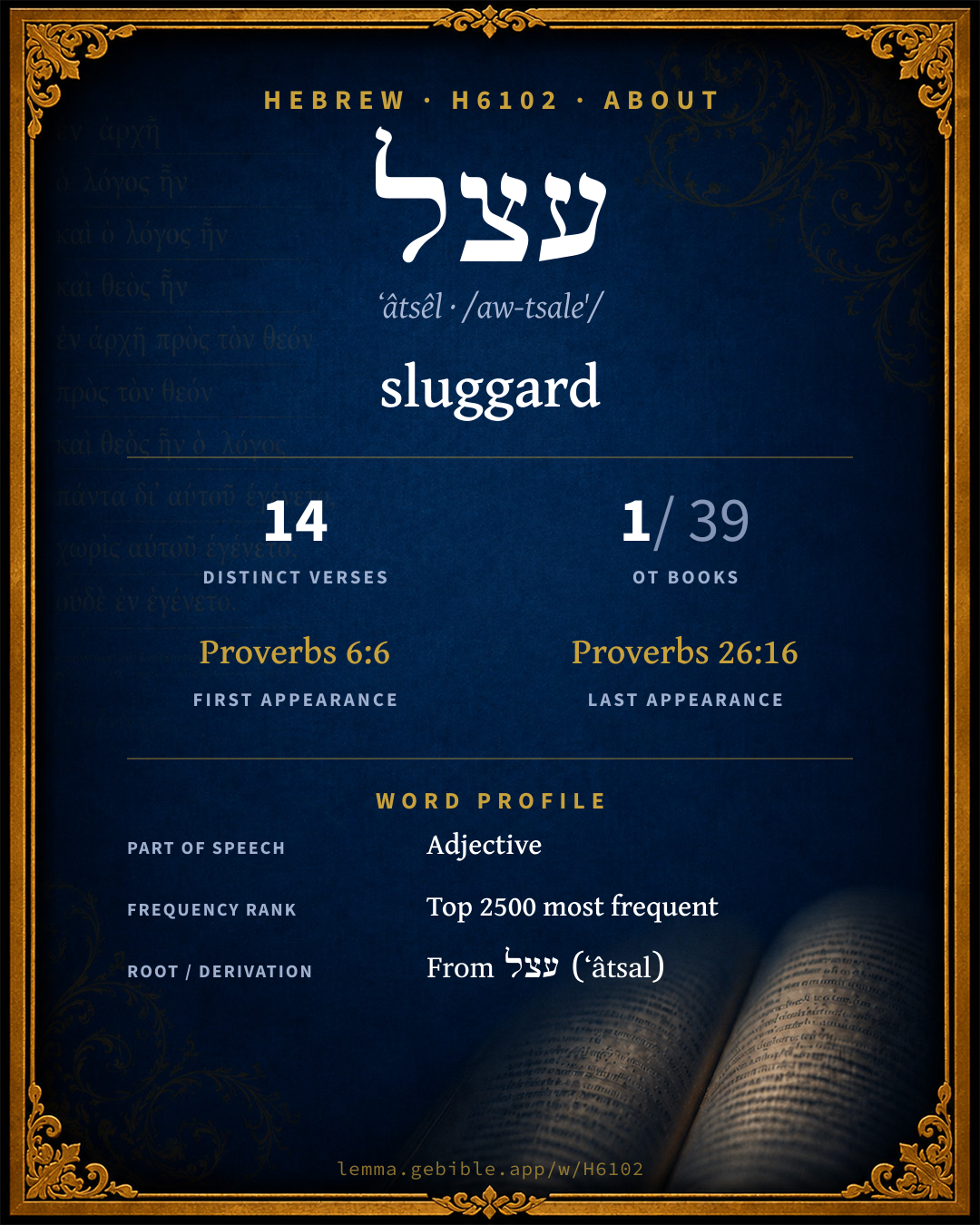
עָצֵל
sluggard
‘sluggard’ is one of 2 main senses fuller range ↓
Full lexicon entry — Brown-Driver-Briggs (BDB)
From Brown-Driver-Briggs (BDB)
Where this word appears
Grammar key — what these labels mean
Part of speech
- Adjective
- A word that describes or qualifies a noun.
State
- Absolute
- The independent form of a noun, not bound to a following word.
Gender
- Masculine
- Grammatically masculine.
Number
- Singular
- One.
Every verse where H6102 appears — 14 distinct verses across 1 book. Click any verse to open its interlinear word-by-word view. Verse text shown in the World English Bible for context — . Each verse’s Hebrew form is shown with its reference; the English is not keyword-highlighted, since the data carries no word-level English alignment. Use “Compare translations” on any verse to read it across multiple English versions. This concordance covers the Hebrew Bible; Septuagint (Greek Old Testament) occurrences are not indexed here.
Proverbs 14 verses
- Proverbs 6:6 עָצֵ֑ל adj Adjective ms Go to the ant, you sluggard. Consider her ways, and be wise;
- Proverbs 6:9 עָצֵ֥ל adj Adjective ms How long will you sleep, sluggard? When will you arise out of your sleep?
- Proverbs 10:26 הֶ֝/עָצֵ֗ל ptcl def.art + Adjective Adjective ms As vinegar to the teeth, and as smoke to the eyes, So is the sluggard to those who send him.
- Proverbs 13:4 עָצֵ֑ל adj Adjective ms The soul of the sluggard desires, and has nothing, But the desire of the diligent shall be fully satisfied.
- Proverbs 15:19 עָ֭צֵל adj Adjective ms The way of the sluggard is like a thorn patch, But the path of the upright is a highway.
- Proverbs 19:24 עָצֵ֣ל adj Adjective ms The sluggard buries his hand in the dish; He will not so much as bring it to his mouth again.
- Proverbs 20:4 עָצֵ֣ל adj Adjective ms The sluggard will not plow by reason of the winter; Therefore he shall beg in harvest, and have nothing.
- Proverbs 21:25 עָצֵ֣ל adj Adjective ms The desire of the sluggard kills him, For his hands refuse to labor.
- Proverbs 22:13 עָ֭צֵל adj Adjective ms The sluggard says, "There is a lion outside! I will be killed in the streets!"
- Proverbs 24:30 עָצֵ֣ל adj Adjective ms I went by the field of the sluggard, By the vineyard of the man void of understanding;
- Proverbs 26:13 עָ֭צֵל adj Adjective ms The sluggard says, "There is a lion in the road! A fierce lion roams the streets!"
- Proverbs 26:14 וְ֝/עָצֵ֗ל conj + Adjective Adjective ms As the door turns on its hinges, So does the sluggard on his bed.
- Proverbs 26:15 עָצֵ֣ל adj Adjective ms The sluggard buries his hand in the dish. He is too lazy to bring it back to his mouth.
- Proverbs 26:16 עָצֵ֣ל adj Adjective ms The sluggard is wiser in his own eyes Than seven men who answer with discretion.
About this entry
At a glance — auto-summarized from this page’s data, not written by a person. Every figure links to its source below. This summary describes the numbers; it doesn’t interpret them.
At its core, עצל (ʻâtsêl) means “sluggard.” The word gravitates to Proverbs (100%). It appears 14 verses across 1 book of the Hebrew Bible, among its uncommon vocabulary. Not a single-sense word: explore its full sense range. Older and newer Bibles part ways — “slothful” in the King James Version, “slacker” (Berean Standard Bible) and “lazy one” (unfoldingWord Literal Text) in modern versions. See the renderings breakdown. Each statement above links to its evidence; the full detail follows below.
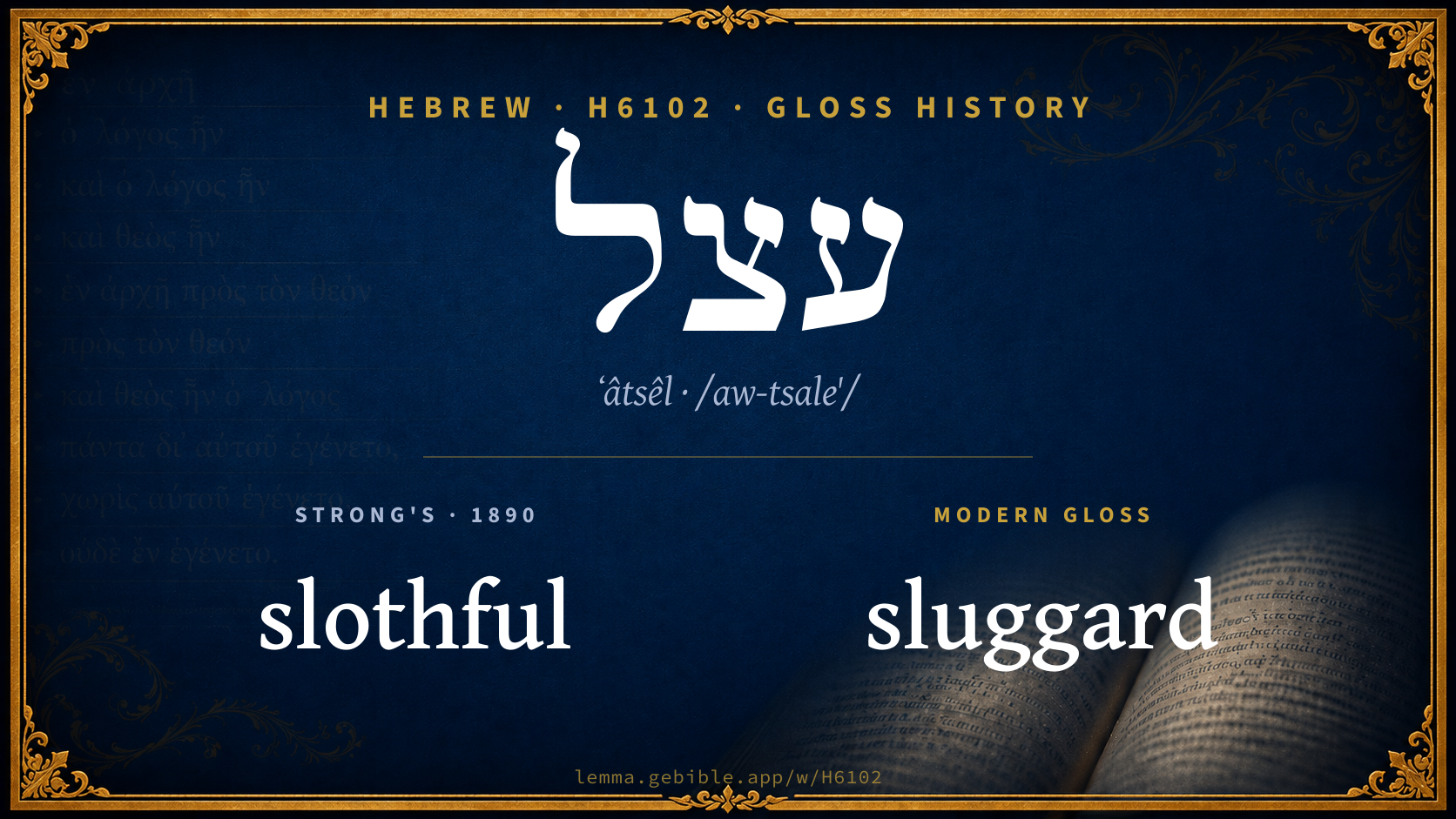
Gloss history
Strong's 1890 vs modern scholarship
About this word
Strong's H6102 catalogs a Hebrew word from the Hebrew Old Testament.
These counts are not copied from any lexicon or concordance. They are computed here, from the morphology-tagged Hebrew Old Testament. What Lemma adds →
- 14
- distinct verses
- The word appears in 14 distinct verses.
- 1 / 39
- OT books
- The word appears in 1 of 39 Old Testament books.
- #1,910
- by frequency
- Top 2500 most frequent Hebrew words (rank 1,910 of 8,640 Hebrew words by occurrence).
View all 14 occurrences in the concordance →
Most concentrated in
- Proverbs 14 verses 100%
By section of the Old Testament
By traditional corpus
Conventional, traditional groupings — biblical authorship is debated, so this is a traditional corpus grouping, not an authorship claim. Each share is this word’s portion of its verses in that division of the Hebrew canon. Each figure is a share of the word’s 14 distinct verses.
- Writings (Ketuvim) 14 verses · 100%
How translations render this word
Counts come from each version’s own published word-to-Strong’s tagging or interlinear alignment — an approximate guide to how each version renders this word, not a word-level alignment the data otherwise carries. Because each total is that version’s own tagged count, the per-version totals vary from one another and need not match the appearance or distinct-verse counts above. These counts may also differ from a printed concordance because Lemma counts each distinctly tagged rendering and does not collapse phrase taggings into a single head-word total. This is a fixed set of word-tagged versions (KJV, ASV, BSB, ULT) and does not change with the reading translation you choose elsewhere. Each version’s license is shown beside its name below (and on Sources).
BDB lists this Strong’s number as 2 distinct words (homographs). Each count above pools all of them and is not split by sense — see the Senses section below. A low-frequency rendering may belong to a different one of those words, not the primary meaning.
- King James Version†: Slothful 6×, Sluggard 4×
- American Standard Version†: Sluggard 10×
- Berean Standard Bible†: Slacker 13×
- unfoldingWord Literal Text†: Lazy one 7×, Lazy 6×, One 4×
King James Version Public Domain
Renders H6102 across 13† tagged occurrences — most commonly:
Plus 3 renderings that appear only once — usually multi-word phrases or single function words the recovered tagging swept in, not distinct renderings. Not rendered by a distinct English word in 1 further occurrence.
American Standard Version Public Domain
Renders H6102 across 13† tagged occurrences — most commonly:
Plus 3 renderings that appear only once — usually multi-word phrases or single function words the recovered tagging swept in, not distinct renderings.
Berean Standard Bible Public Domain
Renders H6102 across 13† tagged occurrences — most commonly:
Not rendered by a distinct English word in 1 further occurrence.
unfoldingWord Literal Text CC BY-SA 4.0
Renders H6102 across 18† tagged occurrences — most commonly:
Plus 1 rendering that appears only once — usually multi-word phrases or single function words the recovered tagging swept in, not distinct renderings.
Senses in the full BDB
What do BDB’s symbols mean?
BDB uses these scholarly abbreviations:
| Symbol | Meaning |
|---|---|
| 𝔊 | the Septuagint (the ancient Greek translation, LXX) |
| 𝔙 | the Vulgate (the Latin translation) |
| 𝔖 | the Syriac version (the Peshitta) |
| 𝔗 | the Targum (the Aramaic translation) |
| ψ | the Psalms |
| √ | root (the underlying root or stem) |
| ‖ | parallel passage (a synonymous or contrasted parallel) |
| † | the dagger: every passage where the word occurs is cited |
The 1 sense the full Brown-Driver-Briggs lexicon distinguishes for this word, in lexicon order (not ranked by frequency), with BDB’s own verbatim wording and sub-sense lettering. Shown in Hebrew script with BDB’s own scholarly abbreviations. The condensed entry is in the Lexicon Entry tab. See also the Forms in the corpus table below.
עצל I
Niphal
- be sluggish (NH in der. species, and deriv.; cf. Arabic عَظِلَ iii. stick fast in coitu, Lane2086; Syriac ܥܛܶܠ be stupid);—Impf. 2 mpl. אַל־תֵּעָֽצְלוּ לָלֶכֶת Ju 18:9 be not sluggish in going. e.g. Judges 18:9
עצל II sluggish, lazy
Senses from the full Brown-Driver-Briggs lexicon (Brown, Driver, Briggs; Oxford 1906 — public domain), digitized via Sefaria, supplemented by the OpenScriptures HebrewLexicon (CC BY 4.0). Full attribution on Sources.
Word origin
adj. sluggish, lazy;—always ע׳ abs.;—אִישׁ־ע׳ Pr 24:30; elsewhere subst. sluggard Pr 6:6, 9 + 10 times Pr + הֶע׳ 10:26.
— Brown-Driver-Briggs (Oxford 1906, public domain), digitized via Sefaria, supplemented by the OpenScriptures HebrewLexicon (CC BY 4.0). See Sources.
Derived from עצל (ʻâtsal) (H6101) — to be sluggish.
Jastrow Dictionary
A second Hebrew/Aramaic lexicon for comparison, covering Aramaic and post-biblical (Talmudic, Targumic, Midrashic) usage that the biblical-Hebrew BDB does not. Matched by lemma rather than by Strong’s number, so a lemma may carry more than one Jastrow headword (shown separately below), and the entries cover usage well beyond the Bible.
עָצַל
- , Hithpa. הִתְעַצֵּל, Nithpa. נִתְעַצֵּל (b. h. Nif.; v. עָצֵל; cmp. b. h. אצל) to withdraw one’s self, shirk the trouble of; to be careless, slothful; to consider one’s self exempt. Tam. II, 2 מימיו לא נ׳ הכהן מלהוציא וכ׳ never did a priest shirk the labor of carrying out the ashes. Lev. R. s. 19 (ref. to בעצלתים, Koh. X, 18) ע"י שהאדם הזה מִתְעַצֵּל מלכסות וכ׳ because that man considers himself exempt from covering his head as it is proper to do, he contracts rheumatism; ע"י שהאשה הזו מִתְעַצֶּלֶת וכ׳ because that woman is too careless (of chastity) to cover herself &c. Ib. ע"י שנִתְעַצְּלוּ … מלחנות וכ׳ because the Israelites shrank from encamping in discord. Y. B. Kam. IX, end, 7ᵃ נתעצלו ולא הקריבוהו they were slothful and failed to offer it up; a. fr. e.g. Ecclesiastes 10:18
עֲצַל
- , ch.,Ithpa. אִיעַצֵּל same. Pes. 85ᵃ דאתי לאִיעַצּוּלֵי ביה (not לעיצולי) one might be slothful about it (and fail to use the sacrifice up in due time).
עָצֵל
- [standing aside,] slow; sluggard; lazy. Deut. R. s. 5 מה ראה … ללמד לע׳ וכ׳ what reason had Solomon to make the sluggard learn from the ant (Prov. VI, 6)?; a. e.—Pl. עֲצֵלִים, עֲצֵלִין, עֲצֵי׳. Pes. 85ᵃ עֲצֵלֵי כהונה the negligent among the priests (opp. זָהִיר); a. e.—Fem. עֲצֵלָה; pl. עֲצֵלוֹת, עֲצֵי׳. Y. ib. I, 27ᶜ bot. הנשים ע׳ הן women are slow (opp. זריז). e.g. Proverbs 6:6
A Dictionary of the Targumim, the Talmud Babli and Yerushalmi, and the Midrashic Literature (Marcus Jastrow; London, Luzac, 1903) — Public Domain. Digitized via Sefaria. Digitized via Sefaria. Full attribution on Sources.
Forms in the corpus
The 6 distinct written forms H6102 takes in the Hebrew Bible, most frequent first — each parse links to that state’s occurrences in the concordance. Hebrew forms include their vowel points and cantillation, so a single lemma takes many written forms.
| Form | Parsing | Example | Uses |
|---|---|---|---|
| עָצֵ֣ל | Adjective, Adjective, Masculine, Singular, Absolute | Proverbs 19:24 | 6 |
| עָ֭צֵל | Adjective, Adjective, Masculine, Singular, Absolute | Proverbs 15:19 | 3 |
| עָצֵ֑ל | Adjective, Adjective, Masculine, Singular, Absolute | Proverbs 6:6 | 2 |
| הֶ֝/עָצֵ֗ל | Adjective, Adjective, Masculine, Singular, Absolute | Proverbs 10:26 | 1 |
| וְ֝/עָצֵ֗ל | Adjective, Adjective, Masculine, Singular, Absolute | Proverbs 26:14 | 1 |
| עָצֵ֥ל | Adjective, Adjective, Masculine, Singular, Absolute | Proverbs 6:9 | 1 |
Same root — word family
Other BDB entries built from the same root as H6102, grouped by Strong’s listed origin. These share a root / origin per the lexicon — not necessarily a shared meaning. Each links to that word’s own entry.
Derives from
Shares the same root
Derived from this word
Compare all same-root words → They share a root, not necessarily a meaning.
Septuagint verse parallels
This word appears in 14 verses that also exist in the Greek Old Testament (Septuagint), out of the 14 Hebrew verses it occurs in. You can read those verses in Greek by switching the Old Testament edition to the Septuagint.
Read these verses in the Septuagint
This is a verse-level parallel only — the same verses exist in both the Hebrew and Greek Old Testaments. No word-level Hebrew↔Greek correspondence is claimed: the data carries no such alignment, so no Greek word is shown as this Hebrew word’s translation. Coverage is not total — the Septuagint omits the deuterocanon and renumbers the Psalms, so some Hebrew verses have no direct Greek parallel.