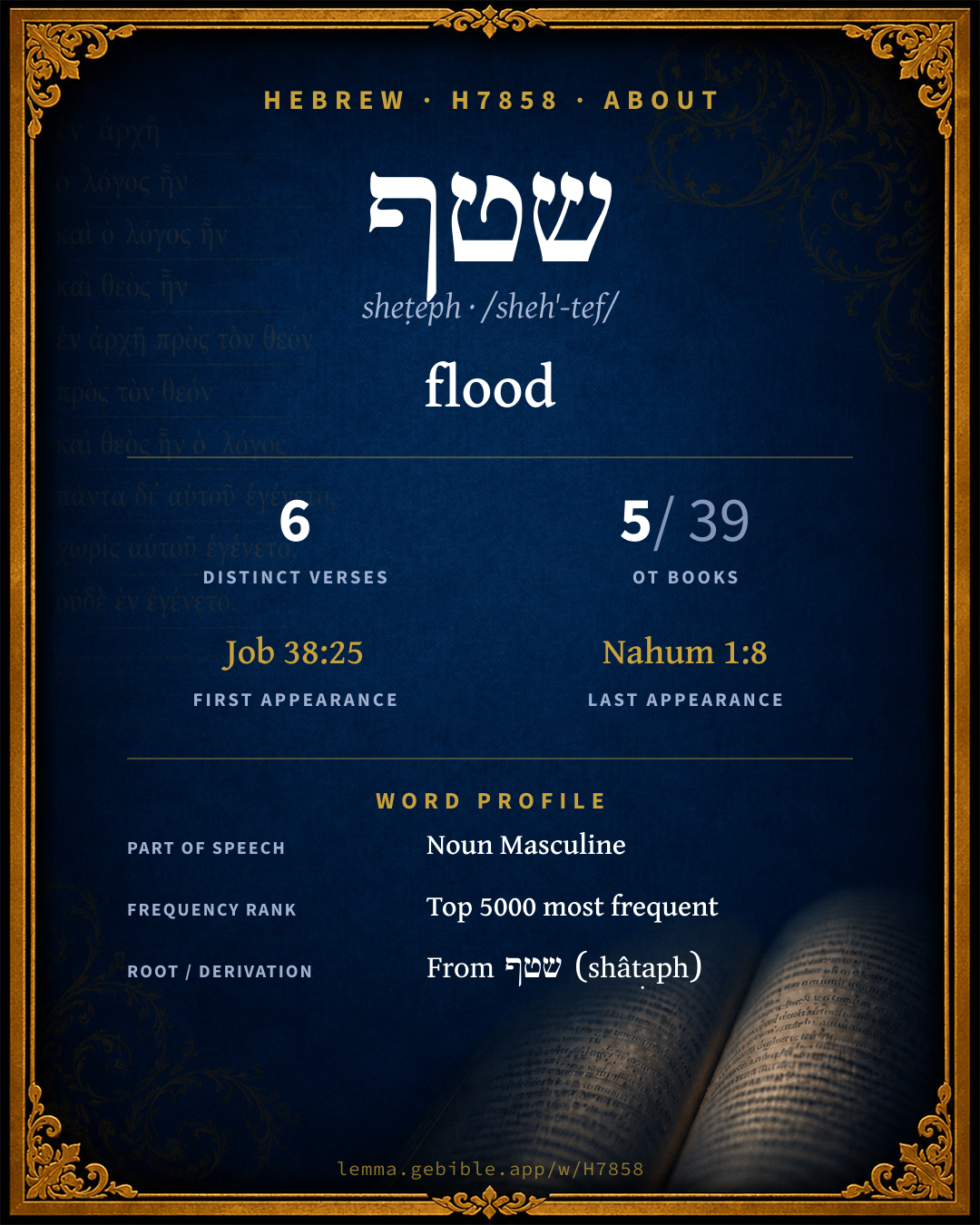
שֶׁ֫טֶף
flood
Full lexicon entry — Brown-Driver-Briggs (BDB)
From Brown-Driver-Briggs (BDB)
Where this word appears
See every Absolute-state word in the Hebrew Bible →
Grammar key — what these labels mean
Noun type
- Common
- A common noun — a general class of person, place, or thing (“king,” “city,” “water”), not a specific name.
State
- Absolute
- The independent form of a noun, not bound to a following word.
- Construct
- A noun bound to a following noun in a possessive / “of” relationship (the construct chain).
Gender
- Masculine
- Grammatically masculine.
Number
- Singular
- One.
Grammatical forms
- Noun, Common, Masculine, Singular, Absolute 4 times (67%)
- Noun, Common, Masculine, Singular, Construct 2 times (33%)
Parsed forms decoded from the imported morphology (morphhb / Westminster Leningrad Codex — WLC text public domain, morphhb tagging CC BY 4.0), counted across 6 parsed occurrences — not distinct verses.
Every verse where H7858 appears — 6 distinct verses across 5 books. Click any verse to open its interlinear word-by-word view. Verse text shown in the World English Bible for context — . Each verse’s Hebrew form is shown with its reference; the English is not keyword-highlighted, since the data carries no word-level English alignment. Use “Compare translations” on any verse to read it across multiple English versions. This concordance covers the Hebrew Bible; Septuagint (Greek Old Testament) occurrences are not indexed here.
Job 1 verse
Psalms 1 verse
Proverbs 1 verse
Daniel 2 verses
- Daniel 9:26 בַ/שֶּׁ֔טֶף prep det + n c ms After the sixty-two weeks the Anointed One shall be cut off, and shall have nothing: and the people of the prince who shall come shall destroy the city and the sanctuary; and the end of it shall be with a flood, and even to the end shall be war; desolations are determined.
- Daniel 11:22 הַ/שֶּׁ֛טֶף ptcl def.art + n c ms The overwhelming forces shall be overwhelmed from before him, and shall be broken; yes, also the prince of the covenant.
Nahum 1 verse
About this entry
At a glance — auto-summarized from this page’s data, not written by a person. Every figure links to its source below. This summary describes the numbers; it doesn’t interpret them.
The Hebrew noun שטף centers on the idea of “flood.” First canonically at Job 38:25, it enters the text early. It turns up in 6 verses across 5 books, an uncommon footprint. The word gravitates to Daniel (33%), then Job and Psalms. It clusters with שטף and שצף under a shared root. For the data behind this summary, explore the sense tree and the renderings breakdown below.
Gloss history
Strong's 1890 vs modern scholarship
About this word
Strong's H7858 catalogs a Hebrew word from the Hebrew Old Testament.
These counts are not copied from any lexicon or concordance. They are computed here, from the morphology-tagged Hebrew Old Testament. What Lemma adds →
- 6
- distinct verses
- The word appears in 6 distinct verses.
- 5 / 39
- OT books
- The word appears in 5 of 39 Old Testament books.
- #3,040
- by frequency
- Top 5000 most frequent Hebrew words (rank 3,040 of 8,640 Hebrew words by occurrence).
View all 6 occurrences in the concordance →
By section of the Old Testament
By traditional corpus
Conventional, traditional groupings — biblical authorship is debated, so this is a traditional corpus grouping, not an authorship claim. Each share is this word’s portion of its verses in that division of the Hebrew canon. Each figure is a share of the word’s 6 distinct verses.
- Writings (Ketuvim) 5 verses · 83%
- Prophets (Nevi'im) 1 verse · 17%
How translations render this word
Counts come from each version’s own published word-to-Strong’s tagging or interlinear alignment — an approximate guide to how each version renders this word, not a word-level alignment the data otherwise carries. Because each total is that version’s own tagged count, the per-version totals vary from one another and need not match the appearance or distinct-verse counts above. These counts may also differ from a printed concordance because Lemma counts each distinctly tagged rendering and does not collapse phrase taggings into a single head-word total. This is a fixed set of word-tagged versions (KJV, ASV, BSB, ULT) and does not change with the reading translation you choose elsewhere. Each version’s license is shown beside its name below (and on Sources).
- King James Version: Flood 2×
- American Standard Version: Flood 1×, Is overwhelming 1×, Overflow 1×
- Berean Standard Bible: Flood 3×
- unfoldingWord Literal Text: Flood of 2×
King James Version Public Domain
Renders H7858 across 6 tagged occurrences — most commonly:
Plus 4 renderings that appear only once — usually multi-word phrases or single function words the recovered tagging swept in, not distinct renderings.
American Standard Version Public Domain
Renders H7858 across 6 tagged occurrences — most commonly:
Berean Standard Bible Public Domain
Renders H7858 across 6 tagged occurrences — most commonly:
Plus 3 renderings that appear only once — usually multi-word phrases or single function words the recovered tagging swept in, not distinct renderings.
unfoldingWord Literal Text CC BY-SA 4.0
Renders H7858 across 8 tagged occurrences — most commonly:
Plus 6 renderings that appear only once — usually multi-word phrases or single function words the recovered tagging swept in, not distinct renderings.
Senses in BDB
The 1 sense BDB distinguishes for this word, in lexicon order (not ranked by frequency or importance). The full entry — with sub-senses — is in the Lexicon Entry tab.
- flood, downpour
Word origin
Derived from שטף (shâṭaph) (H7857) — to wash.
Jastrow Dictionary
A second Hebrew/Aramaic lexicon for comparison, covering Aramaic and post-biblical (Talmudic, Targumic, Midrashic) usage that the biblical-Hebrew BDB does not. Matched by lemma rather than by Strong’s number, so a lemma may carry more than one Jastrow headword (shown separately below), and the entries cover usage well beyond the Bible.
שָׁטַף
- 1. to wash, rinse. Zeb. XI, 6 (94ᵇ) ושׁוֹטְפוֹ, v. מָרַק; Tosef. ib. X, 13 ושׁוֹטְפָן. Tosef. Ḥull. X, 4 השׁוֹטֵף רחיליו חייב וכ׳ if one washes his lambs (in place of clipping), he is bound to give the priest’s share of the wool (that they shed); Ḥull. 137ᵃ; a. fr.—Part. pass. שָׁטוּף. Sabb. 99ᵃ (ref. to Ex. XXXV, 26) ש׳ בעזים וטווו בעזים Ms. M. (ed. מן העזים) the hair was washed on the goats and spun on the goats; ib. 74ᵇ; Yalk. Ex. 370. e.g. Exodus 35:26
- 2. to flood, carry off, drown. B. Mets. VIII, 5 ש׳ נהר זיתיו וכ׳ if a stream carried off one’s olive-trees and deposited them in a neighbor’s field. B. Kam. X, 4 (115ᵇ) ש׳ נהר חמורו וכ׳ (Bab. ed. נחל) if a stream (ravine) carried off his own and his neighbor’s ass …, and he let go his own and saved his neighbor’s. Ib. 5 (117ᵇ) שְׁטָפָהּ נהר if the river washed it (the unlawfully taken field) away. Yoma 78ᵃ נחל שׁוֹטֵף a swiftly running brook. Y. Shek. I, 46ᵃ ירד שֶׁטֶף … ושְׁטָפוֹ a rain shower came down and washed it (the mark on the grave) off. Y. B. Mets. VIII, end, 11ᵈ בששְׁטָפָן (not בששטן), v. גּוּשׁ. Ex. R. s. 24 נתמלא … ובקש לשׁוֹטְפָן the genius of the sea became wroth against them, and wanted to drown them. Num. R. s. 199 ויצאו מים רבים ושָׁטְפוּ כל וכ׳ many waters came forth, and flooded all those who murmured; Midr. Till. to Ps. LXXVIII, 20 (corr. acc.); a. fr.—V. שָׁטוּף.
- same. Taan. 6ᵃ ומַשְׁטִיף את הזרעים (Ms. M. ששׁוֹטֵף, v. Rabb. D. S. a. l. note) it (the heavy rain) washes the seeds away; Yalk. Joel 535 ומְשַׁטֵּף (Pi.).—Part. pass. מוּשְׁטָף; pl. מוּשְׁטָפִים carried off, floating. Ex. R. l. c. לפי שראו … מ׳ על פני המים because they saw the bodies … floating on the water.
- , Nithpa. נִשְׁתַּטֵּף
- 1. to be washed, showered upon; to take a shower bath. Sabb. 40ᵃ ויוצא ומִשְׁתַּטַּף וכ׳ and goes out (of the steam-room), and takes a shower bath in the outer room. Ib.ᵇ ובלבד שלא יִשְׁתַּטֵּף וכ׳ but he must not have a cold shower bath and then warm himself &c. Tosef. ib. III (IV), 4; a. fr.
- 2. to be swept away, drowned. Sifré Deut. 307 מה ראו … שנִשְׁטְפוּ במים why were the men of the flood drowned in water?; Yalk. ib. 942 שיִשָּׁטְפוּ; Sifré l. c. מה … להִשְׁתַּטֵּף באש וכ׳ why were the men of Sodom … swept away by fire and sulphur?; Yalk. l. c. להִשָּׁטֵף; a. e.—Trnsf. to be carried away by passion. Num. R. s. 917; Sifré Num. 12 הרבה קידמוך ונִשְׁטְפוּ many women before thee have been carried away (into infidelity).
שְׁטֵף
- 1. to wash, rinse. Targ. I Kings XXII, 38. Targ. II Sam. XI, 8; a. e.—Tam. 27ᵇ שְׁטוֹף ושתי שטוף ואחית rinse (the cup) and drink, rinse, and set it down; a. e.
- 2. to overflow, flood, wash away. Targ. Ps. LXXVIII, 20 ישטפון מיא Ms. (omitted in ed.). Targ. Is. XXXIII, 21. Targ. Y. II, Num. XXI, 16. Targ. Ps. CXXIV, 4; a. e.—Naz. 32ᵇ שַׁטְפוּהוּ ובנן וכ׳ the Rabbis carried R. El. away, and made him stand on their principle, i.e. made him give up his opinion and adopt theirs. Succ. 53ᵃ למִשְׁטְפָא וכ׳, v. קְפֵי; a. e.
- to wash. Y. Ber. VIII, 12ᵃ bot. ולא מְשַׁטֵּף ידוי וכ׳ and did not wash his hands up to the joints.
שֶׁטֶף
- 1. flood, shower. Y. Shek. I, 46ᵃ, v. שָׁטַף. Gen. R. s. 73 ש׳ של גשמים a flood caused by rains (brought the rams from Laban’s fold to Jacob’s); Yalk. ib. 130; a. e.—Trnsf. passion, anger. Lev. R. s. 24, beg. בזמן שהוא נותן … שיש ש׳ בדינו when he orders execution (punishment), none praise him, for they know that there is passion in his judgment; Yalk. Ps. 843; Y. Ber. IX, 14ᵇ
- 2. washing, rinsing; כלי ש׳ a vessel which requires only rinsing in order to be restored to Levitical cleanness. Ḥull. 25ᵃ; Zeb. 3ᵇ; a. e.
- 3. wool that is gained by washing. Sifré Deut. 166 (ref. to Deut. XVIII, 4) ראשית גז ולא ראשית הש׳ the first of the wool that is cut, but not the first of the wool that comes out by washing.—4) ש׳ של עזים goat-skin made hairless by washing. Cant. R. to IV, 11; Gen. R. s. 65; Yalk. ib. 115 אין לך … מהש׳ וכ׳ there is no smell more offensive than that of washed goat-skins. e.g. Deuteronomy 18:4
- 5. hair that is fallen out, bald pate. Koh. R. to I, 8 (in enigmatic speech) שִׁיטְפִי מאלל (not שיטפו) my hair is going.
A Dictionary of the Targumim, the Talmud Babli and Yerushalmi, and the Midrashic Literature (Marcus Jastrow; London, Luzac, 1903) — Public Domain. Digitized via Sefaria. Digitized via Sefaria. Full attribution on Sources.
Forms in the corpus
The 6 distinct written forms H7858 takes in the Hebrew Bible, most frequent first — each parse links to that state’s occurrences in the concordance. Hebrew forms include their vowel points and cantillation, so a single lemma takes many written forms.
| Form | Parsing | Example | Uses |
|---|---|---|---|
| בַ/שֶּׁ֔טֶף | Noun, Common, Masculine, Singular, Absolute | Daniel 9:26 | 1 |
| הַ/שֶּׁ֛טֶף | Noun, Common, Masculine, Singular, Absolute | Daniel 11:22 | 1 |
| וְ/שֶׁ֣טֶף | Noun, Common, Masculine, Singular, Construct | Proverbs 27:4 | 1 |
| וּ/בְ/שֶׁ֣טֶף | Noun, Common, Masculine, Singular, Absolute | Nahum 1:8 | 1 |
| לְ֭/שֵׁטֶף | Noun, Common, Masculine, Singular, Construct | Psalms 32:6 | 1 |
| לַ/שֶּׁ֣טֶף | Noun, Common, Masculine, Singular, Absolute | Job 38:25 | 1 |
Same root — word family
Other BDB entries built from the same root as H7858, grouped by Strong’s listed origin. These share a root / origin per the lexicon — not necessarily a shared meaning. Each links to that word’s own entry.
Derives from
Shares the same root
Compare all same-root words → They share a root, not necessarily a meaning.
Septuagint verse parallels
This word appears in 6 verses that also exist in the Greek Old Testament (Septuagint), out of the 6 Hebrew verses it occurs in. You can read those verses in Greek by switching the Old Testament edition to the Septuagint.
Read these verses in the Septuagint
This is a verse-level parallel only — the same verses exist in both the Hebrew and Greek Old Testaments. No word-level Hebrew↔Greek correspondence is claimed: the data carries no such alignment, so no Greek word is shown as this Hebrew word’s translation. Coverage is not total — the Septuagint omits the deuterocanon and renumbers the Psalms, so some Hebrew verses have no direct Greek parallel.