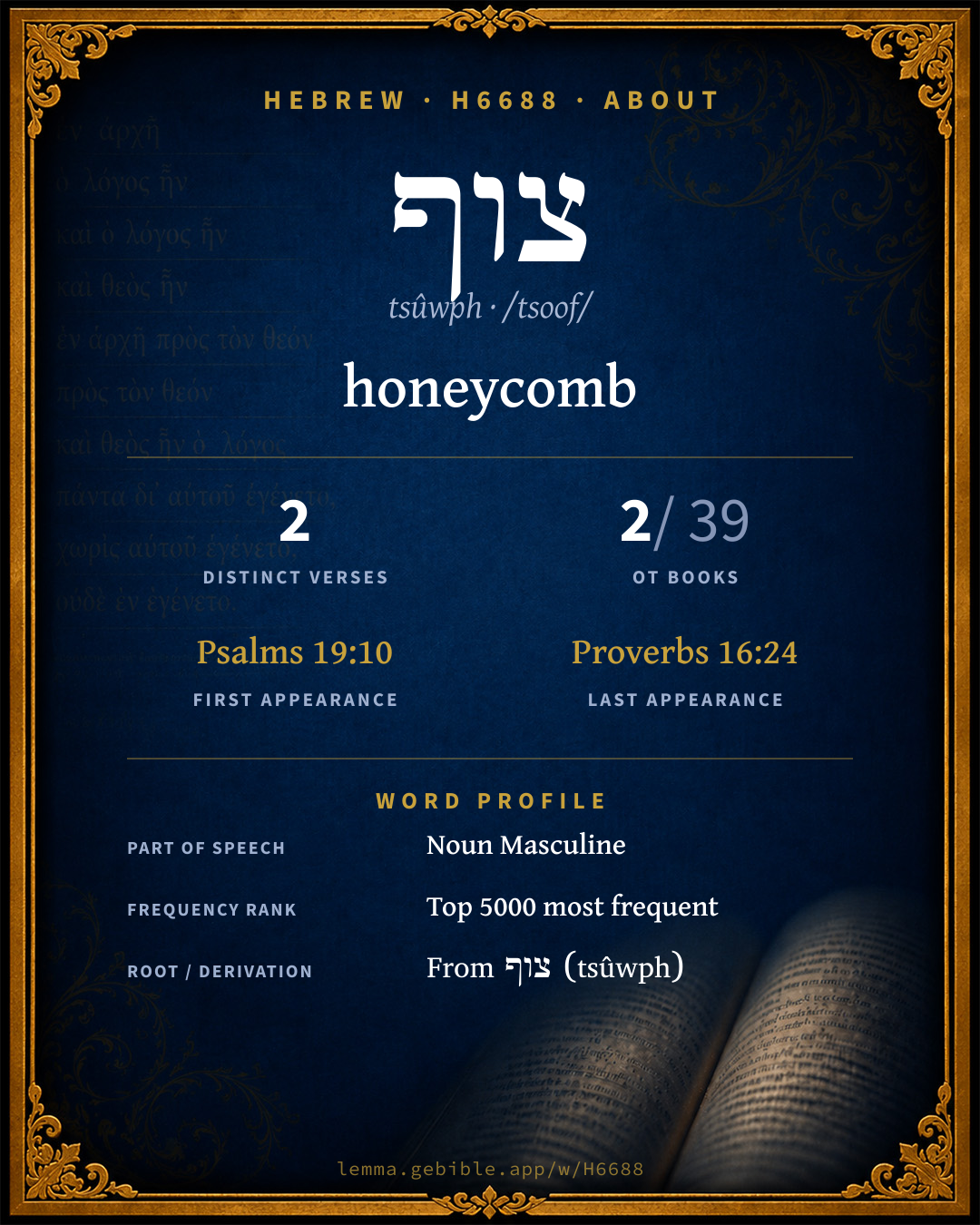
צוּף
honeycomb
Full lexicon entry — Brown-Driver-Briggs (BDB)
From Brown-Driver-Briggs (BDB)
Where this word appears
See every Absolute-state word in the Hebrew Bible →
Grammar key — what these labels mean
Part of speech
- Noun
- A naming word — a person, place, thing, or idea.
Noun type
- Common
- A common noun — a general class of person, place, or thing (“king,” “city,” “water”), not a specific name.
State
- Absolute
- The independent form of a noun, not bound to a following word.
- Construct
- A noun bound to a following noun in a possessive / “of” relationship (the construct chain).
Gender
- Masculine
- Grammatically masculine.
Number
- Plural
- More than one (in Hebrew, generally three or more).
- Singular
- One.
Grammatical forms
- Noun, Common, Masculine, Plural, Absolute 1 time (50%)
- Noun, Common, Masculine, Singular, Construct 1 time (50%)
Parsed forms decoded from the imported morphology (morphhb / Westminster Leningrad Codex — WLC text public domain, morphhb tagging CC BY 4.0), counted across 2 parsed occurrences — not distinct verses.
Every verse where H6688 appears — 2 distinct verses across 2 books. Click any verse to open its interlinear word-by-word view. Verse text shown in the World English Bible for context — . Each verse’s Hebrew form is shown with its reference; the English is not keyword-highlighted, since the data carries no word-level English alignment. Use “Compare translations” on any verse to read it across multiple English versions. This concordance covers the Hebrew Bible; Septuagint (Greek Old Testament) occurrences are not indexed here.
Psalms 1 verse
Proverbs 1 verse
About this entry
At a glance — auto-summarized from this page’s data, not written by a person. Every figure links to its source below. This summary describes the numbers; it doesn’t interpret them.
צוף — transliterated tsûwph — is a Hebrew noun carrying the sense “honeycomb.” A scarce word — 2 verses in all of the Hebrew Bible. Its uses cluster heavily in Psalms (50% of all occurrences). Its earliest occurrence is Psalms 19:10. Sharing its root, it stands alongside צוף, צפצפה and צוף. Each statement above links to its evidence; the full detail follows below.
Gloss history
Strong's 1890 vs modern scholarship
About this word
Strong's H6688 catalogs a Hebrew word from the Hebrew Old Testament.
These counts are not copied from any lexicon or concordance. They are computed here, from the morphology-tagged Hebrew Old Testament. What Lemma adds →
- 2
- distinct verses
- The word appears in 2 distinct verses.
- 2 / 39
- OT books
- The word appears in 2 of 39 Old Testament books.
- #4,807
- by frequency
- Top 5000 most frequent Hebrew words (rank 4,807 of 8,640 Hebrew words by occurrence).
View all 2 occurrences in the concordance →
By traditional corpus
Conventional, traditional groupings — biblical authorship is debated, so this is a traditional corpus grouping, not an authorship claim. Each share is this word’s portion of its verses in that division of the Hebrew canon. Each figure is a share of the word’s 2 distinct verses.
- Writings (Ketuvim) 2 verses · 100%
How translations render this word
Counts come from each version’s own published word-to-Strong’s tagging or interlinear alignment — an approximate guide to how each version renders this word, not a word-level alignment the data otherwise carries. Because each total is that version’s own tagged count, the per-version totals vary from one another and need not match the appearance or distinct-verse counts above. These counts may also differ from a printed concordance because Lemma counts each distinctly tagged rendering and does not collapse phrase taggings into a single head-word total. This is a fixed set of word-tagged versions (KJV, ASV, BSB, ULT) and does not change with the reading translation you choose elsewhere. Each version’s license is shown beside its name below (and on Sources).
BDB lists this Strong’s number as 3 distinct words (homographs). Each count above pools all of them and is not split by sense — see the Senses section below. A low-frequency rendering may belong to a different one of those words, not the primary meaning.
- King James Version†: Are as an honeycomb 1×
- American Standard Version†: Are as a honeycomb 1×
- Berean Standard Bible†: Are a honeycomb 1×, Than honey 1×
- unfoldingWord Literal Text†: Honeycomb of 1×, Honeycombs 1×
King James Version Public Domain
Renders H6688 across 1† tagged occurrence — most commonly:
Not rendered by a distinct English word in 1 further occurrence.
American Standard Version Public Domain
Renders H6688 across 1† tagged occurrence — most commonly:
Berean Standard Bible Public Domain
Renders H6688 across 2† tagged occurrences — most commonly:
unfoldingWord Literal Text CC BY-SA 4.0
Renders H6688 across 2† tagged occurrences — most commonly:
Senses in the full BDB
Hebrew verbs can shift meaning by stem (binyan): Qal is the basic action, Niphal is often passive or reflexive, Piel often intensifies or makes it factitive, and Hiphil is typically causative. The senses below are grouped under the stem BDB assigns to each.
What do BDB’s symbols mean?
BDB uses these scholarly abbreviations:
| Symbol | Meaning |
|---|---|
| 𝔊 | the Septuagint (the ancient Greek translation, LXX) |
| 𝔙 | the Vulgate (the Latin translation) |
| 𝔖 | the Syriac version (the Peshitta) |
| 𝔗 | the Targum (the Aramaic translation) |
| ψ | the Psalms |
| √ | root (the underlying root or stem) |
| ‖ | parallel passage (a synonymous or contrasted parallel) |
| † | the dagger: every passage where the word occurs is cited |
The 3 senses and sub-senses the full Brown-Driver-Briggs lexicon distinguishes for this word, in lexicon order (not ranked by frequency), with BDB’s own verbatim wording and sub-sense lettering. Shown in Hebrew script with BDB’s own scholarly abbreviations. The condensed entry is in the Lexicon Entry tab. See also the Forms in the corpus table below.
צוף I flow, overflow, [float] (NH id.
Qal
- Pf. 3 pl. צָפוּ־מַיִם עַל־רֹאשִׁי La 3:54 (fig.). e.g. Lamentations 3:54
Hiphil
- 1. Pf. cause to flow over, הֵצִיף אֶת־מֵי יַם־סוּף עַל־פְּנֵיהֶם Dt 11:4. e.g. Deuteronomy 11:4
- 2. cause to float: Impf. 3 ms. וַיָּצֶף הַבַּרְזֶל 2 K 6:6. e.g. 2 Kings 6:6
צוף II (honey-)comb (as exuding honey)
צוף III m. Ephr. ancestor of Elḳanah and Samuel, בֶּן־צ׳ 1 S 1
Senses from the full Brown-Driver-Briggs lexicon (Brown, Driver, Briggs; Oxford 1906 — public domain), digitized via Sefaria, supplemented by the OpenScriptures HebrewLexicon (CC BY 4.0). Full attribution on Sources.
Word origin
I. vb. flow, overflow, [float] (NH id.; so Aramaic טוּף, ܛܳܦ;—Arabic طَوْفٌ skin-raft is loan-wd. Frä 220);—
II. n.m. (honey-)comb (as exuding honey);—only fig.: cstr. צוּף־דְּבַשׁ Pr 16:24; pl. נֹפֶת צוּפִים ψ 19:11 (+ דְּבַשׁ), 𝔊 κηρίον, κηρία, 𝔙 favus.
III. n.pr.m. Ephr. ancestor of Elḳanah and Samuel, בֶּן־צ׳ 1 S 1:1 (ἐν Νασειβ, 𝔊L υἱοῦ Σωφ), 1 Ch 6:20 Qr 𝔊 𝔙 (Kt ציף); appar. = צוֹפַי v 11 (Levite), Σουφ(ει): hence prob. אֶרֶץ צוּף 1 S 9:5 (in Benj., τὴν (γὴν) Σ(ε)ιφ(α)).
— Brown-Driver-Briggs (Oxford 1906, public domain), digitized via Sefaria, supplemented by the OpenScriptures HebrewLexicon (CC BY 4.0). See Sources.
Derived from צוף (tsûwph) (H6687) — to overflow.
Jastrow Dictionary
A second Hebrew/Aramaic lexicon for comparison, covering Aramaic and post-biblical (Talmudic, Targumic, Midrashic) usage that the biblical-Hebrew BDB does not. Matched by lemma rather than by Strong’s number, so a lemma may carry more than one Jastrow headword (shown separately below), and the entries cover usage well beyond the Bible.
צוּף
- [to shine,]
- 1. to come to the surface, float; to lie in a conspicuous place (on a stone, pillar &c.). Sifré Deut. 205 (ref. to Deut. XXI, 1 בשדה) ולא צָף על וכ׳ but not when found floating on the water; Sot. IX, 2. Y. Peah VI, 19ᶜ (if two bodies are found, one lying on top of the other, the ceremony of breaking a heifer’s neck is not performed) התחתון משום … משום צף not for the lower one, because it is hidden, nor for the upper one, because it lies in a conspicuous place; Sot. 45ᵃ (referring to two sheaves lying one upon the other) והעליון מפני שהוא צף (Ar. עף) and the upper is not considered a forgotten sheaf, because &c. Ib. צָפוּ עומרין לתוך וכ׳ (Ar. עפו) if sheaves floated into a neighbor’s field; ib. צפו אין מונחין לא only when they came to lie in a conspicuous place, and not when they rested on the ground? Ib. bot. מין במינו לא הוי צף one thing lying on another of the same kind is not considered as above the ground. Cant. R. to VII, 9 צף הכבשן the furnace (in the ground) came up to the surface (v. פְּלַטְיָא II). Ab. II, 6 גולגולת שצָפָה וכ׳ a skull floating on the water. Makhsh. IV, 5 הנתזין והצָפִין water that is squirted out of, and that which overflows the vessel; Sabb. 12ᵃ והצפין Rashi, a. Ms. O. (ed. והנצפין, corr. acc.); a. fr. e.g. Deuteronomy 21:1
- 2. to stick to the surface. Sot. 48ᵇ; Y. ib. IX, 24ᵇ bot., v. נוֹפֶת; Tanḥ. Ekeb 1 fine flour שהיא צפה בנפה (not בפה) which sticks to the sieve; Yalk. Ps. 676 שהוא נפה בנפה (corr. acc.).—V. צָף.
- to bring to the surface, cause to float; to cause to overflow; to flood, inundate. Tanḥ. B’shall. 2 ה׳ הברזל caused the iron axe to float. Gen. R. s. 38 (ref. to Gen. XI, 8) אין ויפץ אלא ויָצֶף ה׳ עליהן הים וה׳ וכ׳ vayafets means vayatsef, he made the sea flow over them, and caused thirty families to flow (issue) from them. Lev. R. s. 27, beg. שלא יַצִּיף העולם that it (the deep) may not inundate the world; Midr. Till. to Ps. XXXVI; Yalk. Ps. 726. Nidd. II, 7 (expl. מימי אדמה) מבקעת בית כרם ומֵצִיף (עליה) מים earth from the valley of Beth Kerem, upon which you make water float; Y. ed. מֵיצֵף עליו מים (fr. צָפַף); expl. ib. 50ᵇ top מיצף מים צ"ג מטלית one makes the water come to the surface through a rag spread and pressed over it. B. Mets. 23ᵇ במציף when he poured the sealing wax over it (without making an impression; Ms. O. a. R. 1 במיצף Hof. when the wax was poured over it). e.g. Genesis 11:8
A Dictionary of the Targumim, the Talmud Babli and Yerushalmi, and the Midrashic Literature (Marcus Jastrow; London, Luzac, 1903) — Public Domain. Digitized via Sefaria. Digitized via Sefaria. Full attribution on Sources.
Forms in the corpus
The 2 distinct written forms H6688 takes in the Hebrew Bible, most frequent first — each parse links to that state’s occurrences in the concordance. Hebrew forms include their vowel points and cantillation, so a single lemma takes many written forms.
| Form | Parsing | Example | Uses |
|---|---|---|---|
| צוּף | Noun, Common, Masculine, Singular, Construct | Proverbs 16:24 | 1 |
| צוּפִֽים | Noun, Common, Masculine, Plural, Absolute | Psalms 19:10 | 1 |
Same root — word family
Other BDB entries built from the same root as H6688, grouped by Strong’s listed origin. These share a root / origin per the lexicon — not necessarily a shared meaning. Each links to that word’s own entry.
Derives from
Shares the same root
Proper names from this root
People and places named from this root — a name, not an additional meaning of the word.
Compare all same-root words → 1 of the same-root words is a proper name (a person or place). They share a root, not necessarily a meaning.
Septuagint verse parallels
This word appears in 2 verses that also exist in the Greek Old Testament (Septuagint), out of the 2 Hebrew verses it occurs in. You can read those verses in Greek by switching the Old Testament edition to the Septuagint.
Read these verses in the Septuagint
This is a verse-level parallel only — the same verses exist in both the Hebrew and Greek Old Testaments. No word-level Hebrew↔Greek correspondence is claimed: the data carries no such alignment, so no Greek word is shown as this Hebrew word’s translation. Coverage is not total — the Septuagint omits the deuterocanon and renumbers the Psalms, so some Hebrew verses have no direct Greek parallel.