

Deuteronomy 25:4

Hebrew (Westminster Leningrad Codex) Deuteronomy 25:4 appears in the Hebrew Old Testament. The text above is from the Westminster Leningrad Codex. Each word links to its Strong’s number, a concise gloss, and parsing drawn from the Open Scriptures Hebrew Bible morphology. Click any word for its full Brown-Driver-Briggs (BDB) entry.
Download image
Cite this verse

Deuteronomy 25:4 (World English Bible). Public Domain. Lemma interlinear Bible study tool, https://lemma.gebible.app/v/deuteronomy/25/4.

Show BibTeX & RIS
BibTeX
RIS
English Translation
You shall not muzzle the ox when he treads out [the grain].
World English Bible · Public Domain
Highlights
  • 2 first appearances in the Hebrew Bible
Full analysis ↓
Download a study sheet

One document with this verse’s original text, its word-by-word gloss line, the meaning frame, cross-references with their text, attributed commentary, and full source and license credits — printable, and it pastes into notes with its structure intact.

This verse Autodidact and up

Study sheet (.html) Plain text (.txt)

A passage Seminary Student

Up to 50 verses in one chapter. A passage sheet keeps up to 6 commentary sources and 12 cross-references per verse, in the order this page ranks them, and says so on the sheet whenever that leaves anything out. Ask for a single verse and you get the Autodidact verse sheet above.

Everything on this page stays free to read, with no account — the sheet is a download of what is already on screen, not access to it.

Want to remove ads? Support Godless Engineer
Compare translations 3

The same verse in 3 English versions, stacked beneath the original-language interlinear above. Click any original word for its lexicon entry.

Each is an independent rendering of the whole verse — the interlinear is not word-aligned to these translations.

Highlighted words mark where these versions differ — a whole-verse word diff, not a word-by-word alignment.

  • World English Bible Public Domain
    You shall not muzzle the ox when he treads out [the grain].
  • King James Version Public Domain
    Thou shalt not muzzle the ox when he treadeth out the corn.
  • unfoldingWord Literal Text CC BY-SA 4.0
    You shall not muzzle an ox in his threshing.

unfoldingWord Literal Text — © unfoldingWord, licensed CC BY-SA 4.0. Word-aligned USFM3 via Door43 (git.door43.org/unfoldingWord/en_ult).

Versions to compare (up to 4)

3 of 4 selected

Show all 18 translations

Every available English version of this verse, each an independent rendering of the whole verse.

  • World English Bible Public Domain
    You shall not muzzle the ox when he treads out [the grain].
  • Berean Standard Bible Public Domain
    Do not muzzle an ox while it is treading out the grain.
  • Majority Standard Bible Public Domain
    Do not muzzle an ox while it is treading out the grain.
  • King James Version Public Domain
    Thou shalt not muzzle the ox when he treadeth out the corn.
  • American Standard Version (1901) Public Domain
    Thou shalt not muzzle the ox when he treadeth out `the grain'.
  • Revised Version (1885) Public Domain
    Thou shalt not muzzle the ox when he treadeth out the corn.
  • Geneva Bible (1599) Public Domain
    Thou shalt not mousell the oxe that treadeth out the corne.
  • Douay-Rheims (1899) Public Domain
    Thou shalt not muzzle the ox that treadeth out thy corn on the floor.
  • Young's Literal Translation Public Domain
    `Thou dost not muzzle an ox in its threshing.
  • Literal Standard Version CC BY-SA 4.0
    You do not muzzle an ox in its threshing.
  • Unlocked Literal Bible CC BY-SA 4.0
    You must not muzzle the ox when he treads out the grain.
  • unfoldingWord Literal Text CC BY-SA 4.0
    You shall not muzzle an ox in his threshing.
  • Darby Bible Public Domain
    Thou shalt not muzzle the ox when he treadeth out [the corn].
  • World Messianic Bible Public Domain
    You shall not muzzle the ox when he treads out the grain.
  • Webster's Bible Public Domain
    Thou shalt not muzzle the ox when he treadeth out the corn.
  • Free Bible Version CC BY-SA 4.0
    Don't muzzle an ox when it is treading out the grain.
  • Bible in Basic English Public Domain
    Do not keep the ox from taking the grain when he is crushing it.
  • JPS Tanakh (1917) Public Domain
    Thou shalt not muzzle the ox when he treadeth out the corn.

Literal Standard Version (2020), Covenant Press — licensed CC BY-SA 4.0. Text via the HelloAO Bible API (eBible.org). Unlocked Literal Bible (unfoldingWord) — licensed CC BY-SA 4.0. Text via the HelloAO Bible API (eBible.org). unfoldingWord Literal Text — © unfoldingWord, licensed CC BY-SA 4.0. Word-aligned USFM3 via Door43 (git.door43.org/unfoldingWord/en_ult). Free Bible Version, Dr. Jonathan Gallagher — licensed CC BY-SA 4.0. Text via the HelloAO Bible API (eBible.org).

Word by word

More ways to search: Search by grammar → Find every occurrence → Compare this word →

Practice this passage: Drill this verse → Learn its vocabulary →

About this verse

These counts appear in no published source. They are computed here, from the morphology-tagged text and Lemma’s own curated glosses. What Lemma adds →

4
words
4
distinct lemmas
Pentateuch
section

Notable vocabulary

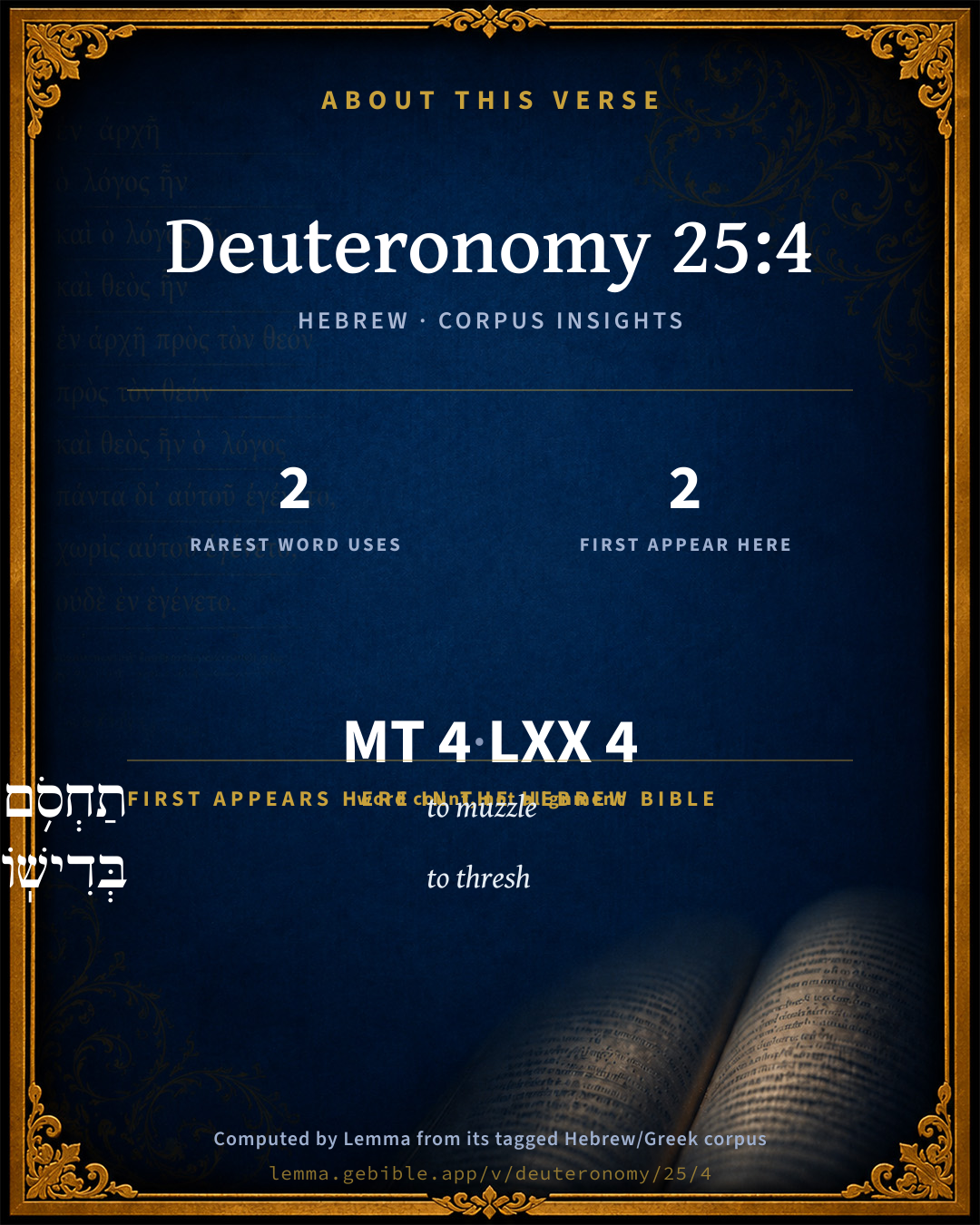
The rarest word here is תַחְסֹ֥ם to muzzle H2629 — appearing just 2 times in the whole Hebrew Bible.

First appearance in Scripture

These words make their first canonical appearance in the Hebrew Bible here:

  • תַחְסֹ֥ם to muzzle H2629
  • בְּדִישֽׁוֹ to thresh H1758

Shared distinctive vocabulary

תַחְסֹ֥ם to muzzle H2629 occurs in 2 verses of the Hebrew Bible. Also found in:

Grammatical profile

  • 2 verbs
  • 1 noun
  • 1 particle

Verb forms

  • תַחְסֹ֥ם Qal · Imperfect
  • בְּדִישֽׁוֹ Qal · Infinitive Construct

Hebrew & Septuagint length

In English translation the verse runs 12 words from the Hebrew and 11 from the Septuagint (LXX English) — closely comparable.

A rough comparison of the two English renderings, which tokenize alike — not a word-level alignment.

Word counts can differ between the Hebrew and the Greek without any difference in meaning — e.g. the Hebrew direct-object marker אֵת has no separate Greek word, and Greek often adds the article ὁ.

In the original languages it is 4 Hebrew tokens and 4 Greek tokens — but the two are counted differently (Hebrew bundles its prefixes and suffixes into one token; the Greek is in lemma form), so that isn’t a like-for-like length.

Cross-references

5

Topical passages linked to Deuteronomy 25:4 in the Treasury of Scripture Knowledge — connected by theme and wording, ordered by reader-vote popularity; previews shown in the World English Bible.

  • 1 Timothy 5:17–18 Let the elders who rule well be counted worthy of double honor, especially those who labor in the word and in teaching.
  • 1 Corinthians 9:9–10 For it is written in the law of Moses, "You shall not muzzle an ox while it treads out the grain." Is it for the oxen that God cares,
  • Proverbs 12:10 A righteous man regards the life of his animal, But the tender mercies of the wicked are cruel.
  • Hosea 10:11 Ephraim is a trained heifer that loves to thresh; So I will put a yoke on her beautiful neck. I will set a rider on Ephraim. Judah will plow. Jacob will break his clods.
  • Isaiah 28:27 For the dill are not threshed with a sharp [threshing] instrument, neither is a cart wheel turned about on the cumin; but the dill are beaten out with a staff, and the cumin with a rod.

Cross-references courtesy of OpenBible.info (CC BY 4.0).

Hebrew and Greek witnesses Masoretic Hebrew ↔ Greek Septuagint

The same verse in the two great witnesses to the Old Testament, shown verse-for-verse.

These are two independent witnesses, not word-aligned to each other, and the Septuagint is shown in lemma (dictionary) form.

Hebrew Deuteronomy 25:4 Masoretic · Westminster Leningrad Codex

לֹא תַחְסֹ֥ם שׁ֖וֹר בְּדִישֽׁוֹ

You shall not muzzle the ox when he treads out [the grain].

World English Bible · Public Domain

Greek LXX Deuteronomy 25:4 Septuagint · lemma form

οὐ φιμόω βοῦς ἀλοάω

You shall not muzzle the ox that treads out the corn.

LXX2012 (modern English Septuagint) · Public Domain

Hebrew: Westminster Leningrad Codex (CC BY 4.0). Greek: Septuagint (public domain); English from LXX2012 (modern English Septuagint) (Public Domain). How the Septuagint differs from the Hebrew →

Targum (Aramaic paraphrase)

2

The Targum is the ancient Jewish Aramaic paraphrase of the Hebrew Scriptures — an interpretive translation, not the Hebrew text itself. Onkelos (literal) and Pseudo-Jonathan (expansive) render the Torah, and Jonathan the Prophets. Coverage is partial: where no permissively-licensed English translation exists for a verse, only the Aramaic is shown. This is verse-level text, not a word-by-word alignment to the Hebrew.

  1. Targum Onkelos Torah (Genesis–Deuteronomy)
    לָא תֵחוֹד פּוּם תּוֹרָא בִּדְיָשֵׁהּ

    (no public-domain English translation for this verse)

    Targum Onkelos — Aramaic: “Onkelos Genesis” (public domain); “Onkelos Exodus” (public domain); “Onkelos Leviticus” (public domain); “Onkelos Numbers” (public domain); “Onkelos Deuteronomy” (public domain). English: “Sefaria Community Translation” (CC0 1.0 (public-domain dedication)); “J.W. Etheridge. The Targums of Onkelos and Jonathan Ben Uzziel on the Pentateuch. London: Longmans, Green, 1862” (public domain). Text via Sefaria.

  2. Targum Pseudo-Jonathan Torah (Genesis–Deuteronomy)
    לָא תְזַמְמוּן פּוּם תּוֹרָא בְּשַׁעַת דָּרְכֵיהּ בְּרַם יְבִימְתָּא דְאִיתְרְעַת קַמֵּיהּ לָקֵי שִׁיחְנָא וּדְלֵי חָמֵי לָא תִזְמָמוּנָהּ לֵיהּ

    You shall not muzzle the mouth of the ox in the time of his treading out; nor the wife of the (deceased) brother, who would be mated with one smitten with an ulcer, and who is poorly related, shalt thou tie up with him.

    Targum Pseudo-Jonathan — Aramaic: “Targum Jonathan on Genesis” (public domain); “Targum Jonathan on Exodus” (public domain); “Targum Jonathan on Leviticus” (public domain); “Targum Jonathan on Numbers” (public domain); “Targum Jonathan on Deuteronomy” (public domain). English: “The Targum of Jonathan ben Uzziel, trans. J. W. Etheridge, London, 1862” (public domain). Text via Sefaria.

Commentary

Notes on Deuteronomy 25:4 from classic Christian and Jewish commentators (each source and its license shown beneath its notes). The classic Christian expositions comment on the surrounding passage and are grouped to its opening verse, so a note may address several verses; the Jewish commentaries on the Tanakh (Rashi and others) are per-verse, so they appear only where the commentator wrote on this verse.

Lemma curates 59 commentaries, every one of them public domain or Creative Commons licensed, each selected and text-cleaned for this edition rather than reprinted as found. About our sources →

Trapp's Complete Commentary

John Trapp

Deu 25:4 Thou shalt not muzzle the ox when he treadeth out [the corn].

Ver. 4. That treadeth out the corn.] Which was the manner of that country: whereunto also the prophet alludeth, {Hos 10:11} "Ephraim is a heifer, that loveth to tread out the corn" (because while it treads, it feeds on the corn), but not to plough, because no refreshing till the work was done.

John Trapp, A Commentary or Exposition upon All the Books of the Old and New Testament (1647–1656) — public domain. Text from a community e-Sword module.

Joseph Benson's Commentary

Deu 25:4. When he treadeth out the corn — Which they did in those parts, either immediately by their hoofs, or by drawing carts or other instruments over the corn. Hereby God taught them humanity, even to their beasts that served them, and much more to their servants, or other men who laboured for them, especially to their ministers, 1Co 9:9.

Joseph Benson's Commentary on the Old and New Testaments (1811–1818) — public domain. Text from a community e-Sword module.

Tyndale Open Study Notes

Tyndale Open Resources

25:4 You must not muzzle an ox: The animal had to be able to eat the grain as it worked (cp. 1 Cor 9:9-14; 1 Tim 5:17-18).

Tyndale Open Study Notes — © Tyndale Open Resources, licensed CC BY-SA 4.0. Text via the HelloAO Bible API.

Jamieson, Fausset & Brown

Robert Jamieson, A. R. Fausset & David Brown

Thou shalt not muzzle the ox when he treadeth out the corn--In Judea, as in modern Syria and Egypt, the larger grains were beaten out by the feet of oxen, which, yoked together, day after day trod round the wide open spaces which form the threshing-floors. The animals were allowed freely to pick up a mouthful, when they chose to do so: a wise as well as humane regulation, introduced by the law of Moses (compare Co1 9:9; Ti1 5:17-18).

Jamieson, Fausset & Brown — Commentary Critical and Explanatory on the Whole Bible (1871) — public domain (CC PDM 1.0). Text via the HelloAO Bible API.

Adam Clarke's Commentary

Verse 4. Thou shalt not muzzle the ox, c.] In Judea, as well as in Egypt, Greece, and Italy, they make use of beeves to tread out the corn and Dr. Shaw tells us that the people of Barbary continue to tread out their corn after the custom of the East. Instead of beeves they frequently made use of mules and horses, by tying by the neck three or four in like manner together, and whipping them afterwards round about the nedders, as they call the treading floors, (the Libycae areae Hor), where the sheaves lie open and expanded, in the same manner as they are placed and prepared with us for threshing. This indeed is a much quicker way than ours, though less cleanly, for as it is performed in the open air, (Ho 13:3), upon any round level plot of ground, daubed over with cow's dung to prevent as much as possible the earth, sand, or gravel from rising; a great quantity of them all, notwithstanding this precaution, must unavoidably be taken up with the grain, at the same time that the straw, which is their chief and only fodder, is hereby shattered to pieces; a circumstance very pertinently alluded to in 2Kg 13:7, where the king of Syria is said to have made the Israelites like the dust by threshing. - Travels, p. 138. While the oxen were at work some muzzled their mouths to hinder them from eating the corn, which Moses here forbids, instructing the people by this symbolical precept to be kind to their servants and labourers, but especially to those who ministered to them in holy things; so St. Paul applies it 1Co 9:9, c. 1Ti 5:18. Le Clerc considers the injunction as wholly symbolical; and perhaps in this view it was intended to confirm the laws enjoined in the fourteenth and fifteenth verses of the former chapter. See Dodd and Shaw.

In Bengal, where the same mode of treading cut the corn is used, some muzzle the ox, and others do not, according to the disposition of the farmer.-Ward.

Adam Clarke's Commentary on the Bible (1810–1826) — public domain. Text from a community e-Sword/MySword module.

The Cambridge Bible for Schools and Colleges

gen. ed. J. J. S. Perowne

4. Against Muzzling the Labouring Ox. Peculiar to D; a clear

The present writer has never seen them muzzled. ‘In all W. Asia it is the universal custom to allow the oxen or other animals thus employed freely to eat of the crop’ (Van Lennep, op. cit. 81). ‘I have seen them muzzled, though this is rare’ (Conder, Tent Work, etc., 329). ‘Not muzzled as a rule’ (Baldensperger, PEFQ, 1907, 20). In 1Co_9:9 f. Paul in illustrating from this law the principle that the labourer is worthy of his hire asks, Is it for oxen that God careth? According to D, undoubtedly He does. Paul may be writing playfully; if not it is a remarkable illustration of the effect of the allegorising habit of the later Jewish exegesis.

The Cambridge Bible for Schools and Colleges (gen. ed. J. J. S. Perowne; Cambridge University Press, 1878–1918) — public domain. Text from a community e-Sword module.

John Gill's Exposition

Thou shall not muzzle the ox when he treadeth out the corn. As oxen are used in ploughing, so likewise in treading or beating out the corn; of the manner of which; see Gill on Co1 9:9; now while it was thus employed, it might not be restrained by any means from eating the corn as it had an opportunity, either by a muzzle put over its mouth, or other ways. The Gentiles had several ways of restraining their cattle from eating, while they thus made use of them, to which this law is opposed. Maimonides (f) has collected several or them together, as prohibited by it; as putting a thorn into its mouth, causing a lion to lie down by it, or causing its calf to lie down without, or spreading a skin on the top of the corn, that so it may not eat. Aelianus (g) relates a very particular way of hindering oxen from eating at such times, used some countries, which was this; that oxen might not eat of the ears of corn, in a floor where they were trod out, they used to besmear their nostrils with cows' dung, which was so disagreeable to the creature, that it would not taste anything though pressed with famine. This law is not to be limited to the ox only, or to this peculiar work assigned it; but, as Jarchi says, respects any sort of cattle, and whatsoever work that has food in it, none of them being to be restrained from eating while at work: and this law was not made for the creatures only, but for men also; and especially for the sake of ministers of the word; who for their strength, labour, and industry, are compared to oxen, and ought to be comfortably supported and maintained on account of their work; for the illustration and confirmation of which this passage is twice produced; see Gill on Co1 9:9; See Gill on Co1 9:10; See Gill on Ti1 5:17; See Gill on Ti1 5:18.

(f) Hilchot Shecirut, c. 13. sect. 2, 3. (g) Hist. Animal. l. 4. c. 25.

John Gill's Exposition of the Whole Bible (1746–1763) — public domain (CC PDM 1.0). Text via the HelloAO Bible API.

Albert Barnes' Notes on the Bible

Compare the marginal references. In other kinds of labor the oxen were usually muzzled. When driven to and fro over the threshing-floor in order to stamp out the grain from the chaff, they were to be allowed to partake of the fruits of their labors.

Albert Barnes' Notes on the Bible (1834–1885) — public domain. Text from a community e-Sword/MySword module.

Haydock's Catholic Bible Commentary

Not muzzle, &c. St. Paul understands this of the spiritual labourer in the church of God, who is not to be denied his maintenance, 1 Corinthians ix. 8, 9, 10. (Challoner) --- Other labourers, and even beasts, must likewise be treated with humanity. It was formerly the custom in Egypt, Judea, Spain, &c., to have a clean spot in the field, round a tree, where, during the heat of the day, they spread the sheaves, and made oxen continually go round, to tread out the corn. Some had the ill nature to muzzle them, or to cover their mouths with dung; (Æliian iv. 25,) whence arose the proverb, "an ox in a heap" of corn, to denote a miser, who amidst plenty will not eat. (Suidas.) --- Moses condemns this cruelty; as it is not just, says Josephus, to refuse these animals so small a recompence for the assistance which they afford us in procuring corn. (Calmet) --- Besides this literal sense, God had principally in view the mystical one, which St. Paul unfolds to us. (Menochius) --- Paine hence takes occasion to ridicule priests, who, he says, "preach up Deuteronomy, for Deuteronomy preaches up tithes." But this bok enjoins them no more that other books of Scripture, and common reason dictates that the labourer is worthy of his hire. If the artizan, &c., will not work for nothing, why should priests spend their lives and fortunes, for the benefit of the people, without deriving any advantage from them? Who has served in the wars at his own charge at any time? (1 Corinthians ix. 7.) Whether the mode of paying tithes be the most eligible for the support of God’s ministers, is a question of smaller importance. It may at least plead a very high antiquity, (Haydock) as it was in force 400 years before the law of Moses. Abraham paid tithes to Melchisedeck, who was both king and priest; and Pisistratus received tithes from the people of Athens, to be expended in the public sacrifices, and for the general good. (Laertius in Solone.; Watson, let. 2.)

George Leo Haydock (1774–1849), Haydock's Catholic Family Bible and Commentary, 1859 edition — public domain. Excludes Psalms (Douay-Rheims chapter numbering differs from Protestant) and Deuterocanonical books (Catholic canon only).

Matthew Poole's English Annotations

As the Gentiles used to do, having divers devices to keep them from eating when they trod out the corn, which they did in those parts and times by oxen, Hos 10:11, either immediately by their hoofs, Isa 28:28; Mic 4:13, or by drawing carts or other instruments over the corn, Isa 25:10; 28:27; 41:15; Amo 1:3. Hereby God taught them humanity and kindness, even to their beasts that served them, Pro 12:10, and much more to their servants or other men who laboured for them, and especially to their ministers, 1Co 9:9.

Matthew Poole's English Annotations on the Holy Bible (1683–1685) — public domain. Text from a community e-Sword/MySword module.

Whedon's Commentary on the Bible

Daniel D. Whedon

4. Thou shalt not muzzle the ox — The ancient mode of threshing with oxen yoked together and driven over the sheaves of grain is still in use in the East. Those who muzzle the ox are looked upon as niggardly peasants.

Daniel D. Whedon (gen. ed.), Commentary on the Old and New Testaments (1874–1909) — public domain. Text from a community e-Sword module.

The Pulpit Commentary

The leaving the ox unmuzzled when treading out the corn was in order that the animal might be free to eat of the grains which its labor severed from the husks. This prohibition, therefore, was dictated by a regard to the rights and claims of animals employed in labor; but there is involved in it the general principle that all labor is to be duly requited, and hence it seems to have passed into a proverb, and was applied to men as well as the lower animals (cf. 1Co_9:9; 1Ti_5:18) The use of oxen to tread out the corn and the rule of leaving the animals so employed unmuzzled still prevail among the Arabs and other Eastern peoples (Robinson, "Bib. Res.," 2:206, 207; 3:6; Kitto, "Bib. Cycl.," 1:86).

Laborers to live by their labor.

The use of this verse by the apostle has brought it out of an obscurity to which it might have been relegated. It is quoted by Paul in 1Co_9:10, and is there applied by him as an illustration in the ancient Law of Moses of the same principle which our Lord affirmed when he appointed that "they that preach the gospel should live of the gospel". (Mat_10:9, Mat_10:10) We can scarcely go so far as John Calvin in reference to Paul"s allusion to it. He says that Paul here says, God does not care for oxen! Surely his meaning is simply that it was not merely from his care for oxen that God commanded Moses to pen such a precept, but that there was a common care of God for all his creatures, and that if he cared thus for the less, it was very certain he would care even more for the greater. Labor, moreover, is to be like all native growths it is to have "its seed within itself." All who employ laborers are to see that their workmen are sufficiently well paid to enable them to live by their labor. Any one desiring to develop this truth in relation to spiritual toil would naturally rather take the New Testament texts referred to above. Keeping, therefore, simply to the earthly sphere, we remark:

1. No precept in this book which is connected with duty or character is too trivial to be "worthy of God.

2. An apparently small command may wrap up in it a great principle.

3. True benevolence will be kind and thoughtful to the humblest laborer even in minute detail.

4. God does not allow any one selfishly to monopolize the fruits of another"s labor without giving the toiler adequate compensation for his toil.

5. The Great Defender of the rights of the working classes is God!

6. It is a divinely appointed ordinance forever that the power of toil is to be a means of self-support; that labor shall bring wealth to the laborer. Here is a blow struck at slavery.

The oxen.

The apostle draws from this passage the general principle that the laborer is entitled to eat of the fruits of his labor. (1Co_9:9, 1Co_9:10) His application teaches us to look for similar general principles wrapped up in other precepts of the Law. We learn

I ANIMALS ARE ENTITLED TO GENEROUS TREATMENT. The ox that trod out the corn was not to be muzzled. He was to be permitted to eat of the fruits of his work. Kindness to animals is a duty:

1. Which man owes to the creatures. Severe moralists, arguing that animals, being destitute of reason, are also destitute of rights, would bring all man"s duties towards them under the head of duties to himself (e.g. Kant). Alford thinks this to be implied in Paul"s language. But Paul"s argument, if it is to be pressed in this connection, rather implies the contrary. It recognizes in the ox, on the ground of its being a laborer, a kind of right to be provided for. All that the apostle affirms is that the precept had an end beyond the reference to oxen, that the "care for oxen" was subordinate to the inculcation of a principle of general application. Our duty to the creatures rests on the ground that they are sentient beings, capable of pain and pleasure, and on the law of love, which requires us to diffuse happiness, and avoid inflicting needless suffering.

2. Which man owes to himself. For this view, while not the whole of the truth, is an important part of it. Leibnitz, in a small treatise written for the education of a prince, advised that, during youth, he should not be permitted to torment or give pain to any living thing, lest, by indulging the spirit of cruelty, he should contract a want of feeling for his fellow-men. Alford says, "The good done to a man"s immortal spirit by acts of humanity and justice infinitely outweighs the mere physical comfort of a brute which perishes.

II THE HUMAN LABORER IS ENTITLED TO SHARE IN THE PROFITS OF HIS LABORS. Theoretically, he does so every time he is paid wages. In the distribution of the fruits of production, the part which the laborer gets, we are told, is wages, the share of the landowner is rent, that of the capitalist is interest, and the Government takes taxes. Practically, however, wages are settled, not by abstract rules of fairness, but by competition, which may press so hard upon the laborer as (till things right themselves) to deprive him of his fair proportion of industrial profits. The wage system is far from working satisfactorily. As society advances, it appears to be leading to an increasing amount of bitterness and friction. Masters and men represent opposing interests, and stand, as it were, at daggers drawn. It is easier to see the evil than to devise a cure. Economists (Mill, Jevons, etc.) seem to look mainly in the direction of some form of co-operation. Their schemes are principally two;

1. Industrial co-operation.

2. Industrial partnerships the system according to which a fixed proportion of profits is assigned for division amongst the workmen engaged in production.

III MINISTERS OF THE GOSPEL ARE ENTITLED TO BE SUPPORTED BY THEIR FLOCKS. This is the application made by Paul. (1Co 9.; cf. Mat_10:10-12; Gal_6:6) Christian ministers, laboring in spiritual things, and by that work withdrawn from ordinary avocations, are to be cheerfully supported. The text applies to this case more strictly than to the case of workmen claiming to participate in profits. The workman claims but his own. The right of the minister to support is of a different kind. He labors in things spiritual, but, it is to be hoped, with a higher end than the mere obtaining of a livelihood. While, therefore, his support is a duty, it is, like duties of benevolence generally, not one that can be enforced by positive law. The right to support is a moral, not a legal one. It creates an obligation, but, as moralists say, an indeterminate obligation. It is an obligation to be freely accepted, and as freely discharged. J.O.

Doing good inseparable from getting good.

Active exercise of our powers is a primary condition of getting good. Real service for others is destined to gain reward.

I SERVICE CAN BE RENDERED TO MAN BY VERY INFERIOR NATURES. The whole animate creation waits upon man. Every living thing upon the earth is a servant and a lackey for men. He is a king here; and, if he have sufficient wisdom, he can rule all for his own advantage. Yet, in a higher sphere, man is only a servant. He who is served by all inferior beings is called to serve the Highest Being. The disparity between God and man is a disparity immeasurable; and yet God permits, yea, encourages, our intelligent and willing service. Inferior as we are to him, we can render efficient service to his kingdom and glory. This is man"s truest honor.

II SERVICE CONTRIBUTES TO PROVIDE AN ABUNDANT BANQUET. The labor of the oxen prepared the corn for men. So gross is our ignorance of the lower creation, that we do not perceive our indebtedness to the birds and insects, which play so useful a part in the preparation of our food. All well-directed service contributes something to the substantial advantage of man. There is a banquet of intellectual food, or a banquet for the aesthetic taste, or a banquet for the soul, resulting. Active labor serves both to create an appetite and to furnish a table.

III SERVICE HAS CLAIMS UPON OUR GENEROUS RECOMPENSE. It would be nothing else than selfish cruelty to deny to the oxen a share in the result of their labor. Thus God cares for the oxen. Thus he cares for all the works of his hands. And does his kindly care for the inferior beasts diminish his tender regard for men? It immeasurably enhances it! Whoever or whatever does us useful service brings us under obligation. To the extent of our power we are bound to recompense such. This sense of indebtedness is a channel of blessing to the soul. The richest man is he who is the most generous. A muzzle is a shackle forged by wanton selfishness. D.

The rights of labor.

The threshing in the East is done by oxen in many cases still, though horses, where procurable, are found more serviceable. While the animals were engaged in their weary round, they were never muzzled, but allowed to eat of the corn they were treading out. It would appear, indeed, that it was the straw simply that they were to receive, and the corn was to be reserved for the men, their masters. But the idea manifestly was the right of the patient animal to a share of the corn he was helping to thresh. It suggests the large subject of the rights of labor. Into this, of course, we cannot enter at any length. But we may observe

I THAT CO-OPERATION IN WORK HAS A RIGHT TO A SHARE IN ITS WAGES. This is recognized in the Mosaic Law regarding the lower animals, and the argument is cumulative with regard to man. "The laborer is worthy of his hire," said our Lord. "The workman is worthy of his meat". (Luk_10:7; Mat_10:10)

II THE SHARE SHOULD BE SUFFICIENT TO SUSTAIN LIFE. The ox was expected to pick up on his rounds as much as would keep up his strength for labor. And in the same way, the wages of a laborer should be sufficient to sustain him in the position he occupies in society. The economic laws about the "wages" fund" are not so inexorable as to prevent such a plain principle being evermore kept in view. There is a heartlessness attributed to the laws of wealth that belongs to the capitalists themselves.

III THERE SHOULD BE SYMPATHY BETWEEN EMPLOYER AND EMPLOYED. The very oxen occupy a position where sympathy must obtain between them and their keepers, if the work is to be properly performed. How much more must this obtain when the workers are our fellow-men! The late Sir Arthur Helps, in one of his early and anonymous volumes entitled, "The Claims of Labor," refers frequently to this. "You must not be surprised," he says to the employer, "at the ingratitude of those to whom you have given nothing but money." "Fortunately," he says in another place, "the proneness of men to regard with favor those put in authority over them is very strong; and I have little fear of finding any large body of thoughtful and kind masters suffering from permanent indifference or ingratitude on the part of their dependents." Sympathy between masters and men is more important even than adequate wages.

IV BOTH JESUS AND PAUL APPLY THE PRINCIPLE TO MINISTERIAL SUPPORT. In the passage already noticed our Lord does. (Mat_10:9-11; Luk_10:7) Paul also, in 1Ti_5:17, 1Ti_5:18, makes use of it, referring both to the passage before us in Deuteronomy and also to our Lord"s deliverance. In placing the ministry upon the same ground as other workers, it is clear that it is to be no exception to the rule of proportional reward. Of course, it is not supported as other and meaner occupations are. Every other occupation is beneath it in dignity, but every other almost is above it in reward. Its rights must be advocated; its claims are valid, and men deny them at their peril. R.M.E.

The Pulpit Commentary (1880–1919), ed. H.D.M. Spence-Jones & Joseph S. Exell — public domain. Text from a community e-Sword module.

John Wesley's Explanatory Notes

He treadeth out the corn - Which they did in those parts, either immediately by their hoofs on by drawing carts or other instruments over the corn. Hereby God taught them humanity, even to their beasts that served them, and much more to their servants or other men who laboured for them, especially to their ministers, 1 Cor. ix, 9.

John Wesley, Explanatory Notes Upon the Whole Bible (1754–1765) — public domain. Text via the GEBible commentary corpus.

Keil & Delitzsch

C. F. Keil & F. Delitzsch

The command not to put a muzzle upon the ox when threshing, is no doubt proverbial in its nature, and even in the context before us is not intended to apply merely literally to an ox employed in threshing, but to be understood in the general sense in which the Apostle Paul uses it in Co1 9:9 and Ti1 5:18, viz., that a labourer was not to be deprived of his wages. As the mode of threshing presupposed here - namely, with oxen yoked together, and driven to and fro over the corn that had been strewn upon the floor, that they might kick out the grains with their hoofs - has been retained to the present day in the East, so has also the custom of leaving the animals employed in threshing without a muzzle (vid., Hoest, Marokos, p. 129; Wellst. Arabien, i. p. 194; Robinson, Pal. ii. pp. 206-7, iii. p. 6), although the Mosaic injunctions are not so strictly observed by the Christians as by the Mohammedans (Robinson, ii. p. 207).

Keil & Delitzsch — Biblical Commentary on the Old Testament (1861–1891) — public domain (CC PDM 1.0). Text via the HelloAO Bible API. (Old Testament only.)

unfoldingWord translationNotes

Door43 World Missions Community

You must not muzzle the ox

"You must not put something over the mouth of an ox"

when he treads out the grain

while he separates the grain from the chaff by walking on it or dragging heavy wood over it

translationWords

cow

grain

unfoldingWord translationNotes — © Distant Shores Media and the Door43 World Missions Community, licensed CC BY-SA 4.0. Source: git.door43.org/Door43/en_tn.

Rashi

Rabbi Shlomo Yitzchaki (Rashi)

לא תחסם שור THOU SHALT NOT MUZZLE THE OX [WHEN HE TREADETH OUT THE CORN] — Scripture is speaking of what usually occurs, but the same law applies to any cattle, non-domesticated beast and fowl that are doing some work that is connected with food. But if so why does it (Scripture) state “ox”? To exclude a human being from being subject to this law! (i.e. that if he restrains a workman from eating whilst engaged on some operation connected with food, the master is exempt from flagellation usually inflicted on one who transgresses a negative commandment) (Bava Metzia 88b).

בדישו WHEN HE TREADETH OUT THE CORN — One might think that one might muzzle it previous to that (lit., outside, i.e., before it starts working)! Scripture, however, states, “thou shalt not muzzle an ox” — which implies thou shalt not muzzle it under any circumstances (Bava Metzia 90b). Then why is threshing mentioned?. In order to tell you the following: What is threshing? Its characteristic is that it is done on a thing the work on which is not yet complete to make it liable to tithing and the giving of Challah, and which grows from the ground. So, too, this prohibition applies only to all operations which have similar characteristics: Thus there are excluded from the prohibition “not to muzzle” (i.e. you may restrain from eating) workmen who are engaged in milking, in cheese-making, or in pressing the moisture out of thick milk, all of which operations are done on things which do not grow from the ground; there are excluded, also, the workmen who are engaged in kneading, or in breaking the dough up into pieces for baking, for the work on it is then completed so that it becomes liable to Challah. There are also excluded the workmen engaged in separating dates and figs from the mass, for the work on them is then completed so that they become liable to tithing (Bava Metzia 89a).

Rashi on the Tanakh — English translations: “The Judaica Press complete Tanach with Rashi, translated by A. J. Rosenberg” (CC BY 4.0); “Pentateuch with Rashi's commentary by M. Rosenbaum and A.M. Silbermann, 1929-1934” (public domain); “The Metsudah Tanach series, Lakewood, N.J” (CC BY 4.0); and “The Book of Joshua, Metsudah Publications, 1997” (CC BY 4.0). Text via Sefaria.

Lesson kit

Teaching starters — assembled from the data on this page, not authored interpretation. Every prompt links to the verse data it draws on. Edit before teaching.

Deuteronomy, in the Pentateuch, opens this verse with 4 words (4 distinct Hebrew lemmas). Its most distinctive word is châçam (“to muzzle”). A historical commentator’s framing appears above. Read the whole chapter for the surrounding context.

Discussion questions

  1. How does “to muzzle” (châçam) shape what this verse is saying?
  2. 2 words here appear for the first time in Scripture. What is being introduced at this debut?
  3. Ezekiel 39:11 shares the word «to muzzle» with this verse. How do the two illuminate each other?
  4. These translations render this verse differently. What is at stake in choosing one wording over another?
  5. The verb «תַחְסֹ֥ם» is Qal Imperfect. How does its form color the action?
  6. Reading how Trapp's Complete Commentary and Joseph Benson's Commentary read this verse, where do the two commentators agree and where do they part?

Things to notice

Reading settings

Reading text

Shown beneath each verse's original-language words.

Old Testament
Old Testament edition

Read the OT as the Masoretic Hebrew (MT) or the Greek Septuagint (LXX).

English shown for the Greek Septuagint (in the Hebrew ↔ Greek comparison).

Comparing translations? Open the Compare panel on any verse page to stack up to four side by side.