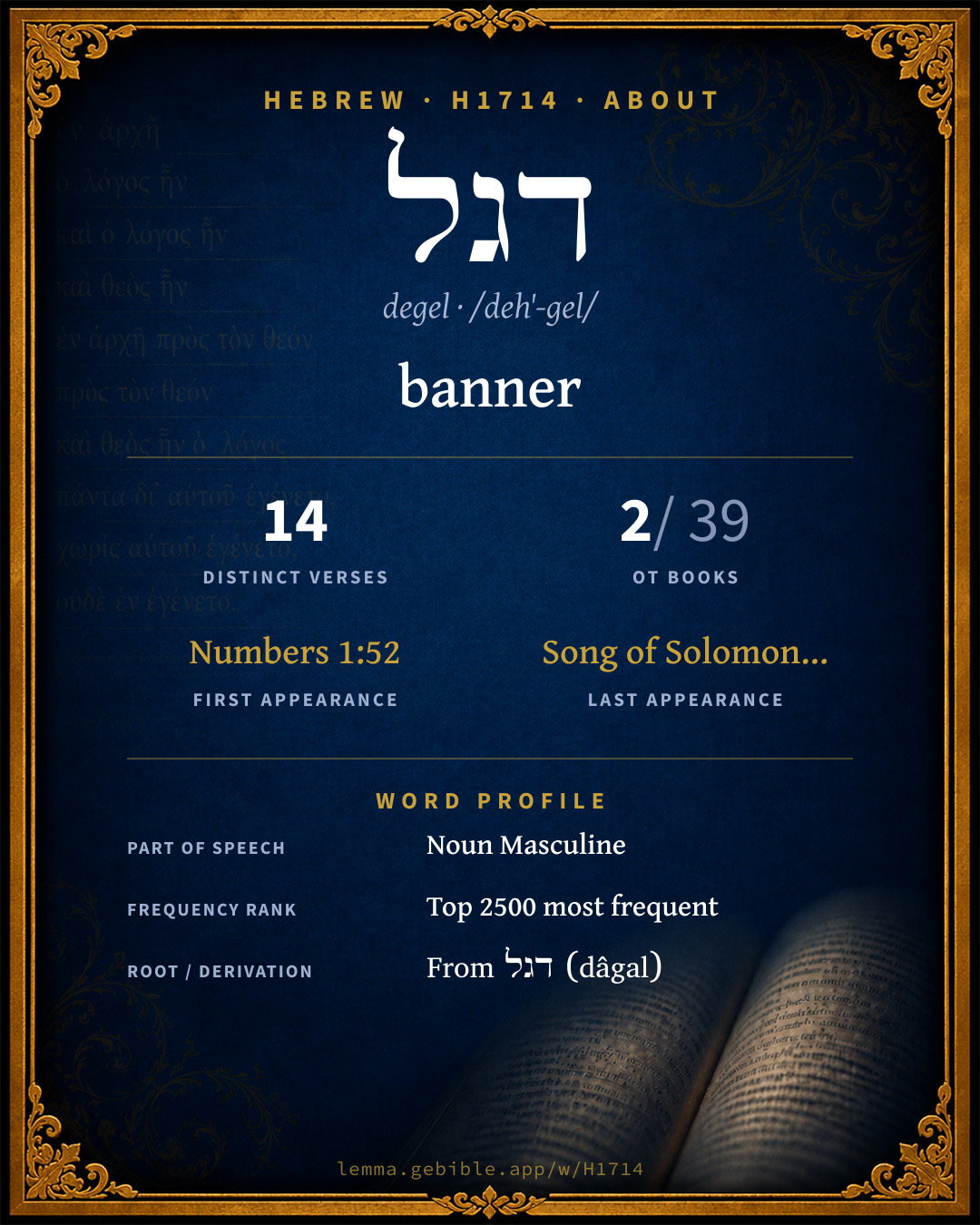
דֶּ֫גֶל
banner
Full lexicon entry — Brown-Driver-Briggs (BDB)
From Brown-Driver-Briggs (BDB)
Where this word appears
Grammar key — what these labels mean
Part of speech
- Noun
- A naming word — a person, place, thing, or idea.
Noun type
- Common
- A common noun — a general class of person, place, or thing (“king,” “city,” “water”), not a specific name.
State
- Construct
- A noun bound to a following noun in a possessive / “of” relationship (the construct chain).
Gender
- Masculine
- Grammatically masculine.
Number
- Singular
- One.
- Plural
- More than one (in Hebrew, generally three or more).
Grammatical forms
- Noun, Common, Masculine, Singular, Construct 11 times (79%)
- Noun, Common, Masculine, Plural, Construct 3 times (21%)
Parsed forms decoded from the imported morphology (morphhb / Westminster Leningrad Codex — WLC text public domain, morphhb tagging CC BY 4.0), counted across 14 parsed occurrences — not distinct verses.
Every verse where H1714 appears — 14 distinct verses across 2 books. Click any verse to open its interlinear word-by-word view. Verse text shown in the World English Bible for context — . Each verse’s Hebrew form is shown with its reference; the English is not keyword-highlighted, since the data carries no word-level English alignment. Use “Compare translations” on any verse to read it across multiple English versions. This concordance covers the Hebrew Bible; Septuagint (Greek Old Testament) occurrences are not indexed here.
Numbers 13 verses
- Numbers 1:52 דִּגְל֖/וֹ n c ms cs + sfx pers 3ms The children of Israel shall pitch their tents, every man by his own camp, and every man by his own standard, according to their divisions.
- Numbers 2:2 דִּגְל֤/וֹ n c ms cs + sfx pers 3ms "The children of Israel shall encamp every man by his own standard, with the ensigns of their fathers' houses: at a distance from the tent of meeting shall they encamp around it."
- Numbers 2:3 דֶּ֛גֶל n c ms cs Those who encamp on the east side toward the sunrise shall be of the standard of the camp of Judah, according to their divisions: and the prince of the children of Judah shall be Nahshon the son of Amminadab.
- Numbers 2:10 דֶּ֣גֶל n c ms cs "On the south side shall be the standard of the camp of Reuben according to their divisions. The prince of the children of Reuben shall be Elizur the son of Shedeur.
- Numbers 2:17 לְ/דִגְלֵי/הֶֽם prep + n c mp cs + sfx pers 3mp "Then the tent of meeting shall set out, with the camp of the Levites in the midst of the camps. As they encamp, so shall they set out, every man in his place, by their standards.
- Numbers 2:18 דֶּ֣גֶל n c ms cs "On the west side shall be the standard of the camp of Ephraim according to their divisions: and the prince of the children of Ephraim shall be Elishama the son of Ammihud.
- Numbers 2:25 דֶּ֣גֶל n c ms cs "On the north side shall be the standard of the camp of Dan according to their divisions: and the prince of the children of Dan shall be Ahiezer the son of Ammishaddai.
- Numbers 2:31 לְ/דִגְלֵי/הֶֽם prep + n c mp cs + sfx pers 3mp "All who were numbered of the camp of Dan were one hundred fifty-seven thousand six hundred. They shall set out last by their standards."
- Numbers 2:34 לְ/דִגְלֵי/הֶם֙ prep + n c mp cs + sfx pers 3mp Thus the children of Israel did. According to all that Yahweh commanded Moses, so they encamped by their standards, and so they set out, everyone by their families, according to their fathers' houses.
- Numbers 10:14 דֶּ֣גֶל n c ms cs In the first [place] the standard of the camp of the children of Judah set forward according to their hosts: and over his host was Nahshon the son of Amminadab.
- Numbers 10:18 דֶּ֛גֶל n c ms cs The standard of the camp of Reuben set forward according to their hosts: and over his host was Elizur the son of Shedeur.
- Numbers 10:22 דֶּ֛גֶל n c ms cs The standard of the camp of the children of Ephraim set forward according to their hosts: and over his host was Elishama the son of Ammihud.
- Numbers 10:25 דֶּ֚גֶל n c ms cs The standard of the camp of the children of Dan, which was the rearward of all the camps, set forward according to their hosts: and over his host was Ahiezer the son of Ammishaddai.
Song of Solomon 1 verse
About this entry
At a glance — auto-summarized from this page’s data, not written by a person. Every figure links to its source below. This summary describes the numbers; it doesn’t interpret them.
“banner” is the headline sense of the Hebrew noun דגל (degel). It clusters heavily in Numbers, which alone accounts for 93% of its uses. It turns up in 14 verses across 2 books, an uncommon footprint. Its earliest occurrence is Numbers 1:52. Older and newer Bibles part ways — “standard” in the King James Version, “under their standard” (Berean Standard Bible) and “banner” (unfoldingWord Literal Text) in modern versions. See the renderings breakdown. See the sense tree, 14-verse concordance, and the renderings breakdown below.
Gloss history
Strong's 1890 vs modern scholarship
About this word
Strong's H1714 catalogs a Hebrew word from the Hebrew Old Testament.
These counts are not copied from any lexicon or concordance. They are computed here, from the morphology-tagged Hebrew Old Testament. What Lemma adds →
- 14
- distinct verses
- The word appears in 14 distinct verses.
- 2 / 39
- OT books
- The word appears in 2 of 39 Old Testament books.
- #1,910
- by frequency
- Top 2500 most frequent Hebrew words (rank 1,910 of 8,640 Hebrew words by occurrence).
View all 14 occurrences in the concordance →
Most concentrated in
- Numbers 13 verses 93%
- Song of Solomon 1 verse 7%
By section of the Old Testament
By traditional corpus
Conventional, traditional groupings — biblical authorship is debated, so this is a traditional corpus grouping, not an authorship claim. Each share is this word’s portion of its verses in that division of the Hebrew canon. Each figure is a share of the word’s 14 distinct verses.
- Torah (Pentateuch) 13 verses · 93%
- Writings (Ketuvim) 1 verse · 7%
How translations render this word
Counts come from each version’s own published word-to-Strong’s tagging or interlinear alignment — an approximate guide to how each version renders this word, not a word-level alignment the data otherwise carries. Because each total is that version’s own tagged count, the per-version totals vary from one another and need not match the appearance or distinct-verse counts above. These counts may also differ from a printed concordance because Lemma counts each distinctly tagged rendering and does not collapse phrase taggings into a single head-word total. This is a fixed set of word-tagged versions (KJV, ASV, BSB, ULT) and does not change with the reading translation you choose elsewhere. Each version’s license is shown beside its name below (and on Sources).
- King James Version: Standard 5×, Standards 3×, Own standard 2×
- American Standard Version: Shall be the standard 3×, Standard 3×, Standards 3×
- Berean Standard Bible: Under their standard 8×, Under their standards 2×
- unfoldingWord Literal Text: Banner 7×, According to their banners 3×, Banner of 3×
King James Version Public Domain
Renders H1714 across 14 tagged occurrences — most commonly:
Plus 2 renderings that appear only once — usually multi-word phrases or single function words the recovered tagging swept in, not distinct renderings.
American Standard Version Public Domain
Renders H1714 across 14 tagged occurrences — most commonly:
Plus 3 renderings that appear only once — usually multi-word phrases or single function words the recovered tagging swept in, not distinct renderings.
Berean Standard Bible Public Domain
Renders H1714 across 14 tagged occurrences — most commonly:
Plus 4 renderings that appear only once — usually multi-word phrases or single function words the recovered tagging swept in, not distinct renderings.
unfoldingWord Literal Text CC BY-SA 4.0
Renders H1714 across 14 tagged occurrences — most commonly:
Plus 1 rendering that appears only once — usually multi-word phrases or single function words the recovered tagging swept in, not distinct renderings.
Senses in BDB
The 1 sense BDB distinguishes for this word, in lexicon order (not ranked by frequency or importance). The full entry — with sub-senses — is in the Lexicon Entry tab.
- banner, standard
Word origin
n.m. Nu 10:14 standard, banner (Assyrian diglu DlHA 40 Pr 58; cf. also Di Nu 2:2); cstr. דֶּגֶל Nu 2:3 + 7 times; sf. דִּגְלוֹ Nu 1:52 + 2 times; pl. sf. דִּגְלֵיהֶם Nu 2:17, 31, 34;—standard, partic. of separate tribes of Isr. ד׳ מחנה יהודה etc. Nu 2:3, 10, 18, 25; 10:14, 18, 22, 25; cf. also 1:52; 2:2 (‖ אֹתֹת) v 17, 31, 34 (all P); fig. Ct 2:4 ודגלו עלי אהבה.
— Brown-Driver-Briggs (Oxford 1906, public domain), digitized via Sefaria, supplemented by the OpenScriptures HebrewLexicon (CC BY 4.0). See Sources.
Derived from דגל (dâgal) (H1713) — to look.
Jastrow Dictionary
A second Hebrew/Aramaic lexicon for comparison, covering Aramaic and post-biblical (Talmudic, Targumic, Midrashic) usage that the biblical-Hebrew BDB does not. Matched by lemma rather than by Strong’s number, so a lemma may carry more than one Jastrow headword (shown separately below), and the entries cover usage well beyond the Bible.
דָּגַל I
- Pi. דִּגֵּל, דִּיגֵּל (denom. of דֶּגֶל) to outgeneral, play tricks (cmp. στραταγέω a. καταστραταγέω). Cant. R. to II, 4 (play on ודגלו ib.) אפי׳ אותן הַדִּיגּוּלִין שדִּיגֵּל … באביו even those devices with which Jacob deceived his father.
- same. Sabb. 63ᵃ (play on ודגלו, v. supra) two students המַדְגִּילִים זה לזה וכ׳ who outwit each other with sophistries (Tosaf. to Ab. Zar. 22ᵇ). [Rashi: who form an assembly (דֶּגֶל) for studies, in the absence of a teacher.]
דְּגַל
- Pa. דַּגֵּיל same. Targ. Prov. XVI, 10 לא נְדַגֵּיל פומיה Ar. (ed. נִדְגוּל) his mouth is not tricky (h. text מעל).
דָּגַל II
- part. pass. דָּגוּל, v. דֶּגֶל.—Nif. נִדְגַּל (denom. of דֶּגֶל) to be divided in troops, arranged. Part. pl. f. נִדְגָּלוֹת those arranged in troops, the hosts of heaven. Num. R. s. 2 (ref. to Cant. VI, 4) ובמה אתם כנ׳ and wherein do ye (Israelites) resemble the angels?; Yalk. Cant. 992. e.g. Song of Solomon 6:4
- 1. to put up a flag, to signalize. Tanḥ., ed. Bub., B’midb. 15 (ref. to Cant. II, 4) ולוי הוא מַדְגִּיל עלי אהבה (Tanḥ. ib. 14; Num. R. l. c. מגדיל) Oh, that He would let the flag of love wave over me! e.g. Song of Solomon 2:4
- 2. to arrange an assembly. Sabb. 63ᵃ, v. דָּגַל I.
דֶּגֶל
- (b. h.) troop, division, cohort (cmp. caterva);standard. Cant. R. to II, 4 ודִגְלוֹ Michael and his band (of angels); a. e.—Pl. דְּגָלִים. Num. R. s. 2 והיו כולם עשויים ד׳ ד׳ וכ׳ and all of them (the angels) were arranged in divisions, as it is said (Cant. V, 10) dagul (surrounded by divisions) of a myriad each (with ref. to Ps. LXVIII, 18). Ib. עֲשֵׂה אותם ד׳ וכ׳ divide them into cohorts as they desired (with ref. to Num. II, 2); v. Cant. R. to II, 4; Tanḥ. B’midb. 10.—Ex. R. s. 15 אין ד׳ אלא צבאות d’galim means hosts. Ib. דִּגְלֵי השמים … וד׳ הארץ וכ׳ the heavenly hosts are the angels, the earthly hosts (of the Lord) are Israel. Ib. s. 24, end; a. fr.—Sabb. 5ᵃ; 98ᵃ דומה לדִגְלֵי מדבר resembling the marches of the Israelites in the desert. e.g. Song of Solomon 5:10
A Dictionary of the Targumim, the Talmud Babli and Yerushalmi, and the Midrashic Literature (Marcus Jastrow; London, Luzac, 1903) — Public Domain. Digitized via Sefaria. Digitized via Sefaria. Full attribution on Sources.
Forms in the corpus
The 8 distinct written forms H1714 takes in the Hebrew Bible, most frequent first — each parse links to that state’s occurrences in the concordance. Hebrew forms include their vowel points and cantillation, so a single lemma takes many written forms.
| Form | Parsing | Example | Uses |
|---|---|---|---|
| דֶּ֣גֶל | Noun, Common, Masculine, Singular, Construct | Numbers 2:10 | 4 |
| דֶּ֛גֶל | Noun, Common, Masculine, Singular, Construct | Numbers 2:3 | 3 |
| לְ/דִגְלֵי/הֶֽם | Noun, Common, Masculine, Plural, Construct | Numbers 2:17 | 2 |
| דִּגְל֖/וֹ | Noun, Common, Masculine, Singular, Construct | Numbers 1:52 | 1 |
| דִּגְל֤/וֹ | Noun, Common, Masculine, Singular, Construct | Numbers 2:2 | 1 |
| דֶּ֚גֶל | Noun, Common, Masculine, Singular, Construct | Numbers 10:25 | 1 |
| וְ/דִגְל֥/וֹ | Noun, Common, Masculine, Singular, Construct | Song of Solomon 2:4 | 1 |
| לְ/דִגְלֵי/הֶם֙ | Noun, Common, Masculine, Plural, Construct | Numbers 2:34 | 1 |
Septuagint verse parallels
This word appears in 14 verses that also exist in the Greek Old Testament (Septuagint), out of the 14 Hebrew verses it occurs in. You can read those verses in Greek by switching the Old Testament edition to the Septuagint.
Read these verses in the Septuagint
This is a verse-level parallel only — the same verses exist in both the Hebrew and Greek Old Testaments. No word-level Hebrew↔Greek correspondence is claimed: the data carries no such alignment, so no Greek word is shown as this Hebrew word’s translation. Coverage is not total — the Septuagint omits the deuterocanon and renumbers the Psalms, so some Hebrew verses have no direct Greek parallel.