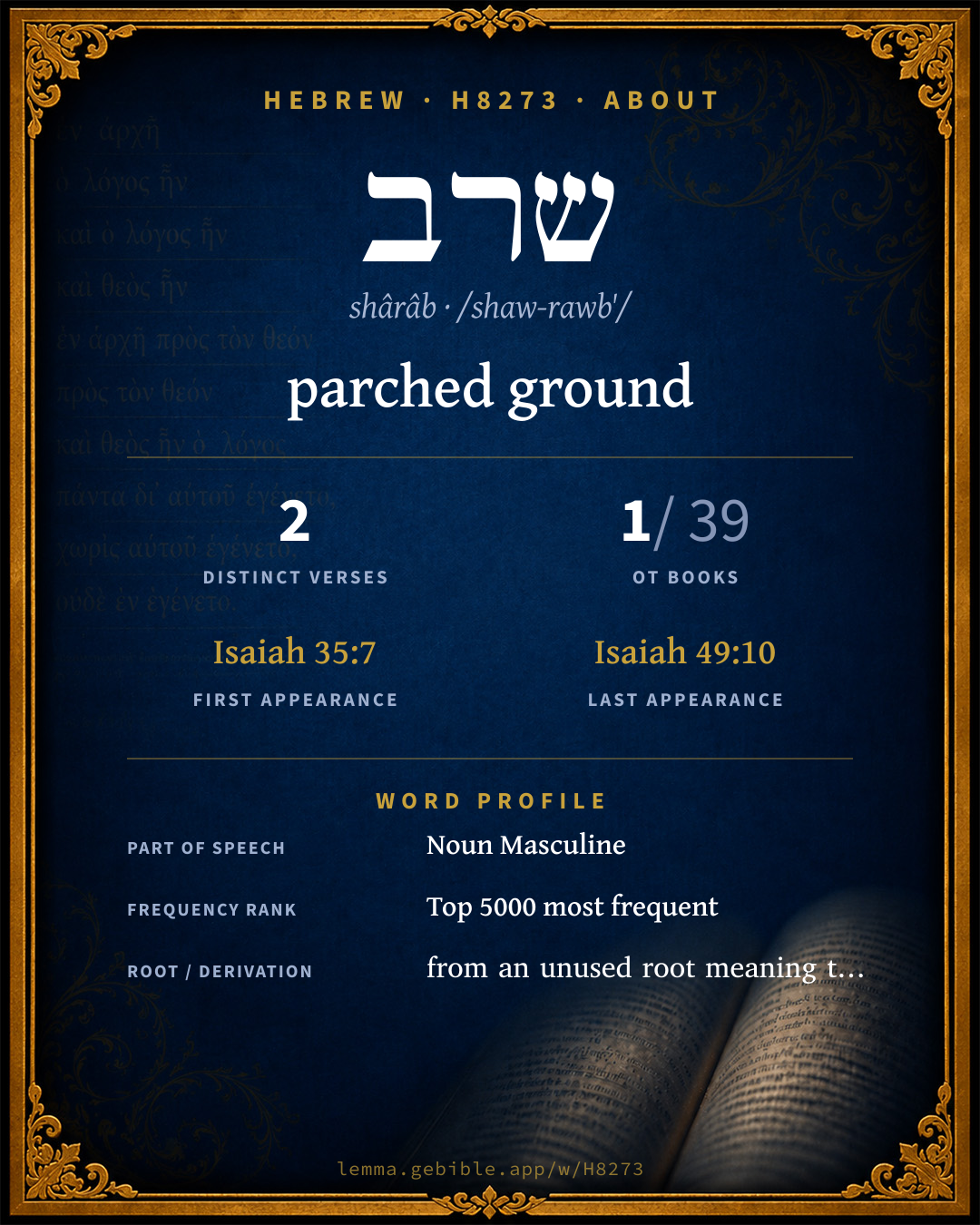
שָׁרָב
parched ground
Full lexicon entry — Brown-Driver-Briggs (BDB)
From Brown-Driver-Briggs (BDB)
Where this word appears
Grammar key — what these labels mean
Part of speech
- Noun
- A naming word — a person, place, thing, or idea.
Noun type
- Common
- A common noun — a general class of person, place, or thing (“king,” “city,” “water”), not a specific name.
State
- Absolute
- The independent form of a noun, not bound to a following word.
Gender
- Masculine
- Grammatically masculine.
Number
- Singular
- One.
Every verse where H8273 appears — 2 distinct verses across 1 book. Click any verse to open its interlinear word-by-word view. Verse text shown in the World English Bible for context — . Each verse’s Hebrew form is shown with its reference; the English is not keyword-highlighted, since the data carries no word-level English alignment. Use “Compare translations” on any verse to read it across multiple English versions. This concordance covers the Hebrew Bible; Septuagint (Greek Old Testament) occurrences are not indexed here.
Isaiah 2 verses
- Isaiah 35:7 הַ/שָּׁרָב֙ ptcl def.art + n c ms The glowing sand shall become a pool, and the thirsty ground springs of water: in the habitation of jackals, where they lay, shall be grass with reeds and rushes.
- Isaiah 49:10 שָׁרָ֖ב n c ms They shall not hunger nor thirst; neither shall the heat nor sun strike them: for he who has mercy on them will lead them, even by springs of water will he guide them.
About this entry
At a glance — auto-summarized from this page’s data, not written by a person. Every figure links to its source below. This summary describes the numbers; it doesn’t interpret them.
“parched ground” is the headline sense of the Hebrew noun שרב (shârâb). A scarce word — 2 verses in all of the Hebrew Bible. More than three-quarters of its appearances fall in Isaiah. Scripture first uses it in Isaiah 35:7. It shares a root with שרביה. See the sense tree, 2-verse concordance, and the renderings breakdown below.
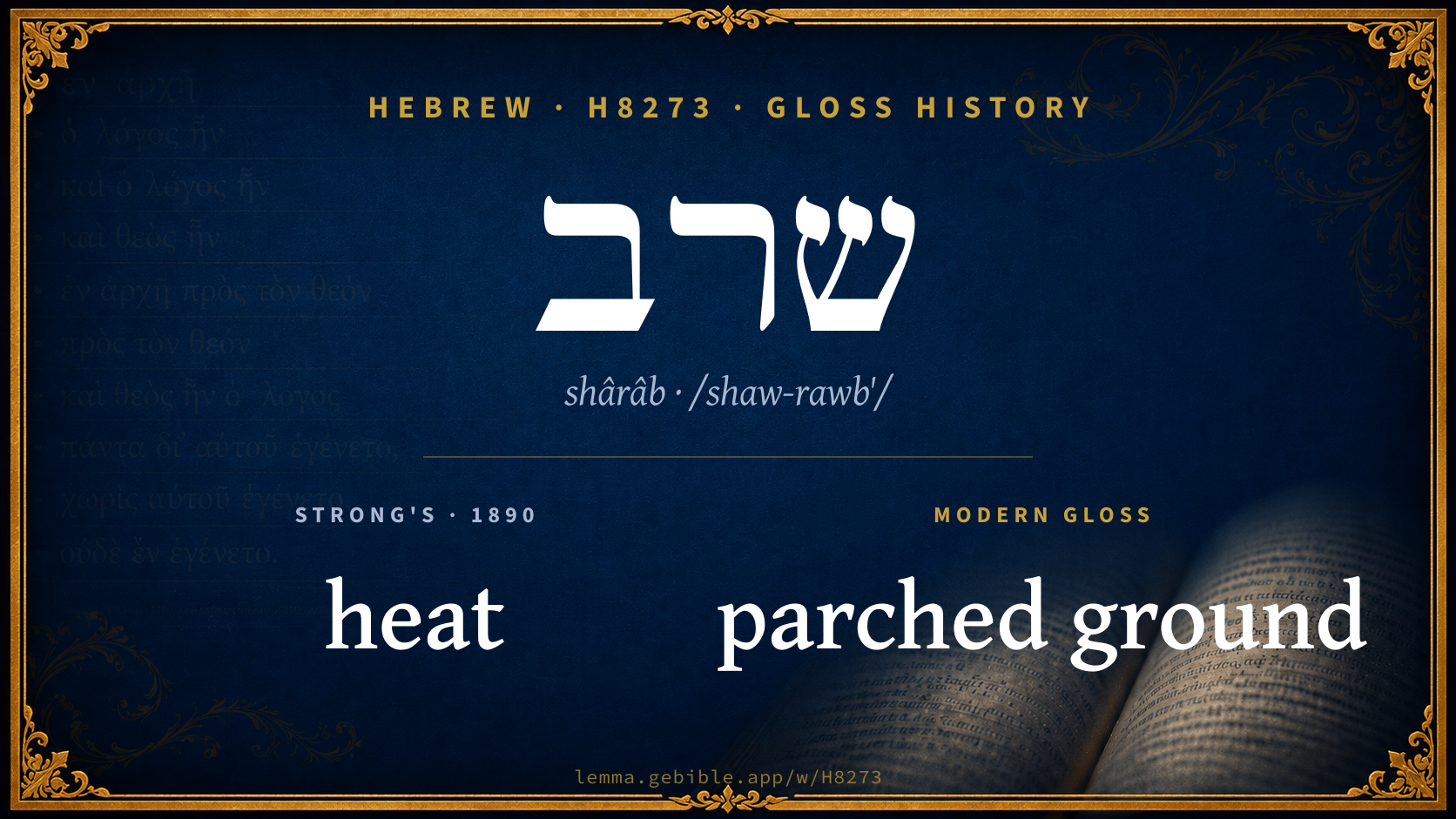
Gloss history
Strong's 1890 vs modern scholarship
About this word
Strong's H8273 catalogs a Hebrew word from the Hebrew Old Testament.
These counts are not copied from any lexicon or concordance. They are computed here, from the morphology-tagged Hebrew Old Testament. What Lemma adds →
- 2
- distinct verses
- The word appears in 2 distinct verses.
- 1 / 39
- OT books
- The word appears in 1 of 39 Old Testament books.
- #4,807
- by frequency
- Top 5000 most frequent Hebrew words (rank 4,807 of 8,640 Hebrew words by occurrence).
View all 2 occurrences in the concordance →
Most concentrated in
- Isaiah 2 verses 100%
By section of the Old Testament
By traditional corpus
Conventional, traditional groupings — biblical authorship is debated, so this is a traditional corpus grouping, not an authorship claim. Each share is this word’s portion of its verses in that division of the Hebrew canon. Each figure is a share of the word’s 2 distinct verses.
- Prophets (Nevi'im) 2 verses · 100%
How translations render this word
Counts come from each version’s own published word-to-Strong’s tagging or interlinear alignment — an approximate guide to how each version renders this word, not a word-level alignment the data otherwise carries. Because each total is that version’s own tagged count, the per-version totals vary from one another and need not match the appearance or distinct-verse counts above. These counts may also differ from a printed concordance because Lemma counts each distinctly tagged rendering and does not collapse phrase taggings into a single head-word total. This is a fixed set of word-tagged versions (KJV, ASV, BSB, ULT) and does not change with the reading translation you choose elsewhere. Each version’s license is shown beside its name below (and on Sources).
- King James Version: Parched ground 1×, Shall the heat 1×
- American Standard Version: Glowing sand 1×, Shall the heat 1×
- Berean Standard Bible: Parched ground 1×, Scorching heat 1×
- unfoldingWord Literal Text: Glaring heat 1×, Glaring land 1×
King James Version Public Domain
Renders H8273 across 2 tagged occurrences — most commonly:
American Standard Version Public Domain
Renders H8273 across 2 tagged occurrences — most commonly:
Berean Standard Bible Public Domain
Renders H8273 across 2 tagged occurrences — most commonly:
unfoldingWord Literal Text CC BY-SA 4.0
Renders H8273 across 2 tagged occurrences — most commonly:
Senses in the full BDB
What do BDB’s symbols mean?
BDB uses these scholarly abbreviations:
| Symbol | Meaning |
|---|---|
| 𝔊 | the Septuagint (the ancient Greek translation, LXX) |
| 𝔙 | the Vulgate (the Latin translation) |
| 𝔖 | the Syriac version (the Peshitta) |
| 𝔗 | the Targum (the Aramaic translation) |
| ψ | the Psalms |
| √ | root (the underlying root or stem) |
| ‖ | parallel passage (a synonymous or contrasted parallel) |
| † | the dagger: every passage where the word occurs is cited |
The 2 senses and sub-senses the full Brown-Driver-Briggs lexicon distinguishes for this word, in lexicon order (not ranked by frequency), with BDB’s own verbatim wording and sub-sense lettering. Shown in Hebrew script with BDB’s own scholarly abbreviations. The condensed entry is in the Lexicon Entry tab. See also the Forms in the corpus table below.
- 1. burning heat;
- 2. parched ground;—only abs.: וְלֹא יַכֵּם שׁ׳ וָשָׁ֑מֶשׁ Is 49:10; of ground, הַשּׁ׳ Is 35:7 (‖ צִמָּאוֹן). e.g. Isaiah 49:10
Senses from the full Brown-Driver-Briggs lexicon (Brown, Driver, Briggs; Oxford 1906 — public domain), digitized via Sefaria, supplemented by the OpenScriptures HebrewLexicon (CC BY 4.0). Full attribution on Sources.
Word origin
Origin: from an unused root meaning to glare
Jastrow Dictionary
A second Hebrew/Aramaic lexicon for comparison, covering Aramaic and post-biblical (Talmudic, Targumic, Midrashic) usage that the biblical-Hebrew BDB does not. Matched by lemma rather than by Strong’s number, so a lemma may carry more than one Jastrow headword (shown separately below), and the entries cover usage well beyond the Bible.
שָׁרַב
- (Shaf. of חרב) to glow, be dry.
- to be overcome by the heat. Sifra K’dosh. ch. III, Par. 2 (ref. to Lev. XIX, 14) אל תאמר … שׁיִשְׁתָּרֵב do not advise him … ‘go on the road at noon-time’, that he may be overcome by the heat; Yalk. Lev. 609. e.g. Leviticus 19:14
שְׁרֵב
- , to glow, burn, be dry. Targ. Y. I Ex. III, 3.—Part. שְׁרִיב; f. שְׁרִיבְתָּא, שְׁרִבְ׳; pl. שְׁרִיבִין; שְׁרִיבָן. Targ. Prov. XVII, 1 (h. text חרבה).—Gen. R. s. 48 שמשא ש׳ (some ed. שרב), v. קָרִיר II. Ib. טולא ושמשא ש׳ כחדא shade and sun are equally hot.—[Targ. Y. Gen. VIII, 1 אשתרבו, v. שְׁדַךְ.—Yalk. Ex. 166 אישתרבו, v. שַׁרְבֵּב I.]
שָׁרָב
- preced.) heat of the sun, dry heat. Y. Snh. X, 29ᵇ top אם ברורה בטל … בש׳ whether he meant a clear day with dew or a clear day with dry heat. Y. Sabb. XIV, beg. 14ᵇ; Tosef. ib. XII (XIII), 5; Bab. Sabb. 106ᵇ בשעת הש׳ at the time of dry heat (midday), opp. בשעת הטל. Tanḥ. Sh’laḥ 12; Num. R. s. 1620 עד שלא בא הש׳ וכ׳ before the heat (of noon) came, you flew off (faded). Gen. R. s. 82 (ref. to כברת הארץ, Gen. XXXV, 16) כבר הבר … והש׳ לא בא the grain was already plentiful, and the rainy season past, but the dry season had not come yet (so that the ground was impassable). Lev. R. s. 348 (ref. to Ruth II, 14) שכן דרך … בשעת הש׳ for that is the way of the harvesters, to dip their bread in vinegar at the hot time of the day. Lev. R. s. 16 תשעים ותשע בש׳ וכ׳ ninety-nine persons die from the effects of heat to one by the hand of heaven. Lam. R. to I, 6; a. fr. e.g. Genesis 35:16
שְׁרַב
- Targ. Is. IV, 6 (h. text חרב). Ib. XXV, 4 מִשְּׁ׳ (ed. Wil. מַשְׁרָב, corr. acc.). Targ. O. Gen. XXXI, 40 (ed. Berl. שָׁרְבָא, ed. Vien. שַׁרְ׳; Y. שְׁרִיבָא). Targ. Y. II ib. VIII, 22 שורבא (h. text חֹם); a. fr.—Lev. R. s. 16 תשתזיב מן ש׳ mayest thou be saved from the effects of the heat; Y. Snh. X, 29ᶜ bot. ישזבינך מן הדין ש׳ וכ׳ may God save thee from the heat that goes out over the world; a. e.
A Dictionary of the Targumim, the Talmud Babli and Yerushalmi, and the Midrashic Literature (Marcus Jastrow; London, Luzac, 1903) — Public Domain. Digitized via Sefaria. Digitized via Sefaria. Full attribution on Sources.
Forms in the corpus
The 2 distinct written forms H8273 takes in the Hebrew Bible, most frequent first — each parse links to that state’s occurrences in the concordance. Hebrew forms include their vowel points and cantillation, so a single lemma takes many written forms.
| Form | Parsing | Example | Uses |
|---|---|---|---|
| הַ/שָּׁרָב֙ | Noun, Common, Masculine, Singular, Absolute | Isaiah 35:7 | 1 |
| שָׁרָ֖ב | Noun, Common, Masculine, Singular, Absolute | Isaiah 49:10 | 1 |
Same root — word family
Other BDB entries built from the same root as H8273, grouped by Strong’s listed origin. These share a root / origin per the lexicon — not necessarily a shared meaning. Each links to that word’s own entry.
Proper names from this root
People and places named from this root — a name, not an additional meaning of the word.
Compare all same-root words → 1 of the same-root words is a proper name (a person or place). They share a root, not necessarily a meaning.
Septuagint verse parallels
This word appears in 2 verses that also exist in the Greek Old Testament (Septuagint), out of the 2 Hebrew verses it occurs in. You can read those verses in Greek by switching the Old Testament edition to the Septuagint.
Read these verses in the Septuagint
This is a verse-level parallel only — the same verses exist in both the Hebrew and Greek Old Testaments. No word-level Hebrew↔Greek correspondence is claimed: the data carries no such alignment, so no Greek word is shown as this Hebrew word’s translation. Coverage is not total — the Septuagint omits the deuterocanon and renumbers the Psalms, so some Hebrew verses have no direct Greek parallel.