
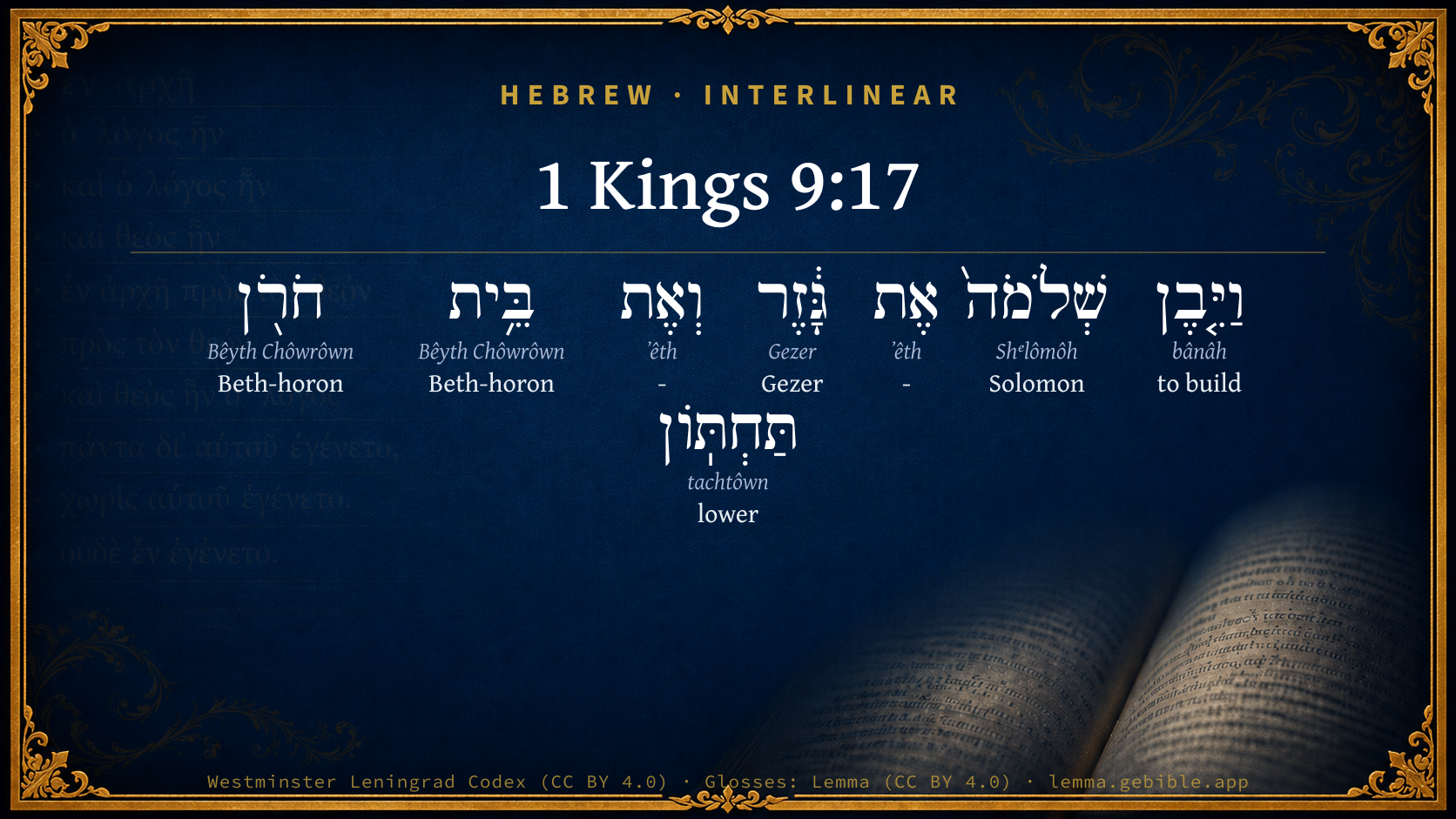
1 Kings 9:17

Hebrew (Westminster Leningrad Codex) 1 Kings 9:17 appears in the Hebrew Old Testament. The text above is from the Westminster Leningrad Codex. Each word links to its Strong’s number, a concise gloss, and parsing drawn from the Open Scriptures Hebrew Bible morphology. Click any word for its full Brown-Driver-Briggs (BDB) entry.
Download image
Cite this verse

1 Kings 9:17 (World English Bible). Public Domain. Lemma interlinear Bible study tool, https://lemma.gebible.app/v/1-kings/9/17.

Show BibTeX & RIS
BibTeX
RIS
English Translation
Solomon built Gezer, and Beth Horon the lower,
World English Bible · Public Domain
Download a study sheet

One document with this verse’s original text, its word-by-word gloss line, the meaning frame, cross-references with their text, attributed commentary, and full source and license credits — printable, and it pastes into notes with its structure intact.

This verse Autodidact and up

Study sheet (.html) Plain text (.txt)

A passage Seminary Student

Up to 50 verses in one chapter. A passage sheet keeps up to 6 commentary sources and 12 cross-references per verse, in the order this page ranks them, and says so on the sheet whenever that leaves anything out. Ask for a single verse and you get the Autodidact verse sheet above.

Everything on this page stays free to read, with no account — the sheet is a download of what is already on screen, not access to it.

Want to remove ads? Support Godless Engineer
Compare translations 3

The same verse in 3 English versions, stacked beneath the original-language interlinear above. Click any original word for its lexicon entry.

Each is an independent rendering of the whole verse — the interlinear is not word-aligned to these translations.

Highlighted words mark where these versions differ — a whole-verse word diff, not a word-by-word alignment.

  • World English Bible Public Domain
    Solomon built Gezer, and Beth Horon the lower,
  • King James Version Public Domain
    And Solomon built Gezer, and Bethhoron the nether,
  • unfoldingWord Literal Text CC BY-SA 4.0
    And Solomon built Gezer and Lower Beth Horon

unfoldingWord Literal Text — © unfoldingWord, licensed CC BY-SA 4.0. Word-aligned USFM3 via Door43 (git.door43.org/unfoldingWord/en_ult).

Versions to compare (up to 4)

3 of 4 selected

Show all 18 translations

Every available English version of this verse, each an independent rendering of the whole verse.

  • World English Bible Public Domain
    Solomon built Gezer, and Beth Horon the lower,
  • Berean Standard Bible Public Domain
    So Solomon rebuilt Gezer, Lower Beth-horon,
  • Majority Standard Bible Public Domain
    So Solomon rebuilt Gezer, Lower Beth-horon,
  • King James Version Public Domain
    And Solomon built Gezer, and Bethhoron the nether,
  • American Standard Version (1901) Public Domain
    And Solomon built Gezer, and Beth-horon the nether,
  • Revised Version (1885) Public Domain
    Solomon built Gezer, and Beth-horon the nether,
  • Geneva Bible (1599) Public Domain
    (Therefore Salomon builte Gezer and Beth-horon the nether,
  • Douay-Rheims (1899) Public Domain
    So Solomon built: Gazer, and Beth-horon the nether,
  • Young's Literal Translation Public Domain
    And Solomon buildeth Gezer, and Beth-Horon the lower,
  • Literal Standard Version CC BY-SA 4.0
    And Solomon builds Gezer, and the lower Beth-Horon,
  • Unlocked Literal Bible CC BY-SA 4.0
    So Solomon rebuilt Gezer and Beth Horon the Lower,
  • unfoldingWord Literal Text CC BY-SA 4.0
    And Solomon built Gezer and Lower Beth Horon
  • Darby Bible Public Domain
    -- And Solomon built Gezer, and lower Beth-horon,
  • World Messianic Bible Public Domain
    Solomon built in the land Gezer, Beth Horon the lower,
  • Webster's Bible Public Domain
    And Solomon built Gezer, and Beth-horon the nether,
  • Free Bible Version CC BY-SA 4.0
    Solomon rebuilt Gezer and lower Beth-horon,
  • Bible in Basic English Public Domain
    ... and Solomon was the builder of Gezer and Beth-horon the lower,
  • JPS Tanakh (1917) Public Domain
    And Solomon built Gezer, and Beth-horon the nether,

Literal Standard Version (2020), Covenant Press — licensed CC BY-SA 4.0. Text via the HelloAO Bible API (eBible.org). Unlocked Literal Bible (unfoldingWord) — licensed CC BY-SA 4.0. Text via the HelloAO Bible API (eBible.org). unfoldingWord Literal Text — © unfoldingWord, licensed CC BY-SA 4.0. Word-aligned USFM3 via Door43 (git.door43.org/unfoldingWord/en_ult). Free Bible Version, Dr. Jonathan Gallagher — licensed CC BY-SA 4.0. Text via the HelloAO Bible API (eBible.org).

Word by word

More ways to search: Search by grammar → Find every occurrence → Compare this word →

Practice this passage: Drill this verse → Learn its vocabulary →

About this verse

These counts appear in no published source. They are computed here, from the morphology-tagged text and Lemma’s own curated glosses. What Lemma adds →

8
words
6
distinct lemmas
Historical
section

Notable vocabulary

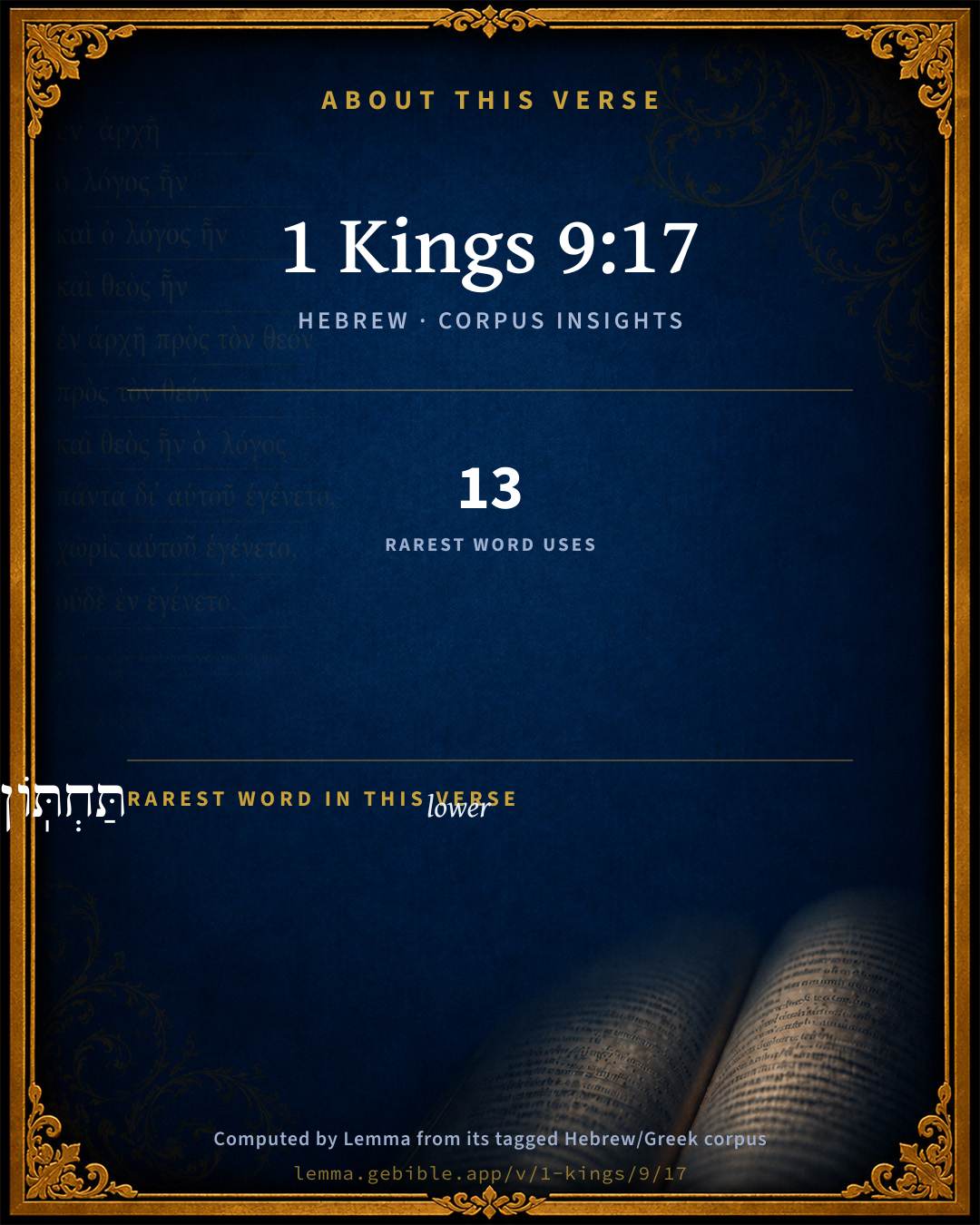
The rarest word here is תַּחְתּֽוֹן lower H8481 — appearing just 13 times in the whole Hebrew Bible.

Shared distinctive vocabulary

תַּחְתּֽוֹן lower H8481 occurs in 13 verses of the Hebrew Bible. Also found in:

Grammatical profile

  • 1 verb
  • 4 nouns
  • 1 adjective
  • 2 particles

Verb forms

  • וַיִּ֤בֶן Qal · Sequential Imperfect

Repetition

A word recurs within this verse — often emphatic in Hebrew:

  • בֵּ֥ית Beth-horon H1032 ×2

Cross-references

5

Topical passages linked to 1 Kings 9:17 in the Treasury of Scripture Knowledge — connected by theme and wording, ordered by reader-vote popularity; previews shown in the World English Bible.

  • Joshua 16:3 and it went down westward to the border of the Japhletites, to the border of Beth Horon the lower, even to Gezer; and the goings out of it were at the sea.
  • Joshua 21:22 and Kibzaim with its suburbs, and Beth Horon with its suburbs; four cities.
  • Joshua 10:10 Yahweh confused them before Israel, and he killed them with a great slaughter at Gibeon, and chased them by the way of the ascent of Beth Horon, and struck them to Azekah, and to Makkedah.
  • Joshua 19:44 and Eltekeh, and Gibbethon, and Baalath,
  • 2 Chronicles 8:4–18 He built Tadmor in the wilderness, and all the store-cities, which he built in Hamath.

Cross-references courtesy of OpenBible.info (CC BY 4.0).

Hebrew and Greek witnesses Masoretic Hebrew ↔ Greek Septuagint

The same verse in the two great witnesses to the Old Testament, shown verse-for-verse.

These are two independent witnesses, not word-aligned to each other, and the Septuagint is shown in lemma (dictionary) form.

Hebrew 1 Kings 9:17 Masoretic · Westminster Leningrad Codex

וַיִּ֤בֶן שְׁלֹמֹה֙ אֶת גָּ֔זֶר וְאֶת בֵּ֥ית חֹרֹ֖ן תַּחְתּֽוֹן

Solomon built Gezer, and Beth Horon the lower,

World English Bible · Public Domain

Greek LXX 1 Kings 9:17 Septuagint · lemma form

καί ἔρχομαι εἰς σωφηρα καί λαμβάνω ἐκεῖθεν χρυσίον ἑκατόν καί εἴκοσι τάλαντον καί φέρω ὁ βασιλεύς σαλωμών

No English rendering of this Greek verse — the small residue in the structurally divergent books.

Hebrew: Westminster Leningrad Codex (CC BY 4.0). Greek: Septuagint (public domain); English from a public-domain English Septuagint. How the Septuagint differs from the Hebrew →

Targum (Aramaic paraphrase)

1

The Targum is the ancient Jewish Aramaic paraphrase of the Hebrew Scriptures — an interpretive translation, not the Hebrew text itself. Onkelos (literal) and Pseudo-Jonathan (expansive) render the Torah, and Jonathan the Prophets. Coverage is partial: where no permissively-licensed English translation exists for a verse, only the Aramaic is shown. This is verse-level text, not a word-by-word alignment to the Hebrew.

  1. Targum Jonathan Prophets (Joshua–Malachi)
    וּבְנָא שְׁלֹמֹה יַת גָזֶר וְיַת בֵּית חוֹרוֹן אַרְעָאָהּ:

    (no public-domain English translation for this verse)

    Targum Jonathan — Aramaic: “Mikraot Gedolot” (public domain). English: “Sefaria Community Translation” (CC0 1.0 (public-domain dedication)); “London "Chaldee Paraphrase," 1871” (public domain). Text via Sefaria.

Commentary

Notes on 1 Kings 9:17 from classic Christian and Jewish commentators (each source and its license shown beneath its notes). The classic Christian expositions comment on the surrounding passage and are grouped to its opening verse, so a note may address several verses; the Jewish commentaries on the Tanakh (Rashi and others) are per-verse, so they appear only where the commentator wrote on this verse.

Lemma curates 59 commentaries, every one of them public domain or Creative Commons licensed, each selected and text-cleaned for this edition rather than reprinted as found. About our sources →

Trapp's Complete Commentary

John Trapp

1Ki 9:17 And Solomon built Gezer, and Bethhoron the nether,

Ver. 17. And Bethhoron, the nether.] Yea, both the Bethhorons, nether and upper too. {2Ch 8:5}

John Trapp, A Commentary or Exposition upon All the Books of the Old and New Testament (1647–1656) — public domain. Text from a community e-Sword module.

Joseph Benson's Commentary

1Ki 9:17-19. And Beth-horon the nether — The lower Beth-horon, which was in the tribe of Benjamin, Jos 18:13. Baalath — A city in the tribe of Dan, Jos 19:44. And Tadmor in the wilderness — The name of this city signifies wonderful, or admirable, and it was so named, probably, from the singularity of the thing, in finding here springs and wells of water, and other conveniences to subsist a city, among such horrid and parched sands, with which it was on all sides surrounded. It is probable that Solomon built this city among the deserts to hinder the communication between the Syrians and the inhabitants of Mesopotamia, that they might not join their forces in confederacy together against the Israelites, as they had done in the time of David. This city appears to have been the same which was afterward called Palmyra by the Greeks, the ruins of which still remain. Some English gentlemen of credit and fortune visited it about the year 1750, who have published such a description of the exceeding magnificence and beauty of its ruins, at this day, as is astonishing. We refer our readers to that publication, not only that they may receive great pleasure, but great improvement; since it is not possible to conceive higher ideas of Solomon’s magnificence than these ruins present, nor more humiliating ideas of the vanity and weakness of all human splendour. See Messrs. Dawkin’s and Wood’s Ruins of Palmyra. In the land — Of Hamath — Zoba, a part of Syria, as is said 2Ch 8:3-4, which country Solomon had conquered. And all the cities of store that Solomon had — Where he laid up corn against a time of need; or arms and ammunition in case of war. And cities for his chariots and — his horsemen — Which he had in great numbers.

Joseph Benson's Commentary on the Old and New Testaments (1811–1818) — public domain. Text from a community e-Sword module.

Tyndale Open Study Notes

Tyndale Open Resources

9:17-18 Lower Beth-horon was an important defensive site for western Judah. Several cities in Canaan were called Baalath; the one here was probably also known as Kiriath-jearim (2 Sam 6:2; see Josh 15:9; 1 Chr 13:5, 6). Tamar was probably located in the southeastern quarter of the Holy Land (see Ezek 47:19; 48:28).

Tyndale Open Study Notes — © Tyndale Open Resources, licensed CC BY-SA 4.0. Text via the HelloAO Bible API.

Jamieson, Fausset & Brown

Robert Jamieson, A. R. Fausset & David Brown

Beth-horon the nether--situated on the way from Joppa to Jerusalem and Gibeon; it required, from so public a road, to be strongly garrisoned.

Jamieson, Fausset & Brown — Commentary Critical and Explanatory on the Whole Bible (1871) — public domain (CC PDM 1.0). Text via the HelloAO Bible API.

Ellicott's Commentary for English Readers

(17) Beth-horon the nether.—The name “Beth-horon” (“the house of caves,”) was given to two small towns or villages (still called Beit-ûr), near Gezer, commanding the steep and rugged pass from the maritime plain, celebrated for three great victories of Israel—the great victory of Joshua (Joshua , 10), the victory of Judas Maccabæus (1Ma_3:13-24), and the last victory of the Jews over the Roman army of Cestius Gallus, before the fall of Jerusalem (Josephus, Wars of the Jews, ii. 19). The lower Beth-horon stands On a low eminence on the edge of the plain.

A Bible Commentary for English Readers, edited by Charles John Ellicott (1878–1897) — public domain. Text from a community e-Sword module.

The Cambridge Bible for Schools and Colleges

gen. ed. J. J. S. Perowne

17. and Beth-horon the nether] This was one of two towns named respectively ‘upper’ and ‘nether’ Beth-horon which lay between Gibeon and Azekah, the one at the top of the ascent, the other in the valley westward. The latter, which is the place here mentioned, was important as forming a barrier against foes from the direction of Philistia and Egypt, and for this reason no doubt it was fortified by Solomon. In earlier history the place is famous for Joshua’s victory (Joshua 10.) over the five kings of the Amorites, and later for the overthrow of the Syrian forces by Judas Maccabaeus (1 Maccabees 3.).

The Cambridge Bible for Schools and Colleges (gen. ed. J. J. S. Perowne; Cambridge University Press, 1878–1918) — public domain. Text from a community e-Sword module.

John Gill's Exposition

And Baalath,.... A city in the tribe of Dan, Jos 19:44.

and Tadmor in the wilderness, in the land; or "Tamar", as in the Cetib, or Scriptural reading; for we go according to the marginal reading, and so Thamato in Ptolemy (p); and is thought by some to be the same with Tamar in Eze 47:19, which Jerom there says is Palmyra. Tamar signifies a palm tree, from whence this city had its name Palmyra, the situation of which place agrees with this; hence we read both in Ptolemy (q) and Pliny (r) of the Palmyrene deserts: the ruins of it are to be seen to this day, and of it this account is given; that it is enclosed on three sides with long ridges of mountains, which open towards the east gradually, to the distance of about an hour's riding; but to the south stretches a vast plain, beyond the reach of the eye; the air is good, but the soil exceeding barren; nothing green to be seen therein, save some few palm trees in the gardens, and here and there about the town; and from these trees, I conceive, says my author, it obtained its name both in Hebrew and in Latin: it appears to have been of a large extent, by the space now taken up by the ruins; but there are no footsteps of any wall remaining, nor is it possible to judge of the ancient figure of the place. The present inhabitants, as they are poor, miserable, dirty people, so they have shut themselves up, to the number of about thirty or forty families, in little huts made of dirt, within the walls of a spacious court, which enclosed a most magnificent Heathen temple (s). Benjamin of Tudela says (t), it is situated in a wilderness, far from any habitable place, and is four days' journey from Baalath before mentioned; which place he takes to be the same with Baalbek, in the valley of Lebanon, built by Solomon for Pharaoh's daughter; which, according to the Arabic geographer (u), was situated at the foot of Mount Lebanon; and Tadmor seems to be in the land of Hamathzobah, Ch2 8:3.

(p) Geograph. l. 5. c. 16. (q) Ib. c. 15. (r) Nat. Hist. l. 5. c. 26. & 6. 28. (s) Halifax apud Philosphic. Transact. vol. 3. p. 504. (t) Itinerar. p. 57, 58. (u) Geograph. Nub. par. 5. clim. 3. p. 117.

John Gill's Exposition of the Whole Bible (1746–1763) — public domain (CC PDM 1.0). Text via the HelloAO Bible API.

Albert Barnes' Notes on the Bible

Beth-horon the nether - See the marginal reference note.

Albert Barnes' Notes on the Bible (1834–1885) — public domain. Text from a community e-Sword/MySword module.

Haydock's Catholic Bible Commentary

Nether, in the tribe of Benjamin. 2 Paralipomenon (viii. 5.) adds, the upper, which was a town of Ephraim. (Menochius)

George Leo Haydock (1774–1849), Haydock's Catholic Family Bible and Commentary, 1859 edition — public domain. Excludes Psalms (Douay-Rheims chapter numbering differs from Protestant) and Deuterocanonical books (Catholic canon only).

Matthew Poole's English Annotations

In Benjamin, Jos 18:13,14; and Beth-horon the upper, which is added 2Ch 8:5, a city in the tribe of Ephraim, Jos 16:5, possibly bordering upon Benjamin, and nigh unto the lower

Beth-horon; which alone may be here mentioned, either because it was the more famous place, or because it needed more reparations.

Matthew Poole's English Annotations on the Holy Bible (1683–1685) — public domain. Text from a community e-Sword/MySword module.

Whedon's Commentary on the Bible

Daniel D. Whedon

17. Solomon built Gezer — That is, rebuilt and fortified the city on the ruined site of the former town. So doubtless of all the other cities mentioned in this chapter, which had existence before. The work of Solomon was that of rebuilding, repairing or enlarging, and fortifying.

Beth-horon the nether — See on Jos_10:10.

Daniel D. Whedon (gen. ed.), Commentary on the Old and New Testaments (1874–1909) — public domain. Text from a community e-Sword module.

The Pulpit Commentary

And Solomon built Gezer In the case of Gezer it was an actual rebuilding. But as applied to Beth-boron, etc., "built" probably means enlarged, strength ened and Beth-horon the nether mentioned in connexion with Gezer, Jos_16:3 (cf. 10:10). It is deserving of mention that the two cities of Beth-horon still survive in the modern villages of Beitur el-tahta and el-fok," names which are "clearly corruptions of Beth-horon "the Nether" and "the Upper" (Stanley, S. and P., p. 208): One lies at the foot of the ravine, on an eminence, the other at the summit of the pass. Like Megiddo and Gezer, this town, too, lay on a high road, viz., that between Jerusalem and the sea coast. The selection of Beth-horon for fortification by Solomon is also justified by history three decisive battles having been fought here. (see Jos_10:10 RAPC 1Macc 3:13-24, and Jos., Bell Jud_1:2:19:8) The object of the king in fortifying this place was to protect the uplands of Judah, Benjamin, and Ephraim against invasion from the Philistine plain. It is perhaps not unnoteworthy that, according to our author, it was Beth-horon the nether that Solomon "built," as this would naturally have suffered more than its loftier neighbour from war. According to 2Ch_8:5, however, Solomon built Beth-horon the upper also.

The Pulpit Commentary (1880–1919), ed. H.D.M. Spence-Jones & Joseph S. Exell — public domain. Text from a community e-Sword module.

unfoldingWord translationNotes

Door43 World Missions Community

So Solomon rebuilt Gezer

It might be best to translate so that the reader understands that other people helped Solomon do this. (See: Synecdoche)

translationWords

desert

Judah

possess

chariot

horseman

Lebanon

unfoldingWord translationNotes — © Distant Shores Media and the Door43 World Missions Community, licensed CC BY-SA 4.0. Source: git.door43.org/Door43/en_tn.

Lesson kit

Teaching starters — assembled from the data on this page, not authored interpretation. Every prompt links to the verse data it draws on. Edit before teaching.

1 Kings, in the Historical, opens this verse with 8 words (6 distinct Hebrew lemmas). Its most distinctive word is tachtôwn (“lower”). A historical commentator’s framing appears above. Read the whole chapter for the surrounding context.

Discussion questions

  1. The word tachtôwn carries the sense “lower.” How does it shape the verse?
  2. Joshua 16:3 shares the word «lower» with this verse. How do the two illuminate each other?
  3. “Beth-horon” occurs 2× in this one verse. What is the effect of the repetition?
  4. These translations render this verse differently; the difference is in the English rendering, not the original. What questions does that raise?
  5. The verb «וַיִּ֤בֶן» is Qal Sequential Imperfect. How does its form color the action?
  6. Reading how Trapp's Complete Commentary and Joseph Benson's Commentary read this verse, where do the two commentators agree and where do they part?

Things to notice

  • These translations choose different wording for 5 words in this verse.
  • “Beth-horon” occurs 2× in this single verse.
  • 6 distinct Hebrew lemmas span 8 words in this verse.

Reading settings

Reading text

Shown beneath each verse's original-language words.

Old Testament
Old Testament edition

Read the OT as the Masoretic Hebrew (MT) or the Greek Septuagint (LXX).

English shown for the Greek Septuagint (in the Hebrew ↔ Greek comparison).

Comparing translations? Open the Compare panel on any verse page to stack up to four side by side.