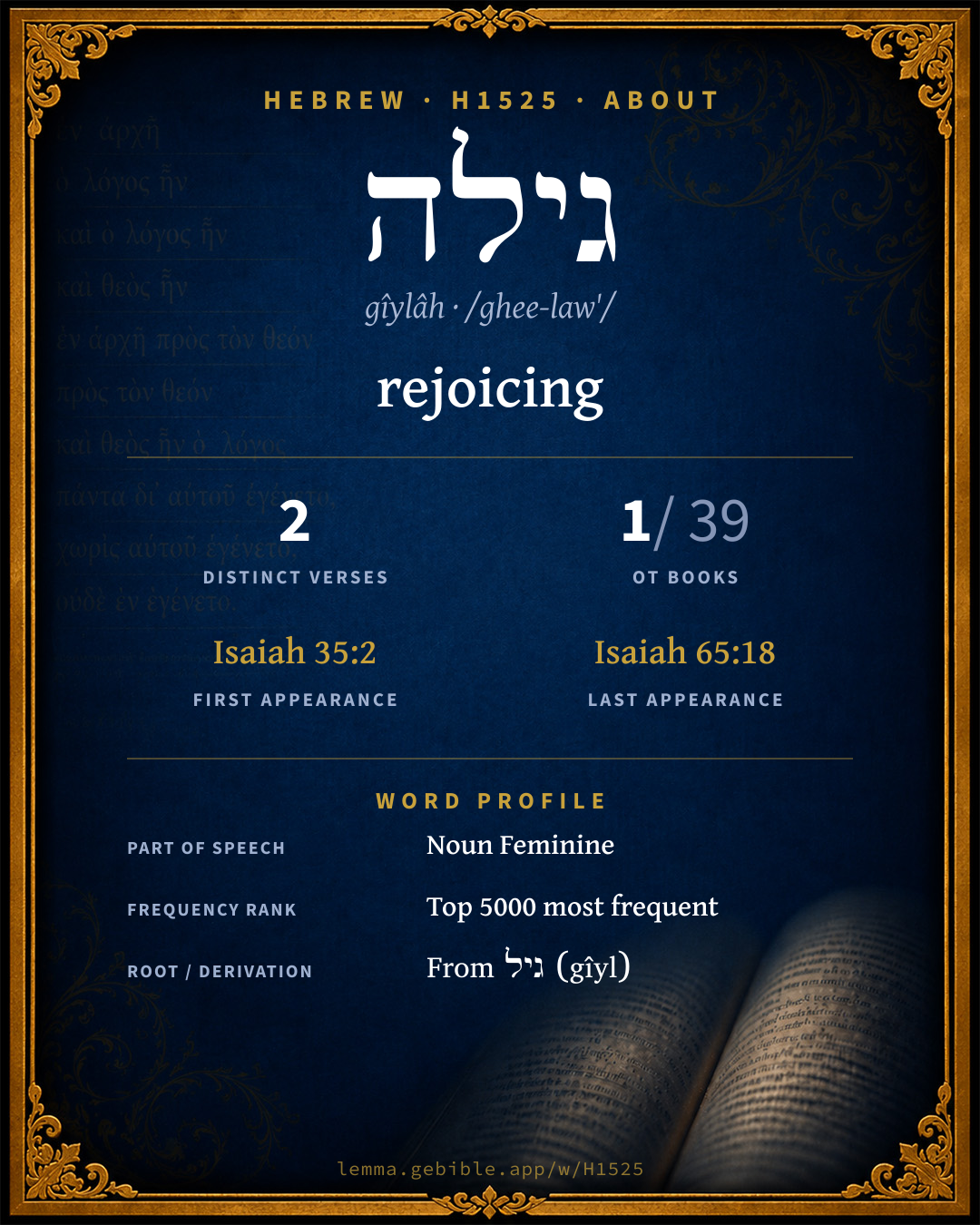
גִּילָה
rejoicing
Full lexicon entry — Brown-Driver-Briggs (BDB)
From Brown-Driver-Briggs (BDB)
Where this word appears
See every Absolute-state word in the Hebrew Bible →
Grammar key — what these labels mean
Part of speech
- Noun
- A naming word — a person, place, thing, or idea.
Noun type
- Common
- A common noun — a general class of person, place, or thing (“king,” “city,” “water”), not a specific name.
State
- Absolute
- The independent form of a noun, not bound to a following word.
- Construct
- A noun bound to a following noun in a possessive / “of” relationship (the construct chain).
Gender
- Feminine
- Grammatically feminine.
Number
- Singular
- One.
Grammatical forms
- Noun, Common, Feminine, Singular, Absolute 1 time (50%)
- Noun, Common, Feminine, Singular, Construct 1 time (50%)
Parsed forms decoded from the imported morphology (morphhb / Westminster Leningrad Codex — WLC text public domain, morphhb tagging CC BY 4.0), counted across 2 parsed occurrences — not distinct verses.
Every verse where H1525 appears — 2 distinct verses across 1 book. Click any verse to open its interlinear word-by-word view. Verse text shown in the World English Bible for context — . Each verse’s Hebrew form is shown with its reference; the English is not keyword-highlighted, since the data carries no word-level English alignment. Use “Compare translations” on any verse to read it across multiple English versions. This concordance covers the Hebrew Bible; Septuagint (Greek Old Testament) occurrences are not indexed here.
Isaiah 2 verses
- Isaiah 35:2 גִּילַ֣ת n c fs cs It shall blossom abundantly, and rejoice even with joy and singing; the glory of Lebanon shall be given to it, the excellency of Carmel and Sharon: they shall see the glory of Yahweh, the excellency of our God.
- Isaiah 65:18 גִּילָ֖ה n c fs But be you glad and rejoice forever in that which I create; for, behold, I create Jerusalem a rejoicing, and her people a joy.
About this entry
At a glance — auto-summarized from this page’s data, not written by a person. Every figure links to its source below. This summary describes the numbers; it doesn’t interpret them.
At its core, גילה (gîylâh) means “rejoicing.” It is rare — just 2 verses in the entire Hebrew Bible. The word gravitates to Isaiah (100%). Scripture first uses it in Isaiah 35:2. Each statement above links to its evidence; the full detail follows below.
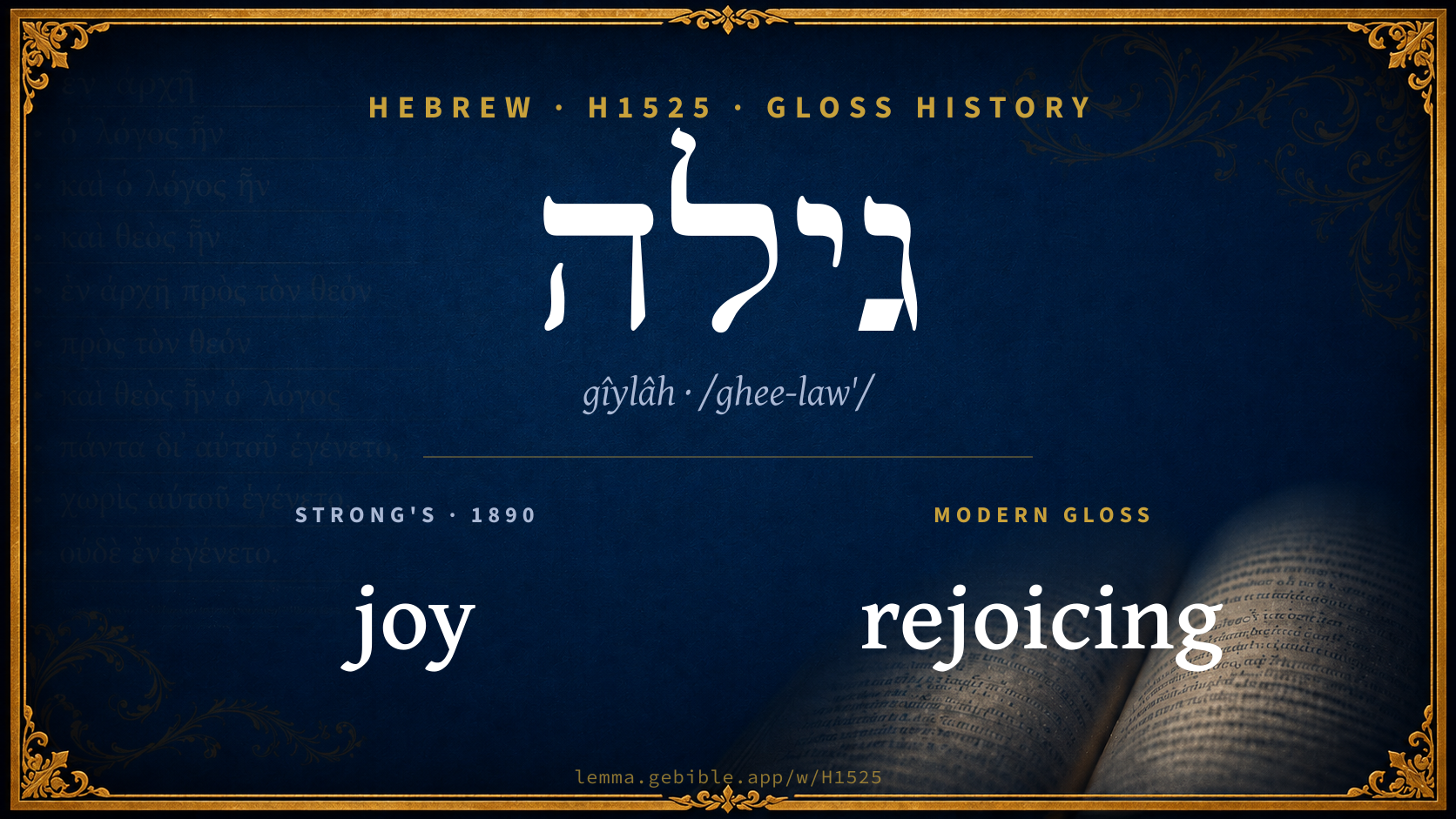
Gloss history
Strong's 1890 vs modern scholarship
About this word
Strong's H1525 catalogs a Hebrew word from the Hebrew Old Testament.
These counts are not copied from any lexicon or concordance. They are computed here, from the morphology-tagged Hebrew Old Testament. What Lemma adds →
- 2
- distinct verses
- The word appears in 2 distinct verses.
- 1 / 39
- OT books
- The word appears in 1 of 39 Old Testament books.
- #4,807
- by frequency
- Top 5000 most frequent Hebrew words (rank 4,807 of 8,640 Hebrew words by occurrence).
View all 2 occurrences in the concordance →
Most concentrated in
- Isaiah 2 verses 100%
By section of the Old Testament
By traditional corpus
Conventional, traditional groupings — biblical authorship is debated, so this is a traditional corpus grouping, not an authorship claim. Each share is this word’s portion of its verses in that division of the Hebrew canon. Each figure is a share of the word’s 2 distinct verses.
- Prophets (Nevi'im) 2 verses · 100%
How translations render this word
Counts come from each version’s own published word-to-Strong’s tagging or interlinear alignment — an approximate guide to how each version renders this word, not a word-level alignment the data otherwise carries. Because each total is that version’s own tagged count, the per-version totals vary from one another and need not match the appearance or distinct-verse counts above. These counts may also differ from a printed concordance because Lemma counts each distinctly tagged rendering and does not collapse phrase taggings into a single head-word total. This is a fixed set of word-tagged versions (KJV, ASV, BSB, ULT) and does not change with the reading translation you choose elsewhere. Each version’s license is shown beside its name below (and on Sources).
- King James Version: Joy 1×, Rejoicing 1×
- American Standard Version: Joy 1×, Rejoicing 1×
- Berean Standard Bible: Be a joy 1×, Joy 1×
- unfoldingWord Literal Text: Gladness 1×, Rejoicing 1×
King James Version Public Domain
Renders H1525 across 2 tagged occurrences — most commonly:
American Standard Version Public Domain
Renders H1525 across 2 tagged occurrences — most commonly:
Berean Standard Bible Public Domain
Renders H1525 across 2 tagged occurrences — most commonly:
unfoldingWord Literal Text CC BY-SA 4.0
Renders H1525 across 2 tagged occurrences — most commonly:
Senses in BDB
The 1 sense BDB distinguishes for this word, in lexicon order (not ranked by frequency or importance). The full entry — with sub-senses — is in the Lexicon Entry tab.
- rejoicing
Word origin
n.f. rejoicing Is 65:18, גִּילַת וְרַנֵּן Is 35:2 (nom. verbal. for Inf. abs. cf. De Di; cstr. before וְ Ges§ 130. 2; but read prob. גִּילָה); הַגִּילָה read Is 9:2 for הַגּוֹי לֹא by Krochm Che RS Di.
— Brown-Driver-Briggs (Oxford 1906, public domain), digitized via Sefaria, supplemented by the OpenScriptures HebrewLexicon (CC BY 4.0). See Sources.
Derived from גיל (gîyl) (H1524) — rejoicing.
Jastrow Dictionary
A second Hebrew/Aramaic lexicon for comparison, covering Aramaic and post-biblical (Talmudic, Targumic, Midrashic) usage that the biblical-Hebrew BDB does not. Matched by lemma rather than by Strong’s number, so a lemma may carry more than one Jastrow headword (shown separately below), and the entries cover usage well beyond the Bible.
גִּילָה
- gathering; rejoicing. Ber. 30ᵇ (ref. to Ps. II, 11) במקום ג׳ שם תהא רעדה where there is a gathering (for prayer and the like) there shall be trembling, v. גִּיל I e.g. Psalms 2:11
גִּילָּה
- , v. גִּלָּה
גלי
- (b. h.)
- 1. to be uncovered. Tosef. Mikv. III, 1 a pit שגָּלַת ed. Zuck. which was left open.—Part. pass. גָּלוּי open, revealed. Sabb. 55ᵃ ג׳ וידוע וכ׳ it is open and known to me. Ber. 60ᵇ; a. fr. V. גָּלוּי.
- 2. (of a place) to become bare of inhabitants (v. Jud. XVIII, 30; Jer. I, 3); (of the inhabitants) to leave home, go into exile. Y. Taan. I, 64ᵃ top בכ"מ שגָּלוּ … גָּלַת וכ׳ whithersoever Israel went as exiles, the Divine Majesty went with them (ref. to נגלה, I Sam. II, 27); Meg. 29ᵃ; a. e.—Pesik. Haḥod. p. 48ᵃ אם ג׳ אחד מכם … כאילו גְּלִיתֶם כולכם if one of you is banished (by the Roman Government) to &c.: … as though ye all had been banished; Pesik. R. s. 15; Cant. R. to II, 8. Arakh. 12ᵃ; Meg. 11ᵇ גָּלוּ בשבע they were transported to Babylonia in the seventh year (after the subjection of Jojakim). Macc. II, 1 אלו הן הַגּוֹלִין the following (involuntary homicides) have to leave for the city of refuge. Ib. אינו גוֹלֶה is not bound to flee to &c. Ib. 3 האב גולה ע"י הבן a father is banished for killing his son; a. fr. e.g. Judges 18:30
- to banish, carry into captivity. Macc. 12ᵇ היו … מַגְלִין וכ׳ the Israelites executed the law of banishment in the desert. Num. R. s. 23, end. Ruth R. to I, 1 ומַגְלָם מארצם and is the cause of their exile &c.; a. fr.—Koh. R. to XII, 6 (play on גלת ib.) ‘the golden bowl’ is the gullet, שהיא מַגְלָה את הזהב ומריצה וכ׳ (not שהיה; Lev. R. s. 18 שמכלה, corr. acc.) which banishes the gold and makes the silver run, i.e. which impoverishes the glutton.
- to be discovered, exposed to view; to reveal one’s self, appear. Tanḥ. Sh’moth 19 נ׳ עליו בקולו וכ׳ He revealed Himself to Moses with the voice of Amram &c.; Ex. R. s. 3. Ex. R. s. 2, end בכ"מ שהשכינה נִגְלֵית wherever the Divine Glory appears. Snh. II, 1, v. כָּסָה II; a. fr.
- to uncover, remove; to discover, reveal, publish. Ex. R. s. 15, beg. גִּלּוּ הצדיקים וכ׳ the righteous uncovered their heads. Sot. V, 2; Gen. R. s. 21 מי יְגַלֶּה עפר וכ׳ Oh that one would remove the dust from over thy eyes, i.e. Oh, that thou wouldst resurrect!; Y. Ber. IX, 13ᵈ bot.—Sabb. 88ᵃ מי גי׳ וכ׳ who revealed this secret to my children? Meg. 3ᵃ; a. fr.—ג׳ משפחות to expose to suspicion the legitimacy of families. Tosef. Naz. I, 3; Kidd. 71ᵃ.—ג׳ פנים בתורה (שלא כהלכה) a) to interpret the Law in opposition to the adopted sense, tomisinterpret, pervert. Ab. III, 11; a. e. b) to put the Law to shame by treating its teachers irreverently. Snh. 99ᵃ; a. e.—ג׳ פנים (in gen.) to expose, put to shame. Pirké d’R. El. ch. XLIV, v. לָבַן II.—Part. pass. מְגוּלֶּה, f. מְגוּלָּה uncovered. Par. XI, 1; Ḥull. 9ᵇ; a. fr. Pl. מְגוּלִּין. Ib.; a. fr.
- to be revealed; to be exposed. Pirké d’R. El. ch. XXIII ונתגל בתוך האהל his nakedness was exposed &c. Yoma 9ᵇ נתג׳ עונם their sins were public (they did not hide them); נתג׳ קיצם the end of their captivity was revealed (through prophecy). Naz. 23ᵇ נ׳ קלונו his disgrace is published.—Pes. 119ᵃ; a. fr.—Tanḥ. Mishp. 6; Yalk. Prov. 956, v. גָּלַע.
A Dictionary of the Targumim, the Talmud Babli and Yerushalmi, and the Midrashic Literature (Marcus Jastrow; London, Luzac, 1903) — Public Domain. Digitized via Sefaria. Digitized via Sefaria. Full attribution on Sources.
Forms in the corpus
The 2 distinct written forms H1525 takes in the Hebrew Bible, most frequent first — each parse links to that state’s occurrences in the concordance. Hebrew forms include their vowel points and cantillation, so a single lemma takes many written forms.
| Form | Parsing | Example | Uses |
|---|---|---|---|
| גִּילַ֣ת | Noun, Common, Feminine, Singular, Construct | Isaiah 35:2 | 1 |
| גִּילָ֖ה | Noun, Common, Feminine, Singular, Absolute | Isaiah 65:18 | 1 |
Septuagint verse parallels
This word appears in 2 verses that also exist in the Greek Old Testament (Septuagint), out of the 2 Hebrew verses it occurs in. You can read those verses in Greek by switching the Old Testament edition to the Septuagint.
Read these verses in the Septuagint
This is a verse-level parallel only — the same verses exist in both the Hebrew and Greek Old Testaments. No word-level Hebrew↔Greek correspondence is claimed: the data carries no such alignment, so no Greek word is shown as this Hebrew word’s translation. Coverage is not total — the Septuagint omits the deuterocanon and renumbers the Psalms, so some Hebrew verses have no direct Greek parallel.