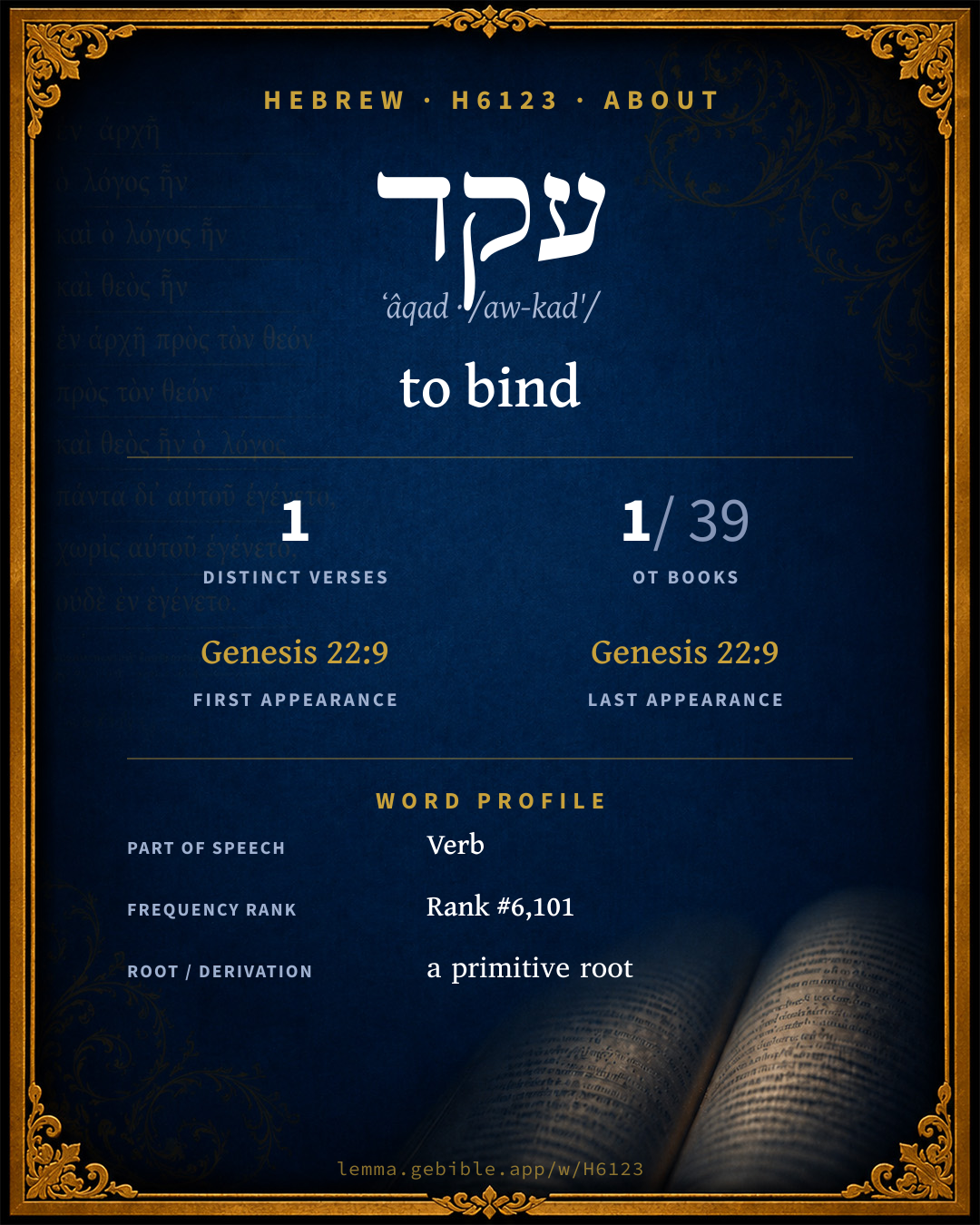
עָקַד
to bind
Full lexicon entry — Brown-Driver-Briggs (BDB)
From Brown-Driver-Briggs (BDB)
Where this word appears
Grammar key — what these labels mean
Stem
- Qal
- The basic, simple active stem — the plain form of the verb (“he wrote”).
Form
- Sequential Imperfect
- An imperfect with prefixed waw — the standard past-narrative form (waw-consecutive imperfect).
Person
- 3rd Person
- The one spoken about (“he / she / it / they”).
Gender
- Masculine
- Grammatically masculine.
Number
- Singular
- One.
Every verse where H6123 appears — 1 distinct verse across 1 book. Click any verse to open its interlinear word-by-word view. Verse text shown in the World English Bible for context — . Each verse’s Hebrew form is shown with its reference; the English is not keyword-highlighted, since the data carries no word-level English alignment. Use “Compare translations” on any verse to read it across multiple English versions. This concordance covers the Hebrew Bible; Septuagint (Greek Old Testament) occurrences are not indexed here.
Genesis 1 verse
About this entry
At a glance — auto-summarized from this page’s data, not written by a person. Every figure links to its source below. This summary describes the numbers; it doesn’t interpret them.
עקד — transliterated ʻâqad — is a Hebrew verb carrying the sense “to bind.” A scarce word — 1 verse in all of the Hebrew Bible. More than three-quarters of its appearances fall in Genesis. A true hapax — its single appearance is Genesis 22:9. It shares a root with עקד. Each statement above links to its evidence; the full detail follows below.
Gloss history
Strong's 1890 vs modern scholarship
About this word
Strong's H6123 catalogs a Hebrew word from the Hebrew Old Testament.
These counts are not copied from any lexicon or concordance. They are computed here, from the morphology-tagged Hebrew Old Testament. What Lemma adds →
- 1
- distinct verses
- The word appears in 1 distinct verse.
- 1 / 39
- OT books
- The word appears in 1 of 39 Old Testament books.
- #6,101
- by frequency
- Rank #6,101 (rank 6,101 of 8,640 Hebrew words by occurrence).
View all 1 occurrence in the concordance →
Most concentrated in
- Genesis 1 verse 100%
By section of the Old Testament
By traditional corpus
Conventional, traditional groupings — biblical authorship is debated, so this is a traditional corpus grouping, not an authorship claim. Each share is this word’s portion of its verses in that division of the Hebrew canon. Each figure is a share of the word’s 1 distinct verse.
- Torah (Pentateuch) 1 verse · 100%
How translations render this word
Counts come from each version’s own published word-to-Strong’s tagging or interlinear alignment — an approximate guide to how each version renders this word, not a word-level alignment the data otherwise carries. Because each total is that version’s own tagged count, the per-version totals vary from one another and need not match the appearance or distinct-verse counts above. These counts may also differ from a printed concordance because Lemma counts each distinctly tagged rendering and does not collapse phrase taggings into a single head-word total. This is a fixed set of word-tagged versions (KJV, ASV, BSB, ULT) and does not change with the reading translation you choose elsewhere. Each version’s license is shown beside its name below (and on Sources).
- King James Version: Bound 1×
- American Standard Version: Bound 1×
- Berean Standard Bible: He bound 1×
- unfoldingWord Literal Text: He bound 1×
King James Version Public Domain
Renders H6123 across 1 tagged occurrence — most commonly:
American Standard Version Public Domain
Renders H6123 across 1 tagged occurrence — most commonly:
Berean Standard Bible Public Domain
Renders H6123 across 1 tagged occurrence — most commonly:
unfoldingWord Literal Text CC BY-SA 4.0
Renders H6123 across 1 tagged occurrence — most commonly:
Senses in BDB
The 1 sense BDB distinguishes for this word, in lexicon order (not ranked by frequency or importance). The full entry — with sub-senses — is in the Lexicon Entry tab.
- (Qal) to bind, tie
Word origin
[ עָקַד ] vb. bind;— Qal Gn 22:9.
— Brown-Driver-Briggs (Oxford 1906, public domain), digitized via Sefaria, supplemented by the OpenScriptures HebrewLexicon (CC BY 4.0). See Sources.
Origin: a primitive root
Jastrow Dictionary
A second Hebrew/Aramaic lexicon for comparison, covering Aramaic and post-biblical (Talmudic, Targumic, Midrashic) usage that the biblical-Hebrew BDB does not. Matched by lemma rather than by Strong’s number, so a lemma may carry more than one Jastrow headword (shown separately below), and the entries cover usage well beyond the Bible.
עָקַד
- (b. h.) [to bend; cmp. כָּפַת,]
- 1. to tie hand to foot, contrad. to כפת (v. infra). Gen. R. s. 56 כל מה שהיה אברהם אבינו עוֹקֵד … הקב"ה כופת וכ׳ as Abraham was tying his son here below, so the Lord bound &c. Lev. R. s. 2; a. fr.—Part. pass. עָקוּד. Sabb. V, 3 לא ע׳ ולא רגול, expl. ib. 54ᵃ ע׳ עקידת יד ורגל כיצחק וכ׳ ʿaḳud refers to tying foreleg to hindleg like the tying of Isaac &c., ragul refers to bending the forefoot upward and tying it to the foreleg; Y. ib. V, 7ᵇ bot. ע׳ בידו אחת; Tosef. ib. IV (V), 3 (v. Var. ed. Zuck.); a. e.
- 2. (denom. of עֲקֵידָה) to sacrifice. R. Hash. 16ᵃ כאילו עֲקַדְתֶּם וכ׳ as if you offered yourselves, v. עֲקֵידָה. Lev. R. s. 30 (play on כפת, Lev. XXIII, 40) זה יצחק שהיה כפות ועָקוּד וכ׳ this typifies Isaac, who was tied and offered up on the altar; a. e. —Gitt. 57ᵇ אתה עָקַדְתָּ אחד ואני עָקַדְתִּי וכ׳ מזבח thou (Abraham) hast put up one altar, but I have put up seven altars (offered seven martyred sons). e.g. Leviticus 23:40
- to be tied; to be put on the altar. Gen. R. l. c. זה לַעֲקוֹד וזה לֵיעָקֵד the one (ready) to sacrifice, the other to be sacrificed. Pirké d’R. El. ch. XXXI; Yalk. Gen. 101 האב מַעֲקִיד בכל לב והבן נ׳ וכ׳ the father offering with a whole heart, and the son offering himself with a whole heart. Ib. רחם … שהוא אדם ובן אדם ונ׳ וכ׳ have pity on Isaac who is a human being, son of a human being, and is being offered before thee like a dumb beast; a. fr.
- 1. to tie (foreleg to hindleg). Tam. IV, 1 (30ᵇ) לא היו כופתין … אלא מַעֲקִידִין אותו (Mish. ed. מְעַקְּדִין Pi.) they did not bind the lamb (all feet together), but tied it, expl. ib. 31ᵇ יד ורגל כעקידת וכ׳, v. supra.
- 2. to put on the altar. Pesik. Aḥãré, p. 170ᵇ והֶעֱקִידוֹ ע"ג המזבח and laid him tied on the altar; a. e.
- same, v. supra.
עֲקַד
- 1. same, to tie; to offer. Targ. O. Gen. XXII, 9. Targ. Y. II, Lev. XXII, 27. Targ. II Esth. V, 1; a. e.—
- *2. to bend, bow. Targ. Y. II, Ex. IV, 31. Ib. XXXIV, 8 (ed. Vien. אֲקַד). Targ. Y. Gen. XXIV, 48 ועקדית Ar. (ed. וגחנית).
- to be tied; to be put on the altar. Targ. Mic. VII, 20. Targ. Y. I Lev. l. c. (Y. II עקד גרמיה). Targ. II Esth. l. c.; a. e.
A Dictionary of the Targumim, the Talmud Babli and Yerushalmi, and the Midrashic Literature (Marcus Jastrow; London, Luzac, 1903) — Public Domain. Digitized via Sefaria. Digitized via Sefaria. Full attribution on Sources.
Same root — word family
Other BDB entries built from the same root as H6123, grouped by Strong’s listed origin. These share a root / origin per the lexicon — not necessarily a shared meaning. Each links to that word’s own entry.
Derived from this word
Compare all same-root words → They share a root, not necessarily a meaning.
Septuagint verse parallels
This word appears in 1 verse that also exists in the Greek Old Testament (Septuagint), out of the 1 Hebrew verse it occurs in. You can read those verses in Greek by switching the Old Testament edition to the Septuagint.
Read these verses in the Septuagint
This is a verse-level parallel only — the same verses exist in both the Hebrew and Greek Old Testaments. No word-level Hebrew↔Greek correspondence is claimed: the data carries no such alignment, so no Greek word is shown as this Hebrew word’s translation. Coverage is not total — the Septuagint omits the deuterocanon and renumbers the Psalms, so some Hebrew verses have no direct Greek parallel.