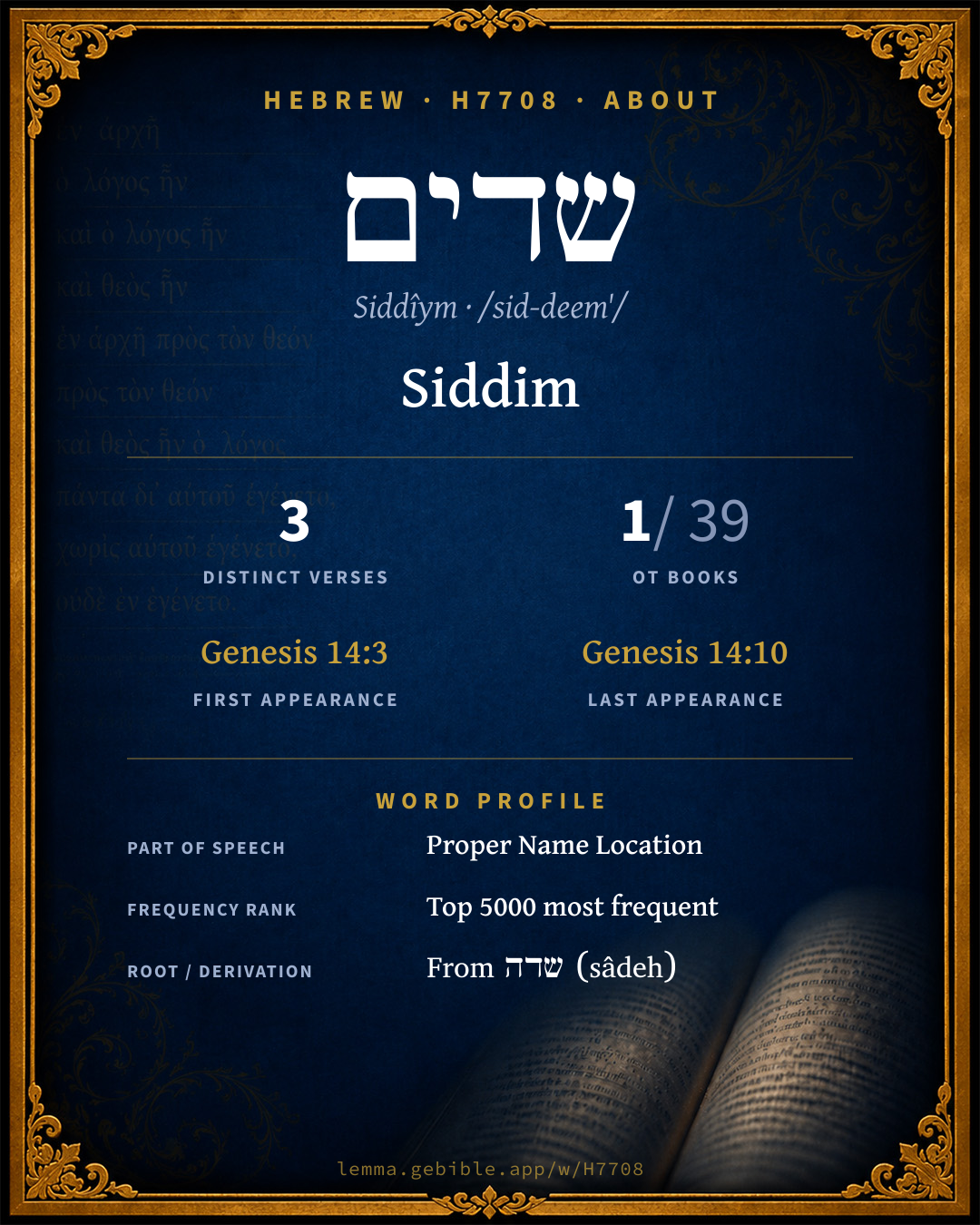
שִׂדִּים
Siddim
BDB lists 2 entries for ‘Siddim’ fuller range ↓
Full lexicon entry — Brown-Driver-Briggs (BDB)
From Brown-Driver-Briggs (BDB)
Where this word appears
Grammar key — what these labels mean
Noun type
- Proper
- A name of a specific person, place, or people (e.g. Abraham, Zion, Israel).
Every verse where H7708 appears — 3 distinct verses across 1 book. Click any verse to open its interlinear word-by-word view. Verse text shown in the World English Bible for context — . Each verse’s Hebrew form is shown with its reference; the English is not keyword-highlighted, since the data carries no word-level English alignment. Use “Compare translations” on any verse to read it across multiple English versions. This concordance covers the Hebrew Bible; Septuagint (Greek Old Testament) occurrences are not indexed here.
Genesis 3 verses
- Genesis 14:3 הַ/שִּׂדִּ֑ים ptcl def.art + n Proper All these joined together in the valley of Siddim (the same is the Salt Sea).
- Genesis 14:8 הַ/שִּׂדִּֽים ptcl def.art + n Proper There went out the king of Sodom, and the king of Gomorrah, and the king of Admah, and the king of Zeboiim, and the king of Bela (the same is Zoar); and they set the battle in array against them in the valley of Siddim;
- Genesis 14:10 הַ/שִׂדִּ֗ים ptcl def.art + n Proper Now the valley of Siddim was full of tar pits; and the kings of Sodom and Gomorrah fled, and they fell there, and those who remained fled to the mountain.
About this entry
At a glance — auto-summarized from this page’s data, not written by a person. Every figure links to its source below. This summary describes the numbers; it doesn’t interpret them.
שדים (Siddîym) is a Hebrew name most often rendered “Siddim.” With only 3 verses it sits in the long tail of Hebrew Bible vocabulary. Genesis dominates its distribution — 3 of 3 verses. Debuting at Genesis 14:3, it then recurs through the corpus. For the data behind this summary, explore 3-verse concordance and the renderings breakdown below.
Gloss history
Strong's 1890 vs modern scholarship
About this word
Strong's H7708 catalogs a Hebrew word from the Hebrew Old Testament.
These counts are not copied from any lexicon or concordance. They are computed here, from the morphology-tagged Hebrew Old Testament. What Lemma adds →
- 3
- distinct verses
- The word appears in 3 distinct verses.
- 1 / 39
- OT books
- The word appears in 1 of 39 Old Testament books.
- #4,179
- by frequency
- Top 5000 most frequent Hebrew words (rank 4,179 of 8,640 Hebrew words by occurrence).
View all 3 occurrences in the concordance →
Most concentrated in
- Genesis 3 verses 100%
By section of the Old Testament
By traditional corpus
Conventional, traditional groupings — biblical authorship is debated, so this is a traditional corpus grouping, not an authorship claim. Each share is this word’s portion of its verses in that division of the Hebrew canon. Each figure is a share of the word’s 3 distinct verses.
- Torah (Pentateuch) 3 verses · 100%
How translations render this word
Counts come from each version’s own published word-to-Strong’s tagging or interlinear alignment — an approximate guide to how each version renders this word, not a word-level alignment the data otherwise carries. Because each total is that version’s own tagged count, the per-version totals vary from one another and need not match the appearance or distinct-verse counts above. These counts may also differ from a printed concordance because Lemma counts each distinctly tagged rendering and does not collapse phrase taggings into a single head-word total. This is a fixed set of word-tagged versions (KJV, ASV, BSB, ULT) and does not change with the reading translation you choose elsewhere. Each version’s license is shown beside its name below (and on Sources).
- King James Version: Siddim 3×
- American Standard Version: Siddim 3×
- Berean Standard Bible: Siddim 3×
- unfoldingWord Literal Text: Siddim 3×
King James Version Public Domain
Renders H7708 across 3 tagged occurrences — most commonly:
American Standard Version Public Domain
Renders H7708 across 3 tagged occurrences — most commonly:
Berean Standard Bible Public Domain
Renders H7708 across 3 tagged occurrences — most commonly:
unfoldingWord Literal Text CC BY-SA 4.0
Renders H7708 across 3 tagged occurrences — most commonly:
Senses in BDB
The 2 senses BDB distinguishes for this word, in lexicon order (not ranked by frequency or importance). The full entry — with sub-senses — is in the Lexicon Entry tab.
- Siddim = "field" or " plain"
- valley where the Dead Sea is located
Word origin
שִׂדִּים n.[m.]pl. in n.pr.loc. vale of Siddim (identif. with Dead Sea)
— Brown-Driver-Briggs (Oxford 1906, public domain), digitized via Sefaria, supplemented by the OpenScriptures HebrewLexicon (CC BY 4.0). See Sources.
Derived from שדה (sâdeh) (H7704) — field.
Jastrow Dictionary
A second Hebrew/Aramaic lexicon for comparison, covering Aramaic and post-biblical (Talmudic, Targumic, Midrashic) usage that the biblical-Hebrew BDB does not. Matched by lemma rather than by Strong’s number, so a lemma may carry more than one Jastrow headword (shown separately below), and the entries cover usage well beyond the Bible.
שִׁידָּה
- (b. h.(?); prob. fr. שָׁדַד = שָׂדַד to join) strong box, chest. Kel. XV, 1. Ib. XVIII, 1. Mikv. VI, 5. Y. Taan. II, 65ᵇ (ref. to Jon. III, 8) מה שהיה בכף … בש׳ וכ׳ what robbery they had in their hands, they restored; what they had in the safe, chest, or closet they did not restore; a. e.—Pl. שִׁידּוֹת, שִׁדִּים. Ib. IV, 69ᵃ bot. שמנים ש׳ של וכ׳ eighty metal chests were in Shiḥin; but R. G. said, a shiddah did not exist in our days; Gitt. 68ᵃ שלש מאות מיני שדים … ושידה עצמה איני יודע מה היא (not ושידת) there were three hundred kinds of shiddim (chests) in Shiḥin, but what a shiddah really is, I do not know; [comment. erroneously read שֵׁידָה, שֵׁדִים].—V. next art. e.g. Jonah 3:8
A Dictionary of the Targumim, the Talmud Babli and Yerushalmi, and the Midrashic Literature (Marcus Jastrow; London, Luzac, 1903) — Public Domain. Digitized via Sefaria. Digitized via Sefaria. Full attribution on Sources.
Forms in the corpus
The 3 distinct written forms H7708 takes in the Hebrew Bible, most frequent first — each parse links to that state’s occurrences in the concordance. Hebrew forms include their vowel points and cantillation, so a single lemma takes many written forms.
| Form | Parsing | Example | Uses |
|---|---|---|---|
| הַ/שִׂדִּ֗ים | Noun, Proper | Genesis 14:10 | 1 |
| הַ/שִּׂדִּ֑ים | Noun, Proper | Genesis 14:3 | 1 |
| הַ/שִּׂדִּֽים | Noun, Proper | Genesis 14:8 | 1 |
Same root — word family
Other BDB entries built from the same root as H7708, grouped by Strong’s listed origin. These share a root / origin per the lexicon — not necessarily a shared meaning. Each links to that word’s own entry.
Derives from
Shares the same root
Proper names from this root
People and places named from this root — a name, not an additional meaning of the word.
Compare all same-root words → 1 of the same-root words is a proper name (a person or place). They share a root, not necessarily a meaning.
Bible dictionary
Public-domain dictionary articles matched to this entry by name (Siddim). A biblical name can be shared by more than one person or place, so an article may treat several.
Smith's Bible Dictionary · William Smith, 1863
(field, plain), The vale of, a place named only in one passage of Genesis-- (Genesis 14:3,8,10) It was one of that class of valleys which the Hebrews designated by the word emek . This term appears to have been assigned to a broad, flattish tract, sometimes of considerable width, enclosed on each side by a definite range of hills. It has so far a suitable spot for the combat between the four and five kings, ver. 8; but it contained a multitude of bitumen-pits sufficient materially to affect the issue of the battle. In this valley the kings of the five allied cities of Sodom, Gomorrah, Admah, Zeboim and Bela seem to, have awaited the approach of the invaders. It is therefore probable that it was in the neighborhood of the "plain or circle of Jordan" in which those cities stood. If we could venture, as some have done, to interpret the latter clause of ver. 3 "which is near," or "which is at, or by, the Salt Sea," then we might agree with Dr. Robinson and others in identifying the valley of Siddim with the enclosed plain which intervenes between the south end of the lake and the range of heights which terminate the Ghor and commence the Wady Arabah . But the original of the passage seems to imply that the Salt Sea covers the actual space formerly occupied by the vale of Siddim. [Sea, The Salt, THE SALT]
Hitchcock's Bible Names Dictionary · Roswell D. Hitchcock, 1869
the tilled field
Classic public-domain reference works; full attribution on Sources.
Septuagint verse parallels
This word appears in 3 verses that also exist in the Greek Old Testament (Septuagint), out of the 3 Hebrew verses it occurs in. You can read those verses in Greek by switching the Old Testament edition to the Septuagint.
Read these verses in the Septuagint
This is a verse-level parallel only — the same verses exist in both the Hebrew and Greek Old Testaments. No word-level Hebrew↔Greek correspondence is claimed: the data carries no such alignment, so no Greek word is shown as this Hebrew word’s translation. Coverage is not total — the Septuagint omits the deuterocanon and renumbers the Psalms, so some Hebrew verses have no direct Greek parallel.