
Ezekiel 37:15

Hebrew (Westminster Leningrad Codex) Ezekiel 37:15 appears in the Hebrew Old Testament. The text above is from the Westminster Leningrad Codex. Each word links to its Strong’s number, a concise gloss, and parsing drawn from the Open Scriptures Hebrew Bible morphology. Click any word for its full Brown-Driver-Briggs (BDB) entry.
Download image
Cite this verse

Ezekiel 37:15 (World English Bible). Public Domain. Lemma interlinear Bible study tool, https://lemma.gebible.app/v/ezekiel/37/15.

Show BibTeX & RIS
BibTeX
RIS
English Translation
The word of Yahweh came again to me, saying,
World English Bible · Public Domain
Download a study sheet

One document with this verse’s original text, its word-by-word gloss line, the meaning frame, cross-references with their text, attributed commentary, and full source and license credits — printable, and it pastes into notes with its structure intact.

This verse Autodidact and up

Study sheet (.html) Plain text (.txt)

A passage Seminary Student

Up to 50 verses in one chapter. A passage sheet keeps up to 6 commentary sources and 12 cross-references per verse, in the order this page ranks them, and says so on the sheet whenever that leaves anything out. Ask for a single verse and you get the Autodidact verse sheet above.

Everything on this page stays free to read, with no account — the sheet is a download of what is already on screen, not access to it.

Want to remove ads? Support Godless Engineer
Compare translations 3

The same verse in 3 English versions, stacked beneath the original-language interlinear above. Click any original word for its lexicon entry.

Each is an independent rendering of the whole verse — the interlinear is not word-aligned to these translations.

Highlighted words mark where these versions differ — a whole-verse word diff, not a word-by-word alignment.

  • World English Bible Public Domain
    The word of Yahweh came again to me, saying,
  • King James Version Public Domain
    The word of the LORD came again unto me, saying,
  • unfoldingWord Literal Text CC BY-SA 4.0
    Then the word of Yahweh came to me, saying,

unfoldingWord Literal Text — © unfoldingWord, licensed CC BY-SA 4.0. Word-aligned USFM3 via Door43 (git.door43.org/unfoldingWord/en_ult).

Versions to compare (up to 4)

3 of 4 selected

Show all 18 translations

Every available English version of this verse, each an independent rendering of the whole verse.

  • World English Bible Public Domain
    The word of Yahweh came again to me, saying,
  • Berean Standard Bible Public Domain
    Again the word of the LORD came to me, saying,
  • Majority Standard Bible Public Domain
    Again the word of the LORD came to me, saying,
  • King James Version Public Domain
    The word of the LORD came again unto me, saying,
  • American Standard Version (1901) Public Domain
    The word of Jehovah came again unto me, saying,
  • Revised Version (1885) Public Domain
    The word of the LORD came again unto me, saying,
  • Geneva Bible (1599) Public Domain
    The word of the Lord came againe vnto me, saying,
  • Douay-Rheims (1899) Public Domain
    And the word of the Lord came to me, saying:
  • Young's Literal Translation Public Domain
    And there is a word of Jehovah unto me, saying,
  • Literal Standard Version CC BY-SA 4.0
    And there is a word of YHWH to me, saying,
  • Unlocked Literal Bible CC BY-SA 4.0
    Then the word of Yahweh came to me, saying,
  • unfoldingWord Literal Text CC BY-SA 4.0
    Then the word of Yahweh came to me, saying,
  • Darby Bible Public Domain
    And the word of Jehovah came unto me, saying,
  • World Messianic Bible Public Domain
    The LORD’s word came again to me, saying,
  • Webster's Bible Public Domain
    The word of the LORD came again to me, saying,
  • Free Bible Version CC BY-SA 4.0
    Another message from the Lord came to me, saying,
  • Bible in Basic English Public Domain
    And the word of the Lord came to me, saying,
  • JPS Tanakh (1917) Public Domain
    And the word of the LORD came unto me, saying:

Literal Standard Version (2020), Covenant Press — licensed CC BY-SA 4.0. Text via the HelloAO Bible API (eBible.org). Unlocked Literal Bible (unfoldingWord) — licensed CC BY-SA 4.0. Text via the HelloAO Bible API (eBible.org). unfoldingWord Literal Text — © unfoldingWord, licensed CC BY-SA 4.0. Word-aligned USFM3 via Door43 (git.door43.org/unfoldingWord/en_ult). Free Bible Version, Dr. Jonathan Gallagher — licensed CC BY-SA 4.0. Text via the HelloAO Bible API (eBible.org).

Word by word

More ways to search: Search by grammar → Find every occurrence → Compare this word →

Practice this passage: Drill this verse → Learn its vocabulary →

About this verse

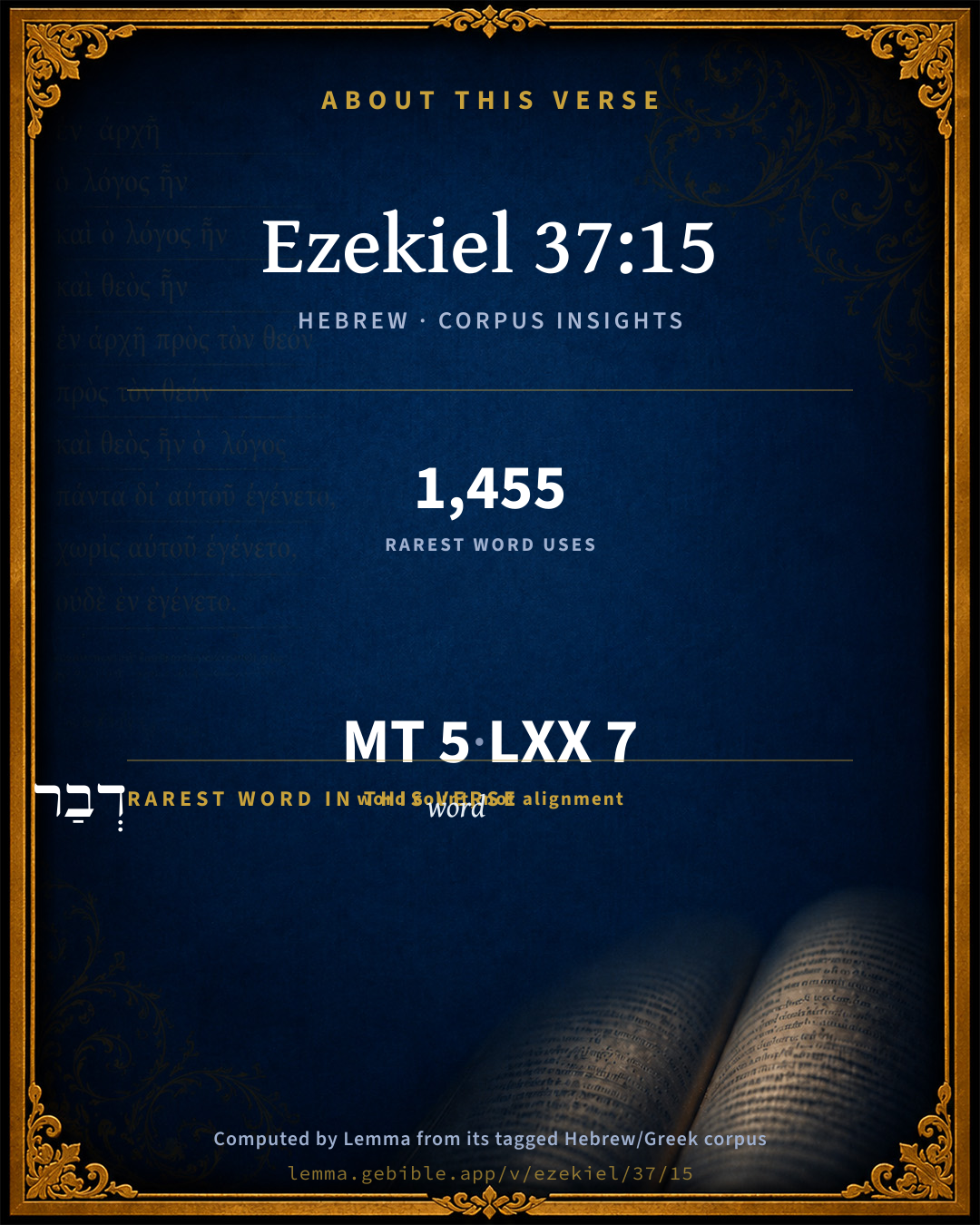
These counts appear in no published source. They are computed here, from the morphology-tagged text and Lemma’s own curated glosses. What Lemma adds →

5
words
5
distinct lemmas
Prophets
section

Grammatical profile

  • 2 verbs
  • 2 nouns
  • 1 preposition

Verb forms

  • וַיְהִ֥י Qal · Sequential Imperfect
  • לֵאמֹֽר Qal · Infinitive Construct

Hebrew & Septuagint length

In English translation the verse runs 9 words from the Hebrew and 10 from the Septuagint (LXX English) — closely comparable.

A rough comparison of the two English renderings, which tokenize alike — not a word-level alignment.

Word counts can differ between the Hebrew and the Greek without any difference in meaning — e.g. the Hebrew direct-object marker אֵת has no separate Greek word, and Greek often adds the article ὁ.

In the original languages it is 5 Hebrew tokens and 7 Greek tokens — but the two are counted differently (Hebrew bundles its prefixes and suffixes into one token; the Greek is in lemma form), so that isn’t a like-for-like length.

Hebrew and Greek witnesses Masoretic Hebrew ↔ Greek Septuagint

The same verse in the two great witnesses to the Old Testament, shown verse-for-verse.

These are two independent witnesses, not word-aligned to each other, and the Septuagint is shown in lemma (dictionary) form.

Hebrew Ezekiel 37:15 Masoretic · Westminster Leningrad Codex

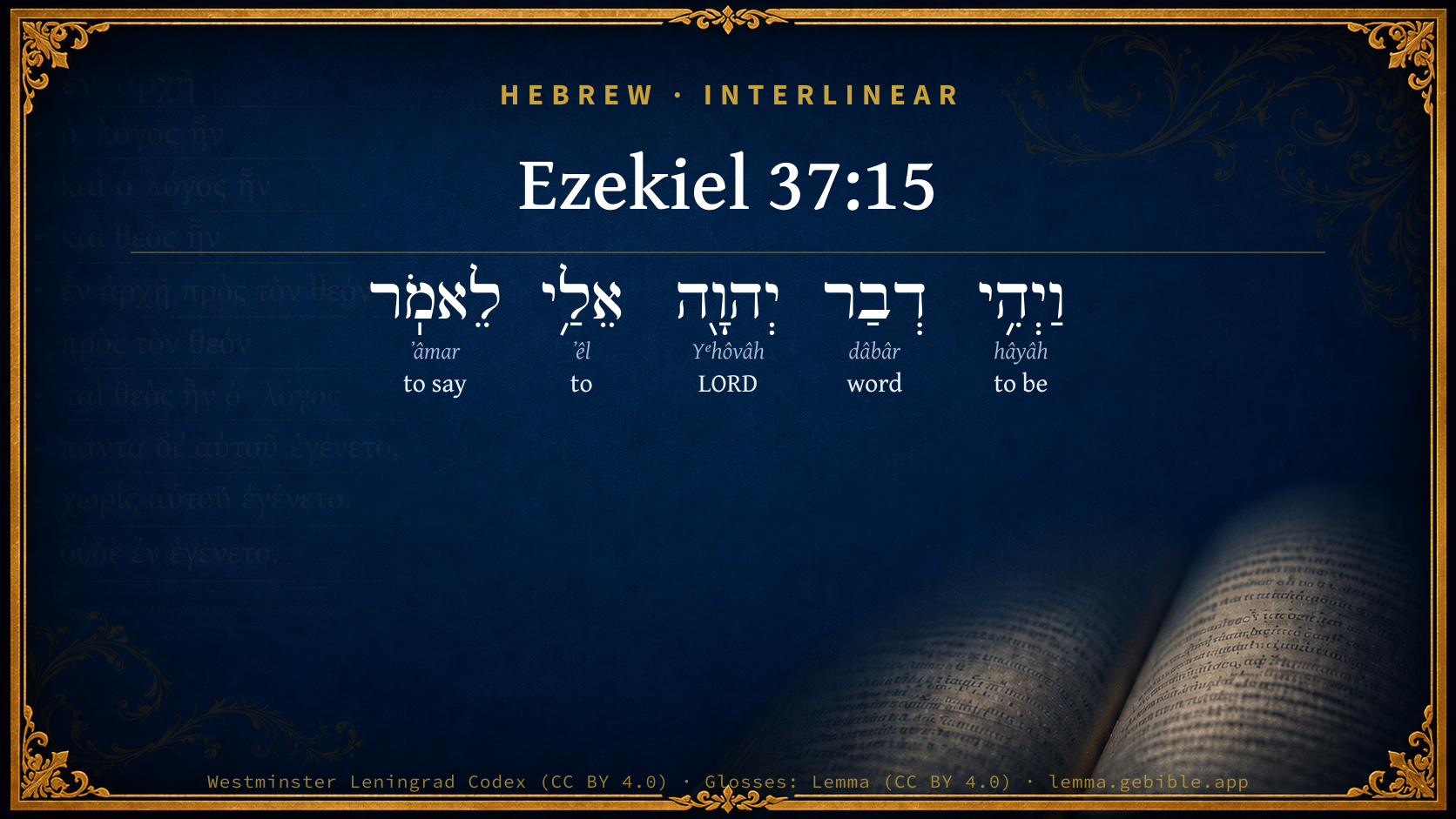
וַיְהִ֥י דְבַר יְהוָ֖ה אֵלַ֥י לֵאמֹֽר

The word of Yahweh came again to me, saying,

World English Bible · Public Domain

Greek LXX Ezekiel 37:15 Septuagint · lemma form

καί γίγνομαι λόγος κύριος πρός ἐγώ λέγω

And the word of the Lord came to me, saying,

LXX2012 (modern English Septuagint) · Public Domain

Hebrew: Westminster Leningrad Codex (CC BY 4.0). Greek: Septuagint (public domain); English from LXX2012 (modern English Septuagint) (Public Domain). How the Septuagint differs from the Hebrew →

Targum (Aramaic paraphrase)

1

The Targum is the ancient Jewish Aramaic paraphrase of the Hebrew Scriptures — an interpretive translation, not the Hebrew text itself. Onkelos (literal) and Pseudo-Jonathan (expansive) render the Torah, and Jonathan the Prophets. Coverage is partial: where no permissively-licensed English translation exists for a verse, only the Aramaic is shown. This is verse-level text, not a word-by-word alignment to the Hebrew.

  1. Targum Jonathan Prophets (Joshua–Malachi)
    וַהֲוָה פִתְגָם נְבוּאָה מִן קֳדָם יְיָ עִמִי לְמֵימָר:

    (no public-domain English translation for this verse)

    Targum Jonathan — Aramaic: “Mikraot Gedolot” (public domain). English: “Sefaria Community Translation” (CC0 1.0 (public-domain dedication)); “London "Chaldee Paraphrase," 1871” (public domain). Text via Sefaria.

Commentary

Notes on Ezekiel 37:15 from classic Christian and Jewish commentators (each source and its license shown beneath its notes). The classic Christian expositions comment on the surrounding passage and are grouped to its opening verse, so a note may address several verses; the Jewish commentaries on the Tanakh (Rashi and others) are per-verse, so they appear only where the commentator wrote on this verse.

Lemma curates 59 commentaries, every one of them public domain or Creative Commons licensed, each selected and text-cleaned for this edition rather than reprinted as found. About our sources →

The Cambridge Bible for Schools and Colleges

gen. ed. J. J. S. Perowne

15–28. Prophecy of the reunion of the restored Israel into one kingdom, ruled by one king, even David

(1) Eze_37:15-23. Symbol of the union of Judah and Israel into one kingdom, with its explanation.

(2) Eze_37:24-25. There shall be one king over the new nation, even David.

(3) Eze_37:26-28. Jehovah’s covenant with the people shall be everlasting, and his presence will sanctify them.

The Cambridge Bible for Schools and Colleges (gen. ed. J. J. S. Perowne; Cambridge University Press, 1878–1918) — public domain. Text from a community e-Sword module.

Trapp's Complete Commentary

John Trapp

Eze 37:15 The word of the LORD came again unto me, saying,

Ver. 15. And the word of the Lord.] See Eze 18:1.

John Trapp, A Commentary or Exposition upon All the Books of the Old and New Testament (1647–1656) — public domain. Text from a community e-Sword module.

The Biblical Illustrator

Joseph S. Exell

Eze_37:15-17

Take thee one stick.

Joining the sticks

I. The sad condition of the people of Israel at the time the prophet wrote. It was that of separation and of estrangement. Such a condition was--

1. Contrary to nature.

2. Displeasing to God.

3. Disastrous to themselves.

That and other sin had reduced them to a condition of national bankruptcy, physical serfdom, social misery, and moral degradation.

II. The happy condition to which the people of Israel were about to be restored. That of unity, harmony, and oneness. Union in a Christian Church is a condition greatly to be desiderated, and earnestly to be sought by all its members.

1. It is of great importance to the Church itself.

2. It is an immense advantage to the surrounding community.

3. It is well pleasing and highly honouring to God.

III. The agency by which this delightful change was to be effected.

1. He breathed into them a principle of spiritual life.

2. He sent them wise advisers and earnest intercessors.

3. He visited them with a sore trial. The Babylonish captivity. Common suffering often awakens common sympathy, and common sorrow begets mutual interest.

4. He appointed them a common work. The rebuilding of the city and temple of Jerusalem. A common service for Christ is still promotive of union among Christians.

5. He makes His residence in their midst (Eze_37:27). Christ in the midst of a Church acts like a magnet in the midst of steel particles: He attracts all to Himself. As Christians are enabled to love Christ and approach Christ, so will they love one another and approach one another. (F. Morgan.)

The Biblical Illustrator, edited by Joseph S. Exell (c. 1880s–1900s) — public domain. Text from a community e-Sword module.

Keil & Delitzsch

C. F. Keil & F. Delitzsch

Reunion of Israel as One Nation under the Future King David

This word of God directs the prophet to represent by a sign the reunion of the tribes of Israel, which have been divided into two kingdoms (Eze 37:15-17), and to explain this sign to the people (Eze 37:18-21), and predict its sanctification and blessedness under the reign of the future David (Eze 37:22-28). What is new in this word of God is the express prediction embodied in a symbolical action, of the reunion of the divided tribes of Israel into one single people of God, which has been already hinted at in the promise of the raising to life of "the whole house of Israel" (Eze 37:11). This brief indication is here plainly expressed and more fully developed.

Eze 37:15-28

Eze 37:15. And the word of Jehovah came to me, saying, Eze 37:16. And thou, son of man, take to thyself a piece of wood, and write upon it: Of Judah, and the sons of Israel, his associates; and take another piece of wood, and write upon it: Of Joseph, the wood of Ephraim, and the whole house of Israel, his associates; Eze 37:17. And put them together, one to the other, into one piece of wood to thee, that they may be united in thy hand. Eze 37:18. And when the sons of thy people say to thee, Wilt thou not show us what thou meanest by this? Eze 37:19. Say to them, Thus saith the Lord Jehovah, Behold, I will take the wood of Joseph, which is in the hand of Ephraim, and the tribes of Israel, his associates, which I put thereon, with the wood of Judah, and will make them into one stick, that they may be one in my hand. Eze 37:20. And the pieces of wood upon which thou hast written shall be in thy hand before their eyes. Eze 37:21. And say to them, Thus saith the Lord Jehovah, Behold, I will take the sons of Israel out of the nations among whom they walk, and will gather them from round about, and lead them into their land. Eze 37:22. I will make them into one nation in the land, upon the mountains of Israel, and one king shall be king over them all; and it shall not become two nations any more, and they shall not henceforth be divided into two kingdoms any more; Eze 37:23. And shall not defile themselves by their idols and their abominations, and by all their transgressions; but I will help them from all their dwelling-places, in which they have sinned, and will cleanse them; so that they shall be my people, and I will be their God. Eze 37:24. And my servant David will be king over them, and be a shepherd for them all; and they will walk in my rights, and keep my statutes and do them. Eze 37:25. And they will dwell in the land which I gave to my servant Jacob, in which their fathers dwelt; there will they dwell, and their children's children for ever; and my servant David will be a prince to them for ever. Eze 37:26. And I make a covenant of peace with them for ever, an everlasting covenant shall be with them; and I will place them, and multiply them, and put my sanctuary in the midst of them for ever. Eze 37:27. And my dwelling will be over them; I will be their God, and they will be my people. Eze 37:28. And the nation shall know that I am Jehovah, who sanctifieth Israel, when my sanctuary shall be in the midst of them for ever.

The symbolical action commanded in Eze 37:16 and Eze 37:17, which the prophet no doubt performed in all its external reality (cf. Eze 37:19 and Eze 37:20), is easily understood, and expresses the thing to be represented in the the clearest manner. The writing of the names of the tribes composing the two kingdoms recalls to mind the similar act on the part of Moses (Num 17:1-13 :17ff.). But the act itself is a different one here, and neither the passage referred to nor Eze 21:15 furnishes any proof that עץ signifies a staff or rod. Ezekiel would undoubtedly have used מטּה for a staff. Nor have we even to think of flat boards, but simply of pieces of wood upon which a few words could be written, and which could be held in one hand. The ל before the names to be written upon each piece of wood is the sign of the genitive, indicating to whom it belongs, as in the case of the heading to David's psalms (לדוד). This is evident from the fact that in אץ אפרים the construct state is used instead. The name is to indicate that the piece of wood belongs to Judah or Ephraim, and represents it. The command to Ezekiel to write upon one piece of wood, not only Judah, but "the sons of Israel, his associates," arose from the circumstance that the kingdom of Judah included, in addition to the tribe of Judah, the greater portion of Benjamin and Simeon, the tribe of Levi and those pious Israelites who emigrated at different times from the kingdom of the ten tribes into that of Judah, who either were or became associates of Judah (Ch2 11:12., Ch2 15:9; Ch2 30:11, Ch2 30:18; Ch2 31:1). In the writing upon the second piece of wood, אץ אפרים is an explanatory apposition to ליוסף, and an accusative governed by כּתב. But the command is not to be understood as signifying that Ezekiel was to write the words עץ אפרים upon the piece of wood; all that he was to write was, "Joseph and the whole house of Israel, his associates." The name of Joseph is chosen, in all probability, not as the more honourable name, as Hvernick supposes, but because the house of Joseph, consisting of the two powerful tribes of Ephraim and Manasseh, formed the trunk of the kingdom of the ten tribes (Kliefoth). The "whole house of Israel, his associates," are the rest of the tribes belonging to that kingdom. The two pieces of wood, with these inscriptions upon them, Ezekiel is to put together, and hold in his hand bound together in one. מה־אלּה לּך, what these (two pieces of wood) are to thee, is equivalent to, what thou meanest to indicate by them. For the rest, compare Eze 24:19. In the word of God explaining the action (Eze 37:19), the wood of Joseph is not the piece of wood with Joseph's name written upon it, but the kingdom represented by this piece of wood which was in Ephraim's hand, inasmuch as the hegemony was with the tribe of Ephraim. Instead of the wood, therefore, the tribes (not staffs) of Israel, i.e., the Israelites who constituted these tribes, are mentioned as his associates. God will put these upon the wood of Joseph (עליו), i.e., will join them together, and then place them with the wood of Judah, i.e., the kingdom of Judah, and unite them into one wood (or nation). את־עץ , the construction of which has been misunderstood by Hitzig, is neither in apposition to עליו, nor governed by נתתּי: "and will put them thereupon, upon the wood of Judah" (Hitzig and Kliefoth), or, "I add them to it, (namely) with the wood of Judah" (De Wette); but it is dependent upon לקח, "I take the wood of Joseph...and the tribes of Israel, his associates, which I put thereon, along with the wood of Judah, and make them into one wood." The construction is rendered obscure simply by the fact that the relative clause, "which I put thereon," is attached to the principal clause 'אני לקח וגו by Vav consec. In בּידי, "they shall be one in my hand," there is probably an antithesis to בּיד אפרים, those who have come into Ephraim's hand, the tribes severed by Ephraim from the kingdom of God, will God once more bring together with Judah, and hold in His hand as an undivided nation. - In Eze 37:20 the description of the sign is completed by the additional statement, that the pieces of wood on which the prophet has written are to be in his hand before their eyes, and consequently that the prophet is to perform the act in such a way that his countrymen may see it; from which it follows that he performed it in its outward reality. The fulfilment of the instructions is not specially mentioned, as being self-evident; but in Eze 37:21-28 the further explanation of the symbolical action is given at once; and the interpretation goes beyond the symbol, inasmuch as it not only describes the manner in which God will effect the union of the divided tribes, but also what He will do for the preservation of the unity of the reunited people, and for the promotion of their blessedness. This explanation is arranged in two strophes through the repetition of the concluding thought: "they will be my people," etc., in Eze 37:23 and Eze 37:27. Each of these strophes contains a twofold promise.

The first (Eze 37:21-23) promises (a) the gathering of the Israelites out of their dispersion, their restoration to their own land, and their union as one nation under the rule of David (Eze 37:21, Eze 37:22); (b) their purification from all sins, and sanctification as the true people of the Lord (Eze 37:23). The second strophe (Eze 37:24-27) promises (a) their undisturbed eternal abode in the land, under David their prince (Eze 37:25); (b) the blessedness conferred upon them through the conclusion of an everlasting covenant of peace (Eze 37:26 and Eze 37:27). This second promise, therefore, constitutes the completion of the first, securing to the nation of Israel its restoration and sanctification for all time. The whole promise, however, is merely a repetition of that contained in Ezekiel 34:11-31 and Eze 36:22-30. - The three factors - the gathering out of the nations, restoration to the land of Israel, and reunion as one people - form the first act of divine grace. The union of the Israelites, when brought back to their land, is accomplished by God giving them in David a king who will so rule the reunited people that they will not be divided any more into two peoples and two kingdoms. The Chetib יהיה is not to be altered into the plural יהיוּ, as in the Keri; but גּוי is to be supplied in thought, from the preceding clause, as the subject to the verb. The division of the nation into two kingdoms had its roots, no doubt, in the ancient jealousy existing between the two tribes Ephraim and Judah; but it was primarily brought to pass through the falling away of Solomon from the Lord. Consequently it could only be completely and for ever terminated through the righteous government of the second David, and the purification of the people from their sins. This is the way in which Eze 36:23 is attached to Eze 36:22. For Eze 36:23 compare Eze 14:11 and Eze 36:25. Different interpretations have been given of the words, "I help them from all their dwelling-places, in which they have sinned." They recall to mind Eze 36:29, "I help them from all their uncleannesses." As הושׁע מן signifies, in that case, "to preserve therefrom," so in the present instance the thought can only be, "God will preserve them from all the dwelling-places in which they have sinned." Hengstenberg is of opinion that the redemption from the dwelling-places does not take place locally, but spiritually, through the cleansing away of all traces of sin, first from the hearts, and then, in consequence, from all around. In this way is the land changed, through the power of the Lord, into another land, from a sinful to a holy one; just as before it had been changed from a holy to a sinful one through the guilt of the people. But if this were the only thought which the words contained, Ezekiel would certainly have placed the וטהרתּי אותם before 'והושׁעתּי וגו. As the words read, the deliverance of the people from their sinful dwelling-places is to precede their purification, to prepare the way for it and bring it to pass, and not to follow after it. The dwelling-places, at or in which they have sinned, cannot be the settlements in foreign lands, as Hitzig supposes, but only the dwelling-places in Canaan, to which the Lord would bring them after gathering them from their dispersion. הושׁע does not signify, "leading out from these dwelling-places," which is the explanation given by Kliefoth, who consequently thinks that we must understand the words as denoting the leading over of Israel from the present Canaan, or the Canaan of this life, to which its sins adhere, to the glorified, new, and eternal Canaan. This view is utterly irreconcilable both with the words themselves and also with the context. Even if הושׁע meant to lead out, it would not be allowable to transform the "leading out" from the sinful Canaan into a "leading in" to the glorified and heavenly Canaan. Moreover, the further development of this promise in Eze 37:25 also shows that it is not in the glorified, eternal Canaan that Israel is to dwell, but in the earthly Canaan in which its fathers dwelt. It is obvious from this, that in all the promise here given there is no allusion to a transformation and glorification of Canaan itself. The helping or saving from all dwelling-places in which they have sinned would rather consist in the fact, therefore, that God would remove from their dwelling-places everything that could offer them an inducement to sin. For although sin has its seat, not in the things without us, but in the heart, the external circumstances of a man do offer various inducements to sin. Before the captivity, Canaan offered such an inducement to the Israelites through the idolatry and moral corruption of the Canaanites who were left in the land. And with reference to this the Lord promises that in future, when His people are brought back to Canaan, He will preserve them from the sinful influence of their dwelling-places. But this preservation will only be effected with complete success when God purifies Israel itself, and, by means of its renovation, eradicates all sinful desire from the heart (cf. Eze 36:26-27). In this way וטהרתּי is appended in the most fitting way to 'והושׁעתּי . - Through the removal of all sinful influences from around them, and the purifying of the heart, Israel will then become in truth the people of God, and Jehovah the God of Israel (Eze 37:23).

Israel, when thus renewed, will walk in the rights of the Lord and fulfil His commandments, under the protection of its one shepherd David, i.e., of the Messiah (Eze 37:24, cf. Eze 36:27, and Eze 34:23); and its children and children's children will dwell for ever in its own land, David being its prince for ever (Eze 37:25, and cf. Eze 36:28 and Eze 34:24). What is new in this promise, which is repeated from Ezekiel 34 and 36, is contained in לעולם, which is to be taken in the strict sense of the word. Neither the dwelling of Israel in Canaan, nor the government of the David-Messiah, will ever have an end. לעולם is therefore repeated in Eze 37:26 in the promise of the covenant which the Lord will make with His people. The thought itself has already been expressed in Eze 34:25, and בּרית שׁלוּם is to be understood, both here and there, as comprehending all the saving good which the Lord will bestow upon all His sanctified people. There are only two factors of this salvation mentioned here in Eze 37:26 and Eze 37:27, namely, the multiplication of the people, as the earthly side of the divine blessing, and the establishing of His eternal sanctuary in the midst of them as the spiritual side. These two points refer back to the former acts of God, and hold up to view the certain and full realization in the future of what has hitherto been neither perfectly nor permanently accomplished on account of the sins of the people. וּנתתּים, in Eze 37:26, is not to be taken in connection with והרבּיתּי אותם, so as to form one idea in the sense of dabo eos multiplicatos (Venema and Hengstenberg), for we have no analogies of such a mode of combination; but נתתּים, I make, or place them, is to be taken by itself, and completed from the context, "I make them into a nation, and I multiply them (cf. Eze 36:10-11, Eze 36:37). Ezekiel has here Lev 26:9 and Lev 26:11 in his mind, as we may see from the fact that the words, "I give my sanctuary in the midst of them for ever," are obviously formed after Lev 26:11, "I give my dwelling in the midst of them;" in such a manner, however, that by the substitution of מקדּשׁי for משׁכּני, and the addition of לעולם, the promise is both deepened and strengthened. In the change of משׁכּני into מקדּשׁי, he may indeed have had the words of Exo 25:8 floating before his mind, "they shall make me a sanctuary, that I may dwell among them;" nevertheless he deliberately selected the expression "my sanctuary," to indicate that the Lord would dwell in the midst of Israel as the Holy One, and the Sanctifier of His people. Moreover, the words are not, "my dwelling will be in the midst of them, or among them" (בּתוכם), but עליהם, over them. This expression is transferred from the site of the temple, towering above the city (Psa 68:30), to the dwelling of God among His people, to give prominence to the protective power and saving grace of the God who rules in Israel (cf. Hengstenberg on Psa 68:30). The sanctuary which Jehovah will give in Israel for ever, i.e., will found and cause to endure, that He may dwelling the midst of it to shelter and bless, is the temple, but not the temple built by Zerubbabel. As an objection to this Jewish interpretation, Jerome has justly said: "but how could it be said to stand 'for ever,' when that temple which was built in the time of Zerubbabel, and afterwards restored by many others, was consumed by Roman fire? All these things are to be taken as referring to the church in the time of the Saviour, when His tabernacle was placed in the church." There is no reference whatever here to the rebuilding of the temple by Zerubbabel; not because that temple did not stand for ever and was destroyed by the Romans, but chiefly because God did not make it His abode, or fill this temple with His gracious presence (Shechinah). The sanctuary which God will place for ever among His people is the sanctuary seen by Ezekiel in Ezekiel 40ff.; and this is merely a figurative representation of the "dwelling of God in the midst of His people through His Son and Holy Spirit" (cf. Vitringa, Observv. I. p. 161), which began to be realized in the incarnation of the Logos, who is set forth in Joh 1:14 as the true משׁכּן, in the words ἐσκήνωσεν ἐν ἡμῖν, and is continued in the spiritual dwelling of God in the heart of believers (Co1 3:16; Co1 6:19), and will be completed at the second coming of our Lord in the "tabernacle (σκηνή) of God with men" of the new Jerusalem, of which the Lord God Almighty and the Lamb are the temple, since Israel will then first have become in truth the people of God, and Jehovah (God with them) their God (Rev 21:3, Rev 21:22). - The promise concludes in Eze 37:28 with an allusion to the impression which these acts of God in Israel will make upon the heathen (cf. Eze 36:36). From the fact that Jehovah erects His sanctuary in the midst of Israel for ever, they will learn that it is He who sanctifieth Israel. קדּשׁ, to sanctify, means, "to remove from all connection either with sin or with its consequences. Here the reference is to the latter, because these alone strike the eyes of the heathen; but the former is presupposed as the necessary foundation" (Hengstenberg). The words rest upon the promises of the Pentateuch, where God describes Himself as He who will and does sanctify Israel (compare Exo 31:13; Lev 22:31-33). This promise, which has hitherto been only imperfectly fulfilled on account of Israel's guilt, will be perfectly realized in the future, when Israel will walk in the ways of the Lord, renewed by the Spirit of God.

Thus does this prophecy of Ezekiel span the whole future of the people of God even to eternity. But the promise in which it culminates, namely, that the Lord will erect His sanctuary in the midst of His restored people, and there take up His abode above them for ever (Eze 37:26.), is of importance as helping to decide the question, how we are to understand the fulfilment of the restoration to Canaan into the land given to the fathers, which is promised to all Israel; whether, in a literal manner, by the restoration of the Israelites to Palestine; or spiritually, by the gathering together of the Israelites converted to the Lord their God and Saviour, and their introduction into the kingdom of God founded by Christ, in which case Canaan, as the site of the Old Testament kingdom of God, would be a symbolical or typical designation of the earthly soil of the heavenly kingdom, which has appeared in the Christian church. - These two different views have stood opposed to one another from time immemorial, inasmuch as the Jews expect from the Messiah, for whose advent they still hope, not only their restoration to Palestine, but the erection of the kingdom of David and the rebuilding of the temple upon Mount Zion, together with the sacrificial worship of the Levitical law; whereas in the Christian church, on the ground of the New Testament doctrine, that the old covenant has been abolished along with the Levitical temple-worship through the perfect fulfilment of the law by Christ and the perpetual efficacy of His atoning sacrifice, the view has prevailed that, with the abolition of the Old Testament form of the kingdom of God, even Palestine has ceased to be the chosen land of the revelation of the saving grace of God, and under the new covenant Canaan extends as far as the Israel of the new covenant, the church of Jesus Christ, is spread abroad over the earth, and that Zion or Jerusalem is to be sought wherever Christendom worships God in spirit and in truth, wherever Christ is with His people, and dwells in the hearts of believers through the Holy Spirit. It was by J. A. Bengel and C. F. Oetinger that the so-called "realistic" interpretation of the Messianic prophecies of the Old Testament - according to which, after the future conversion to Christ of the Jewish people who are hardened still, the establishment of the kingdom of God in Palestine and its capital Jerusalem is to be expected - has been revived and made into one of the leading articles of Christian hope. By means of this "realistic" exposition of the prophetic word the chiliastic dogma of the establishment of a kingdom of glory before the last judgment and the end of the world is then deduced from the twentieth chapter of the Apocalypse; and many of the theologians of our day regard this as the certain resultant of a deeper study of the Scriptures. In the more precise definition of the dogma itself, the several supporters diverge very widely from one another; but they all agree in this, that they base the doctrine chiefly upon the prophetic announcement of the eventual conversion and glorification of all Israel. - As Ezekiel then stands out among all the prophets as the one who gives the most elaborate prediction of the restoration of Israel under the government of the Messiah, and he not only draws in Ezekiel 40-48 a detailed picture of the new form of the kingdom of God, but also in Ezekiel 38 and 39, in the prophecy concerning Gog and Magog, foretells an attack on the part of the heathen world upon the restored kingdom of God, which appears, according to Rev 20:7-9, to constitute the close of the thousand years' reign; we must look somewhat more closely at this view, and by examining the arguments pro and con, endeavour to decide the question as to the fulfilment of the Old Testament prophecies concerning the future of Israel. In doing this, however, we shall fix our attention exclusively upon the exegetical arguments adduced in support of the chiliastic view by its latest supporters.

(Note: These are, C. A. Auberlen, "The Prophet Daniel and the Revelation of John;" also in a treastise on the Messianic Prophecies of the Mosaic times, in the Jahrbb.f. deutsche Theologie, IV pp. 778ff.; J. C. K. Hofmann, in his Weissagung und Erfllung im A. u. N. Testamente, and in the Schriftbeweis, vol. II p. 2; Mich. Baumgarten, article "Ezekiel" in Herzog's Cyclopaedia, and here and there in his commentary on the Old Testament; C. E. Luthardt, The Doctrine of the Last Things in Treatises and Expositions of Scripture (1851); and Dr. Volck, in the Dorpater Zeitschfit fr Theologie und Kirche, IX pp. 142ff.; and others.)

The prophetic announcement, that the Lord will one day gather together again the people of Israel, which has been thrust out among the heathen for its unfaithfulness, will bring it back into the land given to the fathers, and there bless and greatly multiply it, has its roots in the promises of the law. If the stiff-necked transgressors of the commandments of God - these are the words of Lev 26:40-45 - bear the punishment of their iniquity in the land of their enemies, and confess their sins, and their uncircumcised heart is humbled, then will the Lord remember His covenant with the patriarchs, and not cast them off even in the land of their enemies, to destroy them, and to break His covenant with them; but will remember the covenant which He made with their ancestors, when He brought them out of Egypt before the eyes of the nations to be their God. He will, as this is more precisely defined in Deu 30:3., gather them together again out of the heathen nations, lead them back into the land which their fathers possessed, and multiply Israel more than its fathers. On the ground of this promise, of which Moses gives a still further pledge to the people in his dying song (Deu 32:36-43), all the prophets announce the restoration and ultimate glorification of Israel. This song, which closes with the promise, "Rejoice, ye nations, over His people; for He will avenge the blood of His servants, and repay vengeance to His adversaries, and expiate His land, His people," continues to resound - to use the words of Hofmann (Schriftbeweis, II 2, pp. 89, 90) - "through all the Old Testament prophecy. Not only when Obadiah (Oba 1:17) and Joel (Joe 3:5) promise good to their nation do they call Mount Zion and the city of Jerusalem the place where there is protection from the judgment upon the nations of the world; but Micah also, who foretells the destruction of the temple and the carrying away of his people to Babylon, beholds Mount Zion exalted at last above all the seats of worldly power, and his people brought back to the land of their fathers (Eze 4:1; Eze 7:14). The same Isaiah, who was sent to harden his people with the word of his prophecy, is nevertheless certain that at last a holy nation will dwell in Jerusalem, a remnant of Israel (Isa 4:3; Isa 10:21); and the holy mountain of Jehovah, to which His scattered people return from all the ends of the world, is that abode of peace where even wild beasts do no more harm under the rule of the second David (Isa 11:9, Isa 11:11). After all the calamities which it was the mournful lot of Jeremiah to foretell and also to witness, Jehovah showed this prophet the days when He would restore His people, and bring them back to the land which He gave to their fathers (Jer 30:3).... And the same promise is adhered to even after the return. In every way is the assurance given by Zechariah, that Judah shall be God's holy possession in God's holy land."

(Note: Compare with this the words of Auberlen (der Prophet Daniel, p. 399, ed. 2): "The doctrine of the glorious restoration of Israel to Canaan, after severe chastisement and humiliation, is so essential and fundamental a thought of all prophecy, that the difficulty is not so much to find passages to support it, as to make a selection from them. By way of example, let us notice Isa 2:2-4; Isa 4:2-6; Isa 9:1-6, Isa 9:11 and Isa 9:12; more especially Isa 11:11., 24ff., 60ff.; Jer 30-33; Eze 34:23-31, 36-37; Hos 2:16 -25; Hos 3:4-5; Hos 11:8-11; Hos 14:2.; Joe 3:1-5; 4:16-21; Amo 9:8-15; Oba 1:17; Mic 2:12-13; Mic 4:1-13; Mic 5:1-15; Mic 7:11-20); Zep 3:14-20; Zac 2:4., Zac 8:7., Zac 9:9., Zac 10:8-12; 12:2-13:6; Zac 14:8." Auberlen (pp. 400f.) then gives the following as the substance of these prophetic descriptions: "Israel having been brought back to its own land, will be the people of God in a much higher and deeper sense than before; inasmuch as sin will be averted, the knowledge of God will fill the land, and the Lord will dwell again in the midst of His people at Jerusalem. A new period of revelation is thus commenced, the Spirit of God is richly poured out, and with this a plenitude of such gifts of grace as were possessed in a typical manner by the apostolic church. And this rich spiritual life has also its perfect external manifestation both in a priestly and a regal form. The priesthood of Israel was more especially seen by Ezekiel, the son of a priest, in his mysterious vision in ch. 40-48; the monarchy by Daniel, the statesman; while Jeremiah, for example, unites the two (Jer 33:17-22). What took place only in an outward way, i.e., in the letter, during the Old Testament times, and withdrew, on the other hand, into the inward and hidden spirit-life during the time of the Christian church, will then manifest itself outwardly also, and assume an external though pneumatic form. In the Old Testament the whole of the national life of Israel in its several forms of manifestation, domestic and political life, labour and art, literature and culture, was regulated by religion, though only at first in an outward and legal way. The church, on the other hand, has, above all, to urge a renewal of the heart, and must give freedom to the outward forms which life assumes, enjoining upon the conscience of individual men, in these also to glorify Christ. In the thousand years' reign all these departments of life will be truly Christianized, and that from within. Looked at in this light, there will be nothing left to give offence, if we bear in mind that the ceremonial law of Moses corresponds to the priesthood of Israel, and the civil law to the monarchy. The Gentile church has only been able to adopt the moral law, however certainly it has been directed merely to the inwardly working means of the word, or of the prophetic office. But when once the priesthood and the kingly office have been restored, then, without doing violence to the Epistle to the Hebrews, the ceremonial and civil law of Moses will unfold its spiritual depths in the worship and constitution of the thousand years' reign.")

Continued in next section

[continued from previous section]

This restoration of Israel Ezekiel describes, in harmony with Jer 31, though in a much more detailed picture, in the following way: - "The condition of things in the future will differ from that in the past, simply in the fact that Israel will then have a heart converted to fidelity and obedience by the Spirit of God (Eze 11:19; Eze 36:27), and will live in good peace and prosperity under the shelter of its God, who is known and acknowledged by all the world (Eze 36:23). The land to which it is restored, a land most decidedly represented by Ezekiel as the same as that in which its fathers lived (Eze 37:25), appears throughout merely as a happy earthly dwelling-place, and the promise of its possession as an assurance given to a nation continuing to propagate itself in peace" (Hofmann, p. 576). This manner of depicting the condition of the Israel restored and glorified by the Messiah, as a peaceful settlement and a happy life in the land of the fathers, a life rich in earthly possessions, is not confined, however, to Jeremiah and Ezekiel, but stands out more or less conspicuously in the Messianic pictures of all the prophets. What follows, then, from this in relation to the mode in which these prophecies are to be fulfilled? Is it that the form assumed by the life of the people of Israel when restored will be only a heightened repetition of the conditions of its former life in Palestine, undisturbed by sin? By no means. On the contrary, it follows from this that the prophets have depicted the glorious restoration of Israel by the Messiah by means of figures borrowed from the past and present of the national life of Israel, and therefore that their picture is not to be taken literally, but symbolically or typically, and that we are not to expect it to be literally fulfilled.

We are forced to this conclusion by the fact that, through the coming of Christ, and the kingdom of heaven which began with Him, the idea of the people of God has been so expanded, that henceforth not the lineal descendants of Abraham, or the Jewish nation merely, but the church of confessors of Jesus Christ, gathered together out of Israel and the Gentiles, has become the people of God, and the economy of the Old Testament has ceased to constitute the divinely appointed from of the church of God. If, therefore, the Jewish people, who have rejected the Saviour, who appeared in Jesus Christ, and have hardened themselves against the grace and truth revealed in Him, are not cast off for ever, but, according to the promises of the Old Testament and the teaching of the Apostle Paul (Rom 11), will eventually repent, and as a people turn to the crucified One, and then also realize the fulfilm

Keil & Delitzsch — Biblical Commentary on the Old Testament (1861–1891) — public domain (CC PDM 1.0). Text via the HelloAO Bible API. (Old Testament only.)

Tyndale Open Study Notes

Tyndale Open Resources

37:15-28 The prophet then performed a sign act (see “Prophetic Sign Acts” Theme Note) that demonstrated the future reunification of God’s people and the healing of the schism between the northern and southern tribes (see 1 Kgs 12).

Tyndale Open Study Notes — © Tyndale Open Resources, licensed CC BY-SA 4.0. Text via the HelloAO Bible API.

Matthew Henry's Commentary

Here are more exceedingly great and precious promises made of the happy state of the Jews after their return to their own land; but they have a further reference to the kingdom of the Messiah and the glories of gospel-times.

I. It is here promised that Ephraim and Judah shall be happily united in brotherly love and mutual serviceableness; so that whereas, ever since the desertion of the ten tribes from the house of David under Jeroboam, there had been continual feuds and animosities between the two kingdoms of Israel and Judah, and it is to be feared there had been some clashings between them even in the land of their captivity (Ephraim upon all occasions envying Judah and Judah vexing Ephraim), now it should be no longer, but there should be a coalition between them, and, notwithstanding the old differences that had been between them, they should agree to love one another and to do one another all good offices. This is here illustrated by a sign. The prophet was to take two sticks, and write upon one, For Judah (including Benjamin, those of the children of Israel that were his companions), upon the other, For Joseph, including the rest of the tribes, Eze 37:16. These two sticks must be so framed as to fall into one in his hand, Eze 37:17. The people took notice of this, and desired him to tell them the meaning of it, for they knew he did not play with sticks for his diversion, as children do. Those that would know the meaning should ask the meaning of the word of God which they read and hear, and of the instituted signs by which spiritual and divine things are represented to us; the ministers' lips should keep the knowledge hereof and the people should ask it at their mouth, Mal 2:7. It is a necessary question for grown people, as well as children, to ask, What mean you by this service, by this sign? Exo 12:26. The meaning was that Judah and Israel should become one in the hand of God, Eze 37:19. 1. They shall be one, one nation, Eze 37:22. They shall have no separate interests, and, consequently, no divided affections. There shall be no mutual jealousies and animosities, no remembrance, no remains, of their former discord. But there shall be a perfect harmony between them, a good understanding one of another, a good disposition one to another, and a readiness to all good offices and services for one another's credit and comfort. They had been two sticks crossing and thwarting one another, nay, beating and bruising one another; but now they shall become one, supporting and strengthening one another. Vix unita fortior - Force added to force is proportionally more efficient. Behold, how good and how pleasant a thing it is to see Judah and Israel, that had long been at variance, now dwelling together in unity. Then they shall become acceptable to their God, amiable to their friends, and formidable to their enemies, Isa 11:13, Isa 11:14. 2. They shall be one in God's hand; by his power they shall be united, and, being by his hand brought together, his hand shall keep them together, so that they shall not fly off, to be separated again. They shall be one in his hand, for his glory shall be the centre of their unity and his grace the cement of it. In him, in a regard to him and in his service and worship, they shall unite, and so shall become one. Both sides shall agree to put themselves into his hand, and so they shall be one. Qui conveniunt in aliquo tertio inter se conveniunt - Those who agree in a third agree with each other. Note, Those are best united that are one in God's hand, whose union with each other results from their union with Christ and their communion with God through him, Eph 1:10. One in us, Joh 17:21. 3. They shall be one in their return out of captivity (Eze 37:21): I will take them from among the heathen, and gather them on every side, and bring them together incorporated into one body to their own land. They shall be one in their separation from the heathen with whom they had mingled themselves: they shall both agree to part from them, and take their affections off from them, and no longer to comply with their usages, and then they will soon agree to join together in walking according to the rule of God's word. Their having been joint-sufferers will contribute to this blessed comprehension, when they begin to come to themselves and to consider things. Put many pieces of metal together into the furnace, and, when they are melted, they will run all together. It was time for them to strengthen one another when their oppressors were so busy to weaken and ruin them all. Likewise their being joint-sharers in the favour of God, and the great and common deliverance wrought out for them all, should help to unite them. God's loving them all was a good reason why they should love one another. Times of common joy, as well as times of common suffering, should be healing loving times. 4. They shall all be the subjects of one king, and so they shall become one. The Jews, after their return, were under one government, and not divided as formerly. But this certainly looks further, to the kingdom of Christ; he is that one King in allegiance to whom all God's spiritual Israel shall cheerfully unite, and under whose protection they shall all be gathered. All believers unite in one Lord, one faith, and one baptism. And the uniting of Jews and Gentiles in the gospel church, their becoming one fold under Christ the one great Shepherd, is doubtless the union that is chiefly looked at in this prophecy. By Christ and partition-wall between them was taken down, and the enmity slain, and of them twain was made one new man, Eph 2:14, Eph 2:15.

II. It is here promised that the Jews shall by their captivity be cured of their inclination to idolatry; this shall be the happy fruit of that affliction, even the taking away of their sin (Eze 37:23): Neither shall they defile themselves any more with their idols, those detestable defiling things, no, nor with any of their former transgressions. Note, When one sin is sincerely parted with all sin is abandoned too, for he that hates sin, as sin, will hate all sin. And those that are cured of their spiritual idolatry, their inordinate affection to the world and the flesh, that no longer make a god of their money or their belly, have a happy blow given to the root of all their transgressions. Two ways God will take to cure them of their idolatry: - 1. By bringing them out of the way of temptation to it: "I will save them out of all their dwelling-places wherein they have sinned, because there they met with the occasion of sin and allurements to it." Note, It is our wisdom to avoid the places where we have been overcome by temptations to sin, not to remain in them, or return to them, but to save ourselves out of them, as we would out of infected places; see Zac 2:7; Rev 18:4. And it is a great mercy when God, in his providence, saves us out of the dwelling-places where we have sinned, and keeps us from harm by keeping us out of harm's way, in answer to our prayer, Lead us not into temptation, but deliver us from evil. 2. By changing the disposition of their mind: "I will cleanse them (Eze 37:28); that is, I will sanctify them, will work in them an aversion to the pollutions of sin and a complacency in the pleasures of holiness, and then you may be sure they will not defile themselves any more with their idols." Those whom God has cleansed he will keep clean.

III. It is here promised that they shall be the people of God, as their God, and the subjects and sheep of Christ their King and Shepherd. These promises we had before, and they are here repeated (Eze 37:23, Eze 37:24) for the encouragement of the faith of Israel: They shall be my people, to serve me, and I will be their God, to save them and to make them happy. David, my servant, shall be king over them, to fight their battles, to protect them from injury, and to rule them, and overrule all things that concern them for their good. He shall be their shepherd, to guide them and provide for them. Christ is this David, Israel's King of old; and those whom he subdues to himself, and makes willing in the day of his power, he makes to walk in his judgments and to keep his statutes.

IV. It is here promised that they shall dwell comfortably, Eze 37:25, Eze 37:26. They shall dwell in the land of Israel; for where else should Israelites dwell? And many things will concur to make their dwelling agreeable. 1. They shall have it by covenant; they shall come in again upon their old title, by virtue of the grant made unto Jacob, God's servant. As Christ was David, God's servant, so the church is Jacob, his servant too; and the members of the church shall come in for a share, as born in God's house. He will make a covenant of peace with them (Eze 37:26), and in pursuance of that covenant he will place them, and multiply them. Note, Temporal mercies are doubly sweet when they come from the promise of the covenant, and not merely from common providence. 2. They shall come to it by prescription: "It is the land wherein your fathers have dwelt, and for that reason you cannot but have a special kindness for it, which God will graciously gratify." It was the inheritance of their ancestors, and therefore shall be theirs. They are beloved for their fathers' sakes. 3. They shall have it entailed upon them and the heirs of their body, and shall have their families built up, so that it shall not be lost for want of heirs. They shall dwell therein all their time, and never be turned out of possession, and they shall leave it for an inheritance to their children and their children's children for ever, who shall enjoy it when they are gone, the prospect of which will be a satisfaction to them. 4. They shall live under a good government, which will contribute very much to the comfort of their lives: My servant David shall be their prince for ever. This can be no other than Christ, of whom it was said, when he was brought into the world, He shall reign over the house of Jacob for ever, Luk 1:33. Note, It is the unspeakable comfort of all Christ's faithful subjects that, as his kingdom is everlasting, so he is an everlasting King, he lives to reign for ever; and, as sure and as long as he lives and reigns, they shall live and reign also. 5. The charter by which they hold all their privileges is indefeasible. God's covenant with them shall be an everlasting covenant; so the covenant of grace is, for it secures to us an everlasting happiness.

V. It is here promised that God will dwell among them; and this will make them dwell comfortably indeed: I will set my sanctuary in the midst of them for evermore; my tabernacle also shall be with them, Eze 37:26, Eze 37:27. 1. They shall have the tokens of God's special presence with them and his gracious residence among them. God will in very deed dwell with them upon the earth, for where his sanctuary is he is; when they profaned his sanctuary he took it from them (Isa 64:11), but now that they are purified God will dwell with them again. 2. They shall have opportunity of conversing with God, of hearing from him, speaking to him, and so keeping up communion with him, which will be the comfort of their lives. 3. They shall have the means of grace. By the oracles of God in his tabernacle they shall be made wiser and better, and all their children shall be taught of the Lord. 4. Thus their covenant relation to God shall be improved and the bond of it strengthened: "I will be their God and they shall be my people, and they shall know it by having my sanctuary among them, and shall have the comfort of it."

VI. Both God and Israel shall have the honour of this among the heathen, Eze 37:26. "Now the heathen observe how Israel have profaned their own crown by their sins, and God has profaned it by his judgments; but then, when Israel is reformed and God has returned in mercy to them, the very heathen shall be made to know that the Lord sanctifies Israel, has a title to them and an interest in them more than other people, because his sanctuary is, and shall be, in the midst of them." Note, God designs the sanctification of those among whom he sets up his sanctuary. And blessed and holy are those who, enjoying the privileges of the sanctuary, give such proofs and evidences of their sanctification that the heathen may know it is no less than the almighty grace of God that sanctifies them. Such have God's sanctuary in the midst of them, the kingdom of God within them, in the principles of the spiritual life, and shall have it so for evermore in the enjoyments of an eternal life.

Matthew Henry's Commentary on the Whole Bible (1708–1710) — public domain (CC PDM 1.0). Text via the HelloAO Bible API.

John Gill's Exposition

The word of the Lord came unto me again,.... Immediately or quickly after he had the above vision of the dry bones, and the explanation of it:

saying: as follows:

John Gill's Exposition of the Whole Bible (1746–1763) — public domain (CC PDM 1.0). Text via the HelloAO Bible API.

Whedon's Commentary on the Bible

Daniel D. Whedon

15-22. By this symbolic action, the last which is recorded of him, Ezekiel visibly pictures the reunion of Judah and Israel, the southern and northern kingdoms, into one nation. Judah with all the northerners who had settled in the south (2Ch_11:12-16, etc.), together with the northern tribes who looked to Jerusalem as the spiritual capital (Benjamin, Levi, and a part of Simeon), was represented by one stick (compare Num_17:2), and Joseph (embracing the tribes of Ephraim and Manasseh, Ephraim being the more powerful) and the other less influential tribes of north Israel, were represented by another which he joined “with it” (R.V., Eze_37:19), “even with the stick of Judah,” and these two sticks were united as one in the hand (Eze_37:17) signifying the future recovery of both these branches of the house of Israel from their respective captivities and their reuniting into one kingdom in their old home land (Eze_37:18-22). All the prophets sorrowed over the disruption of the unity of the people of God, and looked forward to the time when all schisms should be ended and Jehovah’s people should be one. (Compare 1Co_12:25; 1Co_12:27; Joh_17:21.) That this prophecy had only a very partial fulfillment in the return from Babylon is undoubted. All Israel never returned to Palestine. This prophecy can never be fulfilled excepting by the ingathering of God’s spiritual Israel into their permanent inheritance — the Christian Church and the heavenly Canaan. (Compare Eze_34:22; Eze_34:24.) It may not be that Ezekiel interpreted his vision as referring to the gospel dispensation, and a “better country” (Heb_11:16), but we know now that what he saw was only the “shadow” of the heavenly. (Heb_8:5.) Many seers have spoken better than they knew, and their sublime prophecies have been, not literally fulfilled, but very truly fulfilled, exceeding abundantly above all they were able to ask or think.

(See introduction chapter Ezekiel 40) Fairbairn says, “Thus, as the true David of the promise is Christ, so the covenant people are no longer the Jews distinctively but the faithful in Christ, and the territory of blessing no longer Canaan but the region of which Christ is King and Lord.”

Daniel D. Whedon (gen. ed.), Commentary on the Old and New Testaments (1874–1909) — public domain. Text from a community e-Sword module.

The Pulpit Commentary

Vers. 15-28. The "word" embodied in this section was probably communicated to the prophet at the close of the preceding vision. Its connection with this is apparent, treating as it does of the union of the then severed branches of the house of Israel, and of the subsequent prosperity which should attend united Israel under the rule of the Messianic King of the future. That this oracle, like the former, had only a temporary and partial accomplishment in the return from captivity is so obvious as to stand in no need of demonstration. Its true fulfillment must be sought in the future ingathering of Israel to the Christian Church.

Vers. 15-22The two sticks.

Under the image of two sticks that are joined together, Ezekiel is to symbolize the reunion of Israel and Judah that is to take place in the great restoration. We may see here illustrated a great principle, viz. that reunion accompanies restoration. It was so as a fact in the history of Israel After the restoration we no longer meet with the rivalry of the two nations that made the previous history one long quarrel. The people return to their land as one nation, for no doubt there were representatives of the ten tribes (Luk_2:36) as well as people of Judah in the caravans that traveled back from the Captivity. This must have been understood in Christian times. Thus St. James writes to the twelve tribes. " (Jam_1:1; cf. also 1Pe_1:1) Christ restores man to himself and to God. In doing go he reunites man to his fellow-men. Let us see how this happy result is brought about, observing some of its causes.

I A COMMON SORROW. Here the foundation of the reunion was laid. Both of the rival nations were driven into captivity.

1. Sorrow should soften animosity. In our proud prosperity we may foolishly imagine that we can afford to quarrel. There then seems to be an immense reserve of resources, and we can be lavish in squandering what should be regarded as the riches of friendship. But in truth we need friends, and we desire to cherish them.

2. Trouble subdues pride.

3. Trouble elicits sympathy. They who have passed through the deep waters of affliction are usually most ready to sympathize with their sorrowing brethren. If we are "partners in distress," we are the more naturally drawn together. Perhaps this result will give us one explanation of the mystery of sorrow.

II A COMMON BLESSING. The call to return is for all Israel. All men are called to share in the restoring mercies of Christ. Christians who have responded to the gracious invitation of the gospel and entered into the joy of the new life have all one experience in common. That was a happy day in which hearts leaped for joy when the beloved hills of Palestine came into sight in the blue distance. Surely all old feuds would be forgotten as the restored captives actually walked on their own land and built the cities and planted the vineyards while their gladness overflowed. "When the Lord turned again the captivity of Zion," they said, "we were like them that dream. Then was our mouth filled with laughter, and our tongue with singing: then said they among the heathen, The Lord hath done great things for them. The Lord hath done great things for us; whereof we are glad". (Psa_126:1-3) That was no time for reviving old feuds. Sharing the common blessings of the gospel, we should forget our old quarrels.

III A COMMON RELIGION. Religion, which should be the great bond of union, has become the great divider of men. People who could agree to live together peaceably on all other accounts fall out about their religion and stand apart in hopeless divisions on this one ground. Thus Israel and Judah were divided by their religion. Israel was jealous of the temple privileges of Jerusalem, and Judah was indignant at the calf-worship of Israel. But now the idolatry is over, and a new temple is to be built at which all parties can work. Christ is our Peace. (Eph_2:14) He breaks down distinctions of race and party. It is the Christlessness of religion that makes religious differences. If we all had more of Christ we should all be more united; for he is the one center of union in the Christian Church.

Vers. 15-28Unity.

As in many other instances, so here Ezekiel propounds a great moral and prophetical lesson by means of symbol. The two sticks which he is directed to join one to another into one stick represent the two divisions, the two kingdoms, of Judah and of Northern Israel, and their union represents the abolition of the distinction, the schism, which had been so injurious to the national welfare, and the formation of one people, one in brotherly love, one in mutual helpfulness, one in the unity of national and political life, and one in religious faith, worship, and observance. This exhibition of the beauty and value of unity is worthy of the consideration of Christians in our own time, when divisions are so abundant and are thought of so lightly, whilst they are most injurious to the interests of Christianity and most pernicious in their influence upon the unbelieving world. General lessons underlie the special exhortations and promises of this passage of prophecy.

I UNITY IS BROUGHT ABOUT BY GOD HIMSELF. He is the God of peace, and delights in peace. "I," says he, "will make them one nation in the land." The kind of unity which is effected by the action of common human sympathy or interest is neither valuable nor permanent. True unity needs a Divine basis.

II UNITY IS MANIFEST IN BROTHERLY LOVE AND SYMPATHY. That is to say, it is, first of all, unity of heart. When the same Divine Spirit works in many natures he produces similar effects in all; and his handiwork is nowhere more evident than in the prevalence of mutual love. The members of the same body, being obedient to the one Head, render one to another the tribute of mutual interest and kindly willingness to serve and help.

III UNITY CONSISTS IN COMMON SUBJECTION TO ONE KING. "One King shall be king to them all; My Servant David shall be King over them, and they shall all have one Shepherd." The political unity of the Jews seems lost sight of m the Messianic reference of the prediction. The Church of Christ is one because there is over it but one Head, even Christ himself. All true Christians, every true Christian community in every place, acknowledge his sole sovereignty and confess allegiance to his sole authority.

IV UNITY IS DISPLAYED IN THE ABANDONMENT AND REPUDIATION OF ALL UNFAITHFULNESS. When some of the children of Israel worshipped Jehovah, and others some one or other of the various hateful deities of the heathen, it was impossible that there should be unity. "How can two walk together except they be agreed?" There is thus a negative condition of spiritual oneness. The minds of men must be turned away from error and sin, in order that they may with one accord be turned Godwards and heavenwards. The unfaithful to God cannot be faithful one to another. They must have the same loathing and the same liking.

V UNITY IS DISPLAYED IN A COMMON AND CONJOINT OBEDIENCE. This is a positive condition of spiritual oneness. "They shall also walk in my judgments, and observe my statutes to do them." They who are one in heart will not find it difficult to be one in life. The laws are one, although the obedient are scattered far and wide, although the forms of obedience vary with varying circumstances.

VI THE UNITY IS EVERLASTING. This can be true only of a unity which is Divine in its basis and its bonds. The language used in this portion of prophecy must refer to the spiritual kingdom of Christ. "David my Servant shall be their Prince forever; They shall dwell in the land for ever;" I will make an everlasting covenant with them;" "I will set my sanctuary in the midst of them for evermore." Such expressions are true. and they are true only of the kingdom which is "righteousness, peace, and joy in the Holy Ghost." No national, probably no ecclesiastical, unity upon earth is permanent. But the Son of God is King forever, and the subjects of his spiritual empire are bound together by the common ties which unite them to their Lord ties which time cannot weaken and death cannot dissolve. T.

Vers. 15-28Union essential to highest prosperity.

It is clear that this series of prophecies had, at least, a twofold meaning. These predictions pointed to beneficial changes near, visible, temporal; they pointed also to grandee events more distant, more spiritual. The fulfillment of prophecy was also another prophecy. The immediate performance of God"s promise was a type of larger performance. As each harvest is a prophecy of the next, so one fulfillment of God"s covenant symbolizes a fulfillment on a larger and nobler scale. Time is a picture of eternity. What was really good in the past shall reappear in the future. Israel"s passage through the Red Sea was a symbol of later deliverances. The royal life of David shall be reproduced. As the secret principle of David"s power and David"s prosperity was that he ruled by a spirit of love, which knit the people in unity; so David shall be the emblem of Messiah"s person, and Messiah"s gentle sway. The passage now under consideration refuses to be confined within a local application; it embraces the renovated race and the immortal King. To make this announcement the more impressive, it was attended by a significant action. It is a prophecy both spoken and acted. It was an ancient custom, prevalent still in the East, to write on fiat sticks, and these were sometimes tied together after the simplest fashion of a book. Discord and division had been the first step in Israel"s retrogression and fall. Internal strife prepared the way for invasion and defeat. Now, reunion is a necessary step to the fulfillment of the Divine promise the first step towards a new national life.

I REAL UNION CAN ONLY BE EFFECTED BY INWARD RENOVATION. Hence the gracious promise is repeated, "I will save them out of their dwelling-places wherein they have sinned, and will cleanse them." This truth must be repeated times without number. So long as rebellion against God occupies the heart, so long there will be strife and hatred between man and man. Infidelity has always been hostile to society. But as men get nearer to God as their Center, the circumference diminishes, and they get nearer to each other. The uprooting of selfishness from the human heart is the removal of discord and war. If the fountain be made pure, pure will be the streams. Sin separates. Piety unites. After the descent of the Spirit at Pentecost, men were fused in brotherhood, and did not even count their goods their own. New-felt love swallowed up every other sentiment. "They had all things common.

II UNION AMONG THE PEOPLE IS CEMENTED BY ALLEGIANCE TO ONE KING. "David my servant shall be King over them, and they all shall have one Shepherd." The rivalry of opposing kings in Rehoboam"s day had been the root of endless mischief. "Like king, like people." This new Monarch has such incomparable claims that a rival is out of the question. His august worth will win from his subjects intense loyalty and love; and in proportion to their intense love for him there will develop attachment to each other. In his pure presence mutual suspicion and distrust hide away abashed. It is a part of his royal mission to foster all right sympathies. To be like their King is the high ambition of each. To serve and please their King is the common purpose of every true Israelite. To love one another is but another form of loving him.

III UNION IS FOSTERED BY DOING GOD"S WILL. "They shall also walk in my judgments, and observe my statutes." They that walk in the same road usually become good companions. And these new subjects of Messiah delight in these paths. They speak to each other of their joy. They delight to encourage each other to surmount such obstacles as appear, and to press on in the royal way. Their understandings being divinely illumined, they see such excellence in God"s will that their wills become conformed to his. So, in becoming conformed to God"s will, they become like each other. Among the children a common likeness appears. Fellow-soldiers on the same battle* field become fast friends. Common service and exposure to common dangers form a strong bond of union. In serving God we also serve one another.

IV UNION SECURES GOD"S NEARER PRESENCE. "I will set my sanctuary in the midst of them for evermore." If men feel that it is" good for brethren to dwell together in unity," God feels it still more to be both "good and pleasant." Our God is a God of order. Amid scenes of discord he will not abide. If men prefer his foe-the fomenter of hatreds he will depart. But where true unity of spirit reins among men God will nearer come, wilt take up his abode, will make an everlasting covenant with them; his sanctuary is the sign of union and the security for union. Then the channel is open for the highest good to descend. God will become, in every practical respect, their God. His light shall be their light, his strength shall be their strength, his purity shall become their purity, his joy shall become theirs. God"s fullness shall replenish their emptiness.

V UNION IN THE TRUE ISRAEL SHALL PRODUCE A SALUTARY EFFECT UPON WORLD. "The heathen shall know that I the Lord do sanctify Israel." Here is the germ of the truth which was fully expanded in the intercessory prayer of Christ, "That they all may be one, that the world may believe that thou didst send me." It is little short of a miracle that the kingdom of our Lord should be maintained, much less grow, when so much division exists. That man contracts no light sin who uses his influence in keeping Christians apart. Real schism is a monstrous sin. And when the purity, the piety, the practical love, of the Church become eminent, these will produce a stupendous impression upon the world without. Holiness which is not austere, holiness expressed in its native form of sterling goodness, has an omnipotent charm which, once seen by men, fascinates all hearts. The love of money and of pleasure will fade and vanish when men discover the superior worth of true righteousness. God"s manifest residence in the Church will win the homage of all the nations. "Then shall the heathen know," etc. D.

The Pulpit Commentary (1880–1919), ed. H.D.M. Spence-Jones & Joseph S. Exell — public domain. Text from a community e-Sword module.

Kretzmann's Popular Commentary

Paul E. Kretzmann

The Symbolical Action with the Sticks

v. 15. The word of the Lord came again unto me, saying,

v. 16. Moreover, thou son of man, take thee one stick, literally, "a wood," that is, a piece of wood or rod, probably in allusion to Num 17:2, and write upon It, "For Judah," or "Judah’s, pertaining to Judah," "and for the children of Israel, his companions", the reference being to the members of the northern tribes who had joined their cause with that of Judah after the Assyrian conquest, 2Ch 30:5-11. Then take another stick and write upon it, "For Joseph, the stick of Ephraim," the most powerful tribe of the northern kingdom, "and for all the house of Israel, his companions," all those who had adhered to the kingdom of Jeroboam till the end,

v. 17. and join them, the two pieces, one to another into one stick; and they shall become one in thine hand, very likely by a miraculous act of God. The Lord did not explain the meaning of this symbolical action at once, His intention being to have the Jews consult the prophet about its significance.

v. 18. And when the children of thy people, with whom the Lord, at this point, does not identify Himself, shall speak unto thee, saying, Wilt thou not show us what thou meanest by these? for the joining of the sticks would actually he performed before their eyes.

v. 19. Say unto them, Thus saith the Lord God, Behold, I will take the stick of Joseph, as representing the northern kingdom, Gen 48:19; 1Ch 5:1, which is in the hand of Ephraim, for Ephraim, though the younger, was given the leading position, and the tribes of Israel, his fellows, and will put them with him, even with the stick of Judah, and make them one stick, and they shall be one In Mine hand. In other words, the Lord intended to gather all those who still clung to Him in simple faith, or those who would accept Him in the same spirit, in the great Church of the New Testament.

v. 20. And the sticks where on thou writest shall be in thine hand before their eyes, to heighten the effect of the lesson to be conveyed.

v. 21. And say unto them, Thus saith the Lord God, Behold, I will take the children of Israel from among the heathen whither they be gone, where they were held in captivity, and will gather them on every side, from all the nations round about, and bring them into their own land,

v. 22. and I will make them one nation, united under the rule of the one great King, the Messiah, in the land upon the mountains of Israel, in the land of the Lord’s heritage, and one king shall be king to them all; and they shall be no more two nations, neither shall they be divided into two kingdoms any more at all;

v. 23. neither shall they, now that they have been brought to a full realization of their transgression, defile themselves any more with their idols nor with their detestable things, with any of the abominations which accompanied the practice of idolatry, nor with any of their transgressions, the many wicked acts which had caused the Lord to reject them from being His people; but I will save them out of all their dwelling-places wherein they have sinned, the scene of their idolatries and abominations, and will cleanse them, this statement including all the Gospel-promises; so shall they be My people, and I will be their God, their gracious Lord through the mediation of the Messiah. As often in the Old Testament, the restoration of Judah as the people of the Lord is typical of the gathering of Jehovah’s children, of the believers, from all the nations of the world.

v. 24. And David, My Servant, He who is both David’s Son and David’s Lord, shall be King over them, over His own spiritual Israel, assembled from Jews and Gentiles, and they all shall have one Shepherd, Eze 34:23; they shall also walk in My judgments and observe My statutes and do them, making the will of God, as contained in His holy Word, their one guide and rule in all matters of doctrine and life.

v. 25. And they shall dwell in the land that I have given unto Jacob, My servant, wherein your fathers have dwelt, the text looking forward to the true spiritual Canaan, of which the earthly was but a faint picture and symbol, Cf Heb 11:10; and they shall dwell therein, even they and their children and their children’s children, forever, the land with the eternal foundations thus being clearly indicated; and My Servant David shall be their Prince forever, namely, Christ, the promised Messiah.

v. 26. Moreover, I will make a covenant of peace with them, that based upon His grace through the redemption of the Savior, Rom 5:1; it shall be an everlasting covenant with them, not, like that of the Old Testament, of temporary duration; and I will place them, setting the Church in an established position, where it could not be assailed by the enemies, and multiply them, a great number of believers being gained through the Gospel proclamation, and will set My sanctuary, His true spiritual temple, erected in the hearts of all believers, in the midst of them forevermore.

v. 27. My tabernacle also shall be with them, the dwelling-place of the Triune God, the abode of the Redeemer, Joh 14:23, to be manifested later in glory, Rev 21:3; yea, I will be their God, and they shall be My people, a true communion of saints united in the fellowship of the heavenly Father.

v. 28. And the heathen shall know that I, the Lord, do sanctify Israel, setting it apart as holy to Himself and abounding in holy works, when My sanctuary shall be in the midst of them forevermore. The prophet Ezekiel clearly has the same union and communion of the believers with God in mind which Jesus describes in such beautiful terms in the discourses held on the evening before His death. Cf John 13-17.

Paul E. Kretzmann, Popular Commentary of the Bible (1921–1924) — public domain. Text from a community e-Sword module.

unfoldingWord translationNotes

Door43 World Missions Community

the word of Yahweh came

This is an idiom that is used to introduce something that God told his prophets or his people. See how you translated this in Ezekiel 3:16. AT: "Yahweh spoke this message" or "Yahweh spoke these words" (See: Idiom)

For Judah

Here "For" means "representing." AT: "Representing Judah" or "Belonging to Judah"

Judah

The tribe of Judah lived in the southern kingdom of Israel which was called Judah. Here the name is used to refer to the whole southern kingdom. (See: Synecdoche)

the people of Israel, his companions

This refers to the Israelites who lived in the southern kingdom of Judah. AT: "all the tribes of Judah" or "the tribes of Israel who are part of the kingdom of Judah"

For Joseph, the branch of Ephraim

Joseph was Ephraim's father. The tribe of Ephraim lived in the northern kingdom of Israel. Here the names are used to represent the whole northern kingdom. (See: Synecdoche)

all the people of Israel, their companions

This refers to the Israelites who lived in the northern kingdom of Israel. AT: "all the tribes of Israel" or "the Israelites who were part of the kingdom of Israel"

into one stick

"so that they become one stick"

translationWords

kingdom of Judah

Israel

companion

Joseph (OT)

Ephraim

unfoldingWord translationNotes — © Distant Shores Media and the Door43 World Missions Community, licensed CC BY-SA 4.0. Source: git.door43.org/Door43/en_tn.

Lesson kit

Teaching starters — assembled from the data on this page, not authored interpretation. Every prompt links to the verse data it draws on. Edit before teaching.

Ezekiel, in the Prophets, opens this verse with 5 words (5 distinct Hebrew lemmas). Its most distinctive word is dâbâr (“word”). A historical commentator’s framing appears above. Read the whole chapter for the surrounding context.

Discussion questions

  1. The word dâbâr carries the sense “word.” How does it shape the verse?
  2. These translations render this verse differently. What is at stake in choosing one wording over another?
  3. «וַיְהִ֥י» is a Qal Sequential Imperfect verb. How does that grammatical form shape the action described?
  4. Compare how The Cambridge Bible for Schools and Colleges and Trapp's Complete Commentary read this verse. Where do they agree or differ?

Things to notice

Reading settings

Reading text

Shown beneath each verse's original-language words.

Old Testament
Old Testament edition

Read the OT as the Masoretic Hebrew (MT) or the Greek Septuagint (LXX).

English shown for the Greek Septuagint (in the Hebrew ↔ Greek comparison).

Comparing translations? Open the Compare panel on any verse page to stack up to four side by side.