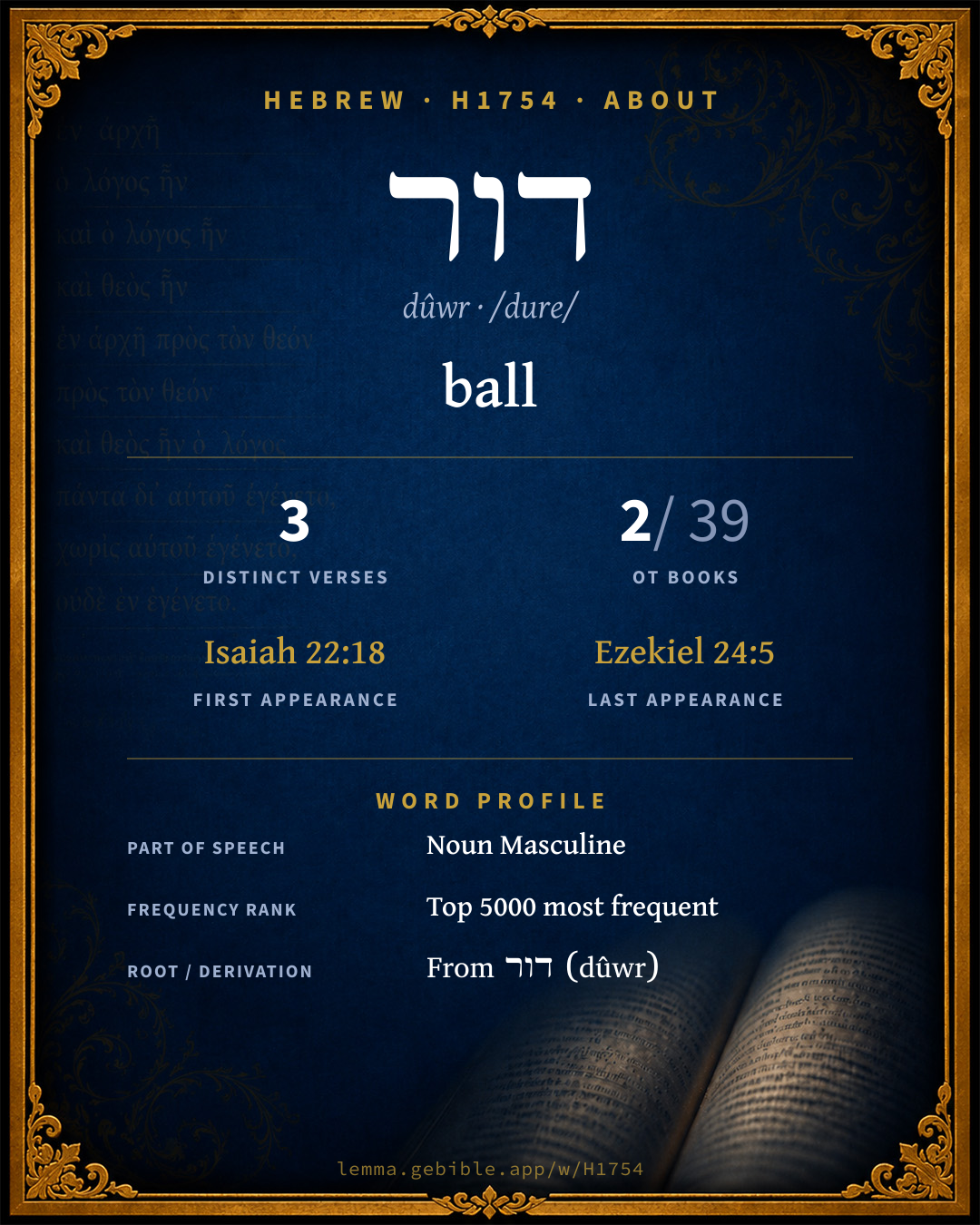
דּוּר
ball
‘ball’ is one of 3 main senses fuller range ↓
Full lexicon entry — Brown-Driver-Briggs (BDB)
From Brown-Driver-Briggs (BDB)
Where this word appears
Grammar key — what these labels mean
Part of speech
- Noun
- A naming word — a person, place, thing, or idea.
- Verb
- An action or state-of-being word.
Noun type
- Common
- A common noun — a general class of person, place, or thing (“king,” “city,” “water”), not a specific name.
Stem
- Qal
- The basic, simple active stem — the plain form of the verb (“he wrote”). Here: ‘in Inf.’
Form
- Imperative
- A direct command (“write!”).
State
- Absolute
- The independent form of a noun, not bound to a following word.
Person
- 2nd Person
- The one addressed (“you”).
Gender
- Masculine
- Grammatically masculine.
Number
- Singular
- One.
Grammatical forms
- Noun, Common, Masculine, Singular, Absolute 2 times (67%)
- Verb, Qal, Imperative, 2nd Person, Masculine, Singular 1 time (33%)
Parsed forms decoded from the imported morphology (morphhb / Westminster Leningrad Codex — WLC text public domain, morphhb tagging CC BY 4.0), counted across 3 parsed occurrences — not distinct verses.
Every verse where H1754 appears — 3 distinct verses across 2 books. Click any verse to open its interlinear word-by-word view. Verse text shown in the World English Bible for context — . Each verse’s Hebrew form is shown with its reference; the English is not keyword-highlighted, since the data carries no word-level English alignment. Use “Compare translations” on any verse to read it across multiple English versions. This concordance covers the Hebrew Bible; Septuagint (Greek Old Testament) occurrences are not indexed here.
Isaiah 2 verses
- Isaiah 22:18 כַּדּ֕וּר n c ms He will surely wind you round and round, [and toss you] like a ball into a large country; there shall you die, and there shall be the chariots of your glory, you shame of your lord's house.
- Isaiah 29:3 כַ/דּ֖וּר prep det + n c ms I will encamp against you round about, and will lay siege against you with posted troops, and I will raise siege works against you.
Ezekiel 1 verse
About this entry
At a glance — auto-summarized from this page’s data, not written by a person. Every figure links to its source below. This summary describes the numbers; it doesn’t interpret them.
“ball” is the headline sense of the Hebrew noun דור (dûwr). A scarce word — 3 verses in all of the Hebrew Bible. It clusters heavily in Isaiah, which alone accounts for 67% of its uses. First canonically at Isaiah 22:18, it enters the text early. Carrying more than one sense, it rewards its full sense range. The sections below give every sense, occurrence, and version rendering.
Gloss history
Strong's 1890 vs modern scholarship
About this word
Strong's H1754 catalogs a Hebrew word from the Hebrew Old Testament.
These counts are not copied from any lexicon or concordance. They are computed here, from the morphology-tagged Hebrew Old Testament. What Lemma adds →
- 3
- distinct verses
- The word appears in 3 distinct verses.
- 2 / 39
- OT books
- The word appears in 2 of 39 Old Testament books.
- #4,179
- by frequency
- Top 5000 most frequent Hebrew words (rank 4,179 of 8,640 Hebrew words by occurrence).
View all 3 occurrences in the concordance →
By traditional corpus
Conventional, traditional groupings — biblical authorship is debated, so this is a traditional corpus grouping, not an authorship claim. Each share is this word’s portion of its verses in that division of the Hebrew canon. Each figure is a share of the word’s 3 distinct verses.
- Prophets (Nevi'im) 3 verses · 100%
How translations render this word
Counts come from each version’s own published word-to-Strong’s tagging or interlinear alignment — an approximate guide to how each version renders this word, not a word-level alignment the data otherwise carries. Because each total is that version’s own tagged count, the per-version totals vary from one another and need not match the appearance or distinct-verse counts above. These counts may also differ from a printed concordance because Lemma counts each distinctly tagged rendering and does not collapse phrase taggings into a single head-word total. This is a fixed set of word-tagged versions (KJV, ASV, BSB, ULT) and does not change with the reading translation you choose elsewhere. Each version’s license is shown beside its name below (and on Sources).
BDB lists this Strong’s number as 2 distinct words (homographs). Each count above pools all of them and is not split by sense — see the Senses section below. A low-frequency rendering may belong to a different one of those words, not the primary meaning.
- King James Version†: Against thee round about 1×, Burn 1×, Thee like a ball 1×
- American Standard Version†: Against thee round about 1×, Pile of wood 1×, Toss thee like a ball 1×
- Berean Standard Bible†: Ball 1×, Circle 1×, Pile the fuel 1×
- unfoldingWord Literal Text†: Like a ball 1×, Like a circle 1×, Pile up the 1×
King James Version Public Domain
Renders H1754 across 3† tagged occurrences — most commonly:
American Standard Version Public Domain
Renders H1754 across 3† tagged occurrences — most commonly:
Berean Standard Bible Public Domain
Renders H1754 across 3† tagged occurrences — most commonly:
unfoldingWord Literal Text CC BY-SA 4.0
Renders H1754 across 3† tagged occurrences — most commonly:
Senses in the full BDB
What do BDB’s symbols mean?
BDB uses these scholarly abbreviations:
| Symbol | Meaning |
|---|---|
| 𝔊 | the Septuagint (the ancient Greek translation, LXX) |
| 𝔙 | the Vulgate (the Latin translation) |
| 𝔖 | the Syriac version (the Peshitta) |
| 𝔗 | the Targum (the Aramaic translation) |
| ψ | the Psalms |
| √ | root (the underlying root or stem) |
| ‖ | parallel passage (a synonymous or contrasted parallel) |
| † | the dagger: every passage where the word occurs is cited |
The 6 senses and sub-senses the full Brown-Driver-Briggs lexicon distinguishes for this word, in lexicon order (not ranked by frequency), with BDB’s own verbatim wording and sub-sense lettering. Shown in Hebrew script with BDB’s own scholarly abbreviations. The condensed entry is in the Lexicon Entry tab. See also the Forms in the corpus table below.
דור I
- 1. heap up, pile.
- 2. dwell (orig. move in a circle, go about, surround, cf. Arabic دَارَ; دَارٌ house, especially as group of buildings about a court; Assyrian dûru, wall, fortress, COTGloss.; thence (denom. Fl NHWBi. 440) dwell Aramaic דּוּר, ܕܳܪ (pt. & Pa), hence in Heb. cf. Giesebr ZAW i. 304 Fl l.c. CheOP 479; Ethiopic ዳር generation (= דּוֹר: prob. loan-word); according to Hpt KAT2 Gloss.. i. Assyrian [darû, endure], dârû, everlasting (cf. Bez Orient Diplom.) = Arabic دَهْرٌ long time, age)—
Qal
- in Inf. מִדּוּר באהלי־רשׁע ψ 84:11 than to dwell in tents of wickedness. Imv. (or Inf. abs. irreg. for דּוֹר, cf. ‖ לָקוֹחַ) דּוּר העצמים Ez 24:5 heap up.—In Gn 6:3 some read Impf. 3 ms. יָדוּר shall dwell, for ידון; v. דין. e.g. Psalms 84:11
דור II [m.] circle, ball
- 1. circle Du Is 29:3 thinks noun here also is כַּדּוּד (or כִּדּוֹד) = כִּידוֹר onset of combatants; Marti כְּדָוִד as 𝔊 Lo Brd al. וְחָנִיתִי כַּדּוּר עליך Is 29:3 (> 𝔊 Brd כְּדָוִד). e.g. Isaiah 29:3
- 2. ball צָנוֹף יִצְנָפְךָ צְנֵפָה כַּדּוּר Is 22:18 (so most; but BöNÄ ii. 134 De Or Jastr PAOS 1888, xcv. ff. regard noun as כַּדּוּר, ball, as Talm., from כדר cf. also MV SS s.v.). [ e.g. Isaiah 22:18
- 3. heap, pile Ez 24:5 Thes Ke MV cf. מְדוּרָה v 9; but v. supr. sub דּוּר vb.] e.g. Ezekiel 24:5
Senses from the full Brown-Driver-Briggs lexicon (Brown, Driver, Briggs; Oxford 1906 — public domain), digitized via Sefaria, supplemented by the OpenScriptures HebrewLexicon (CC BY 4.0). Full attribution on Sources.
Word origin
n.[m.] circle, ball—
— Brown-Driver-Briggs (Oxford 1906, public domain), digitized via Sefaria, supplemented by the OpenScriptures HebrewLexicon (CC BY 4.0). See Sources.
Derived from דור (dûwr) (H1752) — to dwell.
Jastrow Dictionary
A second Hebrew/Aramaic lexicon for comparison, covering Aramaic and post-biblical (Talmudic, Targumic, Midrashic) usage that the biblical-Hebrew BDB does not. Matched by lemma rather than by Strong’s number, so a lemma may carry more than one Jastrow headword (shown separately below), and the entries cover usage well beyond the Bible.
דּוּר I
- 1. to form a circle or enclosure (v. Fl. to Levy Talm. Dict. I, p. 440ᵃ sq.).—Denom. דּוּר II, דּוֹר, דִּירָה &c.].
- 2. (denom. of דִּירָה) to reside, dwell. Ber. 8ᵃ לעולם יָדוֹר וכ׳ one must try to live in the same place with his teacher. Keth. 72ᵃ; a. fr. אין אדם דָּר וכ׳, v. כְּפִיפָה. Ib. 110ᵇ בל הדָּר בא"י whoever lives in Palestine.—Succ. 35ᵃ (ref. to hadar, Lev. XXIII, 40) א"ת הָדָר אלא הַדָּר דבר שֶדָּר וכ׳ ed. (Ms. M. הָדָר דבר הַדָּר וכ׳) read not hadar but haddar, something which remains on its tree from year to year (without withering); a. fr. e.g. Leviticus 23:40
- 3. to lodge, v. infra.
- 1. to cause a circuit; ד׳ שדה to let cattle change folds within a field, to collect manure in a field, by letting cattle live on it. Shebi. III, 4. Y. ib. 34ᶜ bot. מְדַיְּירִין בטובה you may let your cattle live on one’s field as a favor; a. e.
- 2. to lodge, v. infra.
- to lodge. Pesik. R. s. 3, beg. (play on דָּֽ֗רְ֗בָ֗ן֗) שמֵדִ֗יר̇ ב̇ינ̇ה בפרה it (the goad) causes understanding to dwell in the cow; Pesik. Baḥod. p. 153ᵃ שמורה (ed. O. שמדיר); Koh. R. to XII, 11 [read:] שהוא מְדַיֵּיר; Num. R. s. 14 שדָּר; Y. Snh. Tanḥ. B’haăl 15 דָּר אצל הפרה וכ׳.—[Num. R. l. c. the words of the wise דָּ֗רִ֗ים ב̇ינ̇ה וכ׳ lodge understanding with men.]
- to be manured by cattle living in folds, v. Piel. Shebi. IV, 2; M. Kat. 13ᵃ; a. e.
דּוּר
- , to dwell. Targ. Ps. CV, 23; a. fr.—Pes. 113ᵃ top (v. Rabb. D. S. a. l. note 6).—Part. דָּאִיר, דָּיֵיר. Targ. Ps. LVII, 5 דָיְירָא Ms. (ed. חיירא).—Yeb. 52ᵃ דאיר בבי וכ׳ he resides with his father-in-law. B. Mets. 117ᵃ דהוו דָיְירֵי who occupied. Taan. 24ᵃ דָּיִירְנָא וכ׳ I live in a poor village.
- , דַּיֵּיר
- 1. to go around, to peddle (cmp. h. סָחַר). R. Hash. 9ᵇ (expl. דְּרוֹר, Lev. XXV, 10) כמְדַיֵּיר דיירא ומוביל וכ׳ Ms. M. (ed. בי דיירא, Ar. s. v. דר 3: כי מדַוַּאר דריא) as a traveller is licensed to go around and carry his goods through the whole district. e.g. Leviticus 25:10
- 2. to deposit manure, v. preced.Pi.—B. Kam. 113ᵇ הני דדַיְּירֵי דירי Rashi (ed. דרי, Ms. R. דמְדַיְּירֵי דיירי, v. Rabb. D. S. a. l. note) those (gentiles) who manure fields for pay by letting cattle live on them in folds.
- 3. to place around (in a row, Rashi). Kidd. 81ᵃ ד׳ גולפי placed jugs around (as a partition).—
- *4. to round a person, to overtake. B. Kam. 92ᵇ; B. Mets. 107ᵇ (prov.) רהוט … ולא דַּוְּורוּהוּ וכ׳ Ar. (ed. מטו, אמטו) runners run but overtake not one who has taken a morning meal.
דּוּר II
- (preced., cmp. זֵר) rim, wreath. Kel. XVI, 3.—Pl. דּוּרִים. Ib.
*דּוּר III
- a stuffed bag. Lam. R. to I, 1 רבתי (חד כות׳ 2), v. אֵדֶר I. [Y. Snh. X, 28ᵃ top; Num. R. s. 14; 15; Tanḥ. B’haăl. 15, v. כַּדּוּר.]
דּוֹר
- [circle, period, cmp. גִּיל] generation, contemporaries. Arakh. 17ᵃ ד׳ לפי פרנס as the leader so the generation; a. v. fr.—ד׳ הפלגה the generation which witnessed the separation of races; ד׳ המבול which perished in the flood; ד׳ המדבר which perished in the desert, &c. Snh. X, 3 (107ᵇ, sq.); a. fr.—Pl. דּוֹרוֹת. Ib. 99ᵃ; a. fr.—לַדּוֹרוֹת for all time to come; permanent, opp. לשעה, הוראת שעה a temporary ordinance. Ib. 16ᵇ (ref. to Num. VII, 1) אותם במשיחה ולא לד׳ וכ׳ only they were installed with ointment, but not as a precedent for future installations; a. fr.—Men. 19ᵇ, a. e. ד׳ משעה לא ילפינן a permanent law cannot be derived from a special temporary legislation.—פסח ד׳ annual Passover celebration, opp. to פסח מצרים the one observed in Epypt. Pes. IX, 5; a. fr. e.g. Numbers 7:1
דּוֹר ²
- imperat. of נָדַר. Kidd. 41ᵃ; a. fr.
A Dictionary of the Targumim, the Talmud Babli and Yerushalmi, and the Midrashic Literature (Marcus Jastrow; London, Luzac, 1903) — Public Domain. Digitized via Sefaria. Digitized via Sefaria. Full attribution on Sources.
Forms in the corpus
The 3 distinct written forms H1754 takes in the Hebrew Bible, most frequent first — each parse links to that state’s occurrences in the concordance. Hebrew forms include their vowel points and cantillation, so a single lemma takes many written forms.
| Form | Parsing | Example | Uses |
|---|---|---|---|
| דּ֥וּר | Verb, Qal, Imperative, 2nd Person, Masculine, Singular | Ezekiel 24:5 | 1 |
| כַ/דּ֖וּר | Noun, Common, Masculine, Singular, Absolute | Isaiah 29:3 | 1 |
| כַּדּ֕וּר | Noun, Common, Masculine, Singular, Absolute | Isaiah 22:18 | 1 |
Same root — word family
Other BDB entries built from the same root as H1754, grouped by Strong’s listed origin. These share a root / origin per the lexicon — not necessarily a shared meaning. Each links to that word’s own entry.
Derives from
Shares the same root
Compare all same-root words → Showing 4 of 5 — not the complete family. They share a root, not necessarily a meaning.
Septuagint verse parallels
This word appears in 3 verses that also exist in the Greek Old Testament (Septuagint), out of the 3 Hebrew verses it occurs in. You can read those verses in Greek by switching the Old Testament edition to the Septuagint.
Read these verses in the Septuagint
This is a verse-level parallel only — the same verses exist in both the Hebrew and Greek Old Testaments. No word-level Hebrew↔Greek correspondence is claimed: the data carries no such alignment, so no Greek word is shown as this Hebrew word’s translation. Coverage is not total — the Septuagint omits the deuterocanon and renumbers the Psalms, so some Hebrew verses have no direct Greek parallel.