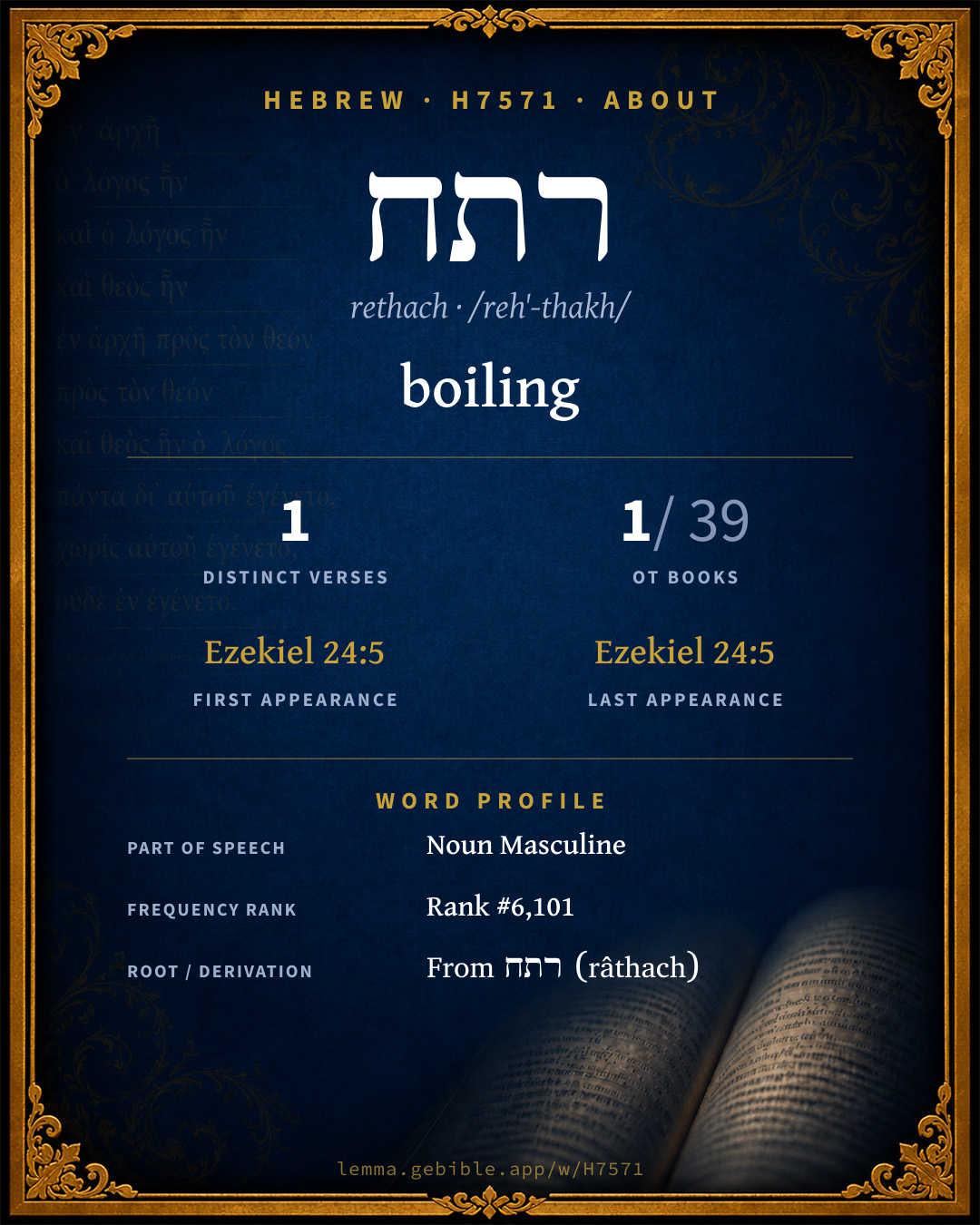
רֶ֫תַח
boiling
Full lexicon entry — Brown-Driver-Briggs (BDB)
From Brown-Driver-Briggs (BDB)
Where this word appears
Grammar key — what these labels mean
Part of speech
- Noun
- A naming word — a person, place, thing, or idea.
Noun type
- Common
- A common noun — a general class of person, place, or thing (“king,” “city,” “water”), not a specific name.
State
- Construct
- A noun bound to a following noun in a possessive / “of” relationship (the construct chain).
Gender
- Masculine
- Grammatically masculine.
Number
- Plural
- More than one (in Hebrew, generally three or more).
Every verse where H7571 appears — 1 distinct verse across 1 book. Click any verse to open its interlinear word-by-word view. Verse text shown in the World English Bible for context — . Each verse’s Hebrew form is shown with its reference; the English is not keyword-highlighted, since the data carries no word-level English alignment. Use “Compare translations” on any verse to read it across multiple English versions. This concordance covers the Hebrew Bible; Septuagint (Greek Old Testament) occurrences are not indexed here.
Ezekiel 1 verse
About this entry
At a glance — auto-summarized from this page’s data, not written by a person. Every figure links to its source below. This summary describes the numbers; it doesn’t interpret them.
רתח (rethach) is a Hebrew noun most often rendered “boiling.” A scarce word — 1 verse in all of the Hebrew Bible. It clusters heavily in Ezekiel, which alone accounts for 100% of its uses. Its lone occurrence is Ezekiel 24:5. The sections below give every sense, occurrence, and version rendering.
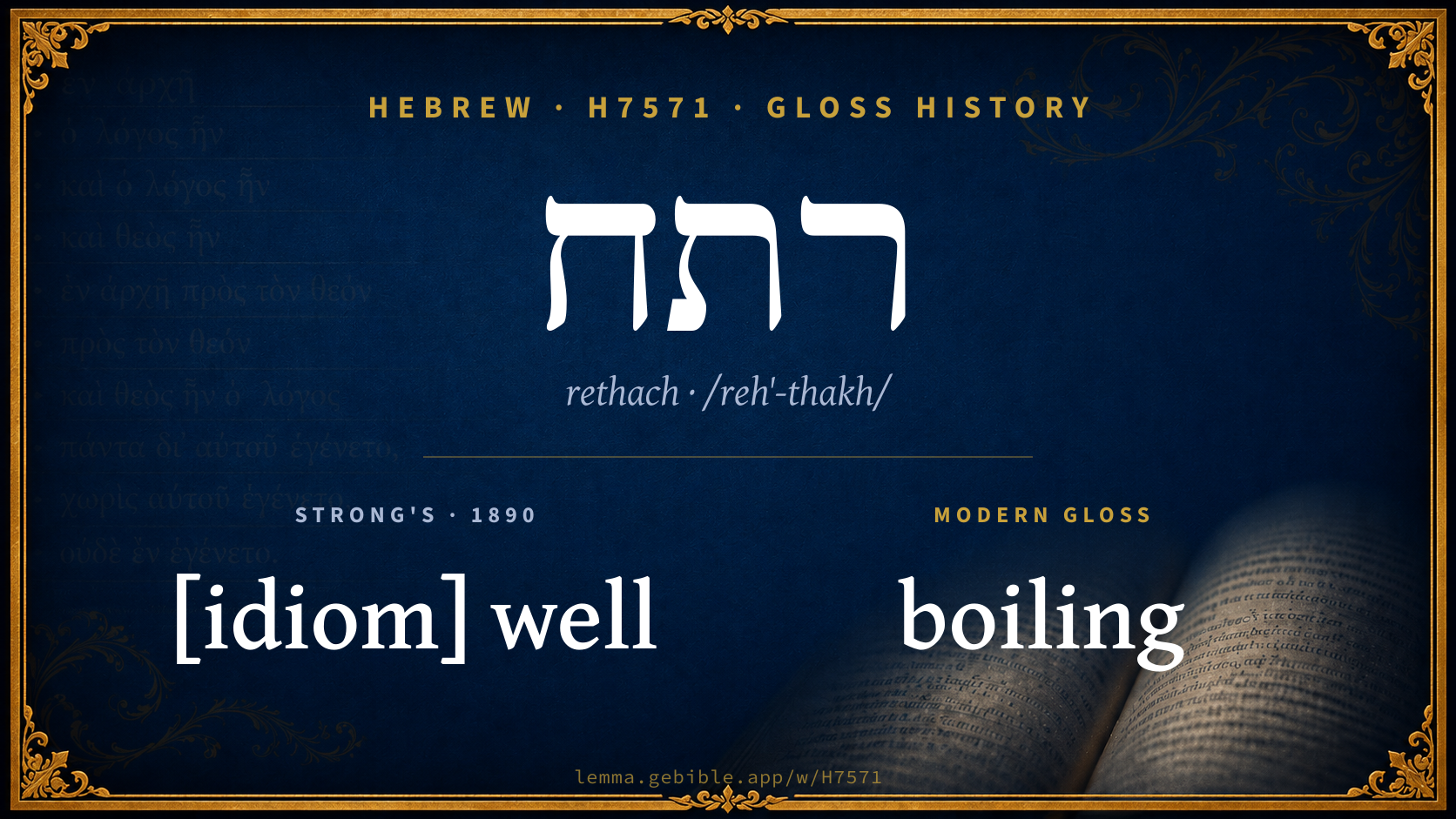
Gloss history
Strong's 1890 vs modern scholarship
About this word
Strong's H7571 catalogs a Hebrew word from the Hebrew Old Testament.
These counts are not copied from any lexicon or concordance. They are computed here, from the morphology-tagged Hebrew Old Testament. What Lemma adds →
- 1
- distinct verses
- The word appears in 1 distinct verse.
- 1 / 39
- OT books
- The word appears in 1 of 39 Old Testament books.
- #6,101
- by frequency
- Rank #6,101 (rank 6,101 of 8,640 Hebrew words by occurrence).
View all 1 occurrence in the concordance →
Most concentrated in
- Ezekiel 1 verse 100%
By section of the Old Testament
By traditional corpus
Conventional, traditional groupings — biblical authorship is debated, so this is a traditional corpus grouping, not an authorship claim. Each share is this word’s portion of its verses in that division of the Hebrew canon. Each figure is a share of the word’s 1 distinct verse.
- Prophets (Nevi'im) 1 verse · 100%
How translations render this word
Counts come from each version’s own published word-to-Strong’s tagging or interlinear alignment — an approximate guide to how each version renders this word, not a word-level alignment the data otherwise carries. Because each total is that version’s own tagged count, the per-version totals vary from one another and need not match the appearance or distinct-verse counts above. These counts may also differ from a printed concordance because Lemma counts each distinctly tagged rendering and does not collapse phrase taggings into a single head-word total. This is a fixed set of word-tagged versions (KJV, ASV, BSB, ULT) and does not change with the reading translation you choose elsewhere. Each version’s license is shown beside its name below (and on Sources).
- King James Version: Well 1×
- American Standard Version: Make it boil well 1×
- Berean Standard Bible: Bring it to a boil 1×
- unfoldingWord Literal Text: Cook 1×
King James Version Public Domain
Renders H7571 across 1 tagged occurrence — most commonly:
American Standard Version Public Domain
Renders H7571 across 1 tagged occurrence — most commonly:
Berean Standard Bible Public Domain
Renders H7571 across 1 tagged occurrence — most commonly:
unfoldingWord Literal Text CC BY-SA 4.0
Renders H7571 across 1 tagged occurrence — most commonly:
Senses in BDB
The 1 sense BDB distinguishes for this word, in lexicon order (not ranked by frequency or importance). The full entry — with sub-senses — is in the Lexicon Entry tab.
- boiling
Word origin
[ רֶ֫תַח ] n.[m.] boiling;—pl. sf. Ez 24:5
— Brown-Driver-Briggs (Oxford 1906, public domain), digitized via Sefaria, supplemented by the OpenScriptures HebrewLexicon (CC BY 4.0). See Sources.
Derived from רתח (râthach) (H7570) — to boil.
Jastrow Dictionary
A second Hebrew/Aramaic lexicon for comparison, covering Aramaic and post-biblical (Talmudic, Targumic, Midrashic) usage that the biblical-Hebrew BDB does not. Matched by lemma rather than by Strong’s number, so a lemma may carry more than one Jastrow headword (shown separately below), and the entries cover usage well beyond the Bible.
רָתַח
- to bubble, boil, be hot.—Part. רוֹתֵחַ; f. רוֹתַחַת; pl. רוֹתְחִים, רוֹתְחִין; רוֹתְחוֹת. [Tradit. pronunc. רוּתָח adj.] Y. Sot. IX, 24ᵃ חלב ר׳ milk fresh from the goat. Y. Pes. VII, beg. 34ᵃ והרי הוא ר׳ ומרתיח but is not the iron spit hot and does is not impart heat (to the lamb on it)? Bab. Pes. 76ᵃ סולת ר׳ heated flour. Ib. 94ᵇ כל העולם כולו ר׳ וכ׳ (in the summer) the whole world is hot, and the springs are cold; כל … מעיינות ר׳ (in the winter) the whole world is cold, and the springs are hot; a. fr.—Esp. רוֹתְחִין hot water. Snh. 108ᵇ; R. Hash. 12ᵃ, v. קִלְקֵל. Y. Ber. II, 5ᵇ bot., v. כָּוָה. Deut. R. s. 3 כשתראה אותי נותן ר׳ וכ׳ when thou seest me put hot water (to the wine), put thou cold water in &c., i.e. when I am angry, appease thou me &c.; a. fr.
- 1. to cause bubbling, foaming. B. Mets. 61ᵇ ובמשורה שלא יַרְתִּיחַ ‘and in liquid measure’ (Lev. XIX, 35) one is warned that one must not make the liquid foam; B. Bath. 89ᵇ; Tosef. ib. V, 5 אין … לא להַרְתִּיחַ … ולא להקפיצה (Var. להרתיע) the storekeeper is not permitted to make the liquid bubble in the measure, or to make it bound. e.g. Leviticus 19:35
- 2. to heat. Tosef. Yoma I, 20 עששיות … היו מַרְתִּיחִין וכ׳ they heated &c.; (Yoma 34ᵇ מחמין); v. עֲשָׁשִׁית. Y. B. Bath. II, beg. 13ᵇ הסלעים מרתיחין the rocks give out heat; Y. Sabb. IV, 6ᵇ bot. Cant. R. to II, 17 עד שאַרְתִּיחַ היום until I shall make the day hot (for Israel’s enemies); a. fr.
- 3. to grow hot. Tosef. Pes. V, 8 אינו מַרְתִּיחַ does not get hot, v. שָׂרַף I. Gen. R. s. 67 התחילו … מרתיחים (not מרתיתים) the walls of the house began to be hot; Yalk. ib. 115. Esth. R. to I, 1 (playon אר̇ת̇ח̇ש̇ש̇ת̇א) שהיה מר̇ת̇יח̇ ות̇ש̇ he used to be hot (angry), and weaken (relent) again. Cant. R. to IV, 5 two families אחת מיקרת ואחת מַרְתַּחַת one of which was cold-blooded, and the other hot-blooded; a. e.
- to heat, boil. [Yalk. Gen. 27 רי׳ עליו, v. רָתָה]—Part. pass. מְרוּתָּח, pl. מְרוּתָּחִין. Lev. R. s. 14 מיעיה של אשה מר׳ וכ׳ the inner parts of woman are hot &c. Sabb. III, 5; Pes. 40ᵇ; a. e.
רְתַח
- , to boil, be hot.—Part. pass. רָתִיחַ; pl. רְתִיחִין. Targ. Y. I Gen. L, 1 חמרין רתי׳ (some ed. רָתְחִין). Targ. Job XXIV, 24 Ms.—Y. Pes. III, 30ᵃ top דלא יִרְתְּחָן ויחמען that they may not get hot and ferment. Ber. 62ᵇ עד דרַתְחָא וכ׳, v. קִדְרָא; a. e.—רָתְחִין hot water. Ex. R. s. 45 מזגין ר׳ (not רתחים), v. מְזַג; Midr. Till. to Ps. XXV, 4.—Trnsf. to be excited, wroth. Targ. Ps. XXXIX, 4. Targ. Y. Deut. XIX, 6. Targ. Koh. VII, 9; a. fr.—Ber. 7ᵃ רגע ר׳ for a moment the Lord is wroth. Ib. 29ᵇ לא תִרְתַּח ולא תחטי be not excited, and thou shalt not sin. Zeb. 30ᵇ hot. אם כן מִרְתַּח ר׳ if so, he might get angry; a. e.
- to boil; to heat, excite, arouse the anger of. Targ. Job XLI, 23 מַרְתַּח (some ed. מְרַתַּח Pa.). Targ. Koh. l. c. מסרב ומַרְתַּח (ed. Vien. ומִרְ׳, corr. acc.; some ed. ומְרַתַּח).—[Targ. Job IV, 10 מרתיחין, v. רְתַת.]—Pes. 76ᵃ רוטב מַרְתַּח ליה וכ׳ (or מְרַתַּח) the juice (dripping) heats the clay (of the oven) &c. Taan. 4ᵃ ההוא … דקא מַרְתְּחָא ליה (or מְרַתְּחָא) if a student gets angry, it is the (zeal for) the Law that excites him; a. e.—Part. pass. Pa. מְרַתַּח; f. מְרַתְּחָא. Targ. Y. I Lev. VI, 14 מְרֻתְּחָא (Hebraism; h. text מרבכת).—Gitt. 57ᵇ אשכחיה … מר׳ וסליק he found the blood of Zechariah bubbling and coming up; (Snh. 96ᵇ דהוה קא רתח).
A Dictionary of the Targumim, the Talmud Babli and Yerushalmi, and the Midrashic Literature (Marcus Jastrow; London, Luzac, 1903) — Public Domain. Digitized via Sefaria. Digitized via Sefaria. Full attribution on Sources.
Septuagint verse parallels
This word appears in 1 verse that also exists in the Greek Old Testament (Septuagint), out of the 1 Hebrew verse it occurs in. You can read those verses in Greek by switching the Old Testament edition to the Septuagint.
Read these verses in the Septuagint
This is a verse-level parallel only — the same verses exist in both the Hebrew and Greek Old Testaments. No word-level Hebrew↔Greek correspondence is claimed: the data carries no such alignment, so no Greek word is shown as this Hebrew word’s translation. Coverage is not total — the Septuagint omits the deuterocanon and renumbers the Psalms, so some Hebrew verses have no direct Greek parallel.