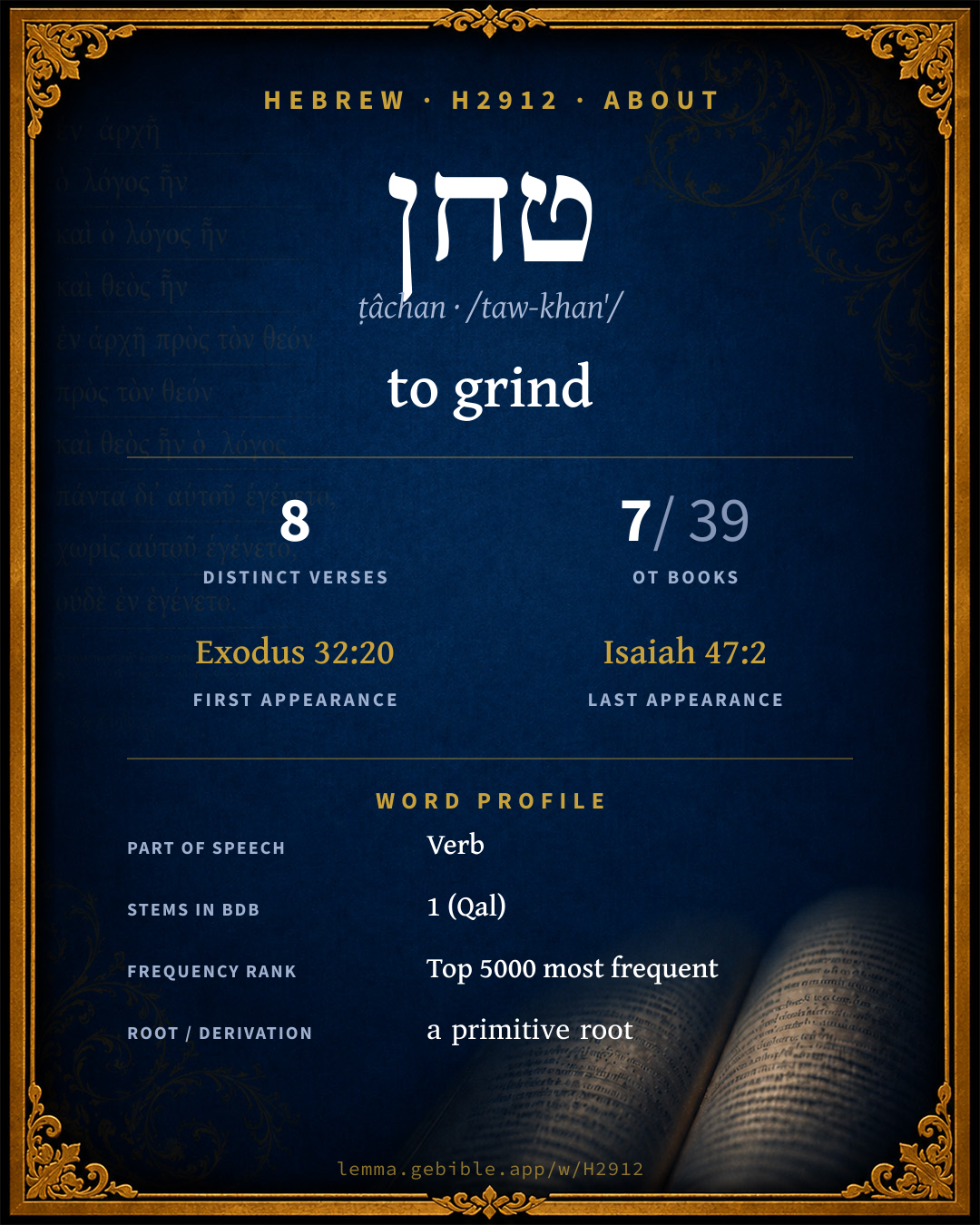
טָחַן
to grind
Full lexicon entry — Brown-Driver-Briggs (BDB)
From Brown-Driver-Briggs (BDB)
Where this word appears
Grammar key — what these labels mean
Part of speech
- Verb
- An action or state-of-being word.
Noun type
- Common
- A common noun — a general class of person, place, or thing (“king,” “city,” “water”), not a specific name.
Stem
- Qal
- The basic, simple active stem — the plain form of the verb (“he wrote”).
Form
- Sequential Perfect
- A perfect with prefixed waw continuing a preceding imperfect or command (waw-consecutive perfect).
- Imperative
- A direct command (“write!”).
- Sequential Imperfect
- An imperfect with prefixed waw — the standard past-narrative form (waw-consecutive imperfect).
- Infinitive Absolute
- An unbound verbal noun, often intensifying or standing in for a finite verb.
- Imperfect
- An incomplete, ongoing, or future action (“he will / would write”).
- Participle Active
- A verbal adjective expressing ongoing or characteristic action (“writing / one who writes”).
State
- Absolute
- The independent form of a noun, not bound to a following word.
Person
- 3rd Person
- The one spoken about (“he / she / it / they”).
- 2nd Person
- The one addressed (“you”).
Gender
- Common
- Either gender — not distinguished for this form.
- Feminine
- Grammatically feminine.
- Masculine
- Grammatically masculine.
Number
- Plural
- More than one (in Hebrew, generally three or more).
- Singular
- One.
Grammatical forms
- Verb, Qal, Sequential Perfect, 3rd Person, Common, Plural 1 time (13%)
- Verb, Qal, Imperative, 2nd Person, Feminine, Singular 1 time (13%)
- Verb, Qal, Sequential Imperfect, 3rd Person, Masculine, Singular 1 time (13%)
- Noun, Common, Feminine, Plural, Absolute 1 time (13%)
- Verb, Qal, Infinitive Absolute 1 time (13%)
- Verb, Qal, Imperfect, 2nd Person, Masculine, Plural 1 time (13%)
- Verb, Qal, Imperfect, 3rd Person, Feminine, Singular 1 time (13%)
- Verb, Qal, Participle Active, Masculine, Singular, Absolute 1 time (13%)
Parsed forms decoded from the imported morphology (morphhb / Westminster Leningrad Codex — WLC text public domain, morphhb tagging CC BY 4.0), counted across 8 parsed occurrences — not distinct verses.
Every verse where H2912 appears — 8 distinct verses across 7 books. Click any verse to open its interlinear word-by-word view. Verse text shown in the World English Bible for context — . Each verse’s Hebrew form is shown with its reference; the English is not keyword-highlighted, since the data carries no word-level English alignment. Use “Compare translations” on any verse to read it across multiple English versions. This concordance covers the Hebrew Bible; Septuagint (Greek Old Testament) occurrences are not indexed here.
Exodus 1 verse
Numbers 1 verse
Deuteronomy 1 verse
Judges 1 verse
Job 1 verse
Ecclesiastes 1 verse
Isaiah 2 verses
- Isaiah 3:15 תִּטְחָ֑נוּ Qal impf 2mp What do you mean that you crush my people, And grind the face of the poor?" says the Lord, Yahweh of Hosts.
- Isaiah 47:2 וְ/טַ֣חֲנִי conj + Qal impv 2fs Take the millstones, and grind meal; remove your veil, strip off the train, uncover the leg, pass through the rivers.
About this entry
At a glance — auto-summarized from this page’s data, not written by a person. Every figure links to its source below. This summary describes the numbers; it doesn’t interpret them.
טחן — transliterated ṭâchan — is a Hebrew verb carrying the sense “to grind.” Debuting at Exodus 32:20, it then recurs through the corpus. It appears 8 verses across 7 books of the Hebrew Bible, among its uncommon vocabulary. More than a quarter of its appearances fall in Isaiah. Related forms include טחון and טחנה. Each statement above links to its evidence; the full detail follows below.
Gloss history
Strong's 1890 vs modern scholarship
About this word
Strong's H2912 catalogs a Hebrew word from the Hebrew Old Testament.
These counts are not copied from any lexicon or concordance. They are computed here, from the morphology-tagged Hebrew Old Testament. What Lemma adds →
- 8
- distinct verses
- The word appears in 8 distinct verses.
- 7 / 39
- OT books
- The word appears in 7 of 39 Old Testament books.
- #2,625
- by frequency
- Top 5000 most frequent Hebrew words (rank 2,625 of 8,640 Hebrew words by occurrence).
View all 8 occurrences in the concordance →
By section of the Old Testament
By traditional corpus
Conventional, traditional groupings — biblical authorship is debated, so this is a traditional corpus grouping, not an authorship claim. Each share is this word’s portion of its verses in that division of the Hebrew canon. Each figure is a share of the word’s 8 distinct verses.
- Torah (Pentateuch) 3 verses · 38%
- Prophets (Nevi'im) 3 verses · 38%
- Writings (Ketuvim) 2 verses · 25%
How translations render this word
Counts come from each version’s own published word-to-Strong’s tagging or interlinear alignment — an approximate guide to how each version renders this word, not a word-level alignment the data otherwise carries. Because each total is that version’s own tagged count, the per-version totals vary from one another and need not match the appearance or distinct-verse counts above. These counts may also differ from a printed concordance because Lemma counts each distinctly tagged rendering and does not collapse phrase taggings into a single head-word total. This is a fixed set of word-tagged versions (KJV, ASV, BSB, ULT) and does not change with the reading translation you choose elsewhere. Each version’s license is shown beside its name below (and on Sources).
- King James Version: Grind 3×, Ground 3×
- American Standard Version: Grind 3×, It 2×
- Berean Standard Bible: Grind 4×, Ground 2×
- unfoldingWord Literal Text: Grind 2×, Ground 2×
King James Version Public Domain
Renders H2912 across 8 tagged occurrences — most commonly:
Plus 2 renderings that appear only once — usually multi-word phrases or single function words the recovered tagging swept in, not distinct renderings.
American Standard Version Public Domain
Renders H2912 across 8 tagged occurrences — most commonly:
Plus 3 renderings that appear only once — usually multi-word phrases or single function words the recovered tagging swept in, not distinct renderings.
Berean Standard Bible Public Domain
Renders H2912 across 8 tagged occurrences — most commonly:
Plus 2 renderings that appear only once — usually multi-word phrases or single function words the recovered tagging swept in, not distinct renderings.
unfoldingWord Literal Text CC BY-SA 4.0
Renders H2912 across 10 tagged occurrences — most commonly:
Plus 6 renderings that appear only once — usually multi-word phrases or single function words the recovered tagging swept in, not distinct renderings.
Senses in the full BDB
What do BDB’s symbols mean?
BDB uses these scholarly abbreviations:
| Symbol | Meaning |
|---|---|
| 𝔊 | the Septuagint (the ancient Greek translation, LXX) |
| 𝔙 | the Vulgate (the Latin translation) |
| 𝔖 | the Syriac version (the Peshitta) |
| 𝔗 | the Targum (the Aramaic translation) |
| ψ | the Psalms |
| √ | root (the underlying root or stem) |
| ‖ | parallel passage (a synonymous or contrasted parallel) |
| † | the dagger: every passage where the word occurs is cited |
The 1 sense the full Brown-Driver-Briggs lexicon distinguishes for this word, in lexicon order (not ranked by frequency), with BDB’s own verbatim wording and sub-sense lettering. Shown in Hebrew script with BDB’s own scholarly abbreviations. The condensed entry is in the Lexicon Entry tab. See also the Forms in the corpus table below.
Qal
- Pf. וְטָֽחֲנוּ Nu 11:8; Impf. וַיִּטְחַן Ex 32:20; 3 fs. תִּטְחַן Jb 31:10; 2 mpl. תִּטְחָ֑נוּ Is 3:15; Inf. abs. טָחוֹן Dt 9:21; Imv. fs. טַחֲנִי Is 47:2; Pt. טוֹחֵן Ju 16:21; טֹחֲנוֹת Ec 12:3;—grind, the work of women, c. acc., with millstones רֵחַיִם Nu 11:8 (JE; obj. the manna), Is 47:2 (obj. קָ֑מַח), this fig. of humiliation of Babylon; abs. Ju 16:21; תטחן לאחר אשׁתי Jb 31:10, i.e. serve him as his slave; no obj. expr. Ex 32:20 (E), Dt 9:21 (of golden calf); הַטֹּחֲנוֹת Ec 12:3 = the teeth (cf. Arabic طَوَاحِنُ molar teeth; so in Lexx Syriac ܛܰܚܳܢܴ̈ܬܳܐ, ܛܰܚ̈ܢܳܝܳܬܳܐ); פְּנֵי עֲנִיִּים ט׳ Is 3:15 the face of the poor ye grind, fig. of extreme oppression. e.g. Numbers 11:8
Senses from the full Brown-Driver-Briggs lexicon (Brown, Driver, Briggs; Oxford 1906 — public domain), digitized via Sefaria, supplemented by the OpenScriptures HebrewLexicon (CC BY 4.0). Full attribution on Sources.
Word origin
vb. grind (NH crush, olives, etc.; Aramaic ܛܚܶܢ, טְחַן grind; Arabic طَحَنَ grind; Ethiopic ጥሕን polenta, farina hordacea)—
— Brown-Driver-Briggs (Oxford 1906, public domain), digitized via Sefaria, supplemented by the OpenScriptures HebrewLexicon (CC BY 4.0). See Sources.
Origin: a primitive root
Jastrow Dictionary
A second Hebrew/Aramaic lexicon for comparison, covering Aramaic and post-biblical (Talmudic, Targumic, Midrashic) usage that the biblical-Hebrew BDB does not. Matched by lemma rather than by Strong’s number, so a lemma may carry more than one Jastrow headword (shown separately below), and the entries cover usage well beyond the Bible.
טָחַן
- 1. to mill, grind. Sabb. VII, 2 הטוֹחֵן he who grinds (on the Sabbath). Ex. R. s. 36, beg. טוֹחֲנִין אותם (the olives) are crushed. Sot. 9ᵇ … ועקרן וטְחָנָן וכ׳ and Samson uprooted them (the mountains) and ground them against one another; Snh. 24ᵃ; a. fr.—Trnsf. to have sexual intercourse (cmp. μύλλω). Gen. R. s. 48, end.—
- *2. to force to menial labor. Pesik. R. s. 23-24 (ed. Fr. p. 122ᵇ) טוֹחֲנוֹ ברחיים, v. infra, a. כָּדַן.
- to cause to grind. Kidd. 31ᵃ bot. ויש מַטְחִינוֹ ברחיים and some one may make his father grind in the mill (v. supra, a. כָּדַן). Keth. 59ᵇ (ref. to ib. V, 5) טוֹחֶנֶת ס"ד … מַטְחֶנֶת you cannot mean that she must do the grinding?… she must attend to the grinding.
טְחַן
- Targ. Jud. XVI, 21; a. e.—Pesik. R. s. 23-24; Y. Kidd. I, 61ᵇ bot.; Y. Peah I, 15ᶜ bot. טְחוֹן תחותי grind thou in my place. Ib. הוה איטחין, read: הוה טָחֵין as Y. Kidd. l. c.—Snh. 96ᵃ טַחְנֵי קשייתא were grinding date-stones; a. fr.—Part. pass. טְחִין, טְחִינָא. Ib.ᵇ טְחִינַת קמחא ט׳ thou groundest ground flour (you conquered Israel because it was doomed to destruction). Ber. 43ᵃ bot. משחא ט׳ oil perfumed with ground ingredients, contrad. to כבישא.—Y. Ned. VI, end, 40ᵃ קליין וטְחִינָן וכ׳ roasted and ground &c. [Cant. R. to I, 16 לא מטחנא, read: מְטַמְּנָא (?), v. נְצַע.]
טְחֹן
- m. = טְחִינָה q. v.
A Dictionary of the Targumim, the Talmud Babli and Yerushalmi, and the Midrashic Literature (Marcus Jastrow; London, Luzac, 1903) — Public Domain. Digitized via Sefaria. Digitized via Sefaria. Full attribution on Sources.
Forms in the corpus
The 8 distinct written forms H2912 takes in the Hebrew Bible, most frequent first — each parse links to that stem’s occurrences in the concordance. Hebrew forms include their vowel points and cantillation, so a single lemma takes many written forms.
| Form | Parsing | Example | Uses |
|---|---|---|---|
| הַ/טֹּֽחֲנוֹת֙ | Noun, Common, Feminine, Plural, Absolute | Ecclesiastes 12:3 | 1 |
| וְ/טַ֣חֲנִי | Verb, Qal, Imperative, 2nd Person, Feminine, Singular | Isaiah 47:2 | 1 |
| וְ/טָחֲנ֣וּ | Verb, Qal, Sequential Perfect, 3rd Person, Common, Plural | Numbers 11:8 | 1 |
| וַ/יִּטְחַ֖ן | Verb, Qal, Sequential Imperfect, 3rd Person, Masculine, Singular | Exodus 32:20 | 1 |
| טָחוֹן֙ | Verb, Qal, Infinitive Absolute | Deuteronomy 9:21 | 1 |
| טוֹחֵ֖ן | Verb, Qal, Participle Active, Masculine, Singular, Absolute | Judges 16:21 | 1 |
| תִּטְחַ֣ן | Verb, Qal, Imperfect, 3rd Person, Feminine, Singular | Job 31:10 | 1 |
| תִּטְחָ֑נוּ | Verb, Qal, Imperfect, 2nd Person, Masculine, Plural | Isaiah 3:15 | 1 |
Same root — word family
Other BDB entries built from the same root as H2912, grouped by Strong’s listed origin. These share a root / origin per the lexicon — not necessarily a shared meaning. Each links to that word’s own entry.
Derived from this word
Compare all same-root words → They share a root, not necessarily a meaning.
Septuagint verse parallels
This word appears in 8 verses that also exist in the Greek Old Testament (Septuagint), out of the 8 Hebrew verses it occurs in. You can read those verses in Greek by switching the Old Testament edition to the Septuagint.
Read these verses in the Septuagint
This is a verse-level parallel only — the same verses exist in both the Hebrew and Greek Old Testaments. No word-level Hebrew↔Greek correspondence is claimed: the data carries no such alignment, so no Greek word is shown as this Hebrew word’s translation. Coverage is not total — the Septuagint omits the deuterocanon and renumbers the Psalms, so some Hebrew verses have no direct Greek parallel.