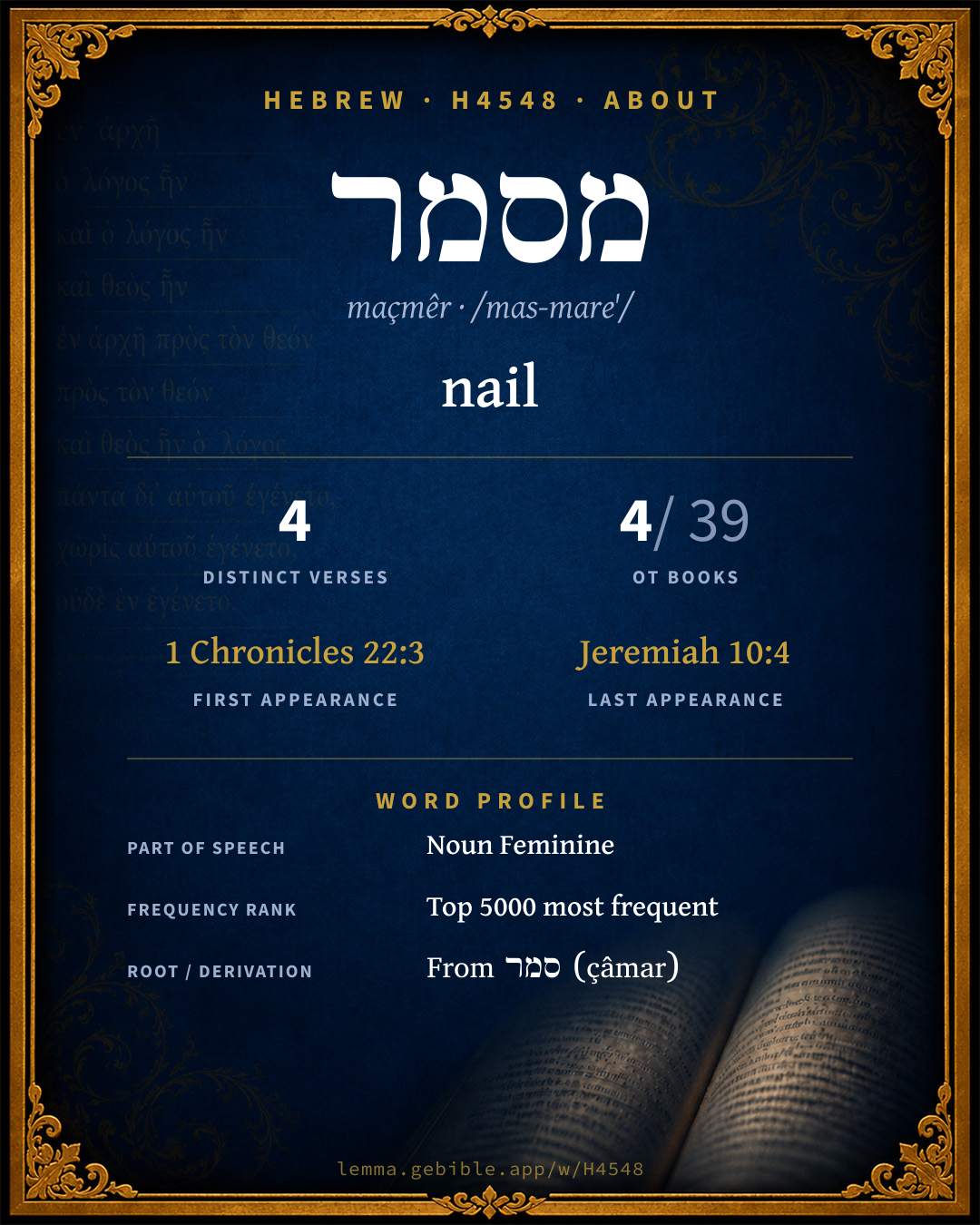
מַסְמֵר
nail
Full lexicon entry — Brown-Driver-Briggs (BDB)
From Brown-Driver-Briggs (BDB)
Where this word appears
Grammar key — what these labels mean
Noun type
- Common
- A common noun — a general class of person, place, or thing (“king,” “city,” “water”), not a specific name.
State
- Absolute
- The independent form of a noun, not bound to a following word.
Gender
- Both
- Attested as both masculine and feminine.
Number
- Plural
- More than one (in Hebrew, generally three or more).
Every verse where H4548 appears — 4 distinct verses across 4 books. Click any verse to open its interlinear word-by-word view. Verse text shown in the World English Bible for context — . Each verse’s Hebrew form is shown with its reference; the English is not keyword-highlighted, since the data carries no word-level English alignment. Use “Compare translations” on any verse to read it across multiple English versions. This concordance covers the Hebrew Bible; Septuagint (Greek Old Testament) occurrences are not indexed here.
1 Chronicles 1 verse
2 Chronicles 1 verse
Isaiah 1 verse
Jeremiah 1 verse
About this entry
At a glance — auto-summarized from this page’s data, not written by a person. Every figure links to its source below. This summary describes the numbers; it doesn’t interpret them.
“nail” is the headline sense of the Hebrew noun מסמר (maçmêr). The Hebrew Bible uses it only 4 verses. More than a quarter of its appearances fall in 1 Chronicles. First canonically at 1 Chronicles 22:3, it enters the text early. It shares a root with סמר, סמר and משמרה. See the sense tree, 4-verse concordance, and the renderings breakdown below.
Gloss history
Strong's 1890 vs modern scholarship
About this word
Strong's H4548 catalogs a Hebrew word from the Hebrew Old Testament.
These counts are not copied from any lexicon or concordance. They are computed here, from the morphology-tagged Hebrew Old Testament. What Lemma adds →
- 4
- distinct verses
- The word appears in 4 distinct verses.
- 4 / 39
- OT books
- The word appears in 4 of 39 Old Testament books.
- #3,696
- by frequency
- Top 5000 most frequent Hebrew words (rank 3,696 of 8,640 Hebrew words by occurrence).
View all 4 occurrences in the concordance →
Most concentrated in
- 1 Chronicles 1 verse 25%
- 2 Chronicles 1 verse 25%
- Isaiah 1 verse 25%
By section of the Old Testament
By traditional corpus
Conventional, traditional groupings — biblical authorship is debated, so this is a traditional corpus grouping, not an authorship claim. Each share is this word’s portion of its verses in that division of the Hebrew canon. Each figure is a share of the word’s 4 distinct verses.
- Prophets (Nevi'im) 2 verses · 50%
- Writings (Ketuvim) 2 verses · 50%
How translations render this word
Counts come from each version’s own published word-to-Strong’s tagging or interlinear alignment — an approximate guide to how each version renders this word, not a word-level alignment the data otherwise carries. Because each total is that version’s own tagged count, the per-version totals vary from one another and need not match the appearance or distinct-verse counts above. These counts may also differ from a printed concordance because Lemma counts each distinctly tagged rendering and does not collapse phrase taggings into a single head-word total. This is a fixed set of word-tagged versions (KJV, ASV, BSB, ULT) and does not change with the reading translation you choose elsewhere. Each version’s license is shown beside its name below (and on Sources).
- King James Version: Nails 4×
- American Standard Version: Nails 4×
- Berean Standard Bible: Nails 2×
- unfoldingWord Literal Text: Nails 4×
King James Version Public Domain
Renders H4548 across 4 tagged occurrences — most commonly:
American Standard Version Public Domain
Renders H4548 across 4 tagged occurrences — most commonly:
Berean Standard Bible Public Domain
Renders H4548 across 3 tagged occurrences — most commonly:
Plus 1 rendering that appears only once — usually multi-word phrases or single function words the recovered tagging swept in, not distinct renderings. Not rendered by a distinct English word in 1 further occurrence.
unfoldingWord Literal Text CC BY-SA 4.0
Renders H4548 across 4 tagged occurrences — most commonly:
Senses in BDB
The 1 sense BDB distinguishes for this word, in lexicon order (not ranked by frequency or importance). The full entry — with sub-senses — is in the Lexicon Entry tab.
- nail
Word origin
Derived from סמר (çâmar) (H5568) — to bristle.
Jastrow Dictionary
A second Hebrew/Aramaic lexicon for comparison, covering Aramaic and post-biblical (Talmudic, Targumic, Midrashic) usage that the biblical-Hebrew BDB does not. Matched by lemma rather than by Strong’s number, so a lemma may carry more than one Jastrow headword (shown separately below), and the entries cover usage well beyond the Bible.
מַסְמָר
- 1. a pointed object, nail, pin. Sabb. VI, 10 (67ᵃ) מ׳ מן הצלוב (Y. ed. מ׳ הצלוב) a nail from the gallows of an impaled convict (used as an amulet). Kel. XII, 4 מ׳ הגרע the blood-letter’s pin (v. infra); מ׳ של אבן השעות the style of the sun-dial; מ׳ הגרדי the weaver’s pin. Ib. 5 מ׳ שהתקינו וכ׳; Tosef. Kel. B. Mets. II, 14 מ׳ שעקמו וכ׳ an iron pin which was bent in order to be used as a key. Kel. l. c. מ׳ של שלחני the banker’s pin for fastening the shutters, v. תְּרִיס.—Num. R. s. 14 מ׳ שיש לו שושנה a nail which has a big knob.—Tosef. Kel. B. Mets. IV, 3 מקל שעשה בראשו מ׳ להיות תופס בו וכ׳ a staff to the end of which a pin was attached for the sake of taking hold of the threshing floor (of making it stationary); ib. V, 10. Ib. B. Bath. VII, 2 חוט המ׳ של וכ׳ the builder’s cord to which a pin is attached (i.e. plumb-line). Ib. B. Mets. II, 11 מ׳ הגרוע the scraper’s pin (fastened to the smith’s block); a. fr.—Pl. מַסְמְרִים, מַסְמְרִין, מַסְמְרוֹת. Gen. R. s. 68, end. B. Bath. 7ᵇ קבע בה מ׳ drive nails into it, i.e. remember it well. Tosef. Kel. B. Mets. II, 11 גולת חנוני שכולה מ׳ a store-keeper’s bowl (?) studded all over with nails. Tanḥ. B’haăl. 15 (ref. to Koh. XII, 11) כתיב כמשמרות ואנו קורין מ׳ וכ׳ it is written k’mishm’roth (like guards) and we read k’masm’roth (like nails) to teach thee, if thou drivest them like a nail into thy heart, they will guard thee; Num. R. s. 4. Esth. R. to VI, 10 אני … חבלים ומ׳ I prepared for thee ropes and nails (for impaling); a. fr. e.g. Ecclesiastes 12:11
- 2. (pl.) cloves. Num. R. l. c. ערבין … כמ׳ נטועים as sweet to their hearers as cloves.
- 3. a peg-shaped attachment to a loaf, knob. T’bul Yom I, 3 מ׳ שאחר הככר the knob on the back of the loaf (supposed to serve as trade-mark).
- 4. a wart or corn (cmp. Lat. clavus).—Pl. מַסְמְרוֹת. Sifra Thazr. Neg., Par. 1, ch. II המ׳; Tosef. Neg. II, 12 המַסְמֶרֶת (sing.).
מַסְמָר ²
- , pin, nail. Targ. Y. Num. XXV, 3.—Y. Ḥag. III, beg. 78ᵈ כל חד וחד נסיב חד מ׳ וכ׳ each took one nail and drove it in. Y. Pes. V, 32ᵇ top [read:] הא קביעא גבך כמסמרא let this be fixed in thy memory like a nail; Y. Yeb. XIII, 13ᶜ top במיסמרה (corr. acc.); a. e.—Pl. מַסְמְרִין, מַסְמְרַיָּא, רַיָּה … Targ. Jer. X, 4; a. e.—Y. B. Bath. II, 13ᵇ bot. [read:] ממחין אילין לאילין מ׳ דנווליה refused to one another the fastening of the weaver’s pin to the party wall.—[מְסַמְּרָא, v. סְמַר.]
A Dictionary of the Targumim, the Talmud Babli and Yerushalmi, and the Midrashic Literature (Marcus Jastrow; London, Luzac, 1903) — Public Domain. Digitized via Sefaria. Digitized via Sefaria. Full attribution on Sources.
Forms in the corpus
The 4 distinct written forms H4548 takes in the Hebrew Bible, most frequent first — each parse links to that state’s occurrences in the concordance. Hebrew forms include their vowel points and cantillation, so a single lemma takes many written forms.
| Form | Parsing | Example | Uses |
|---|---|---|---|
| בְ/מַסְמְרִ֖ים | Noun, Common, Both, Plural, Absolute | Isaiah 41:7 | 1 |
| בְּ/מַסְמְר֧וֹת | Noun, Common, Both, Plural, Absolute | Jeremiah 10:4 | 1 |
| לְ/מִסְמְר֥וֹת | Noun, Common, Both, Plural, Absolute | 2 Chronicles 3:9 | 1 |
| לַֽ/מִּסְמְרִ֞ים | Noun, Common, Both, Plural, Absolute | 1 Chronicles 22:3 | 1 |
Same root — word family
Other BDB entries built from the same root as H4548, grouped by Strong’s listed origin. These share a root / origin per the lexicon — not necessarily a shared meaning. Each links to that word’s own entry.
Derives from
Shares the same root
Derived from this word
Compare all same-root words → They share a root, not necessarily a meaning.
Septuagint verse parallels
This word appears in 4 verses that also exist in the Greek Old Testament (Septuagint), out of the 4 Hebrew verses it occurs in. You can read those verses in Greek by switching the Old Testament edition to the Septuagint.
Read these verses in the Septuagint
This is a verse-level parallel only — the same verses exist in both the Hebrew and Greek Old Testaments. No word-level Hebrew↔Greek correspondence is claimed: the data carries no such alignment, so no Greek word is shown as this Hebrew word’s translation. Coverage is not total — the Septuagint omits the deuterocanon and renumbers the Psalms, so some Hebrew verses have no direct Greek parallel.