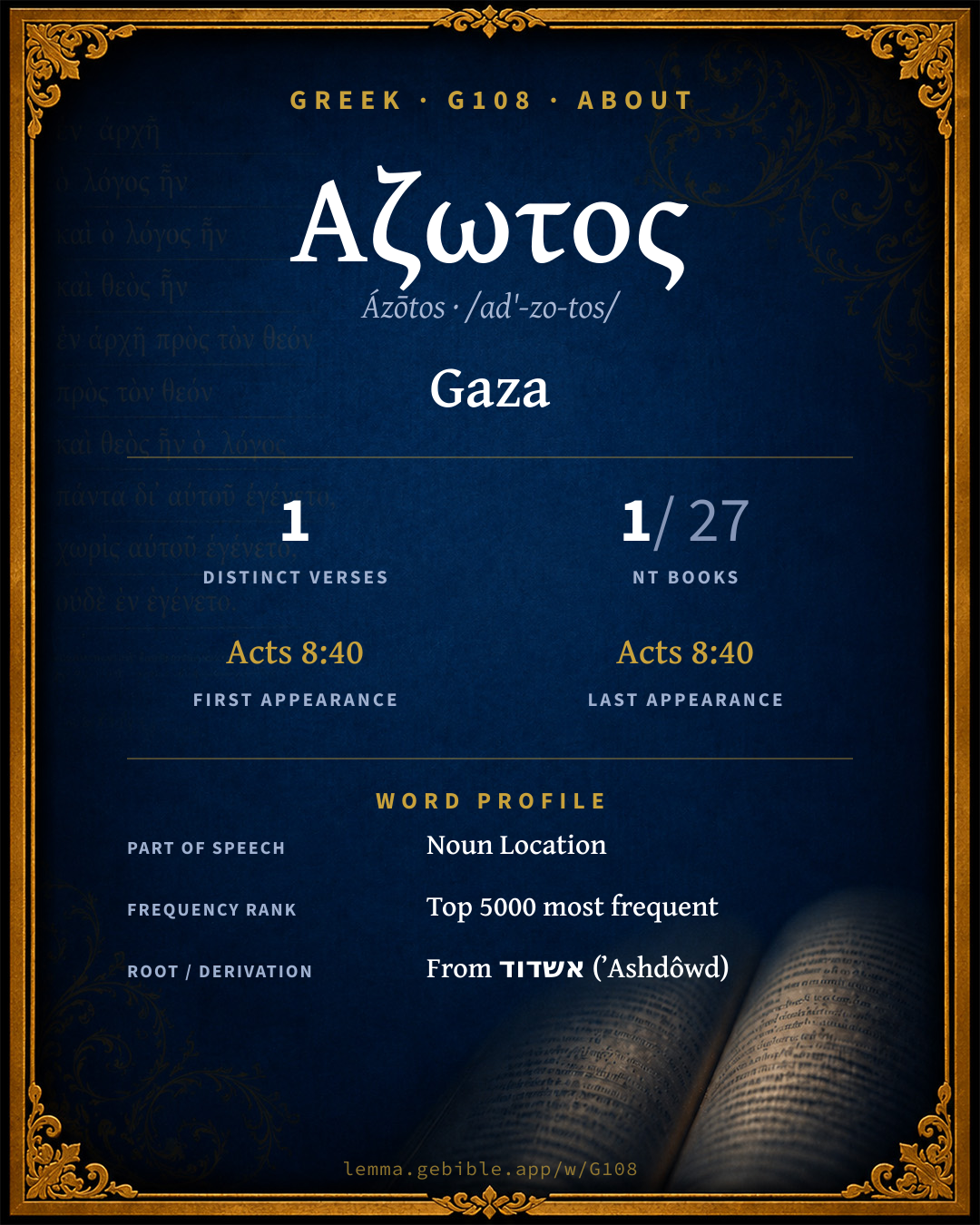
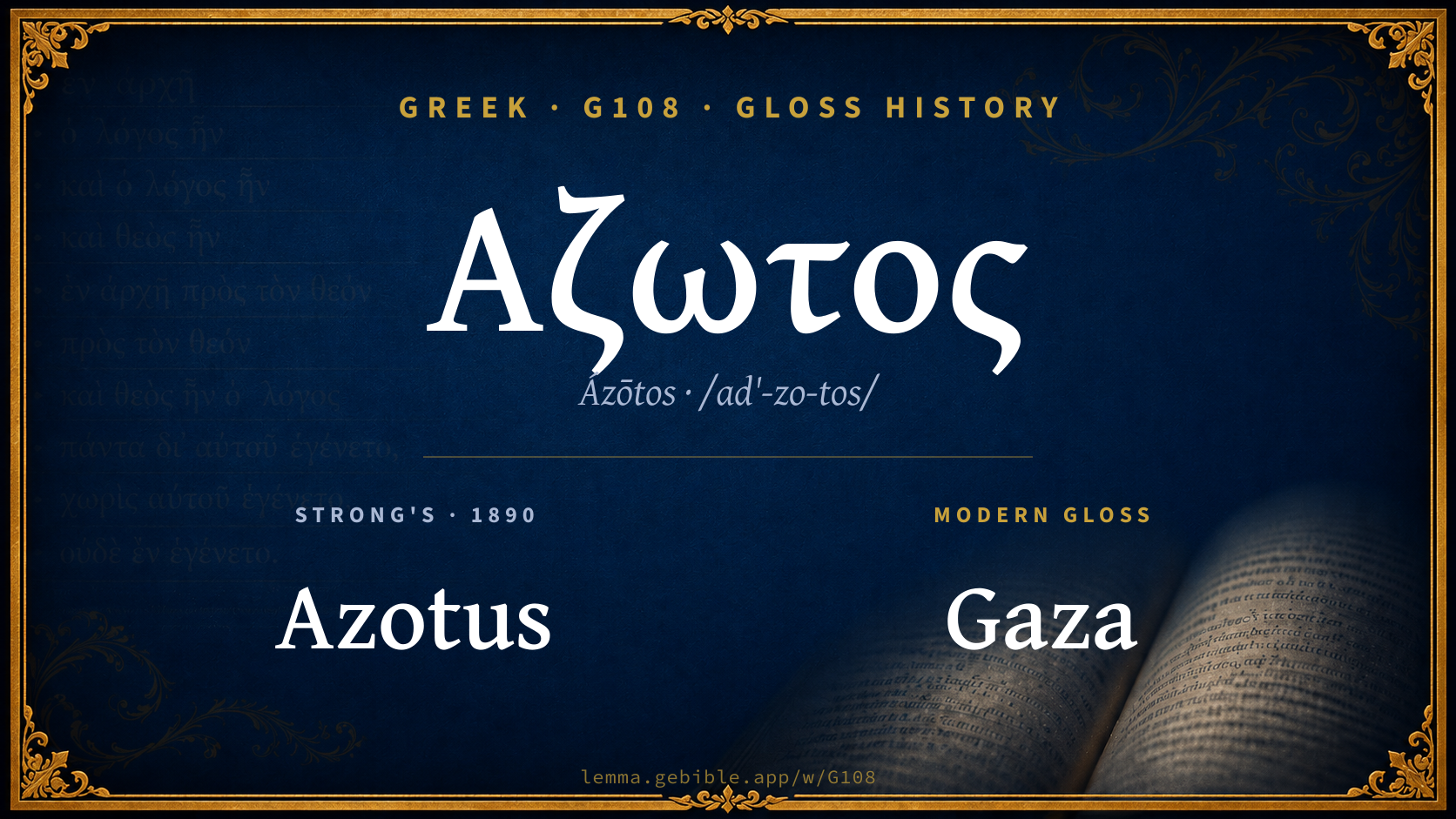
Ἄζωτος
Gaza
Thayer's lists 2 entries for ‘Gaza’ fuller range ↓
Full lexicon entry — Thayer's Greek Lexicon
From Thayer's Greek Lexicon
Where this word appears
Grammar key — what these labels mean
Part of speech
- Noun
- A naming word — a person, place, thing, or idea.
Case
- Accusative
- The case of the direct object and of extent.
Gender
- Feminine
- Grammatically feminine.
Number
- Singular
- One.
Every verse where G108 appears — 1 distinct verse across 1 book. Click any verse to open its interlinear word-by-word view. Verse text shown in the World English Bible for context — . Each verse’s Greek form is shown with its reference; the English is not keyword-highlighted, since the data carries no word-level English alignment. Use “Compare translations” on any verse to read it across multiple English versions. This concordance covers the Greek New Testament; Septuagint (Greek Old Testament) occurrences of this word are not indexed here.
Acts 1 verse
About this entry
At a glance — auto-summarized from this page’s data, not written by a person. Every figure links to its source below. This summary describes the numbers; it doesn’t interpret them.
Αζωτος (Ázōtos) is a Greek name most often rendered “Gaza.” It is rare — just 1 verse in the entire Greek New Testament. Acts dominates its distribution — 1 of 1 verses. Found nowhere else but Acts 8:40. For the data behind this summary, explore 1-verse concordance and the renderings breakdown below.
Gloss history
Strong's 1890 vs modern scholarship
About this word
Strong's G108 catalogs a Greek word from the Greek New Testament.
These counts are not copied from any lexicon or concordance. They are computed here, from the morphology-tagged Greek New Testament. What Lemma adds →
- 1
- distinct verses
- The word appears in 1 distinct verse.
- 1 / 27
- NT books
- The word appears in 1 of 27 New Testament books.
- #3,503
- by frequency
- Top 5000 most frequent Greek words (rank 3,503 of 5,347 Greek words by occurrence).
View all 1 occurrence in the concordance →
Most concentrated in
- Acts 1 verse 100%
By section of the New Testament
By traditional corpus
Conventional, traditional groupings — biblical authorship is debated, so this is a traditional corpus grouping, not an authorship claim. Some books belong to more than one corpus (Luke is in both the Gospels and the Lukan corpus, and so on), so these shares overlap and need not total 100%. Each figure is a share of the word’s 1 distinct verse.
- Lukan (Luke–Acts) 1 verse · 100%
How translations render this word
Counts come from each version’s own published word-to-Strong’s tagging or interlinear alignment — an approximate guide to how each version renders this word, not a word-level alignment the data otherwise carries. Because each total is that version’s own tagged count, the per-version totals vary from one another and need not match the appearance or distinct-verse counts above. These counts may also differ from a printed concordance because Lemma counts each distinctly tagged rendering and does not collapse phrase taggings into a single head-word total. This is a fixed set of word-tagged versions (KJV, ASV, BSB, ULT) and does not change with the reading translation you choose elsewhere. Each version’s license is shown beside its name below (and on Sources).
- King James Version: Azotus 1×
- American Standard Version: Azotus 1×
- Berean Standard Bible: Azotus 1×
- unfoldingWord Literal Text: Azotus 1×
King James Version Public Domain
Renders G108 across 1 tagged occurrence — most commonly:
American Standard Version Public Domain
Renders G108 across 1 tagged occurrence — most commonly:
Berean Standard Bible Public Domain
Renders G108 across 1 tagged occurrence — most commonly:
unfoldingWord Literal Text CC BY-SA 4.0
Renders G108 across 1 tagged occurrence — most commonly:
Senses in Thayer's
The 2 senses Thayer's distinguishes for this word, in lexicon order (not ranked by frequency or importance). The full entry — with sub-senses — is in the Lexicon Entry tab.
- Ashdod or Azotus = "a stronghold"
- one of the five chief cities of the Philistines, lying between Ashkelon and Jamnia and near the Mediterranean
Word origin
Derived from אשדוד (ʼAshdôwd) (H795) — Ashdod.
Of hebrew origin [ H795 ]; Azotus (that is Ashdod) a place in Palestine : - Azotus.
— Strong’s Exhaustive Concordance (1890), public domain.
Same root — word family
Other Thayer's entries built from the same root as G108, grouped by Strong’s listed origin. These share a root / origin per the lexicon — not necessarily a shared meaning. Each links to that word’s own entry.
Derives from
Proper names from this root
People and places named from this root — a name, not an additional meaning of the word.
Compare all same-root words → 2 of the same-root words are proper names (people or places). They share a root, not necessarily a meaning.
Bible dictionary
Public-domain dictionary articles matched to this entry by name (Gaza). A biblical name can be shared by more than one person or place, so an article may treat several.
Easton's Bible Dictionary · M. G. Easton, 1897
Called also Azzah, which is its Hebrew name (Deut. 2:23; 1 Kings 4:24; Jer. 25:20), strong, a city on the Mediterranean shore, remarkable for its early importance as the chief centre of a great commercial traffic with Egypt. It is one of the oldest cities of the world (Gen. 10:19; Josh. 15:47). Its earliest inhabitants were the Avims, who were conquered and displaced by the Caphtorims (Deut. 2:23; Josh. 13:2, 3), a Philistine tribe. In the division of the land it fell to the lot of Judah (Josh. 15:47; Judg. 1:18). It was the southernmost of the five great Philistine cities which gave each a golden emerod as a trespass-offering unto the Lord (1 Sam. 6:17). Its gates were carried away by Samson (Judg. 16:1-3). Here he was afterwards a prisoner, and "did grind in the prison house." Here he also pulled down the temple of Dagon, and slew "all the lords of the Philistines," himself also perishing in the ruin (Judg. 16:21-30). The prophets denounce the judgments of God against it (Jer. 25:20; 47:5; Amos 1:6, 7; Zeph. 2:4). It is referred to in Acts 8:26. Philip is here told to take the road from Jerusalem to Gaza (about 6 miles south-west of Jerusalem), "which is desert", i.e., the "desert road," probably by Hebron, through the desert hills of Southern Judea. (See SAMSON.)
It is noticed on monuments as early as B.C. 1600. Its small port is now called el-Mineh.
Smith's Bible Dictionary · William Smith, 1863
(the fortified; the strong) (properly Azzah), one of the five chief cities of the Philistines. It is remarkable for its continuous existence and importance from the very earliest times. The secret of this unbroken history is to be found in the situation of Gaza. It is the last town in the southwest of Palestine, on the frontier towards Egypt. The same peculiarity of situation has made Gaza important in a military sense. Its name means "the strong;" and this was well elucidated in its siege by Alexander the Great, which lasted five months. In the conquest of Joshua the territory of Gaza is mentioned as one which he was not able to subdue. (Joshua 10:41; 11:22; 13:3) It was assigned to the tribe of Judah, (Joshua 15:47) and that tribe did obtain possession of it, (Judges 1:18) but did not hold it long, (Judges 3:3; 13:1) and apparently it continued through the time of Samuel, Saul and David to be a Philistine city. 1Sam 6:17; 14:52; 31:1; 2Sam 21:15 Solomon became master of "Azzah," (1 Kings 4:24) but in after times the same trouble with the Philistines recurred. (2 Chronicles 21:16; 26:6; 28:18) The passage where Gaza is mentioned in the New Testament (Acts 8:26) is full of interest. It is the account of the baptism of the Ethiopian eunuch on his return from Jerusalem to Egypt. Gaza is the modern Ghuzzeh, a Mohammedan town of about 16,000 inhabitants, situated partly on an oblong hill of moderate height and partly on the lower ground. The climate of the place is almost tropical, but it has deep wells of excellent water. There are a few palm trees in the town, and its fruit orchards are very productive; but the chief feature of the neighborhood is the wide-spread olive grove to the north and northeast
Hitchcock's Bible Names Dictionary · Roswell D. Hitchcock, 1869
strong; a goat
Classic public-domain reference works; full attribution on Sources.
Septuagint usage
The same Greek word Αζωτος appears 15 times in the Greek Old Testament (Septuagint), across 13 verses in 8 books.
- 15
- LXX occurrences
- Tagged occurrences of this Greek word in the Septuagint.
- 13
- verses
- Distinct Septuagint verses containing this word.
- 8 / 39
- OT books
- The word appears in 8 of the 39 Old Testament books.
Sample Septuagint occurrences
- Judges 1:18 ἄζωτος
- 1 Samuel 5:1 ἄζωτος
- 2 Chronicles 26:6 ἄζωτος
- Isaiah 20:1 ἄζωτος
- Jeremiah 32:7 ἄζωτος
- Amos 1:8 ἄζωτος
- Zephaniah 2:4 ἄζωτος
- Zechariah 9:6 ἄζωτος
Septuagint occurrences (same lexeme)
Every verse where the same Strong’s number (G108) appears in the Greek Septuagint. Verse text shown in the World English Bible for context; the Greek form is the matched word — the English is not keyword-highlighted.
- Judges 1:18 ἄζωτος Also Judah took Gaza with the border of it, and Ashkelon with the border of it, and Ekron with the border of it.
- 1 Samuel 5:1 ἄζωτος Now the Philistines had taken the ark of God, and they brought it from Ebenezer to Ashdod.
- 1 Samuel 5:3 ἄζωτος When they of Ashdod arose early on the next day, behold, Dagon was fallen on his face to the ground before the ark of Yahweh. They took Dagon, and set him in his place again.
- 1 Samuel 5:5 ἄζωτος Therefore neither the priests of Dagon, nor any who come into Dagon's house, tread on the threshold of Dagon in Ashdod, to this day.
- 1 Samuel 5:6 ἄζωτος But the hand of Yahweh was heavy on them of Ashdod, and he destroyed them, and struck them with tumors, even Ashdod and the borders of it.
- 1 Samuel 5:7 ἄζωτος When the men of Ashdod saw that it was so, they said, The ark of the God of Israel shall not abide with us; for his hand is sore on us, and on Dagon our god.
- 1 Samuel 6:17 ἄζωτος These are the golden tumors which the Philistines returned for a trespass-offering to Yahweh: for Ashdod one, for Gaza one, for Ashkelon one, for Gath one, for Ekron one;
- 2 Chronicles 26:6 ἄζωτος He went forth and warred against the Philistines, and broke down the wall of Gath, and the wall of Jabneh, and the wall of Ashdod; and he built cities in [the country of] Ashdod, and among the Philistines.
- Isaiah 20:1 ἄζωτος In the year that Tartan came to Ashdod, when Sargon the king of Assyria sent him, and he fought against Ashdod and took it;
- Jeremiah 32:7 ἄζωτος Behold, Hanamel the son of Shallum your uncle shall come to you, saying, Buy you my field that is in Anathoth; for the right of redemption is yours to buy it.
- Amos 1:8 ἄζωτος I will cut off the inhabitant from Ashdod, And him who holds the scepter from Ashkelon; And I will turn my hand against Ekron; And the remnant of the Philistines will perish," says the Lord Yahweh.
- Zephaniah 2:4 ἄζωτος For Gaza will be forsaken, and Ashkelon a desolation. They will drive out Ashdod at noonday, and Ekron will be rooted up.
- Zechariah 9:6 ἄζωτος Foriegners will dwell in Ashdod, And I will cut off the pride of the Philistines.
These are occurrences of the same Greek lexeme (G108) in the Septuagint — not a translation of any one Hebrew word. The store carries no word-level Hebrew↔Greek alignment, so no Hebrew original is asserted here. Counts come from the recovered LXX Strong's tagging — high-frequency vocabulary is well covered, while rare or late forms may be untagged — so they reflect tagged occurrences and may slightly undercount.