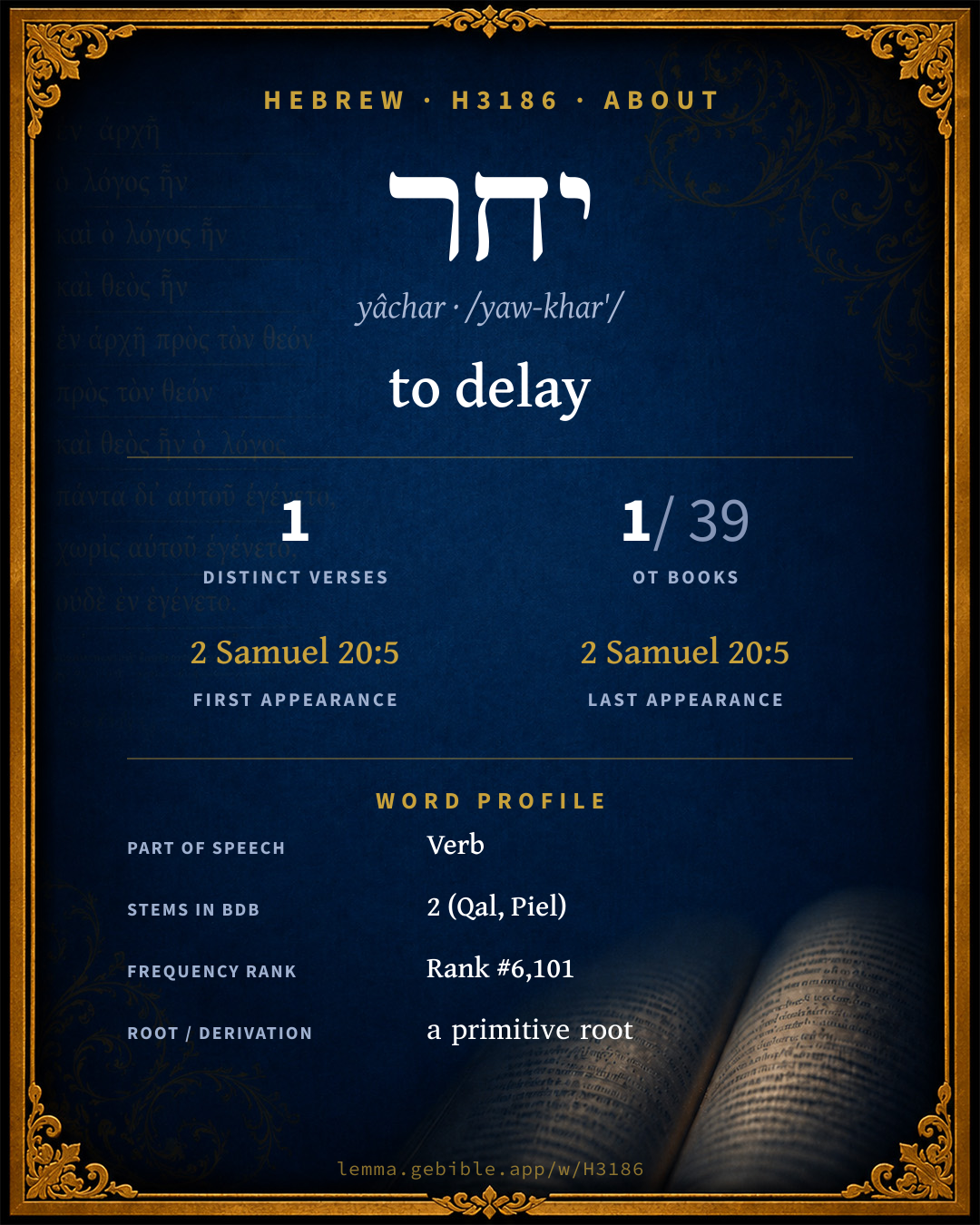
יָחַר
to delay
Full lexicon entry — Brown-Driver-Briggs (BDB)
From Brown-Driver-Briggs (BDB)
Where this word appears
Grammar key — what these labels mean
Stem
- Qal
- The basic, simple active stem — the plain form of the verb (“he wrote”). Here: ‘once only Gn 32’
Form
- Sequential Imperfect
- An imperfect with prefixed waw — the standard past-narrative form (waw-consecutive imperfect).
Person
- 3rd Person
- The one spoken about (“he / she / it / they”).
Gender
- Masculine
- Grammatically masculine.
Number
- Singular
- One.
Every verse where H3186 appears — 1 distinct verse across 1 book. Click any verse to open its interlinear word-by-word view. Verse text shown in the World English Bible for context — . Each verse’s Hebrew form is shown with its reference; the English is not keyword-highlighted, since the data carries no word-level English alignment. Use “Compare translations” on any verse to read it across multiple English versions. This concordance covers the Hebrew Bible; Septuagint (Greek Old Testament) occurrences are not indexed here.
2 Samuel 1 verse
About this entry
At a glance — auto-summarized from this page’s data, not written by a person. Every figure links to its source below. This summary describes the numbers; it doesn’t interpret them.
יחר — transliterated yâchar — is a Hebrew verb carrying the sense “to delay.” It occurs a mere 1 verse across Scripture. More than three-quarters of its appearances fall in 2 Samuel. Found nowhere else but 2 Samuel 20:5. Different stems carry different senses — BDB groups them under 2 stems, among them Qal and Piel. Each statement above links to its evidence; the full detail follows below.
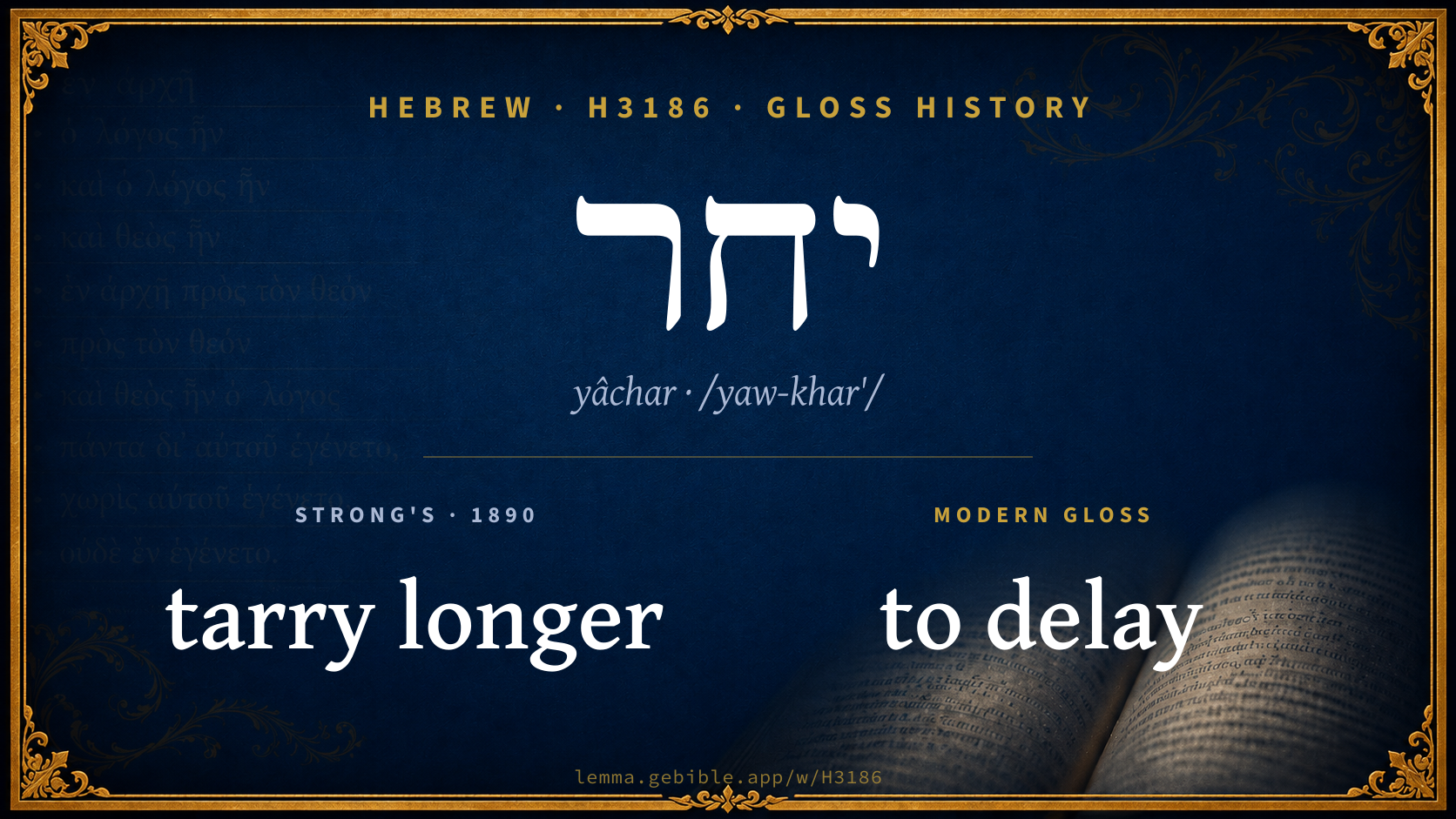
Gloss history
Strong's 1890 vs modern scholarship
About this word
Strong's H3186 catalogs a Hebrew word from the Hebrew Old Testament.
These counts are not copied from any lexicon or concordance. They are computed here, from the morphology-tagged Hebrew Old Testament. What Lemma adds →
- 1
- distinct verses
- The word appears in 1 distinct verse.
- 1 / 39
- OT books
- The word appears in 1 of 39 Old Testament books.
- #6,101
- by frequency
- Rank #6,101 (rank 6,101 of 8,640 Hebrew words by occurrence).
View all 1 occurrence in the concordance →
Most concentrated in
- 2 Samuel 1 verse 100%
By section of the Old Testament
By traditional corpus
Conventional, traditional groupings — biblical authorship is debated, so this is a traditional corpus grouping, not an authorship claim. Each share is this word’s portion of its verses in that division of the Hebrew canon. Each figure is a share of the word’s 1 distinct verse.
- Prophets (Nevi'im) 1 verse · 100%
How translations render this word
Counts come from each version’s own published word-to-Strong’s tagging or interlinear alignment — an approximate guide to how each version renders this word, not a word-level alignment the data otherwise carries. Because each total is that version’s own tagged count, the per-version totals vary from one another and need not match the appearance or distinct-verse counts above. These counts may also differ from a printed concordance because Lemma counts each distinctly tagged rendering and does not collapse phrase taggings into a single head-word total. This is a fixed set of word-tagged versions (KJV, ASV, BSB, ULT) and does not change with the reading translation you choose elsewhere. Each version’s license is shown beside its name below (and on Sources).
- King James Version: not separately translated
King James Version Public Domain
Does not render H3186 with a distinct English word (not separately translated in its 1 tagged occurrence).
Senses in the full BDB
Hebrew verbs can shift meaning by stem (binyan): Qal is the basic action, Niphal is often passive or reflexive, Piel often intensifies or makes it factitive, and Hiphil is typically causative. The senses below are grouped under the stem BDB assigns to each.
What do BDB’s symbols mean?
BDB uses these scholarly abbreviations:
| Symbol | Meaning |
|---|---|
| 𝔊 | the Septuagint (the ancient Greek translation, LXX) |
| 𝔙 | the Vulgate (the Latin translation) |
| 𝔖 | the Syriac version (the Peshitta) |
| 𝔗 | the Targum (the Aramaic translation) |
| ψ | the Psalms |
| √ | root (the underlying root or stem) |
| ‖ | parallel passage (a synonymous or contrasted parallel) |
| † | the dagger: every passage where the word occurs is cited |
The 4 senses and sub-senses the full Brown-Driver-Briggs lexicon distinguishes for this word, in lexicon order (not ranked by frequency), with BDB’s own verbatim wording and sub-sense lettering. Shown in Hebrew script with BDB’s own scholarly abbreviations. The condensed entry is in the Lexicon Entry tab.
Qal
- once only Gn 32:5 וָאֵחַר (contr. from וָאֶאֱחַר cf. אֵהָ֑ב Pr 8:17) and I have tarried until now. e.g. Genesis 32:5
Piel
- Pf. אֵחַר Gn 34:19; אֶחֱרוּ Ju 5:28; Impf. יְאַחֵר, תְּאַחֵר, (3 times תְּאַחַ֑ר) etc. Gn 24:56 + 9 times; Pt. (־רֵי) מְאַחֲרִים 3 times e.g. Genesis 34:19
- 1. intensive, delay, tarry, abs. Ju 5:28 (‖ בּשֵׁשׁ לָבוֹא) Is 46:13 and my salvation לֹא תְאַחֵר Hb 2:3 ψ 40:18 = 70:6 Dn 9:19; with ל & inf. Gn 34:19.—Pr 23:30 מְאַחֲרִים עַל־הַיָּיִ֑ן those tarrying over the wine, Is 5:11 מְאַחֲרֵי בַנֶּשֶׁף, ψ 127:2 מְאַחֲרֵי שֶׁבֶת (‖ מַשְׁכִּימֵי קוּם). e.g. Judges 5:28
- 2. causat. of Qal, cause one to delay, hinder Gn 24:56; keep back (= bring late) Ex 22:28; with ל & inf. delay to … Dt 23:22 quoted Ec 5:3: ellipt. Dt 7:10 he delayeth (it, the recompense) not to his enemy.—2 S 20:5 Qr וַיּ֫וֹחֶר is taken by Ol§ 241 c as Qal (cf. וַתּ֫חֶז v 9 from אָחַז), by Sta§ 498 c KöI. 397 Ges§ 68 2 Rem as Hiph. (lit. shewed, exhibited delay): on the Kt (? וַיֵּיחַר) v. DrSm. e.g. Genesis 24:56
Senses from the full Brown-Driver-Briggs lexicon (Brown, Driver, Briggs; Oxford 1906 — public domain), digitized via Sefaria, supplemented by the OpenScriptures HebrewLexicon (CC BY 4.0). Full attribution on Sources.
Word origin
vb. to remain behind, delay, tarry (Arabic أَخَّرَ to put off, also to remain behind; Aramaic Pa. אְחַר, Aph. ܐܰܘܚܰܕ, Shaph. ܫܰܘܚܰܪ, Sab. אחֿר OsianderZMG 1865, 197; אחֿחֿר DHMEpigr. Denkm. 34).
— Brown-Driver-Briggs (Oxford 1906, public domain), digitized via Sefaria, supplemented by the OpenScriptures HebrewLexicon (CC BY 4.0). See Sources.
Origin: a primitive root
Septuagint verse parallels
This word appears in 1 verse that also exists in the Greek Old Testament (Septuagint), out of the 1 Hebrew verse it occurs in. You can read those verses in Greek by switching the Old Testament edition to the Septuagint.
Read these verses in the Septuagint
This is a verse-level parallel only — the same verses exist in both the Hebrew and Greek Old Testaments. No word-level Hebrew↔Greek correspondence is claimed: the data carries no such alignment, so no Greek word is shown as this Hebrew word’s translation. Coverage is not total — the Septuagint omits the deuterocanon and renumbers the Psalms, so some Hebrew verses have no direct Greek parallel.