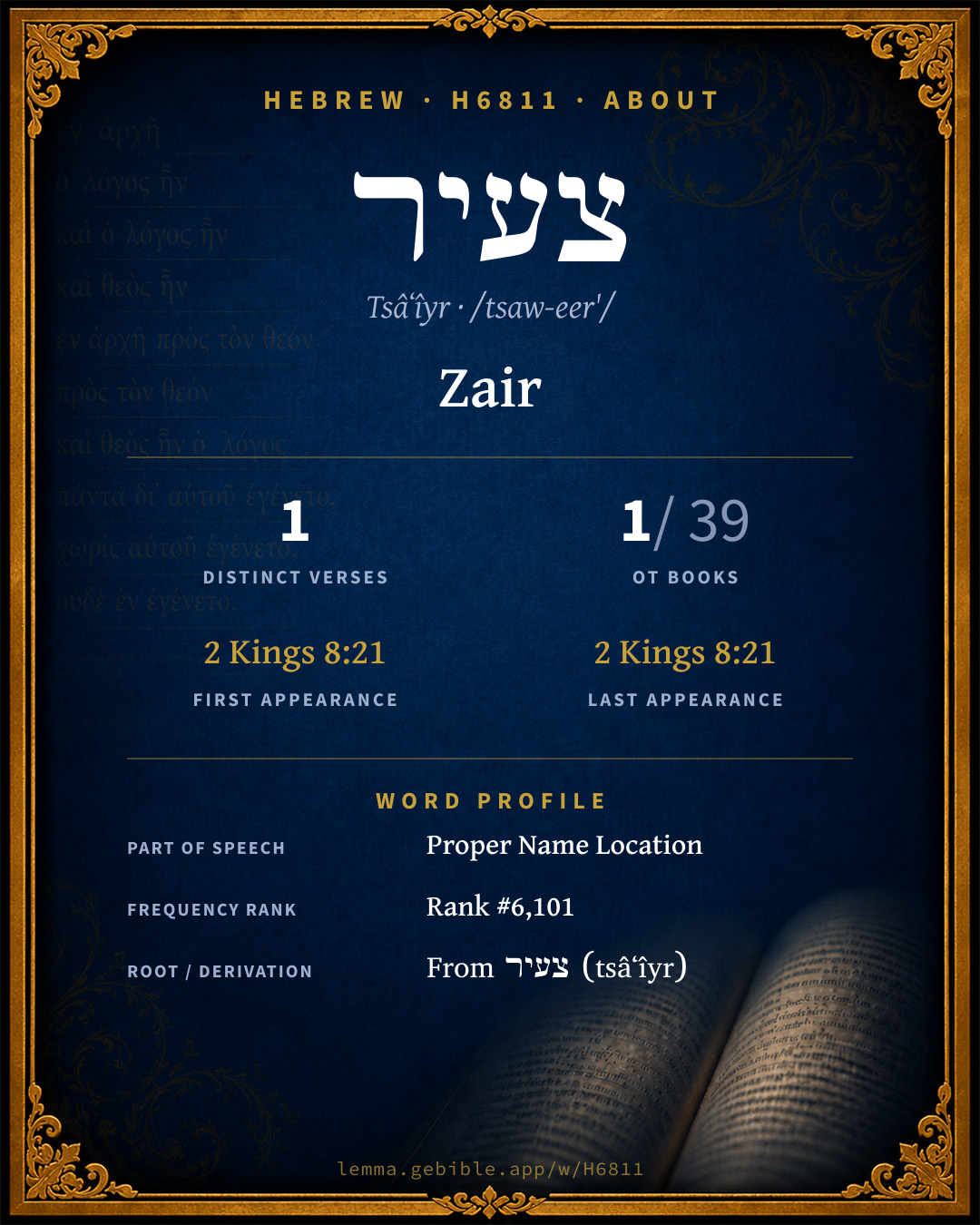
צָעִיר
Zair
BDB lists 2 entries for ‘Zair’ fuller range ↓
Full lexicon entry — Brown-Driver-Briggs (BDB)
From Brown-Driver-Briggs (BDB)
Where this word appears
Grammar key — what these labels mean
Part of speech
- Noun
- A naming word — a person, place, thing, or idea.
Noun type
- Proper
- A name of a specific person, place, or people (e.g. Abraham, Zion, Israel).
Every verse where H6811 appears — 1 distinct verse across 1 book. Click any verse to open its interlinear word-by-word view. Verse text shown in the World English Bible for context — . Each verse’s Hebrew form is shown with its reference; the English is not keyword-highlighted, since the data carries no word-level English alignment. Use “Compare translations” on any verse to read it across multiple English versions. This concordance covers the Hebrew Bible; Septuagint (Greek Old Testament) occurrences are not indexed here.
2 Kings 1 verse
About this entry
At a glance — auto-summarized from this page’s data, not written by a person. Every figure links to its source below. This summary describes the numbers; it doesn’t interpret them.
צעיר — transliterated Tsâʻîyr — is a Hebrew name carrying the sense “Zair.” With only 1 verse it sits in the long tail of Hebrew Bible vocabulary. Its uses cluster heavily in 2 Kings (100% of all occurrences). Its lone occurrence is 2 Kings 8:21. See 1-verse concordance and the renderings breakdown below.
Gloss history
Strong's 1890 vs modern scholarship
About this word
Strong's H6811 catalogs a Hebrew word from the Hebrew Old Testament.
These counts are not copied from any lexicon or concordance. They are computed here, from the morphology-tagged Hebrew Old Testament. What Lemma adds →
- 1
- distinct verses
- The word appears in 1 distinct verse.
- 1 / 39
- OT books
- The word appears in 1 of 39 Old Testament books.
- #6,101
- by frequency
- Rank #6,101 (rank 6,101 of 8,640 Hebrew words by occurrence).
View all 1 occurrence in the concordance →
Most concentrated in
- 2 Kings 1 verse 100%
By section of the Old Testament
By traditional corpus
Conventional, traditional groupings — biblical authorship is debated, so this is a traditional corpus grouping, not an authorship claim. Each share is this word’s portion of its verses in that division of the Hebrew canon. Each figure is a share of the word’s 1 distinct verse.
- Prophets (Nevi'im) 1 verse · 100%
How translations render this word
Counts come from each version’s own published word-to-Strong’s tagging or interlinear alignment — an approximate guide to how each version renders this word, not a word-level alignment the data otherwise carries. Because each total is that version’s own tagged count, the per-version totals vary from one another and need not match the appearance or distinct-verse counts above. These counts may also differ from a printed concordance because Lemma counts each distinctly tagged rendering and does not collapse phrase taggings into a single head-word total. This is a fixed set of word-tagged versions (KJV, ASV, BSB, ULT) and does not change with the reading translation you choose elsewhere. Each version’s license is shown beside its name below (and on Sources).
BDB lists this Strong’s number as 2 distinct words (homographs). Each count above pools all of them and is not split by sense — see the Senses section below. A low-frequency rendering may belong to a different one of those words, not the primary meaning.
- King James Version†: Zair 1×
- American Standard Version†: Zair 1×
- Berean Standard Bible†: Zair 1×
- unfoldingWord Literal Text†: Zair 1×
King James Version Public Domain
Renders H6811 across 1† tagged occurrence — most commonly:
American Standard Version Public Domain
Renders H6811 across 1† tagged occurrence — most commonly:
Berean Standard Bible Public Domain
Renders H6811 across 1† tagged occurrence — most commonly:
unfoldingWord Literal Text CC BY-SA 4.0
Renders H6811 across 1† tagged occurrence — most commonly:
Senses in the full BDB
What do BDB’s symbols mean?
BDB uses these scholarly abbreviations:
| Symbol | Meaning |
|---|---|
| 𝔊 | the Septuagint (the ancient Greek translation, LXX) |
| 𝔙 | the Vulgate (the Latin translation) |
| 𝔖 | the Syriac version (the Peshitta) |
| 𝔗 | the Targum (the Aramaic translation) |
| ψ | the Psalms |
| √ | root (the underlying root or stem) |
| ‖ | parallel passage (a synonymous or contrasted parallel) |
| † | the dagger: every passage where the word occurs is cited |
The 3 senses and sub-senses the full Brown-Driver-Briggs lexicon distinguishes for this word, in lexicon order (not ranked by frequency), with BDB’s own verbatim wording and sub-sense lettering. Shown in Hebrew script with BDB’s own scholarly abbreviations. The condensed entry is in the Lexicon Entry tab.
צעיר I little, insignificant, young
- 1.
- a. little, with idea of insignificance Ju 6:15 (‖ הַדַּל), cf. 1 S 9:21 (‖ קְטַנֵּי), Mi 5:1 ψ 68:28; Is 60:22 (opp. גוי עצום); of horn in vision Dn 8:9, read prob. אחרת צעירה for אחת מִצְּעִירָה, cf. Bev Dr; צְעִירֵי הַצֹּאן Je 49:20; 50:45 (fig. of helpless captives). e.g. Judges 6:15
- b. insignificant, mean, ψ 119:141 (‖ נִבְוֶה), Je 14:3 (as subst.); on Je 48:4 v. צֹעַר. e.g. Psalms 119:141
- 2. more often of age, young (usually c. art. the younger, youngest, as subst.), of son (brother), opp. הַבְּכוֹר Gn 43:33; 48:14 (both J), Jos 6:26; 1 K 16:34, opp. רַב Gn 25:23 (J), cf. צ׳ אני לְיָמִים ואתם יְשִׁישִׁים Jb 32:6, cf. 30:1; of daughter (sister), opp. הַבְּכִירָה Gn 19:31, 34, 35, 38 (J) 29:26 (E); here belongs צְעִירִים מִמֶּנִּי לימים Jb 30:1, si vera l.; GHBWr Siegf Bu del. ממני לימים; 𝔊 ἐλάχιστοι; put then under 1 b. e.g. Genesis 43:33
צעיר II loc. prob. on border of Edom, צָעִ֫ירָה 2 K 8
Senses from the full Brown-Driver-Briggs lexicon (Brown, Driver, Briggs; Oxford 1906 — public domain), digitized via Sefaria, supplemented by the OpenScriptures HebrewLexicon (CC BY 4.0). Full attribution on Sources.
Word origin
I. adj. little, insignificant, young;—abs. צָעִיר Gn 25:23 +; f. צְעִירָה Gn 19:31 +; צְעִרָה 1 S 9:21; mpl. צְעִירִים Jb 30:1; sf. צְעִירֶיהָ Je 48:4 Qr (Kt צעוריה; but v. צֹעַר); צְעִירֵיהֶם Je 14:3 (Kt צעוריהם), etc.;—
II. n.pr.loc. prob. on border of Edom, צָעִ֫ירָה 2 K 8:21, εἰς Σειωρ (𝔊L ἐκ Σιωρ).
— Brown-Driver-Briggs (Oxford 1906, public domain), digitized via Sefaria, supplemented by the OpenScriptures HebrewLexicon (CC BY 4.0). See Sources.
Derived from צעיר (tsâʻîyr) (H6810) — little.
Jastrow Dictionary
A second Hebrew/Aramaic lexicon for comparison, covering Aramaic and post-biblical (Talmudic, Targumic, Midrashic) usage that the biblical-Hebrew BDB does not. Matched by lemma rather than by Strong’s number, so a lemma may carry more than one Jastrow headword (shown separately below), and the entries cover usage well beyond the Bible.
צְעֵיר
- , v. צְעֵר
צָעִיר
- young, junior; attendant, boy. Gen. R. s. 6 (ref. to Gen. XLVIII, 14) וכי … שהוא הצ׳ do we not know from the genealogical records that he was the younger?—Pl. צְעִירִים. Arakh. II, 6 (13ᵇ) וצְעִירֵי הלוים וכ׳ Ar. a. Maim. (Mish. וצוֹעְרי; Bab. ed. וצערי Rashi וצוע׳) and they were called the junior Levites; ib. 13ᵇ תנא וסועדי … ותנא דידן … קרי להו צערי there is a version, ‘and they were called the assistants of the Levites’; and as to our version (צעירי or צוערי), because the voices of those were fine …, therefore he calls them tsa’ăré (the troubles) of the Levites (v. צַעַר). Gen. R. s. 75 צְעִירֵיהֶם של שבטים the youngest of the tribes; a. e.—Fem. צְעִירָה. B. Kam. 38ᵇ צ׳ דקאמרה בן עמי וכ׳ the younger (daughter of Lot) that called her son Ben-ammi &c.; Hor. 11ᵃ; Naz. 23ᵇ; a. e.—Y. Meg. I, 71ᵈ bot. כתבו לו … צְעִירַת הרגלים they (the Greek translators) wrote for him (Ptolemy) ‘the slender-footed’ (in place of ארנבת, Lev. XI, 6); Bab. Meg. 9ᵇ; Treat. Sof’rim I, 8; Mekh. Bo, s. 14; Tanḥ. Sh’moth 22.—[LXX Lev. XI, 5; 6 has δασύποδα = שְׂעִירַת הרגלים.] e.g. Genesis 48:14
צְעֵר
- ; (act. verb) צְעַר [to diminish,] disregard, shame, curse (cmp. גדף, חסד). Targ. II Esth. II, 5 (transl. of תקלל, Ex. XXII, 27). Targ. Prov. XXX, 11 נִיצְעֵיר ed. Lag. (oth. ed. נִצְעַר; ed. Wil. נְצַעֵר Pa.; h. text קלל). Ib. 10 נִיצְעֲרִיךְ ed. Lag. (oth. ed. נְצַעֲרִינָךְ, Pa.). e.g. Exodus 22:27
- 1. same, v. supra.—Meg. 28 same, v. supra.—Meg. 28ᵃ when going to bed he used to pray, שרא … לכל מאן דצַעֲרָן the Lord forgive every one that may have insulted me.
- 2. to afflict, grieve, trouble. Targ. Y. Deut. XXVI, 6 (not צעד׳). Targ. Job XVIII, 4; a. fr.—Ber. 10ᵃ הוו קא מְצַעֲרֵי ליה טובא they annoyed him exceedingly. Ib. 27ᵇ עד כמה נצַעֲרִיה וניזיל how long shall he go on vexing him? Naz. 23ᵇ; Hor. 10ᵇ sq. (ref. to Deut. II, 9) מלחמה הוא דלא הא צַעוּרֵי צֵעֲרִינְהוּ war you must not wage (against Moab), but you may afflict them (put them under tribute); אפי׳ צַעוּרֵי לא you must not even afflict them (the Ammonites); (B. Kam. 38ᵇ עביד בהו אנגריא). Y. Snh. I, 18ᶜ bot. כן … לצעורי וכ׳ is that your custom, to trouble your teacher? Ḥull. 95ᵃ לצַעוּרֵיה, v. כּוּן ch.; a. fr. e.g. Deuteronomy 2:9
- 3. to grieve, take pains. Ber. 18ᵇ הוו מְצַעֲרֵי לאדכוריה they took pains (in vain) to recall (what they had learned; Ms. M. הוו יתבי ומִצְטַעֲרֵי they sat and grieved; v. Rabb. D. S. a. l. note).
- to suffer, grieve, be vexed, troubled. Targ. Y. Num. XI, 1 (h. text מתאננ׳). Targ. Ps. VII, 15; a. fr.—Keth. 104ᵃ חלץ … וקמִצְטַעֵר he put his T’fillin off and put them on again, and was in pain. Sabb. 140ᵇ עד דמִיצְטַעֲרָן until they were vexed (by curiosity). Succ. 52ᵃ. Ber. 18ᵇ Ms. M, v. supra; a. fr.
A Dictionary of the Targumim, the Talmud Babli and Yerushalmi, and the Midrashic Literature (Marcus Jastrow; London, Luzac, 1903) — Public Domain. Digitized via Sefaria. Digitized via Sefaria. Full attribution on Sources.
Same root — word family
Other BDB entries built from the same root as H6811, grouped by Strong’s listed origin. These share a root / origin per the lexicon — not necessarily a shared meaning. Each links to that word’s own entry.
Derives from
Shares the same root
Compare all same-root words → They share a root, not necessarily a meaning.
Bible dictionary
Public-domain dictionary articles matched to this entry by name (Zair). A biblical name can be shared by more than one person or place, so an article may treat several.
Easton's Bible Dictionary · M. G. Easton, 1897
Little, a place probably east of the Dead Sea, where Joram discomfited the host of Edom who had revolted from him (2 Kings 8:21).
Smith's Bible Dictionary · William Smith, 1863
(small), a place named in (2 Kings 8:21) only, in the account of Joram's expedition against the Edomites. It has been conjectured that Zair is identical with Zoar.
Hitchcock's Bible Names Dictionary · Roswell D. Hitchcock, 1869
little; afflicted; in tribulation
Classic public-domain reference works; full attribution on Sources.
Septuagint verse parallels
This word appears in 1 verse that also exists in the Greek Old Testament (Septuagint), out of the 1 Hebrew verse it occurs in. You can read those verses in Greek by switching the Old Testament edition to the Septuagint.
Read these verses in the Septuagint
This is a verse-level parallel only — the same verses exist in both the Hebrew and Greek Old Testaments. No word-level Hebrew↔Greek correspondence is claimed: the data carries no such alignment, so no Greek word is shown as this Hebrew word’s translation. Coverage is not total — the Septuagint omits the deuterocanon and renumbers the Psalms, so some Hebrew verses have no direct Greek parallel.