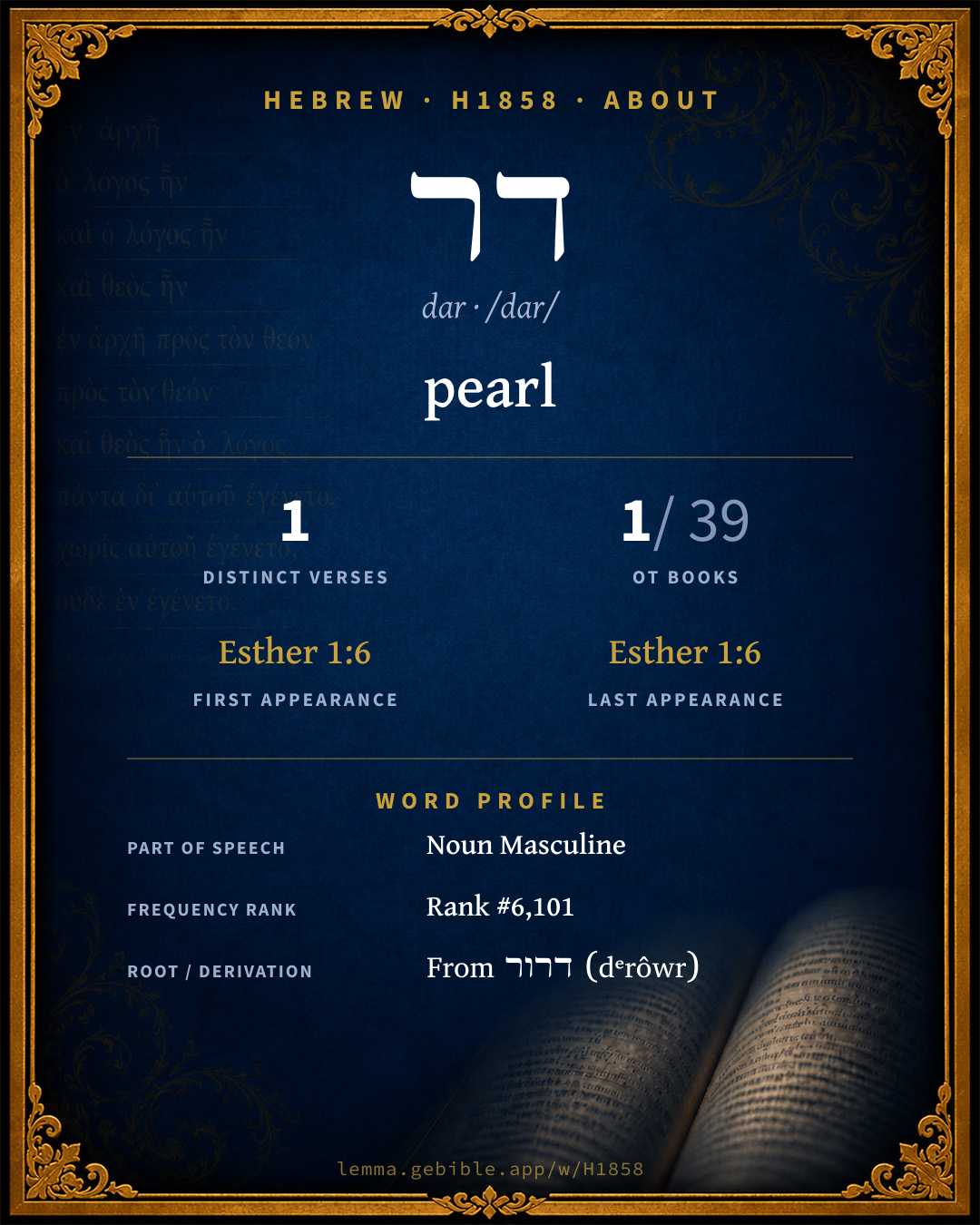
דַּר
pearl
Full lexicon entry — Brown-Driver-Briggs (BDB)
From Brown-Driver-Briggs (BDB)
Where this word appears
Grammar key — what these labels mean
Noun type
- Common
- A common noun — a general class of person, place, or thing (“king,” “city,” “water”), not a specific name.
State
- Absolute
- The independent form of a noun, not bound to a following word.
Gender
- Masculine
- Grammatically masculine.
Number
- Singular
- One.
Every verse where H1858 appears — 1 distinct verse across 1 book. Click any verse to open its interlinear word-by-word view. Verse text shown in the World English Bible for context — . Each verse’s Hebrew form is shown with its reference; the English is not keyword-highlighted, since the data carries no word-level English alignment. Use “Compare translations” on any verse to read it across multiple English versions. This concordance covers the Hebrew Bible; Septuagint (Greek Old Testament) occurrences are not indexed here.
Esther 1 verse
About this entry
At a glance — auto-summarized from this page’s data, not written by a person. Every figure links to its source below. This summary describes the numbers; it doesn’t interpret them.
דר (dar) is a Hebrew noun most often rendered “pearl.” With only 1 verse it sits in the long tail of Hebrew Bible vocabulary. It clusters heavily in Esther, which alone accounts for 100% of its uses. Found nowhere else but Esther 1:6. It clusters with דרור, דרור and דרדע under a shared root. The sections below give every sense, occurrence, and version rendering.
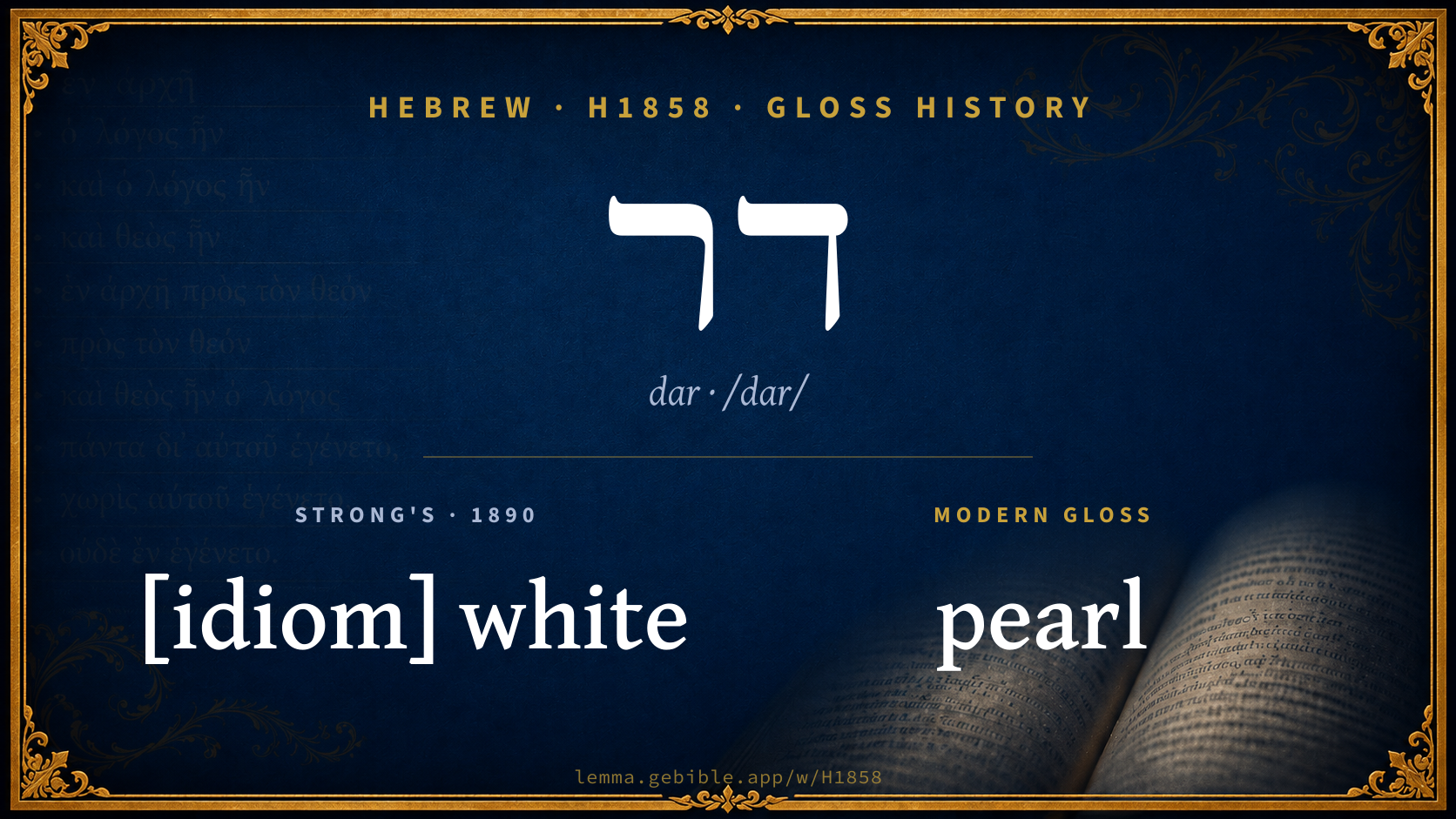
Gloss history
Strong's 1890 vs modern scholarship
About this word
Strong's H1858 catalogs a Hebrew word from the Hebrew Old Testament.
These counts are not copied from any lexicon or concordance. They are computed here, from the morphology-tagged Hebrew Old Testament. What Lemma adds →
- 1
- distinct verses
- The word appears in 1 distinct verse.
- 1 / 39
- OT books
- The word appears in 1 of 39 Old Testament books.
- #6,101
- by frequency
- Rank #6,101 (rank 6,101 of 8,640 Hebrew words by occurrence).
View all 1 occurrence in the concordance →
Most concentrated in
- Esther 1 verse 100%
By section of the Old Testament
By traditional corpus
Conventional, traditional groupings — biblical authorship is debated, so this is a traditional corpus grouping, not an authorship claim. Each share is this word’s portion of its verses in that division of the Hebrew canon. Each figure is a share of the word’s 1 distinct verse.
- Writings (Ketuvim) 1 verse · 100%
How translations render this word
Counts come from each version’s own published word-to-Strong’s tagging or interlinear alignment — an approximate guide to how each version renders this word, not a word-level alignment the data otherwise carries. Because each total is that version’s own tagged count, the per-version totals vary from one another and need not match the appearance or distinct-verse counts above. These counts may also differ from a printed concordance because Lemma counts each distinctly tagged rendering and does not collapse phrase taggings into a single head-word total. This is a fixed set of word-tagged versions (KJV, ASV, BSB, ULT) and does not change with the reading translation you choose elsewhere. Each version’s license is shown beside its name below (and on Sources).
- King James Version: White 1×
- American Standard Version: White 1×
- Berean Standard Bible: Mother-of-pearl 1×
- unfoldingWord Literal Text: Pearl 1×
King James Version Public Domain
Renders H1858 across 1 tagged occurrence — most commonly:
American Standard Version Public Domain
Renders H1858 across 1 tagged occurrence — most commonly:
Berean Standard Bible Public Domain
Renders H1858 across 1 tagged occurrence — most commonly:
unfoldingWord Literal Text CC BY-SA 4.0
Renders H1858 across 1 tagged occurrence — most commonly:
10 senses and sub-senses in the full BDB
What do BDB’s symbols mean?
BDB uses these scholarly abbreviations:
| Symbol | Meaning |
|---|---|
| 𝔊 | the Septuagint (the ancient Greek translation, LXX) |
| 𝔙 | the Vulgate (the Latin translation) |
| 𝔖 | the Syriac version (the Peshitta) |
| 𝔗 | the Targum (the Aramaic translation) |
| ψ | the Psalms |
| √ | root (the underlying root or stem) |
| ‖ | parallel passage (a synonymous or contrasted parallel) |
| † | the dagger: every passage where the word occurs is cited |
The 10 senses and sub-senses the full Brown-Driver-Briggs lexicon distinguishes for this word, in lexicon order (not ranked by frequency), with BDB’s own verbatim wording and sub-sense lettering. Shown in Hebrew script with BDB’s own scholarly abbreviations. The condensed entry is in the Lexicon Entry tab.
- 1. period, age, generation, mostly poet.:
- a. of duration in the past, former age(s) דּוֹרוֹת עוֹלָמִים Is 51:9 (‖ ימי קדם); שְׁנוֹת דֹּר וָדֹר Dt 32:7 (song; ‖ ימות עולם); בְּדֹר וָדֹר ψ 90:1 (cf. v 2); מוֹסְדֵי דּוֹר־וָדוֹר Is 58:12 (‖ חרבות עולם); שֹׁמֲמוֹת דּוֹר וָדוֹר 61:4 (‖ id.) e.g. Isaiah 51:9
- b. usually of duration to come, future age(s), לְדֹר דֹּר Ex 3:15 (E; ‖ לעולם) cf. Pr 27:24 Kt (Qr לְדוֹר וָדוֹר; ‖ id.); מִדֹּר דֹּר Ex 17:16 (E), = מִדּוֹר לָדוֹר Is 34:10; לְדֹר וָדֹר ψ 10:6; 33:11 (‖ לעולם) 49:12; 79:13; 85:6; 102:13; 119:90; 135:13; 146:10 Jo 4:20 (all ‖ id.); ψ 89:2 (‖ עולם) 89:5 (‖ עד־עולם) 106:31 (‖ id.) Is 34:17 (‖ id.); ψ 77:9 (‖ לנצח); עַד־דֹּר וָדֹר ψ 100:5 (‖ לעולם) Is 13:20 (‖ לנצח) Je 50:39 (‖ id.); בְּכָל־דֹּר וָדֹר ψ 45:18 (‖ לעולם ועד) cf. Est 9:28; שְׁנוֹתָיו כְּמוֹ דֹר וָדֹר ψ 61:7 cf. שְׁנֵי דּוֹר וָדוֹר Jo 2:2 (‖ העולם); as modifying phrase מְשׂוֹשׂ דּוֹר וָדוֹר Is 60:15 (‖ גאון עולם); further דּוֹר דּוֹרִים ψ 72:5; 102:25; יְשׁוּעָתִי לְדוֹר דּוֹרִים Is 51:8 (‖ לעולם). e.g. Exodus 3:15
- c. apparently including both past and future בְּדוֹר דּוֹרִים שְׁנוֹתֶיךָ ψ 102:25; בְּכָל דּוֹר וָדֹר ψ 145:13; לְדוֹר וָדוֹר La 5:19. e.g. Psalms 102:25
- 2. of men living at a particular time (period, age), generation, as transitory דּוֹר הֹלֵךְ וְדוֹר בָּא Ec 1:4: specific. e.g. Ecclesiastes 1:4
- a. in the present, and (or) the past Gn 7:1 (J) Ex 1:6 (P) Nu 32:13 (JE) Dt 1:35; 2:14 Ju 2:10(×2) Is 53:8 (cf. Che crit. n.) Je 2:31; also ψ 95:10 Jb 8:8 Is 41:4. e.g. Genesis 7:1
- b. Ju 3:2 (present & future); cf. pl. דֹּרֹתָיו Gn 6:9 (i.e. his own gen. and those immediately contiguous, before and after). e.g. Judges 3:2
- c. especially of a future generation Gn 15:16 (JE), with numeral, cf. Dt 23:3, 4, 9; also Dt 29:21 ψ 48:14; 71:18; 78:4, 6; 102:19; 109:13 Jo 1:3 cf. ψ 22:31, 32 (Che crit. n.); of a succession of generations דּוֹר לְדוֹר יְשַׁבַּח מַעֲשֶׂיךָ ψ 145:4; בְּכָל־דּוֹר וָדוֹר Est 9:28; usually pl. לְדֹרֹת עוֹלָם Gn 9:12 (P); with num. לְאֶלֶף דּוֹר ψ 105:8 (‖ עולם) = 1 Ch 16:15 (‖ לעולם); Dt 7:9; v. further, of posterity, אַרְבָּעָה דֹּרוֹת Jb 42:16; usually pl. c. sf. Gn 17:7, 9, 12 Ex 12:14, 17, 42; 16:32, 33; 27:21; 29:42; 30:8, 10, 21, 31; 31:13, 16; 40:15 Lv 3:17; 6:11; 7:36; 10:9 (all P); 17:7; 21:17; 22:3; 23:14, 21, 31, 41, 43; 24:3; 25:30 (all H); Nu 9:10; 10:8; 15:14, 15, 21, 23, 38; 18:23; 35:29 Jos 22:27, 28 (all P). e.g. Genesis 15:16
- 3. generation characterized by quality or condition, class of men: דּוֹר עִקֵּשׁ crooked generation Dt 32:5 (song) cf. v 20 ψ 78:8(×2) Je 7:29; of diff. classes of wicked, Pr 30:11, 12, 13, 14 cf. ψ 12:8; of the righteous, as a class ψ 14:5; 24:6; 73:15 (דּוֹר בָּנֶיךָ) 112:2 (cf. 22:31 MT, but לדור to v 32 cf. supr. sub 2 c); so also דּוֹר אֲבוֹתָיו i.e. the dead ψ 49:20 (so most; yet v. infr. sub 4). e.g. Deuteronomy 32:5
- 4. dwelling-place, habitation Is 38:12 cf. דּוּר vb., so Saad Ki Ges De Che RVm (Ew life ‖ חַיַּי); so also ψ 49:20 De Witt, cf. CheOP 479. e.g. Isaiah 38:12
Senses from the full Brown-Driver-Briggs lexicon (Brown, Driver, Briggs; Oxford 1906 — public domain), digitized via Sefaria, supplemented by the OpenScriptures HebrewLexicon (CC BY 4.0). Full attribution on Sources.
Word origin
n.m. Dt 32:5 period, generation, dwelling (cf. sub vb. supr.; also NH דּוֹר, Aramaic (incl. Biblical Aramaic) דָּר, ܕܳܪ, age, generation; Arabic دَوْرٌ gyrus, orbis, periodus; Sab. דר, one time, once, דרם דרם each once in a year DHM in MV)—abs. דּוֹר Gn 7:1 + 68 times; דֹּר Ex 3:15; + 36 textual; cstr. דּוֹר Dt 32:20 + 7 times, דֹּר Ex 3:15; sf. דּוֹרִי Is 38:12, דּוֹרוֹ Is 53:8; pl. דּוֹרִים ψ 72:5 + 2 times, דֹּרוֹת abs. Jb 42:16 Is 41:4; cstr. Ju 3:2; דּוֹרוֹת cstr. Is 51:9, דֹּרֹת Gn 9:12; sf. דֹּרֹתָיו Gn 6:9 Lv 25:30, דּוֹרוֹתֵינוּ Jos 22:27, דֹּרֹתֵינוּ v 28, דּרֹתֵיכֶם Gn 17:12 + 27 times, דֹּרֹתָם Gn 17:7 + 10 times;—
— Brown-Driver-Briggs (Oxford 1906, public domain), digitized via Sefaria, supplemented by the OpenScriptures HebrewLexicon (CC BY 4.0). See Sources.
Derived from דרור (dᵉrôwr) (H1865) — flowing.
Jastrow Dictionary
A second Hebrew/Aramaic lexicon for comparison, covering Aramaic and post-biblical (Talmudic, Targumic, Midrashic) usage that the biblical-Hebrew BDB does not. Matched by lemma rather than by Strong’s number, so a lemma may carry more than one Jastrow headword (shown separately below), and the entries cover usage well beyond the Bible.
דֹּר
- , v. דּוֹר
דָּר
- part. of דּוּר.
דָּר ²
- (דּוּר) row.—Pl. דָּרִין. Gen. R. s. 20 (explain. דַּרְדַּר) שהיא עשוייה ד׳ ד׳ because it consists of rows above rows (of the imbricated form of the artichoke).
דָּר ³
- 1. same, row, range, order. Keth. 60ᵃ בד׳ דנשי in a row of women. B. Kam. 117ᵃ בד׳ קמא in the first row of scholars. Ḥull. 11ᵃ top ד׳ דגברי a row of men. Ib. 47ᵃ בד׳ דאוני within the ranges of the lobes of the lungs. Ib. 53ᵃ בד׳ דסיחופיה in the order in which the claws of the lion’s paw appear when he assaults an animal. Snh. 97ᵇ ד׳ קמא דקמי וכ׳ Ms. M. (ed. ד׳ דקמי; Ms. K. a. Ar. דָּרֵי, pl.) the first row (of righteous men) before the Lord; Succ. 45ᵇ (v. Rabb. D. S. a. l. note 9).—Kidd. 36ᵇ ר"י דדריה R. J. his class-mate; a. fr.—Pl. דָּרִין, דָּרֵי. Meg. 12ᵃ (expl. דַּר, Esth. I, 6) ד׳ ד׳ ranges of mosaics. Nidd. 20ᵃ תלתא ד׳ וכ׳ there are three ranges of leaves, and three leaves in each. Ber. 28ᵃ ד׳ חיוורתא rows of white hair. Ib. 62ᵇ (phonetic etymol. of קפנדריא) אַדָּ׳ וכ׳ אדמקיפנא in place of going around the rows of houses &c. Ab. Zar. 28ᵃ ומייתי דמא מבי דרי ed. (Ms. M. מבי ככי); Yoma 84ᵃ ואתי דמא מבי ד׳ (Ms. M. ומייתי ליה דמא מבי ככי ושיני) and he makes blood come (and blood will come) out from between the rows of teeth. [Ib. בככי דריה, v. דְּרָרָא.] [Taan. 3ᵇ; B. Mets. 73ᵃ; B. Kam. 113ᵇ בי ד׳, v. דָּרֵי.] e.g. Esther 1:6
- 2. a range of wood, pyre. Cant. R. to III, 4 ד׳ יקידא יקדת a burning pyre hast thou set on fire, v. יְקַד.—Pl. as above. Targ. Ps. LXXXII, 15 Ms. (ed. זרזי).
- 3. (v. דּוֹר) period, generation. Targ. Deut. XXXIII, 7. Targ. Job. VI, 17; a. fr.—Ḥag. 5ᵃ עד דמלי להו לד׳ until they have completed the period (lived the years allotted to them). Snh. 97ᵇ בכל ד׳ וד׳ (Ms. M.) in each generation; a. fr.—Pl. דָּרִין, דָּרַיָּא, דָּרֵי. Targ. Is. LI, 8 sq.—Targ. Ps. XLIX, 12 (Ms. דָּרָתָא); a. fr.—Ḥull. 93ᵇ; Yeb. 39ᵇ אכשור ד׳ have the generations (the present) grown better?
A Dictionary of the Targumim, the Talmud Babli and Yerushalmi, and the Midrashic Literature (Marcus Jastrow; London, Luzac, 1903) — Public Domain. Digitized via Sefaria. Digitized via Sefaria. Full attribution on Sources.
Same root — word family
Other BDB entries built from the same root as H1858, grouped by Strong’s listed origin. These share a root / origin per the lexicon — not necessarily a shared meaning. Each links to that word’s own entry.
Derives from
Shares the same root
Proper names from this root
People and places named from this root — a name, not an additional meaning of the word.
Compare all same-root words → 1 of the same-root words is a proper name (a person or place). They share a root, not necessarily a meaning.
Septuagint verse parallels
This word appears in 1 verse that also exists in the Greek Old Testament (Septuagint), out of the 1 Hebrew verse it occurs in. You can read those verses in Greek by switching the Old Testament edition to the Septuagint.
Read these verses in the Septuagint
This is a verse-level parallel only — the same verses exist in both the Hebrew and Greek Old Testaments. No word-level Hebrew↔Greek correspondence is claimed: the data carries no such alignment, so no Greek word is shown as this Hebrew word’s translation. Coverage is not total — the Septuagint omits the deuterocanon and renumbers the Psalms, so some Hebrew verses have no direct Greek parallel.