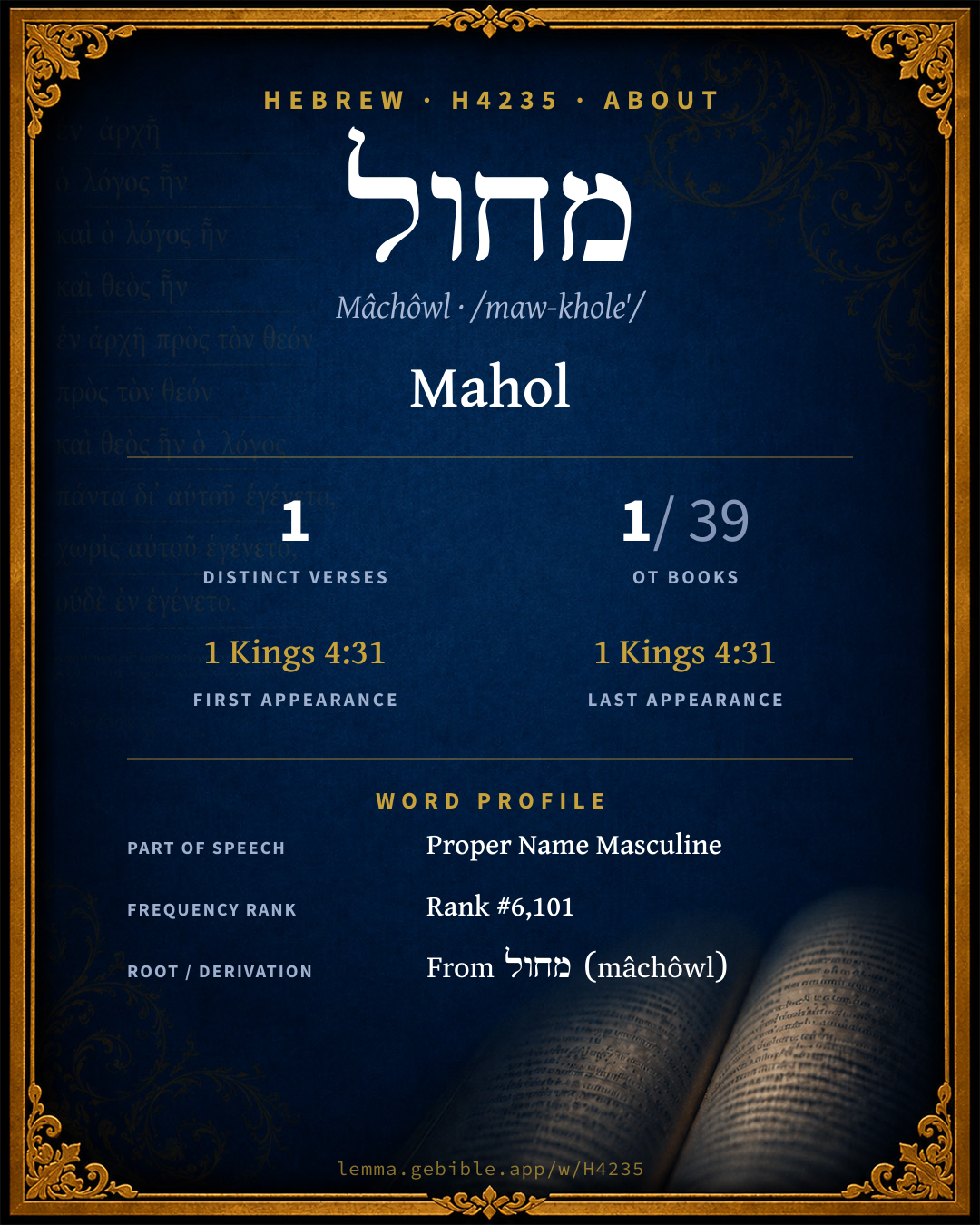
מָחוֹל
Mahol
BDB lists 2 entries for ‘Mahol’ fuller range ↓
Full lexicon entry — Brown-Driver-Briggs (BDB)
From Brown-Driver-Briggs (BDB)
Where this word appears
Grammar key — what these labels mean
Part of speech
- Noun
- A naming word — a person, place, thing, or idea.
Noun type
- Proper
- A name of a specific person, place, or people (e.g. Abraham, Zion, Israel).
Every verse where H4235 appears — 1 distinct verse across 1 book. Click any verse to open its interlinear word-by-word view. Verse text shown in the World English Bible for context — . Each verse’s Hebrew form is shown with its reference; the English is not keyword-highlighted, since the data carries no word-level English alignment. Use “Compare translations” on any verse to read it across multiple English versions. This concordance covers the Hebrew Bible; Septuagint (Greek Old Testament) occurrences are not indexed here.
1 Kings 1 verse
About this entry
At a glance — auto-summarized from this page’s data, not written by a person. Every figure links to its source below. This summary describes the numbers; it doesn’t interpret them.
מחול — transliterated Mâchôwl — is a Hebrew name carrying the sense “Mahol.” It is rare — just 1 verse in the entire Hebrew Bible. More than three-quarters of its appearances fall in 1 Kings. Found nowhere else but 1 Kings 4:31. See 1-verse concordance and the renderings breakdown below.
Gloss history
Strong's 1890 vs modern scholarship
About this word
Strong's H4235 catalogs a Hebrew word from the Hebrew Old Testament.
These counts are not copied from any lexicon or concordance. They are computed here, from the morphology-tagged Hebrew Old Testament. What Lemma adds →
- 1
- distinct verses
- The word appears in 1 distinct verse.
- 1 / 39
- OT books
- The word appears in 1 of 39 Old Testament books.
- #6,101
- by frequency
- Rank #6,101 (rank 6,101 of 8,640 Hebrew words by occurrence).
View all 1 occurrence in the concordance →
Most concentrated in
- 1 Kings 1 verse 100%
By section of the Old Testament
By traditional corpus
Conventional, traditional groupings — biblical authorship is debated, so this is a traditional corpus grouping, not an authorship claim. Each share is this word’s portion of its verses in that division of the Hebrew canon. Each figure is a share of the word’s 1 distinct verse.
- Prophets (Nevi'im) 1 verse · 100%
How translations render this word
Counts come from each version’s own published word-to-Strong’s tagging or interlinear alignment — an approximate guide to how each version renders this word, not a word-level alignment the data otherwise carries. Because each total is that version’s own tagged count, the per-version totals vary from one another and need not match the appearance or distinct-verse counts above. These counts may also differ from a printed concordance because Lemma counts each distinctly tagged rendering and does not collapse phrase taggings into a single head-word total. This is a fixed set of word-tagged versions (KJV, ASV, BSB, ULT) and does not change with the reading translation you choose elsewhere. Each version’s license is shown beside its name below (and on Sources).
BDB lists this Strong’s number as 2 distinct words (homographs). Each count above pools all of them and is not split by sense — see the Senses section below. A low-frequency rendering may belong to a different one of those words, not the primary meaning.
- King James Version†: Mahol 1×
- American Standard Version†: Mahol 1×
- Berean Standard Bible†: Mahol 1×
- unfoldingWord Literal Text†: Mahol 1×
King James Version Public Domain
Renders H4235 across 1† tagged occurrence — most commonly:
American Standard Version Public Domain
Renders H4235 across 1† tagged occurrence — most commonly:
Berean Standard Bible Public Domain
Renders H4235 across 1† tagged occurrence — most commonly:
unfoldingWord Literal Text CC BY-SA 4.0
Renders H4235 across 1† tagged occurrence — most commonly:
Senses in BDB
The 2 senses BDB distinguishes for this word, in lexicon order (not ranked by frequency or importance). The full entry — with sub-senses — is in the Lexicon Entry tab.
- Mahol = "dancing"
- father of Heman
Word origin
I. n.m. La 5:15 dance;—abs. מ׳ ψ 30:12 + 3 times; cstr. מְחוֹל Je 31:4; מְחוֹלֵנוּ La 5:15;—dance, token of joyousness ψ 30:12 (opp. מספד), Je 31:4, 13 (cf. v b), La 5:15 (opp. אֵבֶל); act of praise to י׳ ψ 149:3; 150:4; accompanied by timbrel (תֹּף) and sometimes other instruments ψ 149:3, 4 Je 31:13.
III. n.pr.m. father of Heman, etc., 1 K 5:11, 𝔊 Μαλ, A Μαουλ, 𝔊L Μααλα.
— Brown-Driver-Briggs (Oxford 1906, public domain), digitized via Sefaria, supplemented by the OpenScriptures HebrewLexicon (CC BY 4.0). See Sources.
Derived from מחול (mâchôwl) (H4234) — dance.
Jastrow Dictionary
A second Hebrew/Aramaic lexicon for comparison, covering Aramaic and post-biblical (Talmudic, Targumic, Midrashic) usage that the biblical-Hebrew BDB does not. Matched by lemma rather than by Strong’s number, so a lemma may carry more than one Jastrow headword (shown separately below), and the entries cover usage well beyond the Bible.
חוּל
- [to turn around, circle,]
- 1. to dance. Part. חָל, חוֹל; perf. חָל. Taan. IV, 8 יוצאות וחוֹלוֹת וכ׳ used to go out and dance in the vineyards; Lam. R. introd. וחָלוֹת (ר׳ זעירא) (ed. Wil. וחולות). Koh. R. to I, 11 חָלִין לפניו dance before Him, v. חוֹלָה. Gen. R. s. 74 חָלִים; Cant. R. to VII, 1; a. e.
- 2. (cmp. חַג) to come in turn, to occur. Meg. I, 1 חל להיות וכ׳ if the fourteenth fell on a Monday. R. Hash. IV, 1; a. v. fr.
- 3. (with על) to hover around one’s head, to rest upon one as a duty; to take effect (as a law). Shebu. 25ᵃ הנדרים חָלִים על וכ׳ vows are binding even if referring to a religious obligation. Ib. שבועות חָלוֹת וכ׳ oaths are binding &c.; Ned. 15ᵃ. Ib. 17ᵃ אין חָלָה וכ׳ one vow of nazaritism does not take effect &c.; Ḥull. 101ᵃ איסור חל וכ׳, v. אִיסּוּר. Y. Sabb. VII, 9ᵃ top; a. v. fr.
- [to be made to circle,] to be commenced, established. Ber. 31ᵃ הוּחֲלָה it (prayer at fixed times) was instituted.
חוּל ²
- 1. to dance. Part. חָיֵיל. Targ. Y. Ex. XV, 20 חיילין (read חַיְילָן).
- 2. to take effect. Yoma 14ᵃ חַיְילָא עליה וכ׳ the observation of mourning rests upon him. Ned. 17ᵃ ח׳ נזירות וכ׳, v. preced. Shebu. 24ᵇ ח׳ אתאנים takes effect with reference to figs. Ḥull. 103ᵃ אתי … ח׳ comes and takes effect in addition to &c. Ib. … ובמיתי מֵיחַל (מֵיחוּל) וכ׳ and they differ as to whether or not the prohibition of … comes to take effect &c.; a. fr.
- 3. to hover over one’s head, be impending. Targ. Jer. VII, 20; a. e.
- to turn in a circle, dance. Targ. Ps. XLII, 5 (h. text אדדם).
חוּל II
- (v. חָלָה) to be smooth, quiet, v. infra.
- to be quieted. Ber. 30ᵇ כדי שתִּתְחוֹלֵל דעתו עליו (Ms. M., Yalk. Ex. 392, Deut. 813 שתָּחוּל) until his mind is quieted (collected for prayer).
חוּל ³
- , to be smooth, lax; to be forgiving, renounce; to be sweet. Targ. O. Gen. IV, 26 חָליּ וכ׳ men became lax in worshipping.—Keth. 86ᵃ top תיזיל ותֵיחוּל וכ׳ Alf. (ed. ותיחלה, Asheri ותימחל) let her go and renounce her mother’s widowhood in favor of her father.—Gitt. 47ᵃ דלֵיחוֹל אַדְּמֵיה that he (the gladiator) may be in a forgiving mood for his life (which he is forced to risk); [oth. opin. דלֵיחוֹל אִדְמֵיה that his blood may be sweet, Ar. s. v. אדמא].
- to sweeten (by adding good wine), to improve. B. Mets. 60ᵃ דילמא טפי ומְחַיְּילֵיה וכ׳ lest he may add unmixed wine and improve it, and then sell it (for pure wine).
- (אַחֲלֵי, fr. חלי) to be liberal, to forgive. Ber. 12ᵇ אֲחִילוּ ליה מן וכ׳ they in heaven forgave him. Sabb. 30ᵃ דא׳ להו עון וכ׳ He pardoned them for the violation of the Day of Atonement; M. Kat. 9ᵃ. Keth. l. c. אֲחִילְתָּהּ she renounced it, v. supra.—B. Mets. 73ᵃ אֲחוּלֵי … מַחֲלֵי וכ׳ Ms. R. (ed. אוזולי … מוזלי, v. זוּל I ch.) they were liberal towards you. B. Bath. 144ᵃ אחולי אַחֲלָה she resigned her claim. [M. Kat. 17ᵃ מיתחיל = מִתְחֲלִיל, v. חֲלַל.] V. מְחַל.
חוֹל I
- sand, sand-region, esp. the sand used for glass-making. Sabb. VIII, 5 ח׳ הדק fine sand (marl used for manure); ח׳ הגס coarse sand (for cementing). Meg. 6ᵃ, v. זְכוּכִית. [Sabb. 90ᵃ בורית זה ח׳, v. אֳהָל.]—Pl. חוֹלוֹת sandy region, sea-shore, desert. Sabb. 31ᵃ בין הח׳ on an oasis surrounded with sand-land. Meg. 6ᵃ Cæsarea שהיא יושבת בין הח׳ which was situated between the sea-places, v. חוֹלַת.—Lev. R. s. 5 ח׳ אנטוכיא, v. חוֹלַת.—Y. B. Kam. I, 2ᶜ top בחופר בח׳ if one digs a pit in sandy ground. Sifré Deut. 39 בית הח׳, v. חוֹלָסִית.
חוֹל II
- Ḥol, name of a fabulous bird (Phoenix). Gen. R. s. 19 (ref. to Job XXIX, 18); Midr. Sam. ch. XII; Yalk. Job 917. Cmp. אַיְורַשְׁנָא. e.g. Job 29:18
חוֹל III
- [outside of the sanctuary, foreign,] profane, common, opp. קוֹדֶשׁ; week-day, opp. שַׁבָּת, מוֹעֵד. Pes. 104ᵃ; Ḥull. 26ᵇ בין קודש לח׳ between what is sacred and what is secular. Shebu. 35ᵇ כל שמות … חוץ מזה שהוא ח׳ all names of lordship (Adonay) … are sacred, except the following which is secular (referring to persons).—חוֹלוֹ של מועד, or חול המועד the half-festive days intervening between the first and the last days of Passover or of Succoth. Meg. 22ᵇ; a. fr.—Maas. Sh. III, 8 פתוחות לח׳ having an entrance on secular ground; ib. תוכן ח׳ their inside is secular ground. B. Mets. 84ᵇ כלי … ישתמש בו ח׳ shall the vessel once used for sacred things, be used for secular purposes (shall R. Eleazar’s widow marry Rabbi)?; a. v. fr.—Pl. חוּלִּין profane things, animals &c. not consecrated, ordinary objects. Ḥull. 2ᵇ, a. e. ח׳ שנעשו על וכ׳ ordinary food (not T’rumah) prepared with the precautions required for the levitical cleanness of consecrated food.—Pes. 22ᵃ, a. fr. ח׳ שנשחטו בעזרה animals not consecrated for sacrifices which were slaughtered in the Temple court. Ib., a. fr. ח׳ … דאורייתא the law forbidding the use of ordinary animals slaughtered &c., is not Biblical. Gitt. 62ᵃ עיסת חוּלָּיו his ordinary dough; זיתי חוליו (not ים …), v. טָהֳרָה. Ḥag. I, 3 באות מן הח׳ are procured from secular funds, opp. to proceeds from second tithes; a. fr.—Ber. 32ᵃ (play on ויחל, Ex. XXXII, 11) ח׳ הוא לך וכ׳ it is too foreign to thy nature to do such a thing; Yalk. Gen. 83, v. חָלִילָה.—Ḥullin (= שְׁחִיטַת ח׳), name of a treatise of the Mishnah, Tosefta and Talmud Babli, of the Order of Kodashim, containing the laws concerning ordinary meat. e.g. Exodus 32:11
מָחוֹל
- [circle,]
- 1. untilled ground surrounding the vineyard (between the vines and the fence). Kil. IV, 1, sq. מְחוֹל הכרם; Erub. 3ᵇ. Y. Kil. IV, 29ᵇ top ולא מ׳ לכרם קטן nor does the law concerning the planting of the maḥol apply to a small vineyard. Ib. יש לו מ׳ the law does apply to it. Ib. ניטל המ׳ (prob. to be read בטל) it has no more the nature of a maḥol
- 2. chorus of singers and dancers. Taan. 31ᵃ לעשות מ׳ to arrange a chorus. Yalk. Is. 294, v. חוֹלָה II.
A Dictionary of the Targumim, the Talmud Babli and Yerushalmi, and the Midrashic Literature (Marcus Jastrow; London, Luzac, 1903) — Public Domain. Digitized via Sefaria. Digitized via Sefaria. Full attribution on Sources.
Bible dictionary
Public-domain dictionary articles matched to this entry by name (Mahol). A biblical name can be shared by more than one person or place, so an article may treat several.
Easton's Bible Dictionary · M. G. Easton, 1897
Dance, the father of four sons (1 Kings 4:31) who were inferior in wisdom only to Solomon.
Smith's Bible Dictionary · William Smith, 1863
(dancing), the father of the four men most famous for wisdom next to Solomon himself. (1 Kings 4:31; 1 Chronicles 2:6)
Classic public-domain reference works; full attribution on Sources.