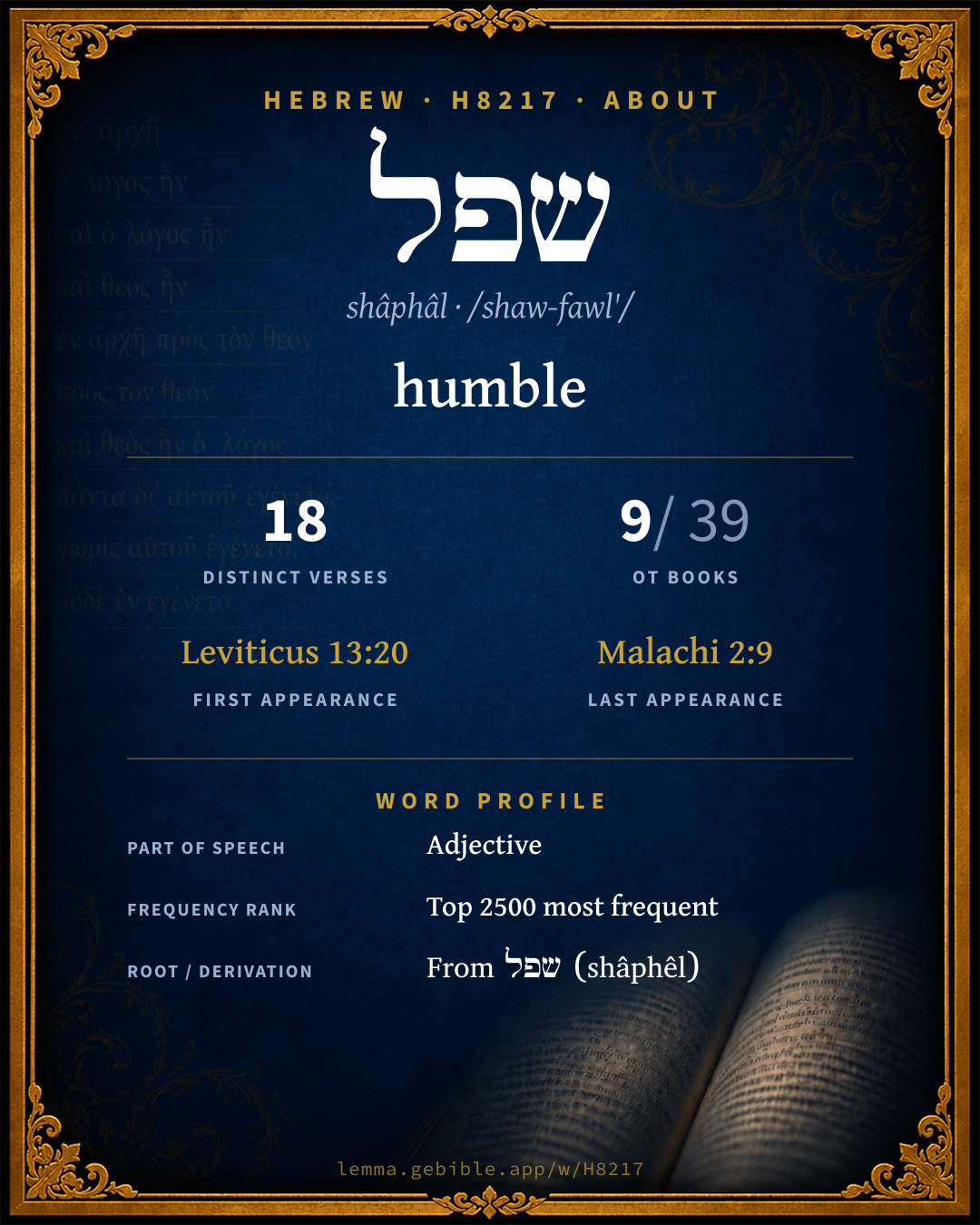
שָׁפָל
humble
‘humble’ is one of 5 main senses fuller range ↓
Full lexicon entry — Brown-Driver-Briggs (BDB)
From Brown-Driver-Briggs (BDB)
Where this word appears
See every Absolute-state word in the Hebrew Bible →
Grammar key — what these labels mean
Part of speech
- Adjective
- A word that describes or qualifies a noun.
- Verb
- An action or state-of-being word.
Stem
- Qal
- The basic, simple active stem — the plain form of the verb (“he wrote”).
Form
- Infinitive Construct
- A bound verbal noun, frequently with prepositions (“to write / in writing”).
State
- Absolute
- The independent form of a noun, not bound to a following word.
- Construct
- A noun bound to a following noun in a possessive / “of” relationship (the construct chain).
Gender
- Masculine
- Grammatically masculine.
- Feminine
- Grammatically feminine.
Number
- Singular
- One.
- Plural
- More than one (in Hebrew, generally three or more).
1 verse where H8217 appears in the Absolute state in the Book of Isaiah. Filtered view — show all forms. Click any verse to open its interlinear word-by-word view. Verse text shown in the World English Bible for context — . Each verse’s Hebrew form is shown with its reference; the English is not keyword-highlighted, since the data carries no word-level English alignment. Use “Compare translations” on any verse to read it across multiple English versions. This concordance covers the Hebrew Bible; Septuagint (Greek Old Testament) occurrences are not indexed here.
Isaiah
About this entry
At a glance — auto-summarized from this page’s data, not written by a person. Every figure links to its source below. This summary describes the numbers; it doesn’t interpret them.
The Hebrew adjective שפל centers on the idea of “humble.” The lexicon spreads it across several senses; see its full sense range. It turns up in 18 verses across 9 books, an uncommon footprint. The word gravitates to Ezekiel (33%), then Leviticus and Proverbs. Its earliest occurrence is Leviticus 13:20. Dig into 18-verse concordance and the renderings breakdown below.
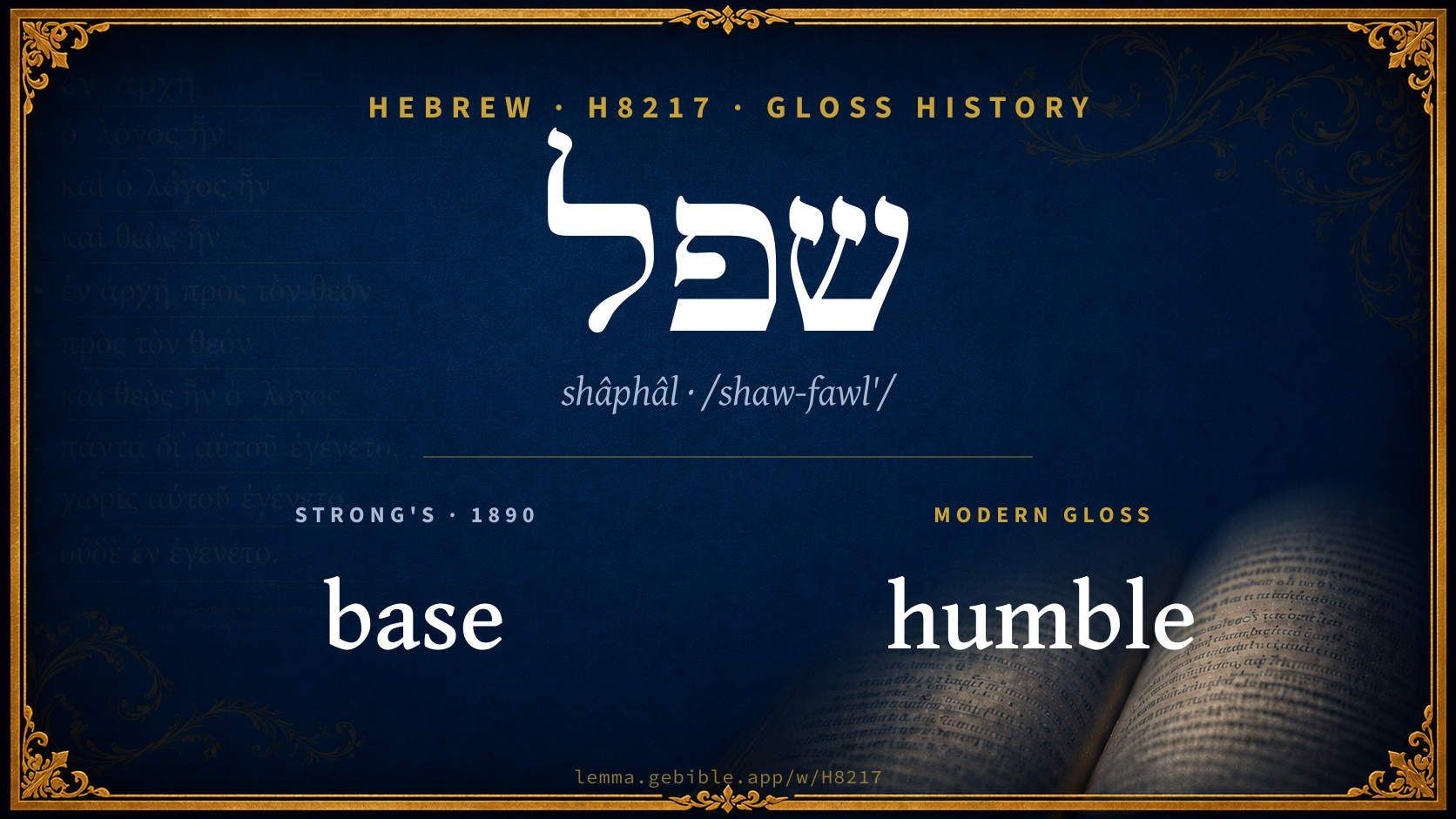
Gloss history
Strong's 1890 vs modern scholarship
About this word
Strong's H8217 catalogs a Hebrew word from the Hebrew Old Testament.
These counts are not copied from any lexicon or concordance. They are computed here, from the morphology-tagged Hebrew Old Testament. What Lemma adds →
- 18
- distinct verses
- The word appears in 18 distinct verses.
- 9 / 39
- OT books
- The word appears in 9 of 39 Old Testament books.
- #1,563
- by frequency
- Top 2500 most frequent Hebrew words (rank 1,563 of 8,640 Hebrew words by occurrence).
View all 18 occurrences in the concordance →
By section of the Old Testament
By traditional corpus
Conventional, traditional groupings — biblical authorship is debated, so this is a traditional corpus grouping, not an authorship claim. Each share is this word’s portion of its verses in that division of the Hebrew canon. Each figure is a share of the word’s 18 distinct verses.
- Prophets (Nevi'im) 9 verses · 50%
- Writings (Ketuvim) 5 verses · 28%
- Torah (Pentateuch) 4 verses · 22%
How translations render this word
Counts come from each version’s own published word-to-Strong’s tagging or interlinear alignment — an approximate guide to how each version renders this word, not a word-level alignment the data otherwise carries. Because each total is that version’s own tagged count, the per-version totals vary from one another and need not match the appearance or distinct-verse counts above. These counts may also differ from a printed concordance because Lemma counts each distinctly tagged rendering and does not collapse phrase taggings into a single head-word total. This is a fixed set of word-tagged versions (KJV, ASV, BSB, ULT) and does not change with the reading translation you choose elsewhere. Each version’s license is shown beside its name below (and on Sources).
- King James Version: Humble 3×, Is low 2×, Low 2×
- American Standard Version: Is low 2×, Low 2×
- Berean Standard Bible: Lowly 5×, Humble 3×, Be beneath 2×
- unfoldingWord Literal Text: Lowly 5×, Is deeper 2×
King James Version Public Domain
Renders H8217 across 19 tagged occurrences — most commonly:
Plus 12 renderings that appear only once — usually multi-word phrases or single function words the recovered tagging swept in, not distinct renderings.
American Standard Version Public Domain
Renders H8217 across 19 tagged occurrences — most commonly:
Plus 15 renderings that appear only once — usually multi-word phrases or single function words the recovered tagging swept in, not distinct renderings.
Berean Standard Bible Public Domain
Renders H8217 across 17 tagged occurrences — most commonly:
Plus 5 renderings that appear only once — usually multi-word phrases or single function words the recovered tagging swept in, not distinct renderings.
unfoldingWord Literal Text CC BY-SA 4.0
Renders H8217 across 22 tagged occurrences — most commonly:
Plus 15 renderings that appear only once — usually multi-word phrases or single function words the recovered tagging swept in, not distinct renderings.
Senses in the full BDB
What do BDB’s symbols mean?
BDB uses these scholarly abbreviations:
| Symbol | Meaning |
|---|---|
| 𝔊 | the Septuagint (the ancient Greek translation, LXX) |
| 𝔙 | the Vulgate (the Latin translation) |
| 𝔖 | the Syriac version (the Peshitta) |
| 𝔗 | the Targum (the Aramaic translation) |
| ψ | the Psalms |
| √ | root (the underlying root or stem) |
| ‖ | parallel passage (a synonymous or contrasted parallel) |
| † | the dagger: every passage where the word occurs is cited |
The 4 senses and sub-senses the full Brown-Driver-Briggs lexicon distinguishes for this word, in lexicon order (not ranked by frequency), with BDB’s own verbatim wording and sub-sense lettering. Shown in Hebrew script with BDB’s own scholarly abbreviations. The condensed entry is in the Lexicon Entry tab. See also the Forms in the corpus table below.
- 1. low, in height, of vine Ez 17:6, tree v 24 (opp. גָּבֹהַּ); שׁ׳ מִן־הָעוֹר Lv 13:20 lower (deeper) than the skin (around it), so v 21, 26, cf. 14:37. e.g. Ezekiel 17:6
- 2. of a modest, unambitious kingdom Ez 17:14; 29:14, 15; low in station Jb 5:11 (opp. שָֽׂגְבוּ), Ez 21:31 (Ges§ 90 f; read הַשְּׁפָלָה֣). e.g. Ezekiel 17:14
- 3. humiliated, שׁ׳ בְּעֵינָ֑י 2 S 6:22; pl. Mal 2:9 (‖ נִבְזִים). e.g. 2 Samuel 6:22
- 4. lowly, as subst. ψ 138:6 (opp. גָּבֹהַּ), רוּחַ שְׁפָלִים Is 57:15 (‖ נִדְכָּאִים); שְׁפַל רוּחַ v 15, Pr 29:23 (opp. גַּאֲוַת אָדָם), + 16:19 Thes al. (but v. √ Qal 2). e.g. Psalms 138:6
Senses from the full Brown-Driver-Briggs lexicon (Brown, Driver, Briggs; Oxford 1906 — public domain), digitized via Sefaria, supplemented by the OpenScriptures HebrewLexicon (CC BY 4.0). Full attribution on Sources.
Word origin
adj. low;—abs. שׁ׳ 2 S 6:22 +, cstr. שְׁפַל ψ 29:23 +; fs. שְׁפָלָה Ez 17:14 +, cstr. שִׁפְלַת v 6; pl. שְׁפָלִים Jb 5:11;—
— Brown-Driver-Briggs (Oxford 1906, public domain), digitized via Sefaria, supplemented by the OpenScriptures HebrewLexicon (CC BY 4.0). See Sources.
Derived from שפל (shâphêl) (H8213) — to humble.
Jastrow Dictionary
A second Hebrew/Aramaic lexicon for comparison, covering Aramaic and post-biblical (Talmudic, Targumic, Midrashic) usage that the biblical-Hebrew BDB does not. Matched by lemma rather than by Strong’s number, so a lemma may carry more than one Jastrow headword (shown separately below), and the entries cover usage well beyond the Bible.
שָׁפֵל I
- to be low.
- to lower, humble. Erub. 13ᵇ המַשְׁפִּיל עצמו; הקב"ה מַשְׁפִּילוֹ, v. גָּבַהּ; Ned. 55ᵃ. Pesik. R. s. 10 (ref. to Is. II, 9) אימתי שחו ונִשְׁפָּלוּ … הִשְׁפִּילָם הקב"ה when did they sink and were lowered? When they committed that deed (worshipped the golden calf), the Lord lowered them. Arakh. 15ᵇ יַשְׁפִּיל דעתו let him humble his mind (think of his shortcomings). M. Kat. 16ᵇ (play on ת̇ח̇כ̇מ̇נ̇י̇, II Sam. XXIII, 8) הואיל והִשְׁפַּלְתָּ עצמך ת̇ה̇א כ̇מ̇ו̇נ̇י̇ because thou didst lower thyself, thou shalt be like myself; a. fr. e.g. Isaiah 2:9
- to be lowered. Pesik. R. l. c., v. supra.
- same. Pesik. Ki Thissa, p. 11ᵇ (ref. to Is. II, 9) יודע … והָשְׁפַּלְתִּי אני והם וכ׳ I know that Israel bowed to the golden calf, and I and they have been lowered, but wilt thou not raise (forgive) them?; Tanḥ. Ki Thissa 4 והשפלתי אותי and I myself have been lowered; Yalk. Is. 260 והוּשְׁפַּלְתִּי. Tanḥ. l. c. 5 (ref. to Ps. LXXV, 8) בלשון זה הו׳ וכ׳ for the word zeh (Ex. XXXII, 24) was he (Aaron) lowered, v. גָּבַהּ; בלשון זה הוּשְׁפָּלוּ וכ׳ through zeh (ib. 23) were they lowered, and with zeh (ib. XXX, 13) have they been raised; Lev. R. s. 8; a. fr. e.g. Isaiah 2:9
- [to let one’s self drop,]
- 1. to be humble, gentle. Lev. R. s. 19 (ref. to שפלות ידים, Koh. X, 18) ע"י שנִשְׁתַּפְּלוּ ישראל מלחנות וכ׳ because the Israelites were too gentle to encamp (before Sinai) in discord &c. e.g. Ecclesiastes 10:18
- 2. to be lazy, indolent. Ib. ע"י … מִשְׁתַּפֵּל מלקנח וכ׳ (not לקנח) because that man is too careless to wipe his body properly, he gets scabs. Ib. ע"י … מִשְׁתַּפֶּלֶת וכ׳ because that woman is too indolent to examine her body properly &c.; a. e.
שְׁפַל
- , to fall down, go down. B. Kam. 92ᵇ; Meg. 14ᵇ (prov.) שפיל ואזיל בר אווזא וכ׳ the duck bends its head down in walking, and its eyes look all around (it follows two pursuits at the same time, v. פִּלְכָא). Snh. 7ᵃ ודיקולא שָׁפֵיל, v. דִּיקוּלָא. Ber. 10ᵃ שְׁפִיל לסיפיה דקרא go to the end of the verse (in order to understand the whole of it); a. fr.
- 1. to lower. Targ. Y. II, Lev. X, 20. Targ. Prov. XXV, 7. Ib. XXIX, 23; a. fr.
- 2. to carry down, carry along. Yeb. 121ᵃ גלי אַשְׁפְּלוּ the waves may have carried (and landed him).
- to humble one’s self. Targ. I Sam. II, 36.
שָׁפָל
- preced.)
- 1. low, humble. Num. R. s. 420 ואל … ש׳ בעיני וכ׳ say not that I was low in the eyes of others, and was not despised in my own eyes. Taan. 16ᵃ; Snh. 88ᵇ, a. e. שְׁפַל ברך low of knee, polite. Y. ib. I, 19ᶜ נפש ש׳ a humble soul, humility; Ab. V, 19 נפש ש׳ contented, opp. רחבה. Ib. IV, 10 הוי שְׁ׳ רוח בפני וכ׳ be humble before every man. Snh. 43ᵇ מי שדעתו ש׳ מעלה וכ׳ to him whose mind is lowly the Lord accounts it as if he had offered all kinds of sacrifices. Sot. 5ᵃ ואין … את הש׳, v. גָּבוֹהַּ. Ib. אבל … ורואה את הש׳ but not so the Lord, he is high and looks at the low; a. fr.—Pl. שְׁפָלִים, שְׁפָלִין; שְׁפָלוֹת. Ib. 47ᵇ, v. גָּבַהּ; a. e.
- 2. (v. שָׁפֵל, Hithpa.) [letting the hands sink,] indolent, negligent, opp. זָרִיז. Tosef. Yeb. IV, 8; Pes. 50ᵇ יש ש׳ וכ׳ sometimes one is lazy and profits, and sometimes one is lazy and loses.—Pl. as ab. Ib. 89ᵃ; Ned. 36ᵃ; Gitt. 25ᵃ
שְׁפַל II
- , lowly. Targ. Prov. XVI, 19.
שָׁפֵל
- II (or שׁפֶל) m., v. next w.
A Dictionary of the Targumim, the Talmud Babli and Yerushalmi, and the Midrashic Literature (Marcus Jastrow; London, Luzac, 1903) — Public Domain. Digitized via Sefaria. Digitized via Sefaria. Full attribution on Sources.
Forms in the corpus
The 15 distinct written forms H8217 takes in the Hebrew Bible, most frequent first — each parse links to that state’s occurrences in the concordance. Hebrew forms include their vowel points and cantillation, so a single lemma takes many written forms.
Same root — word family
Other BDB entries built from the same root as H8217, grouped by Strong’s listed origin. These share a root / origin per the lexicon — not necessarily a shared meaning. Each links to that word’s own entry.
Derives from
Shares the same root
- שפל shᵉphal H8214 to humble
- שפל shephel H8216 lowliness
- שפלה shᵉphêlâh H8219 valley
- שפלות shiphlûwth H8220 idleness
Compare all same-root words → Showing 4 of 6 — not the complete family. They share a root, not necessarily a meaning.
Septuagint verse parallels
This word appears in 18 verses that also exist in the Greek Old Testament (Septuagint), out of the 18 Hebrew verses it occurs in. You can read those verses in Greek by switching the Old Testament edition to the Septuagint.
Read these verses in the Septuagint
- Leviticus 13:20
- 2 Samuel 6:22
- Job 5:11
- Psalms 138:6
- Proverbs 16:19
- Ecclesiastes 12:4
- Isaiah 57:15
- Ezekiel 17:6
- Malachi 2:9
This is a verse-level parallel only — the same verses exist in both the Hebrew and Greek Old Testaments. No word-level Hebrew↔Greek correspondence is claimed: the data carries no such alignment, so no Greek word is shown as this Hebrew word’s translation. Coverage is not total — the Septuagint omits the deuterocanon and renumbers the Psalms, so some Hebrew verses have no direct Greek parallel.