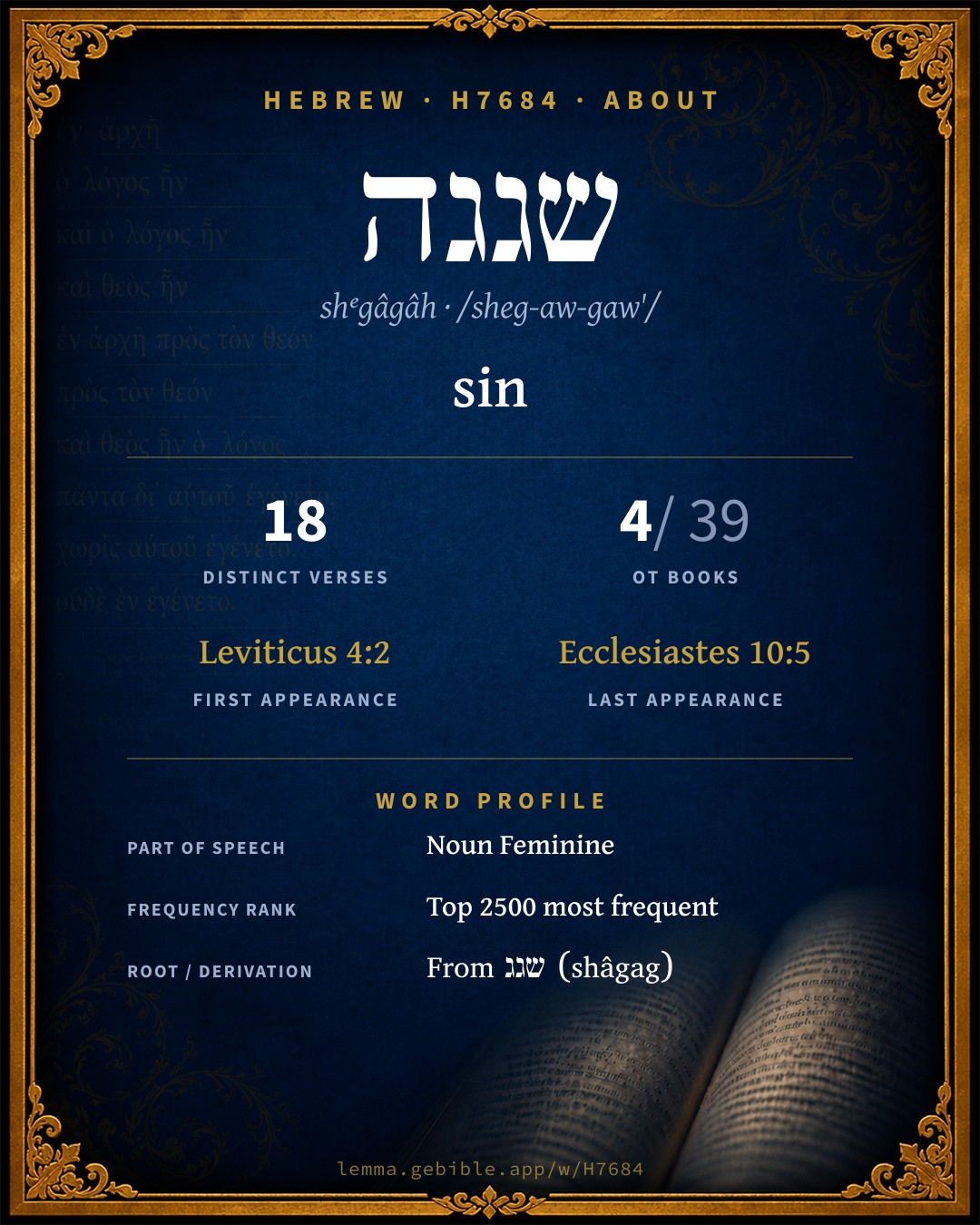
שְׁגָגָה
sin
‘sin’ is one of 2 main senses fuller range ↓
Full lexicon entry — Brown-Driver-Briggs (BDB)
From Brown-Driver-Briggs (BDB)
Where this word appears
See every Absolute-state word in the Hebrew Bible →
Grammar key — what these labels mean
Part of speech
- Noun
- A naming word — a person, place, thing, or idea.
Noun type
- Common
- A common noun — a general class of person, place, or thing (“king,” “city,” “water”), not a specific name.
Stem
- Qal
- The basic, simple active stem — the plain form of the verb (“he wrote”).
Form
- Participle Active
- A verbal adjective expressing ongoing or characteristic action (“writing / one who writes”).
State
- Absolute
- The independent form of a noun, not bound to a following word.
- Construct
- A noun bound to a following noun in a possessive / “of” relationship (the construct chain).
Gender
- Feminine
- Grammatically feminine.
Number
- Singular
- One.
8 verses where H7684 appears in the Absolute state in the Book of Numbers. Filtered view — show all forms. Click any verse to open its interlinear word-by-word view. Verse text shown in the World English Bible for context — . Each verse’s Hebrew form is shown with its reference; the English is not keyword-highlighted, since the data carries no word-level English alignment. Use “Compare translations” on any verse to read it across multiple English versions. This concordance covers the Hebrew Bible; Septuagint (Greek Old Testament) occurrences are not indexed here.
Numbers
- Numbers 15:24 לִ/שְׁגָגָה֒ prep + n c fs then it shall be, if it be done unwittingly, without the knowledge of the congregation, that all the congregation shall offer one young bull for a burnt offering, for a sweet savor to Yahweh, with the meal-offering of it, and the drink-offering of it, according to the ordinance, and one male goat for a sin-offering.
- Numbers 15:25 שְׁגָגָ֣ה שִׁגְגָתָֽ/ם n c fs n c fs cs + sfx pers 3mp The priest shall make atonement for all the congregation of the children of Israel, and they shall be forgiven; for it was an error, and they have brought their offering, an offering made by fire to Yahweh, and their sin-offering before Yahweh, for their error:
- Numbers 15:26 בִּ/שְׁגָגָֽה prep + n c fs and all the congregation of the children of Israel shall be forgiven, and the stranger who lives as a foreigner among them; for in respect of all the people it was done unwittingly.
- Numbers 15:27 בִ/שְׁגָגָ֑ה prep + n c fs If one person sin unwittingly, then he shall offer a female goat a year old for a sin-offering.
- Numbers 15:28 הַ/שֹּׁגֶ֛גֶת ptcl def.art + Qal ptcp.act fs The priest shall make atonement for the soul who errs, when he sins unwittingly, before Yahweh, to make atonement for him; and he shall be forgiven.
- Numbers 15:29 בִּ/שְׁגָגָֽה prep + n c fs You shall have one law for him who does anything unwittingly, for him who is home-born among the children of Israel, and for the stranger who lives as a foreigner among them.
- Numbers 35:11 בִּ/שְׁגָגָֽה prep + n c fs then you shall appoint you cities to be cities of refuge for you, that the manslayer who kills any person unwittingly may flee there.
- Numbers 35:15 בִּ/שְׁגָגָֽה prep + n c fs For the children of Israel, and for the stranger and for the foreigner living among them, shall these six cities be for refuge; that everyone who kills any person unwittingly may flee there.
About this entry
At a glance — auto-summarized from this page’s data, not written by a person. Every figure links to its source below. This summary describes the numbers; it doesn’t interpret them.
שגגה — transliterated shᵉgâgâh — is a Hebrew noun carrying the sense “sin.” Where the King James Version says “through ignorance,” newer translations reach for “unintentionally” (Berean Standard Bible) and “mistake” (unfoldingWord Literal Text); the renderings breakdown has the detail. The Hebrew Bible uses it across 18 verses — uncommon. More than a third of its appearances fall in Numbers. BDB distinguishes 2 senses for it. See the sense tree, 18-verse concordance, and the renderings breakdown below.
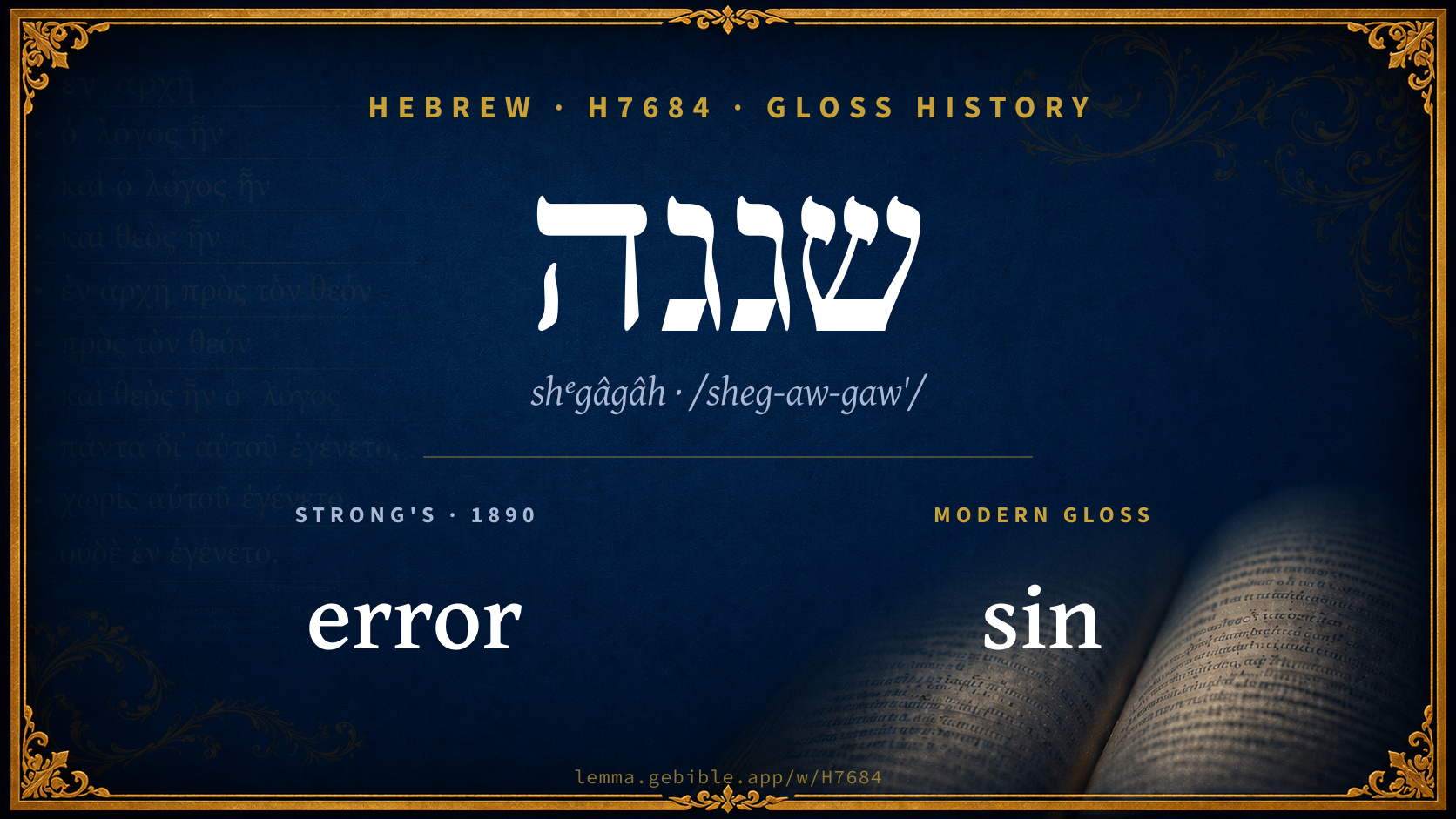
Gloss history
Strong's 1890 vs modern scholarship
About this word
Strong's H7684 catalogs a Hebrew word from the Hebrew Old Testament.
These counts are not copied from any lexicon or concordance. They are computed here, from the morphology-tagged Hebrew Old Testament. What Lemma adds →
- 18
- distinct verses
- The word appears in 18 distinct verses.
- 4 / 39
- OT books
- The word appears in 4 of 39 Old Testament books.
- #1,563
- by frequency
- Top 2500 most frequent Hebrew words (rank 1,563 of 8,640 Hebrew words by occurrence).
View all 18 occurrences in the concordance →
By section of the Old Testament
By traditional corpus
Conventional, traditional groupings — biblical authorship is debated, so this is a traditional corpus grouping, not an authorship claim. Each share is this word’s portion of its verses in that division of the Hebrew canon. Each figure is a share of the word’s 18 distinct verses.
- Torah (Pentateuch) 14 verses · 78%
- Prophets (Nevi'im) 2 verses · 11%
- Writings (Ketuvim) 2 verses · 11%
How translations render this word
Counts come from each version’s own published word-to-Strong’s tagging or interlinear alignment — an approximate guide to how each version renders this word, not a word-level alignment the data otherwise carries. Because each total is that version’s own tagged count, the per-version totals vary from one another and need not match the appearance or distinct-verse counts above. These counts may also differ from a printed concordance because Lemma counts each distinctly tagged rendering and does not collapse phrase taggings into a single head-word total. This is a fixed set of word-tagged versions (KJV, ASV, BSB, ULT) and does not change with the reading translation you choose elsewhere. Each version’s license is shown beside its name below (and on Sources).
- King James Version: Through ignorance 5×, Unawares 4×, Ignorance 3×
- American Standard Version: Unwittingly 13×, Was an error 2×
- Berean Standard Bible: Unintentionally 10×, Error 3×
- unfoldingWord Literal Text: Mistake 16×
King James Version Public Domain
Renders H7684 across 19 tagged occurrences — most commonly:
Plus 7 renderings that appear only once — usually multi-word phrases or single function words the recovered tagging swept in, not distinct renderings.
American Standard Version Public Domain
Renders H7684 across 20 tagged occurrences — most commonly:
Plus 5 renderings that appear only once — usually multi-word phrases or single function words the recovered tagging swept in, not distinct renderings.
Berean Standard Bible Public Domain
Renders H7684 across 19 tagged occurrences — most commonly:
Plus 6 renderings that appear only once — usually multi-word phrases or single function words the recovered tagging swept in, not distinct renderings.
unfoldingWord Literal Text CC BY-SA 4.0
Renders H7684 across 19 tagged occurrences — most commonly:
Plus 3 renderings that appear only once — usually multi-word phrases or single function words the recovered tagging swept in, not distinct renderings.
Senses in BDB
The 2 senses BDB distinguishes for this word, in lexicon order (not ranked by frequency or importance). The full entry — with sub-senses — is in the Lexicon Entry tab.
- sin, sin of error or inadvertence, inadvertent sin
- error
Word origin
n.f. sin of error, inadvertence;—abs. שׁ׳ Nu 15:25 +; sf. שִׁגְגָתוֹ Lv 5:18; שִׁגְגָתָם Nu 15:25;—error (opp. sins of intention, or בְּיָד רָמָה) only P Ec: Nu 15:25 = Ec 5:5, cf. Ec 10:5; על שׁ׳ Lv 5:18 Nu 15:25; חטא בִּשׁ׳ Lv 4:2, 22, 27; 5:15; Nu 15:27, 28 + (vb. om.) v 26; עשׂה בִשׁ׳ Lv 4:22; Nu 15:29 + (לִשׁ׳) v 24; אכל קֹדֶשׁ בִּשׁ׳ Lv 22:14; מַכֵּה־נֶפֶשׁ בִּשׁ׳ of unintended killing Nu 35:11, 15 = Jos 20:3, 9 (‖ in D בִּבְלִי־דַעַת).—1 S 14:24 v. שׁגה.
— Brown-Driver-Briggs (Oxford 1906, public domain), digitized via Sefaria, supplemented by the OpenScriptures HebrewLexicon (CC BY 4.0). See Sources.
Derived from שגג (shâgag) (H7683) — to go astray.
Jastrow Dictionary
A second Hebrew/Aramaic lexicon for comparison, covering Aramaic and post-biblical (Talmudic, Targumic, Midrashic) usage that the biblical-Hebrew BDB does not. Matched by lemma rather than by Strong’s number, so a lemma may carry more than one Jastrow headword (shown separately below), and the entries cover usage well beyond the Bible.
שְׁגָגָה
- preced.) inadvertent act, error. Ker. I, 2 על אלו … ועל שִׁגְגָתָם חטאת for the following acts one incurs the punishment of extinction if wilfully committed, and is bound to bring a sin-offering if committed inadvertently. Ib. II, 2 אלו … הזדון כש׳ the following must offer a sacrifice for their wilful acts as if they were inadvertent ones. Sabb. 70ᵃ (in Chald. dict.) קרבן דחייב רחמנא אמאי אש׳ for what act does the Law demand a sacrifice? Only for an inadvertent act. Ib. 69ᵃ שִׁגְגַת קרבן שמה ש׳ ignorance as to eventual liability to a sacrifice is called inadvertency; Shebu. 26ᵇ. Ib. איזוהי שגגת שבועת וכ׳ how is inadvertency in a vain oath with regard to a past event possible?; a. v. fr.—M. Kat. 18ᵃ, a. fr. והואי כש׳ שיוצאה מלפני השליט (fr. Koh. X, 5) and it was as an error proceeding from the ruler, i.e. his ominous words, although not meant as such, came true.—Pl. שְׁגָגוֹת. Sabb. 70ᵃ (in Chald. dict.) התם חדא שגגה הכא טובא ש׳ הוייו there it is only one error, here there are several. B. Mets. 33ᵇ, v. זָרוֹן. Y. Shebu. I, 33ᵃ חטאתם אלו הש׳ ‘their sins’ (Lev. XVI, 21) this refers to inadvertent acts; a. fr. e.g. Ecclesiastes 10:5
A Dictionary of the Targumim, the Talmud Babli and Yerushalmi, and the Midrashic Literature (Marcus Jastrow; London, Luzac, 1903) — Public Domain. Digitized via Sefaria. Digitized via Sefaria. Full attribution on Sources.
Forms in the corpus
The 14 distinct written forms H7684 takes in the Hebrew Bible, most frequent first — each parse links to that state’s occurrences in the concordance. Hebrew forms include their vowel points and cantillation, so a single lemma takes many written forms.
Septuagint verse parallels
This word appears in 17 verses that also exist in the Greek Old Testament (Septuagint), out of the 18 Hebrew verses it occurs in. You can read those verses in Greek by switching the Old Testament edition to the Septuagint.
Read these verses in the Septuagint
This is a verse-level parallel only — the same verses exist in both the Hebrew and Greek Old Testaments. No word-level Hebrew↔Greek correspondence is claimed: the data carries no such alignment, so no Greek word is shown as this Hebrew word’s translation. Coverage is not total — the Septuagint omits the deuterocanon and renumbers the Psalms, so some Hebrew verses have no direct Greek parallel.