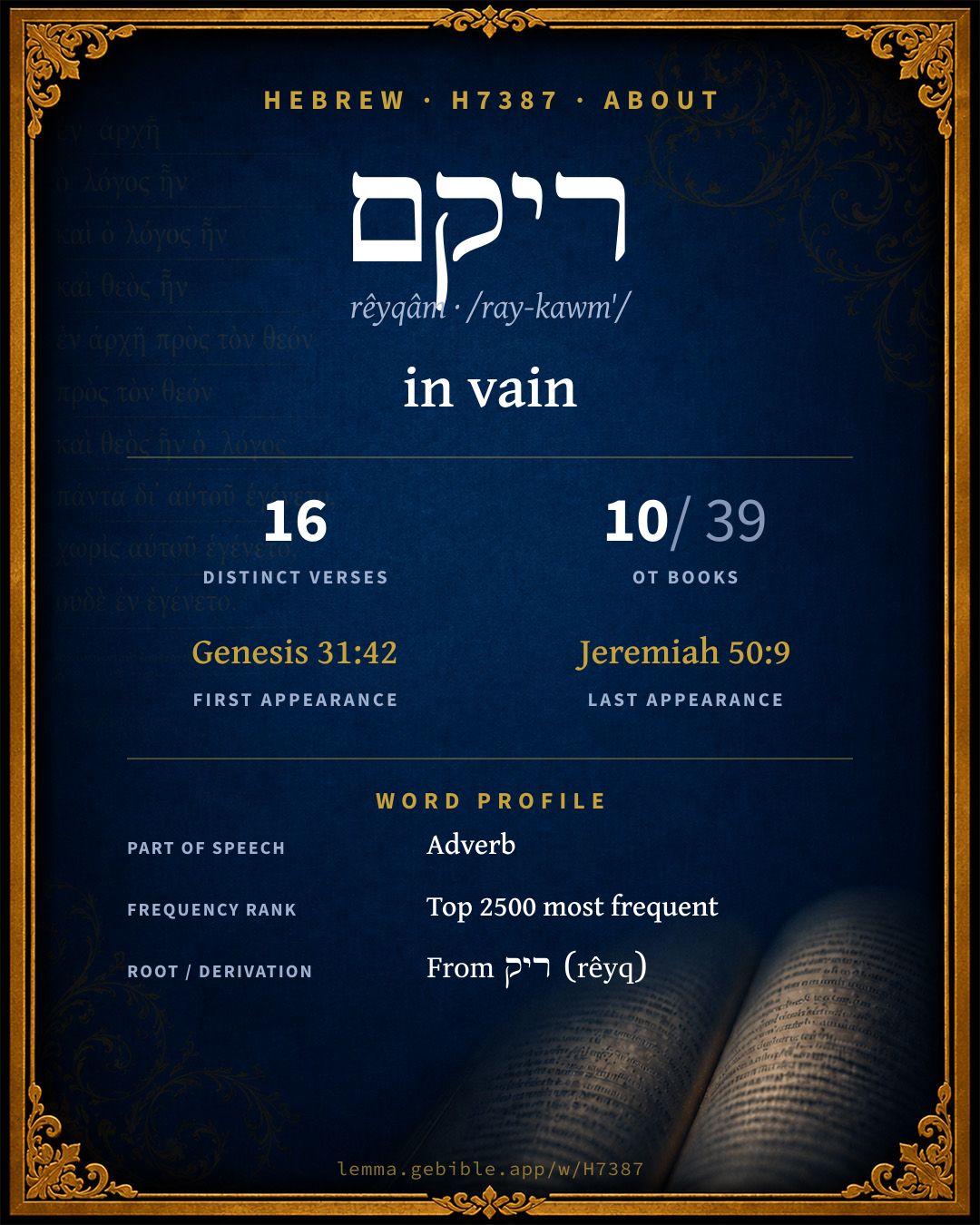
רֵיקָם
in vain
‘in vain’ is one of 3 main senses fuller range ↓
Full lexicon entry — Brown-Driver-Briggs (BDB)
From Brown-Driver-Briggs (BDB)
Where this word appears
Grammar key — what these labels mean
Part of speech
- Adverb
- A word that modifies a verb, adjective, or other adverb.
Every verse where H7387 appears in the Book of Isaiah — 1 distinct verse. Click any verse to open its interlinear word-by-word view. Verse text shown in the World English Bible for context — . Each verse’s Hebrew form is shown with its reference; the English is not keyword-highlighted, since the data carries no word-level English alignment. Use “Compare translations” on any verse to read it across multiple English versions. This concordance covers the Hebrew Bible; Septuagint (Greek Old Testament) occurrences are not indexed here.
Isaiah
About this entry
At a glance — auto-summarized from this page’s data, not written by a person. Every figure links to its source below. This summary describes the numbers; it doesn’t interpret them.
The Hebrew verb ריקם centers on the idea of “in vain.” The King James Version usually renders it “empty,” while modern versions prefer “empty-handed” (Berean Standard Bible) — see the renderings breakdown. Spanning 16 verses in 10 books, it ranks among the uncommon words of the Hebrew Bible. Debuting at Genesis 31:42, it then recurs through the corpus. The lexicon spreads it across several senses; see its full sense range. For the data behind this summary, explore the sense tree and the renderings breakdown below.
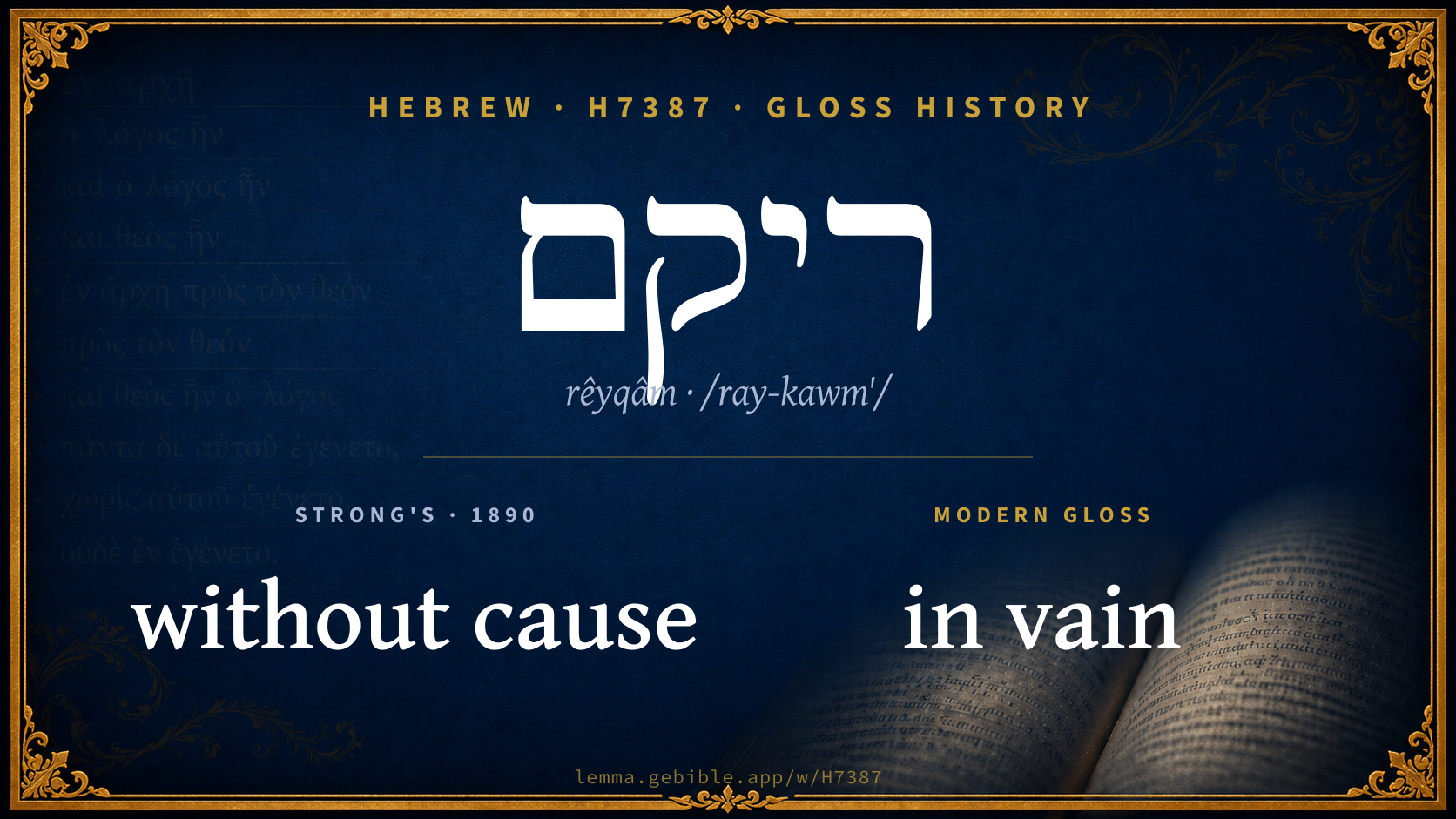
Gloss history
Strong's 1890 vs modern scholarship
About this word
Strong's H7387 catalogs a Hebrew word from the Hebrew Old Testament.
These counts are not copied from any lexicon or concordance. They are computed here, from the morphology-tagged Hebrew Old Testament. What Lemma adds →
- 16
- distinct verses
- The word appears in 16 distinct verses.
- 10 / 39
- OT books
- The word appears in 10 of 39 Old Testament books.
- #1,752
- by frequency
- Top 2500 most frequent Hebrew words (rank 1,752 of 8,640 Hebrew words by occurrence).
View all 16 occurrences in the concordance →
Most concentrated in
- Exodus 3 verses 19%
- Deuteronomy 2 verses 13%
- Ruth 2 verses 13%
By section of the Old Testament
By traditional corpus
Conventional, traditional groupings — biblical authorship is debated, so this is a traditional corpus grouping, not an authorship claim. Each share is this word’s portion of its verses in that division of the Hebrew canon. Each figure is a share of the word’s 16 distinct verses.
- Torah (Pentateuch) 6 verses · 38%
- Prophets (Nevi'im) 5 verses · 31%
- Writings (Ketuvim) 5 verses · 31%
How translations render this word
Counts come from each version’s own published word-to-Strong’s tagging or interlinear alignment — an approximate guide to how each version renders this word, not a word-level alignment the data otherwise carries. Because each total is that version’s own tagged count, the per-version totals vary from one another and need not match the appearance or distinct-verse counts above. These counts may also differ from a printed concordance because Lemma counts each distinctly tagged rendering and does not collapse phrase taggings into a single head-word total. This is a fixed set of word-tagged versions (KJV, ASV, BSB, ULT) and does not change with the reading translation you choose elsewhere. Each version’s license is shown beside its name below (and on Sources).
- King James Version: Empty 10×, Without cause 2×
- American Standard Version: Empty 9×
- Berean Standard Bible: Empty-handed 9×, Empty 5×, Without cause 2×
- unfoldingWord Literal Text: Empty 7×, Emptily 3×, Empty handed 3×
King James Version Public Domain
Renders H7387 across 16 tagged occurrences — most commonly:
Plus 4 renderings that appear only once — usually multi-word phrases or single function words the recovered tagging swept in, not distinct renderings.
American Standard Version Public Domain
Renders H7387 across 16 tagged occurrences — most commonly:
Plus 7 renderings that appear only once — usually multi-word phrases or single function words the recovered tagging swept in, not distinct renderings.
Berean Standard Bible Public Domain
Renders H7387 across 16 tagged occurrences — most commonly:
unfoldingWord Literal Text CC BY-SA 4.0
Renders H7387 across 16 tagged occurrences — most commonly:
Plus 3 renderings that appear only once — usually multi-word phrases or single function words the recovered tagging swept in, not distinct renderings.
Senses in the full BDB
What do BDB’s symbols mean?
BDB uses these scholarly abbreviations:
| Symbol | Meaning |
|---|---|
| 𝔊 | the Septuagint (the ancient Greek translation, LXX) |
| 𝔙 | the Vulgate (the Latin translation) |
| 𝔖 | the Syriac version (the Peshitta) |
| 𝔗 | the Targum (the Aramaic translation) |
| ψ | the Psalms |
| √ | root (the underlying root or stem) |
| ‖ | parallel passage (a synonymous or contrasted parallel) |
| † | the dagger: every passage where the word occurs is cited |
The 2 senses and sub-senses the full Brown-Driver-Briggs lexicon distinguishes for this word, in lexicon order (not ranked by frequency), with BDB’s own verbatim wording and sub-sense lettering. Shown in Hebrew script with BDB’s own scholarly abbreviations. The condensed entry is in the Lexicon Entry tab. See also the Forms in the corpus table below.
- 1. in empty condition, empty = with empty hands; c. vb. of sending Gn 31:42 (E), Dt 15:13 1 S 6:3 Jb 22:9; of going forth Ex 3:21, returning Ru 1:21; 3:17; = without an offering, לֹא יֵרָאוּ פָנַי ר׳ Ex 23:15 (E) = 34:20 (J), more fully Dt 16:16 (cf. [פָּנֶה] II. 2, ראה Niph. 1 b). e.g. Genesis 31:42
- 2. in vain, without effect: c. שׁוּב 2 S 1:22 (poem), Is 55:11 Je 14:3 (but v. רֵיק 1), 50:9; prob. also צוֹרֲרִי ר׳ ψ 7:5 those who were my adversaries in vain (without success); הַבּוֹגְדִים ר׳ 25:3 that deal treacherously in vain (in both most without cause). e.g. 2 Samuel 1:22
Senses from the full Brown-Driver-Briggs lexicon (Brown, Driver, Briggs; Oxford 1906 — public domain), digitized via Sefaria, supplemented by the OpenScriptures HebrewLexicon (CC BY 4.0). Full attribution on Sources.
Word origin
adv. emptily, vainly;—
— Brown-Driver-Briggs (Oxford 1906, public domain), digitized via Sefaria, supplemented by the OpenScriptures HebrewLexicon (CC BY 4.0). See Sources.
Derived from ריק (rêyq) (H7386) — empty.
Jastrow Dictionary
A second Hebrew/Aramaic lexicon for comparison, covering Aramaic and post-biblical (Talmudic, Targumic, Midrashic) usage that the biblical-Hebrew BDB does not. Matched by lemma rather than by Strong’s number, so a lemma may carry more than one Jastrow headword (shown separately below), and the entries cover usage well beyond the Bible.
רֵיקָם
- empty; (adv.) void, without effect. Num. R. s. 420 שאין ר׳ הימנו וכ׳ none is emptier (of virtue) than he &c., v. רֵיק. Deut. R. s. 115 ויצא לחוץ ר׳ and came out empty-handed (without the jewel which he was to produce). Ber. 32ᵇ אין תפלתו חוזרת ר׳ his prayer will not come back void (unfulfilled). R. Hash. 17ᵇ אינן חוזרות ר׳, v. כָּרַת; a. fr.
רֵיקָם ²
- ch., v. רֵיקָן ch.
רִיקָם
- pr. n. pl., v. רְקָם
רָקַם
- (b. h.) to variegate, embroider. Yoma 72ᵇ רוֹקְמִין, v. חָשַׁב. Ib. רוֹקֵם מעשה וכ׳ the embroiderer’s is needle work, therefore it has only one face; a. e.
- same, trnsf. (v. Ps. CXXXIX, 15) to form the limbs of an embryo, shape. Lev. R. s. 29, beg.; Pesik. R. s. 46 שלישית ביום צבר … רִיקְּמוֹ at three hours of the day he gathered his (Adam’s) dust, at four he kneaded him, at five he shaped him; Midr. Till. to Ps. XCII חמשית … ששית רקמו at five he made him a shapeless body, at six he articulated him. Y. Bets. I, 60ᵃ בצים שרִיקֵּימוּ גוזלים שלא העלו עליהן וכ׳ (not העליהן) eggs which developed chicks without a formation of wings. Ḥull. 64ᵃ אם רִיקְּמָה וניקבה if the egg had developed a distinct embryo, and was perforated; a. e.—Part. pass. מְרוּקָּם; f. מְרוּקֶּמֶת. Esth. R. to III, 1 עשה לו צלם מר׳ וכ׳ he (Haman) made himself an image embroidered on his garment over his breast. Nidd. III, 3 (24ᵇ) ואם היה מר׳ and if the fœtus was articulated. Y. ib. 50ᵈ top, v. רָשׁוֹן. Tosef. ib. IV, 12. Ḥull. IX, 6 (126ᵇ) ביצת השרץ המר׳ the egg of a creeping thing (serpent &c.) in a developed state; a. e. e.g. Psalms 139:15
A Dictionary of the Targumim, the Talmud Babli and Yerushalmi, and the Midrashic Literature (Marcus Jastrow; London, Luzac, 1903) — Public Domain. Digitized via Sefaria. Digitized via Sefaria. Full attribution on Sources.
Forms in the corpus
The 6 distinct written forms H7387 takes in the Hebrew Bible, most frequent first — each parse links to that state’s occurrences in the concordance. Hebrew forms include their vowel points and cantillation, so a single lemma takes many written forms.
| Form | Parsing | Example | Uses |
|---|---|---|---|
| רֵיקָֽם | Adverb | Deuteronomy 15:13 | 9 |
| רֵיקָ֑ם | Adverb | Isaiah 55:11 | 2 |
| רֵיקָ֔ם | Adverb | 1 Samuel 6:3 | 2 |
| וְ/רֵיקָ֖ם | Adverb | Ruth 1:21 | 1 |
| רֵיקָ֖ם | Adverb | Ruth 3:17 | 1 |
| רֵיקָ֣ם | Adverb | Genesis 31:42 | 1 |
Septuagint verse parallels
This word appears in 16 verses that also exist in the Greek Old Testament (Septuagint), out of the 16 Hebrew verses it occurs in. You can read those verses in Greek by switching the Old Testament edition to the Septuagint.
Read these verses in the Septuagint
- Genesis 31:42
- Exodus 3:21
- Deuteronomy 15:13
- Ruth 1:21
- 1 Samuel 6:3
- 2 Samuel 1:22
- Job 22:9
- Psalms 7:4
- Isaiah 55:11
- Jeremiah 14:3
This is a verse-level parallel only — the same verses exist in both the Hebrew and Greek Old Testaments. No word-level Hebrew↔Greek correspondence is claimed: the data carries no such alignment, so no Greek word is shown as this Hebrew word’s translation. Coverage is not total — the Septuagint omits the deuterocanon and renumbers the Psalms, so some Hebrew verses have no direct Greek parallel.