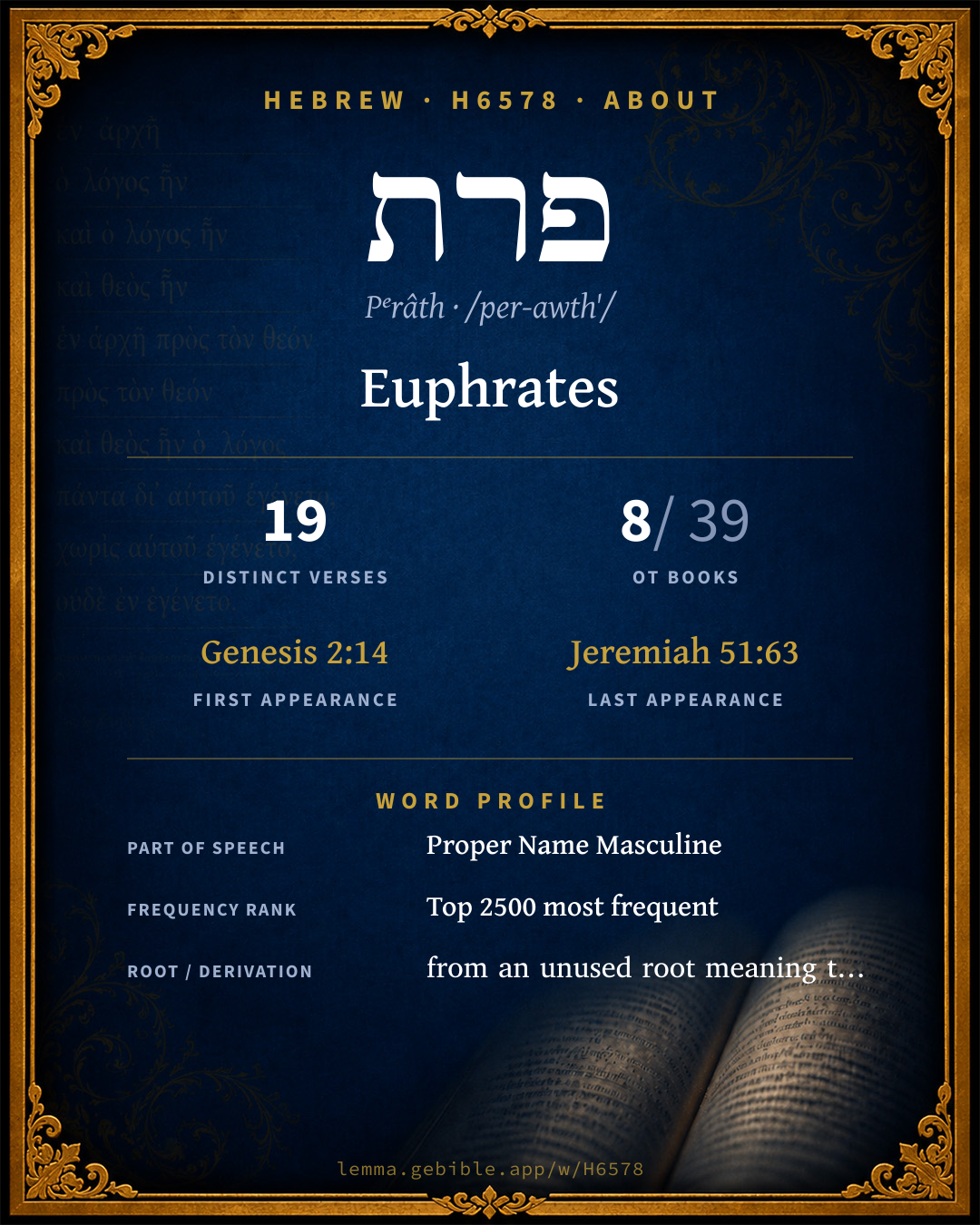
פְּרָת
Euphrates
BDB lists 2 entries for ‘Euphrates’ fuller range ↓
Full lexicon entry — Brown-Driver-Briggs (BDB)
From Brown-Driver-Briggs (BDB)
Where this word appears
Grammar key — what these labels mean
Part of speech
- Noun
- A naming word — a person, place, thing, or idea.
Noun type
- Proper
- A name of a specific person, place, or people (e.g. Abraham, Zion, Israel).
Every verse where H6578 appears in the Book of 1 Chronicles — 2 distinct verses. Click any verse to open its interlinear word-by-word view. Verse text shown in the World English Bible for context — . Each verse’s Hebrew form is shown with its reference; the English is not keyword-highlighted, since the data carries no word-level English alignment. Use “Compare translations” on any verse to read it across multiple English versions. This concordance covers the Hebrew Bible; Septuagint (Greek Old Testament) occurrences are not indexed here.
1 Chronicles
- 1 Chronicles 5:9 פְּרָ֑ת n Proper and eastward he lived even to the entrance of the wilderness from the river Euphrates, because their cattle were multiplied in the land of Gilead.
- 1 Chronicles 18:3 פְּרָֽת n Proper David struck Hadarezer king of Zobah to Hamath, as he went to establish his dominion by the river Euphrates.
About this entry
At a glance — auto-summarized from this page’s data, not written by a person. Every figure links to its source below. This summary describes the numbers; it doesn’t interpret them.
At its core, פרת (Pᵉrâth) means “Euphrates.” It first appears in Genesis 2:14. Spanning 19 verses in 8 books, it ranks among the uncommon words of the Hebrew Bible. Its uses concentrate in Jeremiah (42% of all occurrences). Each statement above links to its evidence; the full detail follows below.
Gloss history
Strong's 1890 vs modern scholarship
About this word
Strong's H6578 catalogs a Hebrew word from the Hebrew Old Testament.
These counts are not copied from any lexicon or concordance. They are computed here, from the morphology-tagged Hebrew Old Testament. What Lemma adds →
- 19
- distinct verses
- The word appears in 19 distinct verses.
- 8 / 39
- OT books
- The word appears in 8 of 39 Old Testament books.
- #1,563
- by frequency
- Top 2500 most frequent Hebrew words (rank 1,563 of 8,640 Hebrew words by occurrence).
View all 19 occurrences in the concordance →
Most concentrated in
- Jeremiah 8 verses 42%
- Genesis 2 verses 11%
- Deuteronomy 2 verses 11%
By section of the Old Testament
By traditional corpus
Conventional, traditional groupings — biblical authorship is debated, so this is a traditional corpus grouping, not an authorship claim. Each share is this word’s portion of its verses in that division of the Hebrew canon. Each figure is a share of the word’s 19 distinct verses.
- Prophets (Nevi'im) 12 verses · 63%
- Torah (Pentateuch) 4 verses · 21%
- Writings (Ketuvim) 3 verses · 16%
How translations render this word
Counts come from each version’s own published word-to-Strong’s tagging or interlinear alignment — an approximate guide to how each version renders this word, not a word-level alignment the data otherwise carries. Because each total is that version’s own tagged count, the per-version totals vary from one another and need not match the appearance or distinct-verse counts above. These counts may also differ from a printed concordance because Lemma counts each distinctly tagged rendering and does not collapse phrase taggings into a single head-word total. This is a fixed set of word-tagged versions (KJV, ASV, BSB, ULT) and does not change with the reading translation you choose elsewhere. Each version’s license is shown beside its name below (and on Sources).
- King James Version: Euphrates 18×
- American Standard Version: Euphrates 17×
- Berean Standard Bible: Euphrates 13×, Perath 4×
- unfoldingWord Literal Text: Euphrates 10×, Perath 4×
King James Version Public Domain
Renders H6578 across 19 tagged occurrences — most commonly:
Plus 1 rendering that appears only once — usually multi-word phrases or single function words the recovered tagging swept in, not distinct renderings.
American Standard Version Public Domain
Renders H6578 across 19 tagged occurrences — most commonly:
Plus 2 renderings that appear only once — usually multi-word phrases or single function words the recovered tagging swept in, not distinct renderings.
Berean Standard Bible Public Domain
Renders H6578 across 18 tagged occurrences — most commonly:
Plus 1 rendering that appears only once — usually multi-word phrases or single function words the recovered tagging swept in, not distinct renderings.
unfoldingWord Literal Text CC BY-SA 4.0
Renders H6578 across 14 tagged occurrences — most commonly:
Senses in BDB
The 2 senses BDB distinguishes for this word, in lexicon order (not ranked by frequency or importance). The full entry — with sub-senses — is in the Lexicon Entry tab.
- Euphrates = "fruitfulness"
- the largest and longest river of western Asia…
Word origin
n.pr. flum. Euphrates, Ευφρατης (Assyrian Purattu DlPa 169 ff., whence OPers. Ufrâtu, SpiegAPK 211);—the greatest river of W. Asia; פ׳ Gn 2:14, נְהַר פ׳ 15:18 (both secondary phrases in J), נְהַר פ׳ also 2 S 8:3 (Qr, v. נָהָר), Je 46:2, 6, 10 Dt 1:7; 11:24; Jos 1:4 (D), 2 K 23:29; 24:7; 1 Ch 5:9; 18:3; נהר om. Je 13:4, 5, 6, 7 (where Ew Hi Marti, after SchickZPV iii. 11, think of some other פְּרָת, but Gf Gie and most defend Euphrates), 51:63 2 Ch 35:20 (cf. Gn 2:14 supr.); name not certainly attested before D Je; on earlier הַנָּהָר for this river v. נ׳.
— Brown-Driver-Briggs (Oxford 1906, public domain), digitized via Sefaria, supplemented by the OpenScriptures HebrewLexicon (CC BY 4.0). See Sources.
Origin: from an unused root meaning to break forth
Jastrow Dictionary
A second Hebrew/Aramaic lexicon for comparison, covering Aramaic and post-biblical (Talmudic, Targumic, Midrashic) usage that the biblical-Hebrew BDB does not. Matched by lemma rather than by Strong’s number, so a lemma may carry more than one Jastrow headword (shown separately below), and the entries cover usage well beyond the Bible.
פְּרָת
- (b. h.) pr. n. P’rath,
- 1. the river Euphrates. Gen. R. s. 16 פ׳ שפ̇ר̇ה ורבה וכ׳ it is named P’rath (the growing), for its waters grow and increase, until people pass it on ships; פ׳ שמימיו פרין ורבין וכ׳ P’rath, for its waters are fruitful (fructifying); פ׳ שמפ̇ר̇יד והולך עד שכלה במגריפה ‘Rashi’ (ed. שמפרש) it is named P’rath (v. פְּרַת), because it goes on dividing (branching off in channels), until it ends under the (digging) spade; Yalk. Deut. 801 כמגרפה (corr. acc.); Sifré Deut. 6 שמפרה והולך עד שכלה מגריפה לגרפי it goes on fructifying (irrigating), until the spade ceases to dig it; Yalk. Gen. 22 מפריס והולך עד שהוא כלה ופותחין וכ׳ goes on dividing, until it disappears, and they open it with the spade. Bekh. 55ᵃ; a. fr.—Denom. פְּרָתִי, pl. פְּרָתִים. Midr. Till. to Ps. CXXXVII שתו מים הפ׳ ומתים they drank Euphrates water and died; (Pesik. R. s. 28 מימי הפרת).
- 2. P’rath, name of certain districts or towns. Yoma 10ᵃ פ׳ דמישן (= רחנת עיר, Gen. X, 11): פ׳ דבורסיף (= כלח ib.); Kidd. 72ᵃ (expl. חביל ימא) פ׳ דבורסי, v. בּוֹרְסִיף. e.g. Genesis 10:11
פָּרַת
- (cmp. פרר, פרד) to divide, crush, crumble.
- same, trnsf. (with ב) to belittle, make light of. Koh. R. to III, 11 אילו אחד … הוא פ׳ בממונו של עולם וכ׳ if any one else had said, ‘vanity of vanities &c.’ (ib. I, 2), I might have thought, one that never owned two pennies in his life, made light of the wealth of the world &c.
פְּרַת II
- m., v. פְּרָתָא
A Dictionary of the Targumim, the Talmud Babli and Yerushalmi, and the Midrashic Literature (Marcus Jastrow; London, Luzac, 1903) — Public Domain. Digitized via Sefaria. Digitized via Sefaria. Full attribution on Sources.
Forms in the corpus
The 8 distinct written forms H6578 takes in the Hebrew Bible, most frequent first — each parse links to that state’s occurrences in the concordance. Hebrew forms include their vowel points and cantillation, so a single lemma takes many written forms.
| Form | Parsing | Example | Uses |
|---|---|---|---|
| פְּרָֽת | Noun, Proper | Deuteronomy 1:7 | 6 |
| פְּרָ֑ת | Noun, Proper | 1 Chronicles 5:9 | 3 |
| פְּרָ֔תָ/ה | Noun, Proper | Jeremiah 13:4 | 3 |
| פְּרָ֔ת | Noun, Proper | 2 Kings 24:7 | 2 |
| פְּרָ֗ת | Noun, Proper | Deuteronomy 11:24 | 2 |
| בִּ/פְרָ֑ת | Noun, Proper | Jeremiah 13:5 | 1 |
| פְרָֽת | Noun, Proper | Genesis 2:14 | 1 |
| פְּרָ֖ת | Noun, Proper | Jeremiah 46:2 | 1 |
Bible dictionary
Public-domain dictionary articles matched to this entry by name (Euphrates). A biblical name can be shared by more than one person or place, so an article may treat several.
Easton's Bible Dictionary · M. G. Easton, 1897
Hebrew, Perath; Assyrian, Purat; Persian cuneiform, Ufratush, whence Greek Euphrates, meaning "sweet water." The Assyrian name means "the stream," or "the great stream." It is generally called in the Bible simply "the river" (Ex. 23:31), or "the great river" (Deut. 1:7).
The Euphrates is first mentioned in Gen. 2:14 as one of the rivers of Paradise. It is next mentioned in connection with the covenant which God entered into with Abraham (15:18), when he promised to his descendants the land from the river of Egypt to the river Euphrates (comp. Deut. 11:24; Josh. 1:4), a covenant promise afterwards fulfilled in the extended conquests of David (2 Sam. 8:2-14; 1 Chr. 18:3; 1 Kings 4:24). It was then the boundary of the kingdom to the north-east. In the ancient history of Assyria, and Babylon, and Egypt many events are recorded in which mention is made of the "great river." Just as the Nile represented in prophecy the power of Egypt, so the Euphrates represented the Assyrian power (Isa. 8:7; Jer. 2:18).
It is by far the largest and most important of all the rivers of Western Asia. From its source in the Armenian mountains to the Persian Gulf, into which it empties itself, it has a course of about 1,700 miles. It has two sources, (1) the Frat or Kara-su (i.e., "the black river"), which rises 25 miles north-east of Erzeroum; and (2) the Muradchai (i.e., "the river of desire"), which rises near Ararat, on the northern slope of Ala-tagh. At Kebban Maden, 400 miles from the source of the former, and 270 from that of the latter, they meet and form the majestic stream, which is at length joined by the Tigris at Koornah, after which it is called Shat-el-Arab, which runs in a deep and broad stream for above 140 miles to the sea. It is estimated that the alluvium brought down by these rivers encroaches on the sea at the rate of about one mile in thirty years.
Smith's Bible Dictionary · William Smith, 1863
is probably a word of Aryan origin, signifying "the good and abounding river. " It is most frequently denoted in the Bible by the term "the river." The Euphrates is the largest, the longest and by far the most important of the rivers of western Asia. It rises from two chief sources in the Armenian mountains, and flows into the Persian Gulf. The entire course is 1780 miles, and of this distance more than two-thirds (1200 miles) is navigable for boats. The width of the river is greatest at the distance of 700 or 800 miles from its mouth--that is to say, from it junction with the Khabour to the village of Werai . It there averages 400 yards. The annual inundation of the Euphrates is caused by the melting of the snows in the Armenian highlands. It occurs in the month of May. The great hydraulic works ascribed to Nebuchadnezzar had for their chief object to control the inundation. The Euphrates is first mentioned in Scripture as one of the four rivers of Eden. (Genesis 2:14) We next hear of it in the covenant made with Abraham. (Genesis 15:18) During the reigns of David and Solomon it formed the boundary of the promised land to the northeast. (11:24; Joshua 1:4) Prophetical reference to the Euphrates is found in (Jeremiah 13:4-7; 46:2-10; 51:63; Revelation 9:14; 16:12) "The Euphrates is linked with the most important events in ancient history. On its banks stood the city of Babylon; the army of Necho was defeated on its banks by Nebuchadnezzar; Cyrus the Younger and Crassus perished after crossing it; Alexander crossed it, and Trajan and Severus descended it."--Appleton's Cyc.
Hitchcock's Bible Names Dictionary · Roswell D. Hitchcock, 1869
that makes fruitful
Classic public-domain reference works; full attribution on Sources.
Septuagint verse parallels
This word appears in 17 verses that also exist in the Greek Old Testament (Septuagint), out of the 19 Hebrew verses it occurs in. You can read those verses in Greek by switching the Old Testament edition to the Septuagint.
Read these verses in the Septuagint
- Genesis 2:14
- Deuteronomy 1:7
- Joshua 1:4
- 2 Samuel 8:3
- 2 Kings 23:29
- 1 Chronicles 5:9
- 2 Chronicles 35:20
- Jeremiah 13:4
This is a verse-level parallel only — the same verses exist in both the Hebrew and Greek Old Testaments. No word-level Hebrew↔Greek correspondence is claimed: the data carries no such alignment, so no Greek word is shown as this Hebrew word’s translation. Coverage is not total — the Septuagint omits the deuterocanon and renumbers the Psalms, so some Hebrew verses have no direct Greek parallel.