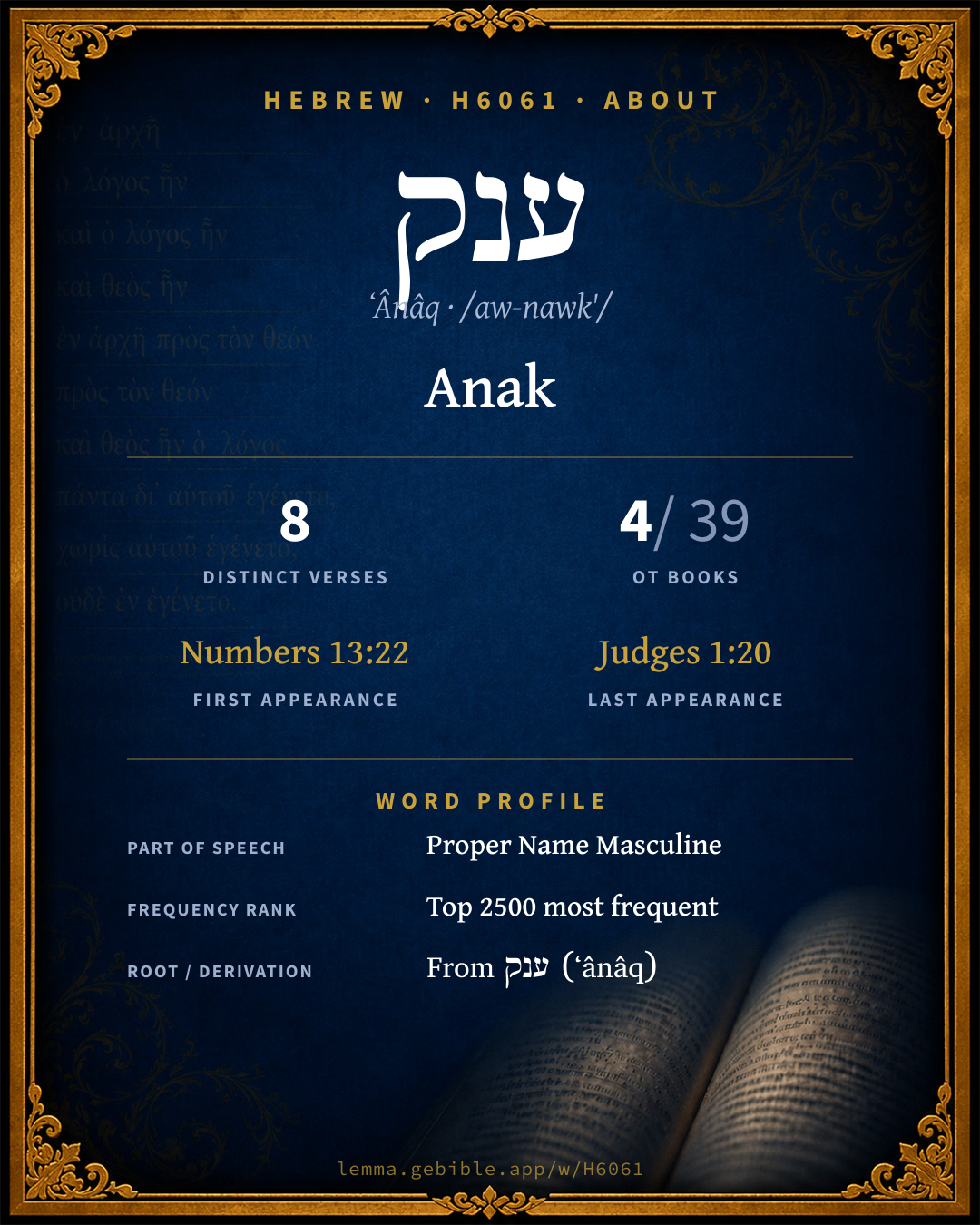
עָנָק
Anak
BDB lists 2 entries for ‘Anak’ fuller range ↓
Full lexicon entry — Brown-Driver-Briggs (BDB)
From Brown-Driver-Briggs (BDB)
Where this word appears
Grammar key — what these labels mean
Part of speech
- Noun
- A naming word — a person, place, thing, or idea.
Noun type
- Proper
- A name of a specific person, place, or people (e.g. Abraham, Zion, Israel).
- Gentilic
- A noun naming a member of a people, tribe, or region of origin (e.g. an Israelite, a Moabite).
State
- Absolute
- The independent form of a noun, not bound to a following word.
Gender
- Masculine
- Grammatically masculine.
Number
- Singular
- One.
Every verse where H6061 appears in the Book of Joshua — 3 distinct verses. Click any verse to open its interlinear word-by-word view. Verse text shown in the World English Bible for context — . Each verse’s Hebrew form is shown with its reference; the English is not keyword-highlighted, since the data carries no word-level English alignment. Use “Compare translations” on any verse to read it across multiple English versions. This concordance covers the Hebrew Bible; Septuagint (Greek Old Testament) occurrences are not indexed here.
Joshua
- Joshua 15:13 הָ/עֲנָ֖ק ptcl def.art + n Proper To Caleb the son of Jephunneh he gave a portion among the children of Judah, according to the commandment of Yahweh to Joshua, even Kiriath Arba, [which Arba was] the father of Anak (the same is Hebron).
- Joshua 15:14 הָ/עֲנָ֑ק הָ/עֲנָֽק ptcl def.art + n Proper ptcl def.art + n Proper Caleb drove out there the three sons of Anak: Sheshai, and Ahiman, and Talmai, the children of Anak.
- Joshua 21:11 הָֽ/עֲנ֛וֹק ptcl def.art + n Proper They gave them Kiriath Arba, [which Arba was] the father of Anak (the same is Hebron), in the hill-country of Judah, with the suburbs of it round about it.
About this entry
At a glance — auto-summarized from this page’s data, not written by a person. Every figure links to its source below. This summary describes the numbers; it doesn’t interpret them.
ענק — transliterated ʻÂnâq — is a Hebrew name carrying the sense “Anak.” It first appears in Numbers 13:22. With 8 verses in 4 books, it is an uncommon word in the Hebrew Bible. Its uses concentrate in Numbers (38% of all occurrences). See 8-verse concordance and the renderings breakdown below.
Gloss history
Strong's 1890 vs modern scholarship
About this word
Strong's H6061 catalogs a Hebrew word from the Hebrew Old Testament.
These counts are not copied from any lexicon or concordance. They are computed here, from the morphology-tagged Hebrew Old Testament. What Lemma adds →
- 8
- distinct verses
- The word appears in 8 distinct verses.
- 4 / 39
- OT books
- The word appears in 4 of 39 Old Testament books.
- #2,481
- by frequency
- Top 2500 most frequent Hebrew words (rank 2,481 of 8,640 Hebrew words by occurrence).
View all 8 occurrences in the concordance →
Most concentrated in
- Numbers 3 verses 38%
- Joshua 3 verses 38%
- Deuteronomy 1 verse 13%
By section of the Old Testament
By traditional corpus
Conventional, traditional groupings — biblical authorship is debated, so this is a traditional corpus grouping, not an authorship claim. Each share is this word’s portion of its verses in that division of the Hebrew canon. Each figure is a share of the word’s 8 distinct verses.
- Torah (Pentateuch) 4 verses · 50%
- Prophets (Nevi'im) 4 verses · 50%
How translations render this word
Counts come from each version’s own published word-to-Strong’s tagging or interlinear alignment — an approximate guide to how each version renders this word, not a word-level alignment the data otherwise carries. Because each total is that version’s own tagged count, the per-version totals vary from one another and need not match the appearance or distinct-verse counts above. These counts may also differ from a printed concordance because Lemma counts each distinctly tagged rendering and does not collapse phrase taggings into a single head-word total. This is a fixed set of word-tagged versions (KJV, ASV, BSB, ULT) and does not change with the reading translation you choose elsewhere. Each version’s license is shown beside its name below (and on Sources).
- King James Version: Anak 9×
- American Standard Version: Anak 8×
- Berean Standard Bible: Anak 9×
- unfoldingWord Literal Text: Anak 9×
King James Version Public Domain
Renders H6061 across 9 tagged occurrences — most commonly:
American Standard Version Public Domain
Renders H6061 across 9 tagged occurrences — most commonly:
Plus 1 rendering that appears only once — usually multi-word phrases or single function words the recovered tagging swept in, not distinct renderings.
Berean Standard Bible Public Domain
Renders H6061 across 9 tagged occurrences — most commonly:
unfoldingWord Literal Text CC BY-SA 4.0
Renders H6061 across 9 tagged occurrences — most commonly:
Senses in BDB
The 2 senses BDB distinguishes for this word, in lexicon order (not ranked by frequency or importance). The full entry — with sub-senses — is in the Lexicon Entry tab.
- Anak = "neck"
- progenitor of a family, or tribe of the giant people in Canaan
Word origin
Derived from ענק (ʻânâq) (H6060) — necklace.
Jastrow Dictionary
A second Hebrew/Aramaic lexicon for comparison, covering Aramaic and post-biblical (Talmudic, Targumic, Midrashic) usage that the biblical-Hebrew BDB does not. Matched by lemma rather than by Strong’s number, so a lemma may carry more than one Jastrow headword (shown separately below), and the entries cover usage well beyond the Bible.
עָנַק
- 1. to be narrow, elongated; denom. עֲנָק, עוּנְקָא &c.
- 2. to press, force, rule. Gen. R. s. 26 (expl. עֲנָקִים) שהיו עוֹנְקִים גלגל חמה ואומרים הורד וכ׳ they seized the globe of the sun and said, Send us rain down; Yalk. ib. 47. Num. R. s. 16 (ref. to ילידי הענק, Num. XIII, 28) שראוהו שהיה עוֹנֵק את השמש they (the spies) saw him force the sun (to give rain); Tanḥ. Shlaḥ 7. e.g. Numbers 13:28
- 1. same. Yoma 10ᵃ (ref. to Num. l. c.) שמַעֲנִיקִין החמה בקומתן they lorded it over the sun by virtue of their height; Sot. 34ᵇ (Rashi: they had the appearance of squeezing their heads into the sun).
- 2. [to suspend around the neck, load,] to outfit the emancipated slave with gifts (Deut. XV, 14). Y. Kidd. I, 59ᶜ bot. אילו שמַעֲנִיקִין להן וכ׳ the following are those who must be sent away with gifts; Bab. Kidd. 16ᵇ. Ib. יכול לא יהיו מַעֲנִיקִים וכ׳ you might think that only he who is discharged after the expiration of six years of servitude, must be outfitted. Sifré Deut. 119 שאם הֶעֱנַקְתָּ … תַּעֲנִיק לו וכ׳ that when thou hast outfitted him once, thou must do it again &c. Kidd. l. c. כמה מעניקים לו how much must he be given?; a. fr. e.g. Deuteronomy 15:14
עֶנֶק
- (preced.) an emancipated slave’s outfit. Kidd. 16ᵇ ע׳ עבד עברי לעצמו וע׳ אמה וכ׳ the outfit of a Hebrew slave belongs to himself, and that of a Hebrew handmaid to herself; ע׳ אמה העבריה ומציאתה וכ׳ the outfit of a Hebrew handmaid and what she finds belong to her father; a. e.
עֲנָק I
- giant. Num. R. s. 16, a. e., v. עָנַק.—Pl. עֲנָקִים. Gen. R. s. 26 (ref. to Gen. VI, 4) שבע שמות … ע׳ וכ׳ they (of that race) are called by seven names: Emim, … ʿĂnaḳim; Yalk. ib. 47, v. עָנַק. e.g. Genesis 6:4
עֲנָק II
- [neck,] necklace, chain. Erub. 54ᵃ (ref. to Prov. I, 9) אם … כע׳ זה שרף על וכ׳ if a man trains himself to be like a necklace which is loose around the neck, and is (sometimes) seen and (sometimes) not seen (i.e. is yielding and modest), his learning will be established &c.; Yalk. Prov. 929 שיפה לצואר (read: שרָפֶה). Yalk. Ps. 675 the Law is ע׳ לצואר a chain for the neck (Lev. R. s. 12 מונייק). B. Bath. 75ᵃ לא זכה עושין לו ע׳ if he is not worthy, they will make a chain for him. [Ib. זכה עושין לו ע׳ if he is worthy, they will make a necklace for him; omitted in Ms. R.; v. Rabb. D. S. a. l. note 9.]—Pl. עֲנָקִים. Gen. R. s. 26 (they are called ʿĂnaḳim) שהיו מרבים ע׳ ע"ג עֳנָקִים they increased the chains around the necks (subjugated many people); Yalk. ib. 47. e.g. Proverbs 1:9
עֹנֶק
- (preced.) neck.—Pl. עֳנָקִים, v. preced.
A Dictionary of the Targumim, the Talmud Babli and Yerushalmi, and the Midrashic Literature (Marcus Jastrow; London, Luzac, 1903) — Public Domain. Digitized via Sefaria. Digitized via Sefaria. Full attribution on Sources.
Forms in the corpus
The 7 distinct written forms H6061 takes in the Hebrew Bible, most frequent first — each parse links to that state’s occurrences in the concordance. Hebrew forms include their vowel points and cantillation, so a single lemma takes many written forms.
| Form | Parsing | Example | Uses |
|---|---|---|---|
| הָ/עֲנָ֑ק | Noun, Gentilic, Masculine, Singular, Absolute | Numbers 13:22 | 2 |
| הָ/עֲנָֽק | Noun, Proper | Joshua 15:14 | 2 |
| הָ/עֲנָ֖ק | Noun, Proper | Joshua 15:13 | 1 |
| הָֽ/עֲנ֛וֹק | Noun, Proper | Joshua 21:11 | 1 |
| הָֽ/עֲנָ֖ק | Noun, Gentilic, Masculine, Singular, Absolute | Numbers 13:28 | 1 |
| עֲנָ֖ק | Noun, Proper | Numbers 13:33 | 1 |
| עֲנָֽק | Noun, Proper | Deuteronomy 9:2 | 1 |
Same root — word family
Other BDB entries built from the same root as H6061, grouped by Strong’s listed origin. These share a root / origin per the lexicon — not necessarily a shared meaning. Each links to that word’s own entry.
Derives from
Proper names from this root
People and places named from this root — a name, not an additional meaning of the word.
Compare all same-root words → 1 of the same-root words is a proper name (a person or place). They share a root, not necessarily a meaning.
Bible dictionary
Public-domain dictionary articles matched to this entry by name (Anak). A biblical name can be shared by more than one person or place, so an article may treat several.
Easton's Bible Dictionary · M. G. Easton, 1897
Long-necked, the son of Arba, father of the Anakim (Josh. 15:13; 21:11, Heb. Anok).
Hitchcock's Bible Names Dictionary · Roswell D. Hitchcock, 1869
a collar; ornament
Classic public-domain reference works; full attribution on Sources.
Septuagint verse parallels
This word appears in 8 verses that also exist in the Greek Old Testament (Septuagint), out of the 8 Hebrew verses it occurs in. You can read those verses in Greek by switching the Old Testament edition to the Septuagint.
Read these verses in the Septuagint
This is a verse-level parallel only — the same verses exist in both the Hebrew and Greek Old Testaments. No word-level Hebrew↔Greek correspondence is claimed: the data carries no such alignment, so no Greek word is shown as this Hebrew word’s translation. Coverage is not total — the Septuagint omits the deuterocanon and renumbers the Psalms, so some Hebrew verses have no direct Greek parallel.