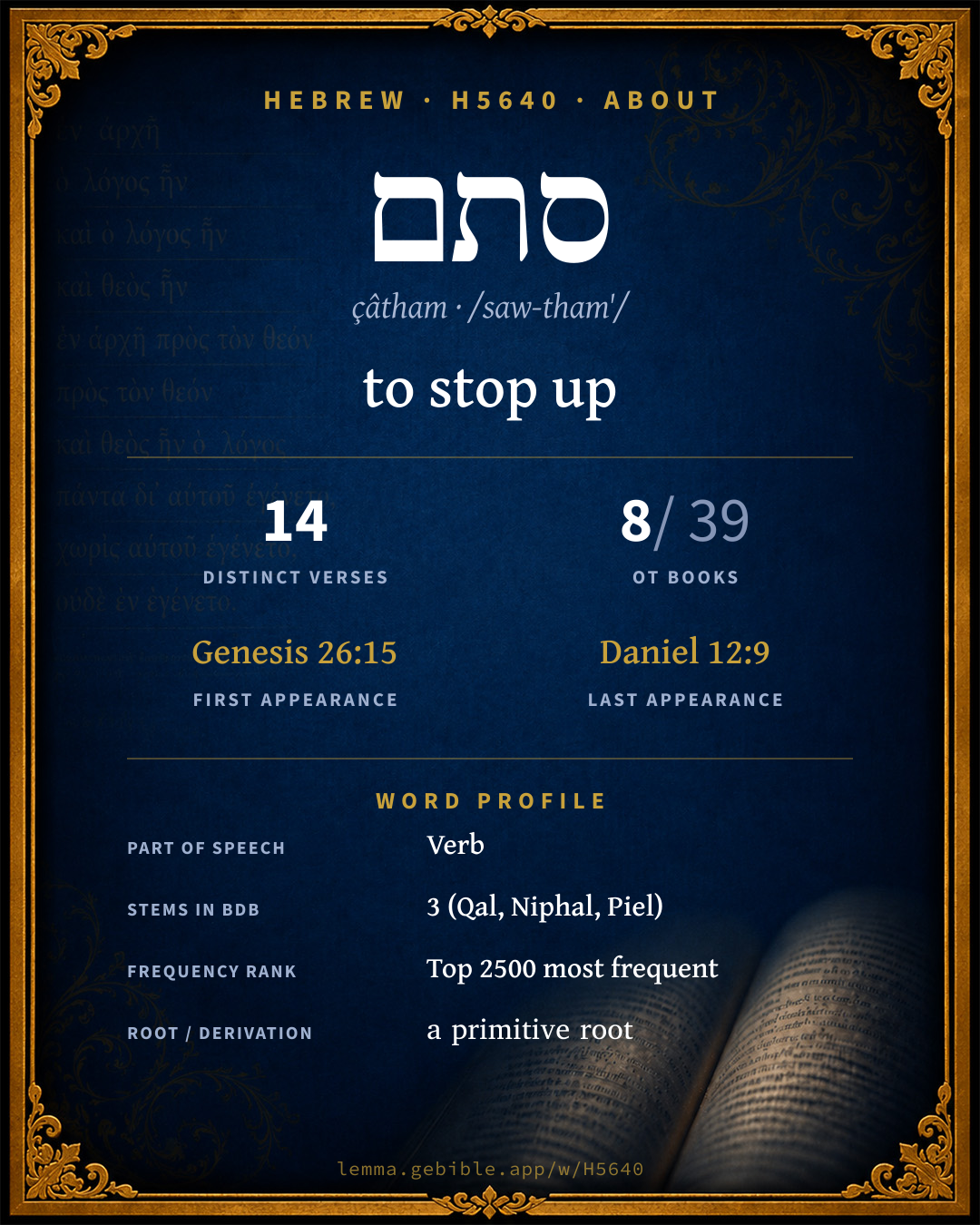
סָתַם
to stop up
also: shut up, keep close fuller range ↓
Full lexicon entry — Brown-Driver-Briggs (BDB)
From Brown-Driver-Briggs (BDB)
Where this word appears
Grammar key — what these labels mean
Part of speech
- Verb
- An action or state-of-being word.
Stem
- Qal
- The basic, simple active stem — the plain form of the verb (“he wrote”). Here: ‘stop up springs of water 2 K 3’
- Piel
- An intensive or resultative active stem.
- Niphal
- Usually the simple passive or reflexive of the Qal (“he was written”).
Form
- Perfect
- A completed action or state — Hebrew marks aspect (completeness) more than strict tense (“he wrote”).
- Imperative
- A direct command (“write!”).
- Participle Passive
- A verbal adjective expressing action received (“written”).
- Sequential Imperfect
- An imperfect with prefixed waw — the standard past-narrative form (waw-consecutive imperfect).
- Infinitive Construct
- A bound verbal noun, frequently with prepositions (“to write / in writing”).
- Imperfect
- An incomplete, ongoing, or future action (“he will / would write”).
State
- Absolute
- The independent form of a noun, not bound to a following word.
Person
- 3rd Person
- The one spoken about (“he / she / it / they”).
- 2nd Person
- The one addressed (“you”).
Gender
- Masculine
- Grammatically masculine.
- Common
- Either gender — not distinguished for this form.
Number
- Singular
- One.
- Plural
- More than one (in Hebrew, generally three or more).
Every verse where H5640 appears in the Book of Psalms — 1 distinct verse. Click any verse to open its interlinear word-by-word view. Verse text shown in the World English Bible for context — . Each verse’s Hebrew form is shown with its reference; the English is not keyword-highlighted, since the data carries no word-level English alignment. Use “Compare translations” on any verse to read it across multiple English versions. This concordance covers the Hebrew Bible; Septuagint (Greek Old Testament) occurrences are not indexed here.
Psalms
About this entry
At a glance — auto-summarized from this page’s data, not written by a person. Every figure links to its source below. This summary describes the numbers; it doesn’t interpret them.
At its core, סתם (çâtham) means “to stop up.” First canonically at Genesis 26:15, it enters the text early. It appears 14 verses across 8 books of the Hebrew Bible, among its uncommon vocabulary. Across 3 stems, its meaning turns on the binyan (Qal, Niphal). Each statement above links to its evidence; the full detail follows below.
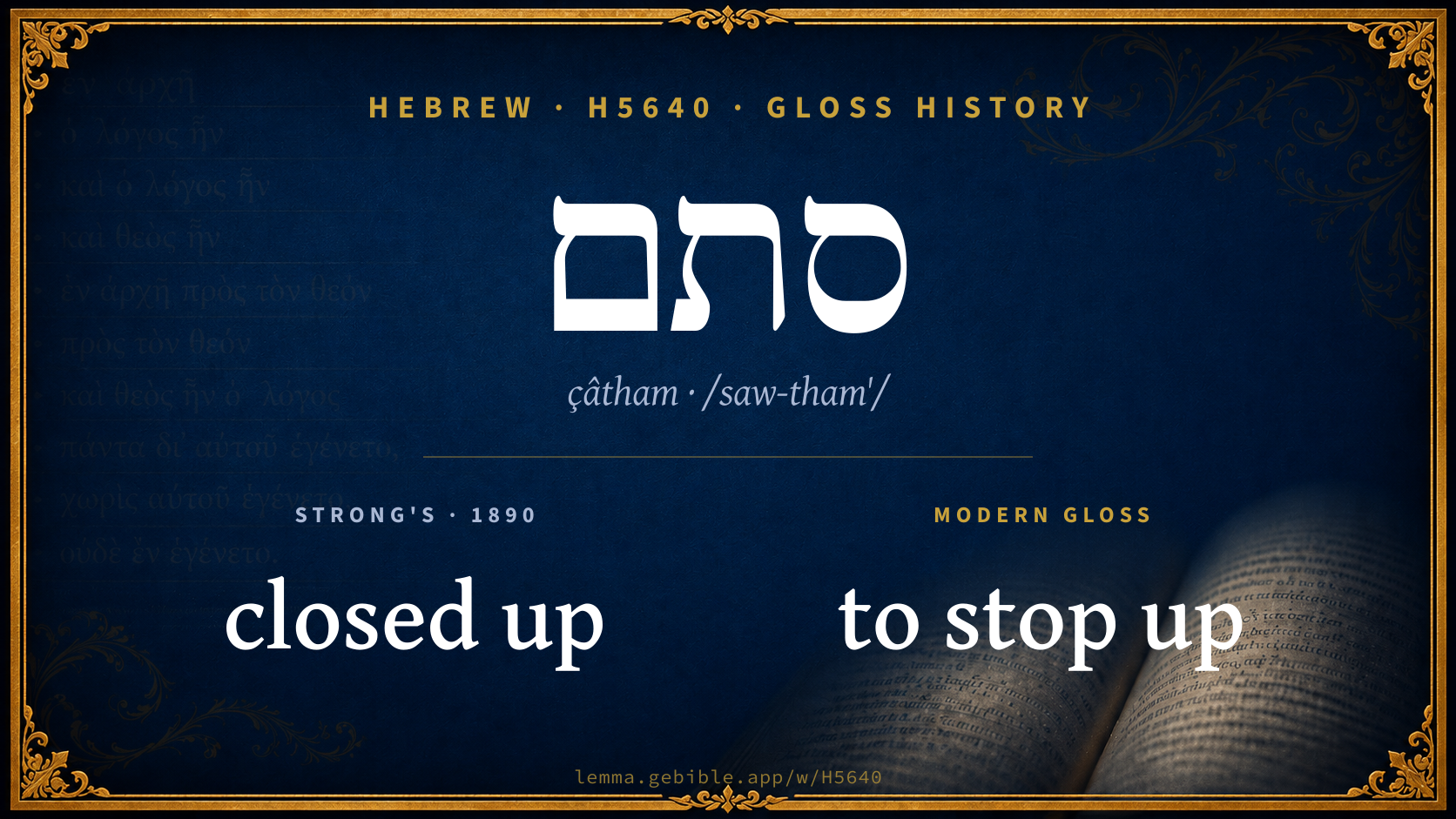
Gloss history
Strong's 1890 vs modern scholarship
About this word
Strong's H5640 catalogs a Hebrew word from the Hebrew Old Testament.
These counts are not copied from any lexicon or concordance. They are computed here, from the morphology-tagged Hebrew Old Testament. What Lemma adds →
- 14
- distinct verses
- The word appears in 14 distinct verses.
- 8 / 39
- OT books
- The word appears in 8 of 39 Old Testament books.
- #1,910
- by frequency
- Top 2500 most frequent Hebrew words (rank 1,910 of 8,640 Hebrew words by occurrence).
View all 14 occurrences in the concordance →
Most concentrated in
- 2 Chronicles 3 verses 21%
- Daniel 3 verses 21%
- Genesis 2 verses 14%
By section of the Old Testament
By traditional corpus
Conventional, traditional groupings — biblical authorship is debated, so this is a traditional corpus grouping, not an authorship claim. Each share is this word’s portion of its verses in that division of the Hebrew canon. Each figure is a share of the word’s 14 distinct verses.
- Writings (Ketuvim) 9 verses · 64%
- Prophets (Nevi'im) 3 verses · 21%
- Torah (Pentateuch) 2 verses · 14%
How translations render this word
Counts come from each version’s own published word-to-Strong’s tagging or interlinear alignment — an approximate guide to how each version renders this word, not a word-level alignment the data otherwise carries. Because each total is that version’s own tagged count, the per-version totals vary from one another and need not match the appearance or distinct-verse counts above. These counts may also differ from a printed concordance because Lemma counts each distinctly tagged rendering and does not collapse phrase taggings into a single head-word total. This is a fixed set of word-tagged versions (KJV, ASV, BSB, ULT) and does not change with the reading translation you choose elsewhere. Each version’s license is shown beside its name below (and on Sources).
BDB lists this Strong’s number as 2 distinct words (homographs). Each count above pools all of them and is not split by sense — see the Senses section below. A low-frequency rendering may belong to a different one of those words, not the primary meaning.
- King James Version†: Had stopped 2×, Stop 2×, Stopped 2×
- American Standard Version†: Had stopped 2×, Stop 2×
- Berean Standard Bible†: About stopping up 1×, Blocked 1×, Closed up 1×
- unfoldingWord Literal Text†: And 2×, Stopped up 2×, They stopped up 2×
King James Version Public Domain
Renders H5640 across 14† tagged occurrences — most commonly:
Plus 8 renderings that appear only once — usually multi-word phrases or single function words the recovered tagging swept in, not distinct renderings.
American Standard Version Public Domain
Renders H5640 across 15† tagged occurrences — most commonly:
Plus 11 renderings that appear only once — usually multi-word phrases or single function words the recovered tagging swept in, not distinct renderings.
Berean Standard Bible Public Domain
Renders H5640 across 14† tagged occurrences — most commonly:
Plus other, less common renderings.
unfoldingWord Literal Text CC BY-SA 4.0
Renders H5640 across 19† tagged occurrences — most commonly:
Plus 13 renderings that appear only once — usually multi-word phrases or single function words the recovered tagging swept in, not distinct renderings.
Senses in the full BDB
Hebrew verbs can shift meaning by stem (binyan): Qal is the basic action, Niphal is often passive or reflexive, Piel often intensifies or makes it factitive, and Hiphil is typically causative. The senses below are grouped under the stem BDB assigns to each.
What do BDB’s symbols mean?
BDB uses these scholarly abbreviations:
| Symbol | Meaning |
|---|---|
| 𝔊 | the Septuagint (the ancient Greek translation, LXX) |
| 𝔙 | the Vulgate (the Latin translation) |
| 𝔖 | the Syriac version (the Peshitta) |
| 𝔗 | the Targum (the Aramaic translation) |
| ψ | the Psalms |
| √ | root (the underlying root or stem) |
| ‖ | parallel passage (a synonymous or contrasted parallel) |
| † | the dagger: every passage where the word occurs is cited |
The 6 senses and sub-senses the full Brown-Driver-Briggs lexicon distinguishes for this word, in lexicon order (not ranked by frequency), with BDB’s own verbatim wording and sub-sense lettering. Shown in Hebrew script with BDB’s own scholarly abbreviations. The condensed entry is in the Lexicon Entry tab. See also the Forms in the corpus table below.
סתם I stop up, shut up, keep close (NH id.
Qal
- Pf. 3 ms. ס׳ 2 Ch 32:30; Impf. 2 mpl. תִּסְתֹּ֑מוּ 2 K 3:19; 3 mpl. יִסְתֹּ֑מוּ v 25, וַיִּסְתְּמוּ 2 Ch 32:4; Imv. ms. סְתֹם Dn 8:26; 12:4; Inf. cstr. לִסְתּוֹם 2 Ch 32:3; Pt. pass. סָתוּם Ez 28:3, סָתֻם ψ 51:8, pl. סְתֻמִים Dn 12:9;— e.g. 2 Chronicles 32:30
- 1. stop up springs of water 2 K 3:19, 25; 2 Ch 32:3, 4, cf. v 30. e.g. 2 Kings 3:19
- 2. shut up, keep close, prophetic words Dn 8:26; 12:4, 9; בְּסָתֻם ψ 51:8 in (the) closed (chamber of the breast; ‖ טֻחוֹת).—כָּל־סָתוּם Ez 28:3 usually no secret is too dark for thee, but doubtful (v. II. עמם); 𝔊 σοφοί, Co חַרְטֻמִּים חֲכָמִים, or Berthol. קֹסְמִים. e.g. Daniel 8:26
Niphal
- Inf. cstr. לְהִסָּתֵם Ne 4:1 the breaches [in the walls] had begun to be stopped up. e.g. Nehemiah 4:1
Piel
- Pf. 3 pl. sf. סִתְּמוּם Gn 26:15; Impf. 3 mpl. sf. וַיְסַתְּמוּם v 18, both of stopping wells quite up (RJE). e.g. Genesis 26:15
סתם II usually stop up, in sense of shut out, shut ears against (late ‖ form of סָתַם
Qal
- Pf. 3 ms. שׂ׳ תְּפִלָּתִי La 3:8 (> van d. H. שָׂתָם) he (י׳) hath shut out my prayer (Bu שׂ׳ מִתּ׳ shut up [himself] from). e.g. Lamentations 3:8
Senses from the full Brown-Driver-Briggs lexicon (Brown, Driver, Briggs; Oxford 1906 — public domain), digitized via Sefaria, supplemented by the OpenScriptures HebrewLexicon (CC BY 4.0). Full attribution on Sources.
Word origin
I. vb. stop up, shut up, keep close (NH id.; 𝔗 סְתַם id.; Syriac ܣܛܰܡ (ܣܬܡ very rare); Arabic سَدَمَ close door Lane1334, and سَطَمَ Ḳam Frey, are perhaps loan-words; cf. Assyrian (bît) šutummu, storehouse, treasury, ZehnpfBAS i. 531); —
I. vb. usually stop up, in sense of shut out, shut ears against (late ‖ form of סָתַם; yet awkward; BaES 9 cp. Arabic شَمَّتَ frustrate, disappoint);—
— Brown-Driver-Briggs (Oxford 1906, public domain), digitized via Sefaria, supplemented by the OpenScriptures HebrewLexicon (CC BY 4.0). See Sources.
Origin: a primitive root
Jastrow Dictionary
A second Hebrew/Aramaic lexicon for comparison, covering Aramaic and post-biblical (Talmudic, Targumic, Midrashic) usage that the biblical-Hebrew BDB does not. Matched by lemma rather than by Strong’s number, so a lemma may carry more than one Jastrow headword (shown separately below), and the entries cover usage well beyond the Bible.
סָתַם
- (b. h.; = סחתם, Saf. of חתם)
- 1. to stop up, close, shut. Ab. Zar. V, 3 כדי שישתום ויִסְתּוֹם ויגוב, v. נָגַב. B. Mets. VII, 5 שלא יהא … ויהא סוֹתֵם את הפתח וכ׳ that he (the laborer) must not be greedy so as to shut the door before himself (make himself objectionable to employers). Ḥull. 43ᵃ, a. e. מרה שניקבה וכבד סוֹתַמְתָּהּ if the bladder of the gall is perforated, and the liver (adhering to the perforated spot) closes it up. Ib. 49ᵇ חלב טהור סותם clean fat (such as it is permitted to eat) forms a stopper (to an adjacent organ, and makes the animal so affected permitted). Pes. IV, 9 (56ᵃ) ס׳ מי גיחון וכ׳ he stopped up the water of the upper Gihon (II Chr. XXXII, 3); a. fr.—Part. pass. סָתוּם; f. סְתוּמָה; pl. סְתוּמִים, סְתוּמִין; סְתוּמוֹת. Yeb. 71ᵇ; Nidd. 30ᵇ; Lev. R. s. 14 נפתח הס׳ ונסתם וכ׳ the organ which (in the embryonic stage) was closed, opens, and that which was open, closes itself. Bets. IV, 3 בית … ס׳ a room filled with fruit which was closed up (with bricks). Y. ib. 62ᶜ bot. לפסים ס׳ pots with their lids on (not yet cut apart); Tosef. ib. III, 13; Tosef. Sabb. XVI (XVII), 13. Snh. 94ᵃ (ref. to לסרבה, Is. IX, 6) מפני מה כל מ"ם … וזה ס׳ why is every Mem in the middle of a word open, and this one is closed (final Mem). Meg. 3ᵃ פתוחין … וס׳ בסוף וכ׳ open in the middle of words and closed at the end (v. מנצפ"ך); a. fr.—Esp. פרשה סתומה a paragraph in the Torah separated from the preceding by a vacant space in the middle of the line, opp. to פתוחה a section beginning a new indented line. Gen. R. s. 96, beg., v. infra. Treat. Sof’rim I, 14 איזוהי ס׳ כל שהניח וכ׳ what is a closed paragraph? When space is left &c.; וכמה יניח … ותהא נקראת ס׳ and how much space must be left …, in order that the paragraph may be called closed?; a. fr. e.g. 2 Chronicles 32:3
- 2. to conceal. Gen. R. l. c. (ref. to the section beginning with Gen. XLVII, 28) that paragraph is closed, שס׳ ממנו וכ׳ because the Lord concealed from his vision all (coming) troubles; (Yalk. ib. 154 שנסתמו ממנו, v. infra); a. e.—Part. pass. as ab. concealed, not explicitly stated, opp. מפורש. Zeb. 53ᵃ יִלָּמֵד ס׳ מן המפורש let that which is not explicitly stated in a law be derived (by analogy) from what is explicitly stated; Sifra Aḥăré, beg. יְלַמֵּד פתוח על הס׳ let the explicit statement throw light on the implicit. Meg. 15ᵃ כל … אבותיו ס׳ a person (mentioned in the Bible) whose deeds and the deeds of whose ancestors are not stated; a. fr.—Y. Bets. l. c. (in Chald. dict.) סתומה the anonymous opinion, v. סְתָמָא. e.g. Genesis 47:28
- , Nithpa. נִסְתַּתֵּם to be closed; to be concealed; to be silenced. Gen. R. l. c. בקש … ונ׳ ממנו Jacob wanted to reveal the end of the captivity, and it was closed before him; Yalk. ib. l. c. נִסְתְּמוּ ממנו, v. supra. Cant. R. to I, 4 היה אומר … ומִסְתַּתְּמִין he said a word (of charm) over them, and they became silent (dumb). Snh. 31ᵇ לעולם … עד שיִסְתַּתֵּם טענותיו (Alf. שיִסְתּוֹם; Asheri שיסתיר) he may continually bring evidence and refute, until he declares himself closed as to his pleas, i.e., until he declares that he has no more evidence to offer. Yeb. 76ᵃ; Tosef. ib. X, 4, a. e. נ׳ כשר if the perforation in the membrum has closed itself again, he is considered unblemished. Kel. XIV, 8 נִסְתַּתְּמוּ נקבין if the holes have been stopped up. Snh. 94ᵃ לכך נ׳ therefore the Mem was closed (the final מ was written). Sot. 13ᵇ נסתתמו ממנו שערי וכ׳ the gates of wisdom were closed before him (he lost his judicial judgment); a. e.
- to close. Y. Snh. X, 28ᶜ bot. היו … מְסַתְּמִין וכ׳ the ministering angels closed the windows (of heaven) that the prayer of Manasseh might not rise; Deut. R. s. 2; (Pesik. Shub., p. 162ᵇ סוֹתְמִין).
סְתַם
- Targ. II Chr. XXXII, 3. Targ. II Esth. I, 2 (3) ס׳ נפשיה (the gate) closed itself; a. fr.—Part. pass. סְתִים; f. סְתִימָא; pl. סְתִימִין, סְתִימַיָּא; סְתִימָן. Targ. Ez. XLI, 16. Targ. Y. I Gen. XLIX, 1; a. e.—Ḥull. 49ᵇ חד סָתֵים one of them stops up a perforation (by close adhesion, v. preced.). Ib. sq. אינהו … ולדידן מִיסְתַּם נמי לא ס׳ they eat (that kind of fat), and for us was it not even to have the effect of closing up the perforation (that the animal in the case be permitted)?; a. fr.—Esp. to conceal an authority; to state a law without naming the author. Bets. 2ᵃ (ref. to Sabb. XXIV, 4) דס׳ לן תנא כר"ש where the editor of the Mishnah states the law anonymously, in agreement with R. S.’s opinion. Ib.ᵇ (ref. to Bets. IV, 3) דס׳ לן תנא כד"י where the editor gives R. Judah’s opinion anonymously; a. fr.
- same. Gitt. 68ᵃ וסַתְּמִינְהוּ בגבבי וכ׳ and stopped the waters up with wool.—Part. pass. מְסַתַּם; f. מְסַתְּמָא; pl. מְסַתְּמִין; מְסַתְּמָן. Meg. 3ᵃ in the Prophets איכא מילי … דמ׳ (Ms. O. דסְתִימָן) some things are clearly stated, others obscurely.
- ; Ithpe. אִסְתְּתַם to be closed, stopped up, sealed. Targ. Esth. VIII, 10. Ib. V, 14 (some ed. אסתממו, incorr.); a. fr.—Targ. Y. Lev. XV, 3 אִיתְסַתַּם (v. חֲתַם).—Keth. 106ᵃ איסתתם טענתיה (v. preced.) he declared he had nothing to say (was intimidated). Shebu. 30ᵇ מִסְתַּתְּמָן טענתיה דבעל וכ׳ (Ms. M. קמִסְתַּתְּמָא) the opponent will be intimidated; Yalk. Deut. 922 מִיסַּתְּמָא טענתיה וכ׳; a. e.
סְתָם
- (preced.)
- 1. closing up. Tosef. Ab. Zar. VII (VIII), 14; Ab. Zar. 69ᵇ, v. סְתוֹם, a. שְׁתָם.
- 2. something unknown, undefined. Ib. 74ᵃ bot. סְתַם יינן Ms. M. a. Rashi (ed. יין) wine of gentiles of which it is not known that it has been dedicated to an idol, opp. יין נסך; Ḥull. 4ᵇ. Y. Ab. Zar. III, 43ᵇ bot. בס׳ חלוקין they differ with regard to a tree (Asherah) of which it is not known that is has been worshipped. Ib. סְתָמָן עובדין וכ׳ those of them (the gentiles) not otherwise known worship an image but not a tree. Macc. 3ᵇ המלוה את חבירו ס׳ he who makes a loan to his neighbor without terms, cannot claim payment before thirty days. Snh. 25ᵇ ס׳ גבאי כשר a tax collector, unless known to be dishonest, is admissible as witness; ס׳ רועה פסול a shepherd, unless known to guard his flock from illicit pasture, is disqualified. B. Mets. 69ᵃ (in Chald. dict.) ס׳ אריסא וכ׳ the presumption is that a tenant obligates himself, etc. R. Hash. 7ᵇ ס׳ כי אגר וכ׳ as a rule, when one rents a house etc.; a. v. fr.
- 3. an opinion stated without an authority, anonymous opinion. Yeb. 42ᵇ, a. fr. מחלוקת ואח"כ ס׳ הלכה כס׳ where differing opinions are quoted and followed by an anonymous opinion (‘the scholars say’), the latter is the practice. Ḥull. 43ᵃ, a. e. הלכה כס׳ משנה the practice follows the anonymous opinion in the Mishnah. Snh. 86ᵃ, a. e. ס׳ מתני׳ ר׳ מאיר וכ׳ wherever an anonymous opinion is stated in the Mishnah, it is R. Meïr’s; in the Tosefta, etc.; a. fr.—Y. Sot. I, 17ᵇ bot. כתוב לה ס׳ write the order for two men without specified names.
A Dictionary of the Targumim, the Talmud Babli and Yerushalmi, and the Midrashic Literature (Marcus Jastrow; London, Luzac, 1903) — Public Domain. Digitized via Sefaria. Digitized via Sefaria. Full attribution on Sources.
Forms in the corpus
The 14 distinct written forms H5640 takes in the Hebrew Bible, most frequent first — each parse links to that stem’s occurrences in the concordance. Hebrew forms include their vowel points and cantillation, so a single lemma takes many written forms.
Septuagint verse parallels
This word appears in 13 verses that also exist in the Greek Old Testament (Septuagint), out of the 14 Hebrew verses it occurs in. You can read those verses in Greek by switching the Old Testament edition to the Septuagint.
Read these verses in the Septuagint
This is a verse-level parallel only — the same verses exist in both the Hebrew and Greek Old Testaments. No word-level Hebrew↔Greek correspondence is claimed: the data carries no such alignment, so no Greek word is shown as this Hebrew word’s translation. Coverage is not total — the Septuagint omits the deuterocanon and renumbers the Psalms, so some Hebrew verses have no direct Greek parallel.