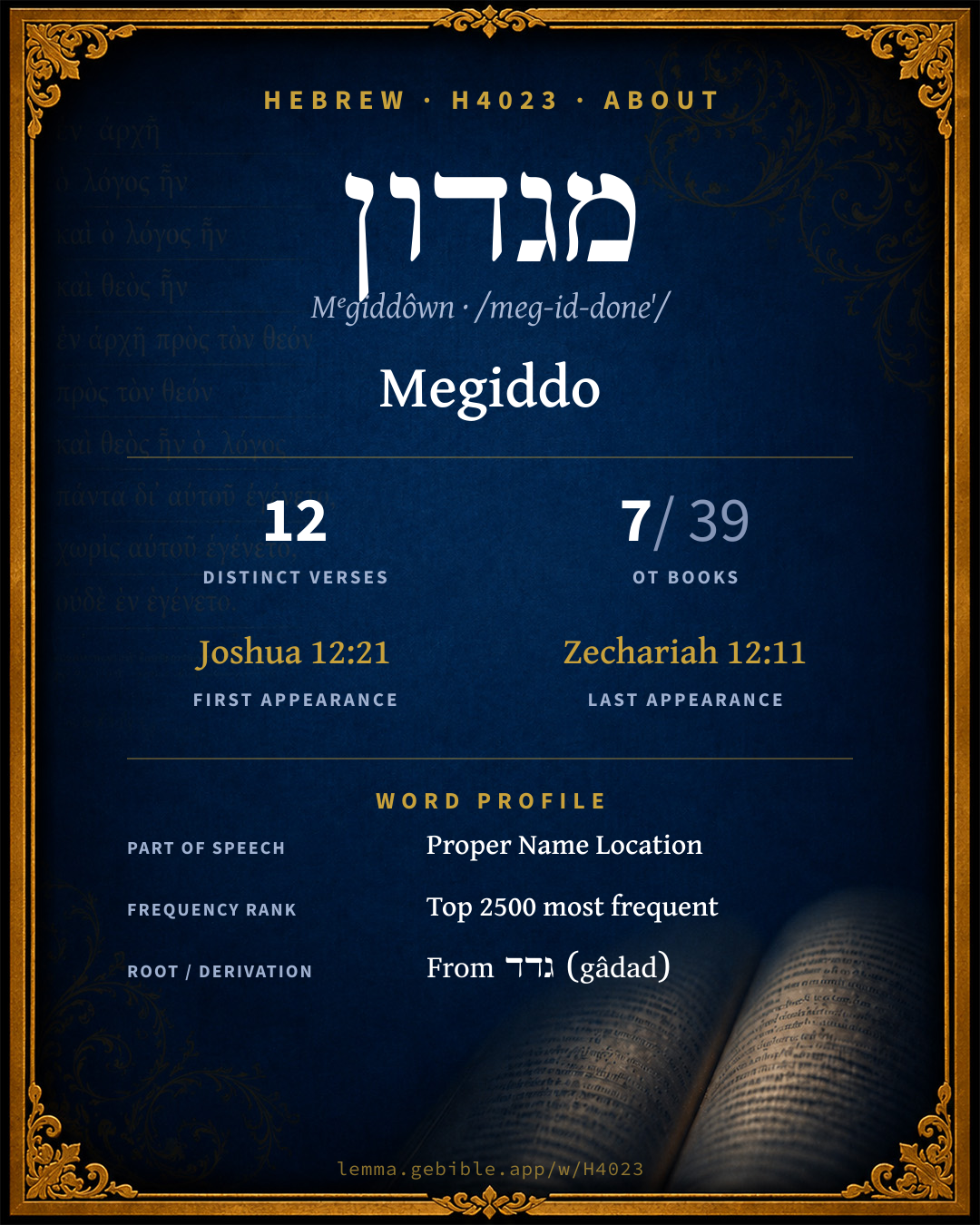
מְגִדּוֹ
Megiddo
BDB lists 2 entries for ‘Megiddo’ fuller range ↓
Full lexicon entry — Brown-Driver-Briggs (BDB)
From Brown-Driver-Briggs (BDB)
Where this word appears
Grammar key — what these labels mean
Part of speech
- Noun
- A naming word — a person, place, thing, or idea.
Noun type
- Proper
- A name of a specific person, place, or people (e.g. Abraham, Zion, Israel).
Every verse where H4023 appears in the Book of Joshua — 2 distinct verses. Click any verse to open its interlinear word-by-word view. Verse text shown in the World English Bible for context — . Each verse’s Hebrew form is shown with its reference; the English is not keyword-highlighted, since the data carries no word-level English alignment. Use “Compare translations” on any verse to read it across multiple English versions. This concordance covers the Hebrew Bible; Septuagint (Greek Old Testament) occurrences are not indexed here.
Joshua
- Joshua 12:21 מְגִדּ֖וֹ n Proper the king of Taanach, one; the king of Megiddo, one;
- Joshua 17:11 מְגִדּ֖וֹ n Proper Manasseh had in Issachar and in Asher Beth-shean and its towns, and Ibleam and its towns, and the inhabitants of Dor and its towns, and the inhabitants of En-dor and its towns, and the inhabitants of Taanach and its towns, and the inhabitants of Megiddo and its towns, even the three heights.
About this entry
At a glance — auto-summarized from this page’s data, not written by a person. Every figure links to its source below. This summary describes the numbers; it doesn’t interpret them.
מגדון — transliterated Mᵉgiddôwn — is a Hebrew name carrying the sense “Megiddo.” Debuting at Joshua 12:21, it then recurs through the corpus. With 12 verses in 7 books, it is an uncommon word in the Hebrew Bible. Its uses concentrate in 2 Kings (25% of all occurrences). Each statement above links to its evidence; the full detail follows below.
Gloss history
Strong's 1890 vs modern scholarship
About this word
Strong's H4023 catalogs a Hebrew word from the Hebrew Old Testament.
These counts are not copied from any lexicon or concordance. They are computed here, from the morphology-tagged Hebrew Old Testament. What Lemma adds →
- 12
- distinct verses
- The word appears in 12 distinct verses.
- 7 / 39
- OT books
- The word appears in 7 of 39 Old Testament books.
- #2,101
- by frequency
- Top 2500 most frequent Hebrew words (rank 2,101 of 8,640 Hebrew words by occurrence).
View all 12 occurrences in the concordance →
By section of the Old Testament
By traditional corpus
Conventional, traditional groupings — biblical authorship is debated, so this is a traditional corpus grouping, not an authorship claim. Each share is this word’s portion of its verses in that division of the Hebrew canon. Each figure is a share of the word’s 12 distinct verses.
- Prophets (Nevi'im) 10 verses · 83%
- Writings (Ketuvim) 2 verses · 17%
How translations render this word
Counts come from each version’s own published word-to-Strong’s tagging or interlinear alignment — an approximate guide to how each version renders this word, not a word-level alignment the data otherwise carries. Because each total is that version’s own tagged count, the per-version totals vary from one another and need not match the appearance or distinct-verse counts above. These counts may also differ from a printed concordance because Lemma counts each distinctly tagged rendering and does not collapse phrase taggings into a single head-word total. This is a fixed set of word-tagged versions (KJV, ASV, BSB, ULT) and does not change with the reading translation you choose elsewhere. Each version’s license is shown beside its name below (and on Sources).
- King James Version: Megiddo 11×
- American Standard Version: Megiddo 10×
- Berean Standard Bible: Megiddo 12×
- unfoldingWord Literal Text: Megiddo 11×
King James Version Public Domain
Renders H4023 across 12 tagged occurrences — most commonly:
Plus 1 rendering that appears only once — usually multi-word phrases or single function words the recovered tagging swept in, not distinct renderings.
American Standard Version Public Domain
Renders H4023 across 12 tagged occurrences — most commonly:
Plus 2 renderings that appear only once — usually multi-word phrases or single function words the recovered tagging swept in, not distinct renderings.
Berean Standard Bible Public Domain
Renders H4023 across 12 tagged occurrences — most commonly:
unfoldingWord Literal Text CC BY-SA 4.0
Renders H4023 across 12 tagged occurrences — most commonly:
Plus 1 rendering that appears only once — usually multi-word phrases or single function words the recovered tagging swept in, not distinct renderings.
Senses in BDB
The 2 senses BDB distinguishes for this word, in lexicon order (not ranked by frequency or importance). The full entry — with sub-senses — is in the Lexicon Entry tab.
- Megiddo or Megiddon = "place of crowds"
- ancient city of Canaan assigned to Manasseh and located on the southern rim of the plain of Esdraelon 6 miles (10…
Word origin
and (Zc 12:11) מְגִדּוֹן n.pr.loc. (connexion with above √ not clear; 𝔊 Μαγεδδω, Μεκεδω, Μαγεδω, etc.; 𝔙 Mageddo; Assyrian Magadû, Magidû, COTGloss DlPa 287) old Canaanitish city, assigned to Manasseh 1 K 4:12; 9:15 2 K 9:27; 23:29, 30; מֶלֶךְ מ׳ Jos 12:21; ישְׁבֵי מ׳ Jos 17:11 = Ju 1:27; מֵי מ׳ Ju 5:19; בִּקְעַת מ׳ Zc 12:11 2 Ch 35:22;—mod. Lejjûn (= legio) RobBR ii, 329 f. 364 BdPal 229.
— Brown-Driver-Briggs (Oxford 1906, public domain), digitized via Sefaria, supplemented by the OpenScriptures HebrewLexicon (CC BY 4.0). See Sources.
Derived from גדד (gâdad) (H1413) — to penetrate.
Forms in the corpus
The 8 distinct written forms H4023 takes in the Hebrew Bible, most frequent first — each parse links to that state’s occurrences in the concordance. Hebrew forms include their vowel points and cantillation, so a single lemma takes many written forms.
| Form | Parsing | Example | Uses |
|---|---|---|---|
| מְגִדּ֖וֹ | Noun, Proper | 1 Kings 9:15 | 5 |
| בִּ/מְגִדּ֔וֹ | Noun, Proper | 2 Kings 23:29 | 1 |
| וּ/מְגִדּ֑וֹ | Noun, Proper | 1 Kings 4:12 | 1 |
| מְגִדּ֑וֹ | Noun, Proper | Judges 5:19 | 1 |
| מְגִדּ֥וֹ | Noun, Proper | 1 Chronicles 7:29 | 1 |
| מְגִדּֽוֹ | Noun, Proper | 2 Chronicles 35:22 | 1 |
| מְגִדּֽוֹן | Noun, Proper | Zechariah 12:11 | 1 |
| מִ/מְּגִדּ֔וֹ | Noun, Proper | 2 Kings 23:30 | 1 |
Same root — word family
Other BDB entries built from the same root as H4023, grouped by Strong’s listed origin. These share a root / origin per the lexicon — not necessarily a shared meaning. Each links to that word’s own entry.
Derives from
Shares the same root
- גד gad H1407 coriander
- גדד gᵉdad H1414 to cut down
- גדוד gᵉdûwd H1416 troop
- גדוד gᵉdûwd H1417 furrow
- גדודה gᵉdûwdâh H1418 furrow
- גוד gûwd H1464 to attack
Proper names from this root
People and places named from this root — a name, not an additional meaning of the word.
Compare all same-root words → Showing 4 of 9 — not the complete family. 1 of the same-root words is a proper name (a person or place). They share a root, not necessarily a meaning.
Bible dictionary
Public-domain dictionary articles matched to this entry by name (Megiddo). A biblical name can be shared by more than one person or place, so an article may treat several.
Easton's Bible Dictionary · M. G. Easton, 1897
Place of troops, originally one of the royal cities of the Canaanites (Josh. 12:21), belonged to the tribe of Manasseh (Judg. 1:27), but does not seem to have been fully occupied by the Israelites till the time of Solomon (1 Kings 4:12; 9:15).
The valley or plain of Megiddo was part of the plain of Esdraelon, the great battle-field of Palestine. It was here Barak gained a notable victory over Jabin, the king of Hazor, whose general, Sisera, led on the hostile army. Barak rallied the warriors of the northern tribes, and under the encouragement of Deborah (q.v.), the prophetess, attacked the Canaanites in the great plain. The army of Sisera was thrown into complete confusion, and was engulfed in the waters of the Kishon, which had risen and overflowed its banks (Judg. 4:5).
Many years after this (B.C. 610), Pharaohnecho II., on his march against the king of Assyria, passed through the plains of Philistia and Sharon; and King Josiah, attempting to bar his progress in the plain of Megiddo, was defeated by the Egyptians. He was wounded in battle, and died as they bore him away in his chariot towards Jerusalem (2 Kings 23:29; 2 Chr. 35:22-24), and all Israel mourned for him. So general and bitter was this mourning that it became a proverb, to which Zechariah (12:11, 12) alludes. Megiddo has been identified with the modern el-Lejjun, at the head of the Kishon, under the north-eastern brow of Carmel, on the south-western edge of the plain of Esdraelon, and 9 miles west of Jezreel. Others identify it with Mujedd'a, 4 miles south-west of Bethshean, but the question of its site is still undetermined.
Smith's Bible Dictionary · William Smith, 1863
(place of crowns) was in a very marked position on the southern rim of the plain of Esdraelon, on the frontier line of the territories of the tribes of Issachar and Manasseh, 6 miles from Mount Carmel and 11 from Nazareth. It commanded one of those passes from the north into the hill country which were of such critical importance on various occasions in the history of Judea. Judith 4:7. The first mention occurs in (Joshua 12:21) where Megiddo appears as the city of one of the kings whom Joshua defeated on the west of the Jordan. The song of Deborah brings the place vividly before us, as the scene of the great conflict between Sisera and Barak. When Pharaoh-necho came from Egypt against the king of Assyria, Josiah joined the latter, and was slain at Megiddo. (2 Kings 23:29; 2 Chronicles 35:22-24) Megiddo is the modern el-Lejjun, which is undoubtedly the Legio of Eusebius and Jerome. There is a copious stream flowing down the gorge, and turning some mills before joining the Kishon. Here are probably the "waters of Megiddo" of (Judges 5:19)
Hitchcock's Bible Names Dictionary · Roswell D. Hitchcock, 1869
his precious fruit; declaring a message
Classic public-domain reference works; full attribution on Sources.
Septuagint verse parallels
This word appears in 12 verses that also exist in the Greek Old Testament (Septuagint), out of the 12 Hebrew verses it occurs in. You can read those verses in Greek by switching the Old Testament edition to the Septuagint.
Read these verses in the Septuagint
- Joshua 12:21
- Judges 1:27
- 1 Kings 4:12
- 2 Kings 9:27
- 1 Chronicles 7:29
- 2 Chronicles 35:22
- Zechariah 12:11
This is a verse-level parallel only — the same verses exist in both the Hebrew and Greek Old Testaments. No word-level Hebrew↔Greek correspondence is claimed: the data carries no such alignment, so no Greek word is shown as this Hebrew word’s translation. Coverage is not total — the Septuagint omits the deuterocanon and renumbers the Psalms, so some Hebrew verses have no direct Greek parallel.