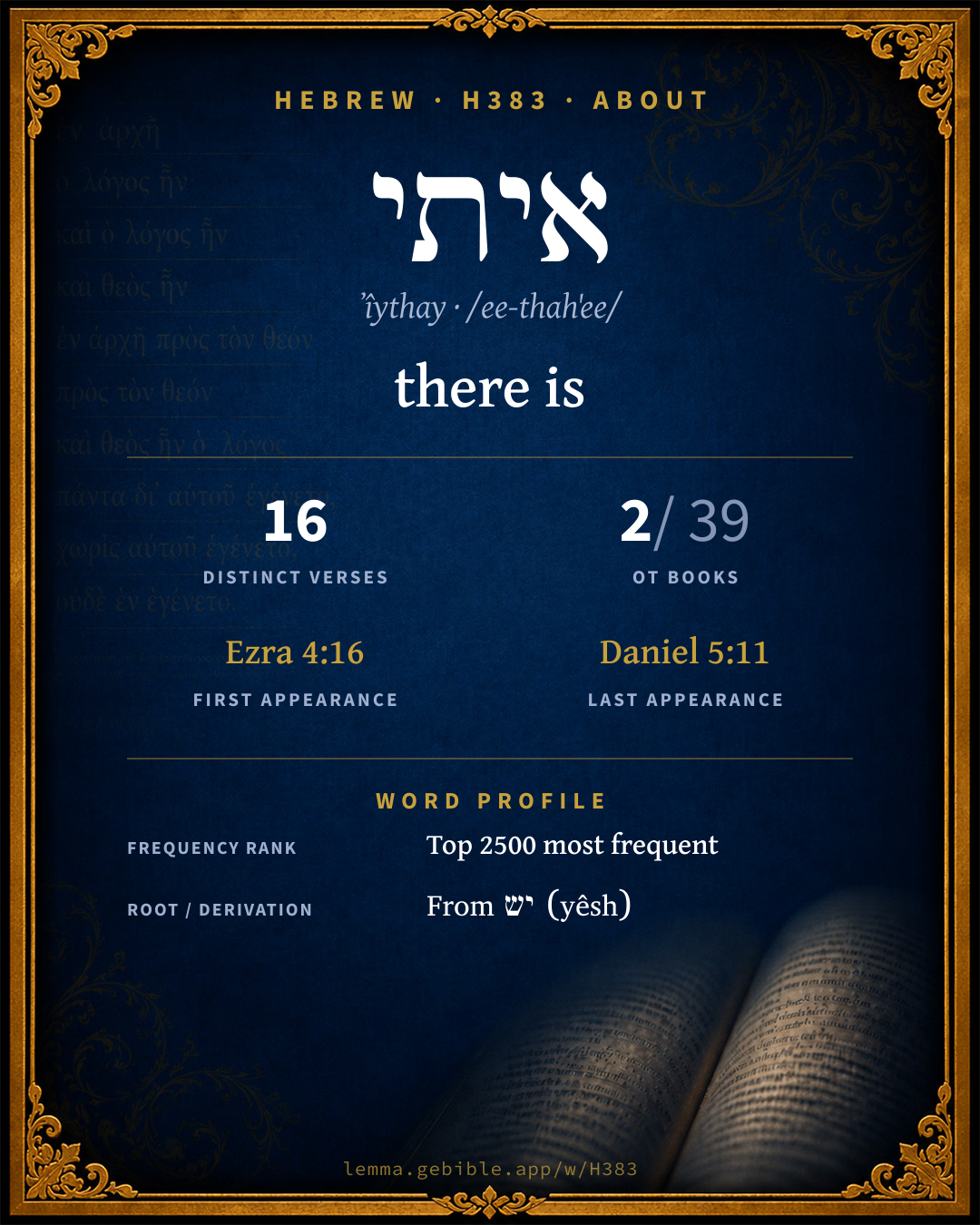
אִיתַי
there is
‘there is’ is one of 2 main senses fuller range ↓
Full lexicon entry — Brown-Driver-Briggs (BDB)
From Brown-Driver-Briggs (BDB)
Where this word appears
Grammar key — what these labels mean
Part of speech
- Particle
- A short function word — article, negation, interrogative, the sign of the direct object, and the like.
Every verse where H383 appears in the Book of Daniel — 14 distinct verses. Click any verse to open its interlinear word-by-word view. Verse text shown in the World English Bible for context — . Each verse’s Hebrew form is shown with its reference; the English is not keyword-highlighted, since the data carries no word-level English alignment. Use “Compare translations” on any verse to read it across multiple English versions. This concordance covers the Hebrew Bible; Septuagint (Greek Old Testament) occurrences are not indexed here.
Daniel
- Daniel 2:10 אִיתַ֤י ptcl acc The Chaldeans answered before the king, and said, There is not a man on the earth who can show the king's matter, because no king, lord, or ruler, has asked such a thing of any magician, or enchanter, or Chaldean.
- Daniel 2:11 אִיתַ֔י אִיתֽוֹ/הִי ptcl acc ptcl acc + sfx pers 3ms It is a rare thing that the king requires, and there is no other who can show it before the king, except the gods, whose dwelling is not with flesh.
- Daniel 2:26 ה/איתי/ך הַֽ/אִיתָ֣/ךְ ptcl inter + ptcl acc + sfx pers 2ms ptcl inter + ptcl acc + sfx pers 2ms The king answered Daniel, whose name was Belteshazzar, Are you able to make known to me the dream which I have seen, and the interpretation of it?
- Daniel 2:28 אִיתַ֞י ptcl acc but there is a God in heaven who reveals secrets, and he has made known to the king Nebuchadnezzar what shall be in the latter days. Your dream, and the visions of your head on your bed, are these:
- Daniel 2:30 אִיתַ֥י ptcl acc But as for me, this secret is not revealed to me for any wisdom that I have more than any living, but to the intent that the interpretation may be made known to the king, and that you may know the thoughts of your heart.
- Daniel 3:12 אִיתַ֞י ptcl acc There are certain Jews whom you have appointed over the affairs of the province of Babylon: Shadrach, Meshach, and Abednego; these men, O king, have not regarded you: they don't serve your gods, nor worship the golden image which you have set up.
- Daniel 3:14 אִֽיתֵי/כוֹן֙ ptcl acc + sfx pers 2mp Nebuchadnezzar answered them, Is it on purpose, Shadrach, Meshach, and Abednego, that you don't serve my god, nor worship the golden image which I have set up?
- Daniel 3:15 אִֽיתֵי/כ֣וֹן ptcl acc + sfx pers 2mp Now if you are ready whenever you hear the sound of the horn, flute, zither, lyre, harp, pipe, and all kinds of music to you fall down and worship the image which I have made, [well]: but if you don't worship, you shall be cast the same hour into the midst of a burning fiery furnace; and who is that god that shall deliver you out of my hands?
- Daniel 3:17 אִיתַ֗י ptcl acc If it be [so], our God whom we serve is able to deliver us from the burning fiery furnace; and he will deliver us out of your hand, O king.
- Daniel 3:18 איתי/נא אִיתַ֣/נָא ptcl acc + sfx pers 1cp ptcl acc + sfx pers 1cp But if not, be it known to you, O king, that we will not serve your gods, nor worship the golden image which you have set up.
- Daniel 3:25 אִיתַ֣י ptcl acc He answered, Look, I see four men loose, walking in the midst of the fire, and they have no hurt; and the aspect of the fourth is like a son of the gods.
- Daniel 3:29 אִיתַי֙ ptcl acc Therefore I make a decree, that every people, nation, and language, which speak anything evil against the God of Shadrach, Meshach, and Abednego, shall be cut in pieces, and their houses shall be made a dunghill; because there is no other god who is able to deliver after this sort.
- Daniel 4:35 אִיתַי֙ ptcl acc All the inhabitants of the earth are reputed as nothing; and he does according to his will in the army of heaven, and among the inhabitants of the earth; and none can stay his hand, or tell him, What do you?
- Daniel 5:11 אִיתַ֨י ptcl acc There is a man in your kingdom, in whom is the spirit of the holy gods; and in the days of your father light and understanding and wisdom, like the wisdom of the gods, were found in him; and the king Nebuchadnezzar your father, the king, [I say], your father, made him master of the magicians, enchanters, Chaldeans, and soothsayers;
About this entry
At a glance — auto-summarized from this page’s data, not written by a person. Every figure links to its source below. This summary describes the numbers; it doesn’t interpret them.
איתי (ʼîythay) is a Hebrew word most often rendered “there is.” Daniel dominates its distribution — 14 of 16 verses. The Hebrew Bible uses it across 16 verses — uncommon. Debuting at Ezra 4:16, it then recurs through the corpus. Its lexical range runs to 2 senses. The sections below give every sense, occurrence, and version rendering.
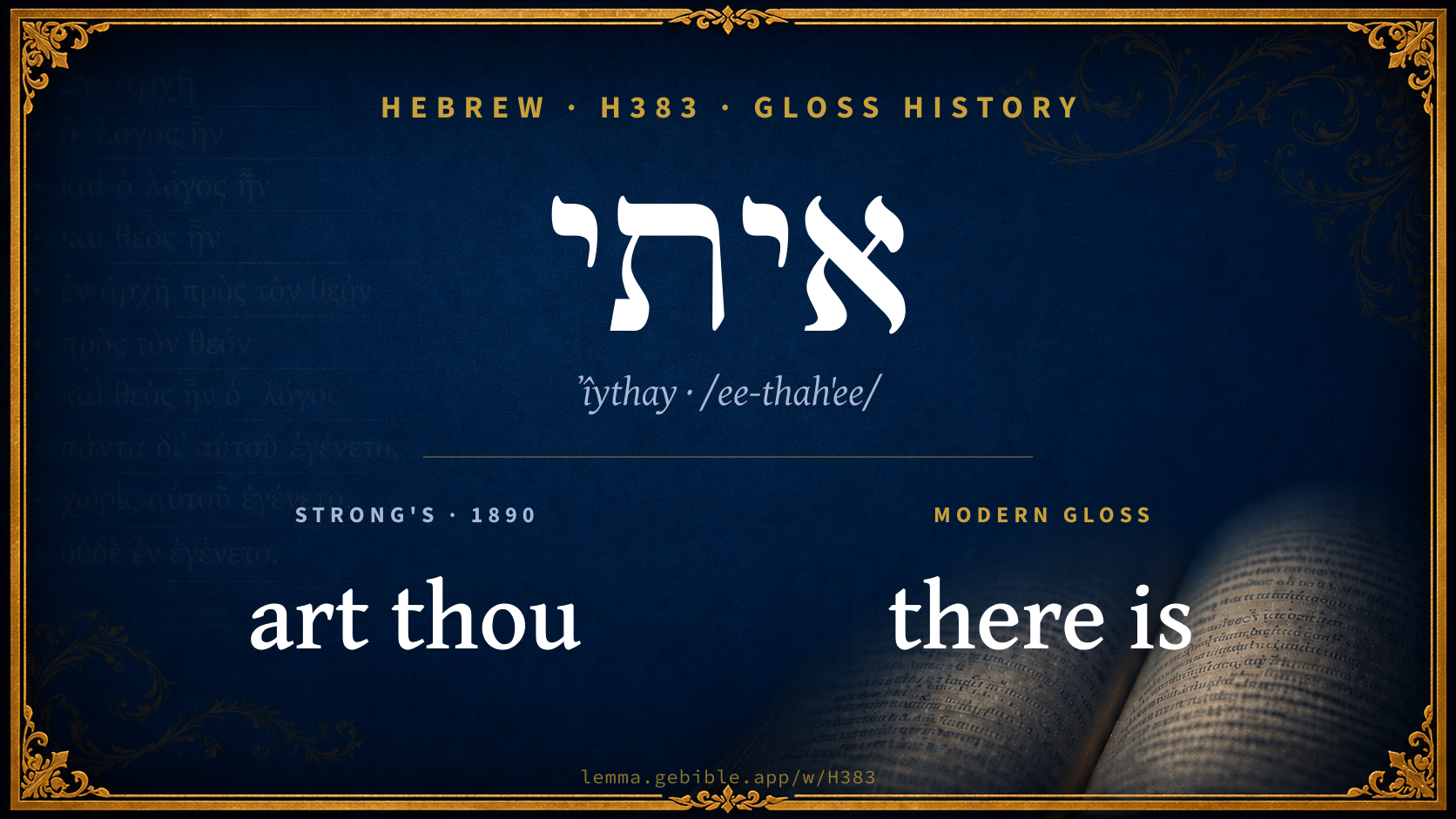
Gloss history
Strong's 1890 vs modern scholarship
About this word
Strong's H383 catalogs a Hebrew word from the Hebrew Old Testament.
These counts are not copied from any lexicon or concordance. They are computed here, from the morphology-tagged Hebrew Old Testament. What Lemma adds →
- 16
- distinct verses
- The word appears in 16 distinct verses.
- 2 / 39
- OT books
- The word appears in 2 of 39 Old Testament books.
- #1,563
- by frequency
- Top 2500 most frequent Hebrew words (rank 1,563 of 8,640 Hebrew words by occurrence).
View all 16 occurrences in the concordance →
By traditional corpus
Conventional, traditional groupings — biblical authorship is debated, so this is a traditional corpus grouping, not an authorship claim. Each share is this word’s portion of its verses in that division of the Hebrew canon. Each figure is a share of the word’s 16 distinct verses.
- Writings (Ketuvim) 16 verses · 100%
How translations render this word
Counts come from each version’s own published word-to-Strong’s tagging or interlinear alignment — an approximate guide to how each version renders this word, not a word-level alignment the data otherwise carries. Because each total is that version’s own tagged count, the per-version totals vary from one another and need not match the appearance or distinct-verse counts above. These counts may also differ from a printed concordance because Lemma counts each distinctly tagged rendering and does not collapse phrase taggings into a single head-word total. This is a fixed set of word-tagged versions (KJV, ASV, BSB, ULT) and does not change with the reading translation you choose elsewhere. Each version’s license is shown beside its name below (and on Sources).
BDB lists this Strong’s number as 2 distinct words (homographs). Each count above pools all of them and is not split by sense — see the Senses section below. A low-frequency rendering may belong to a different one of those words, not the primary meaning.
- King James Version†: Is 7×
- American Standard Version†: Is 8×
- Berean Standard Bible†: Is 5×
- unfoldingWord Literal Text†: Is 7×
King James Version Public Domain
Renders H383 across 17† tagged occurrences — most commonly:
Plus 10 renderings that appear only once — usually multi-word phrases or single function words the recovered tagging swept in, not distinct renderings.
American Standard Version Public Domain
Renders H383 across 18† tagged occurrences — most commonly:
Plus 10 renderings that appear only once — usually multi-word phrases or single function words the recovered tagging swept in, not distinct renderings.
Berean Standard Bible Public Domain
Renders H383 across 10† tagged occurrences — most commonly:
Plus 5 renderings that appear only once — usually multi-word phrases or single function words the recovered tagging swept in, not distinct renderings. Not rendered by a distinct English word in 7 further occurrences.
unfoldingWord Literal Text CC BY-SA 4.0
Renders H383 across 17† tagged occurrences — most commonly:
Plus 10 renderings that appear only once — usually multi-word phrases or single function words the recovered tagging swept in, not distinct renderings.
Senses in BDB
The 2 senses BDB distinguishes for this word, in lexicon order (not ranked by frequency or importance). The full entry — with sub-senses — is in the Lexicon Entry tab.
- there is, there are
- particle denoting existence
Word origin
(י)תַי, אִיתִיאֵל v. sub II. אֵת.
— Brown-Driver-Briggs (Oxford 1906, public domain), digitized via Sefaria, supplemented by the OpenScriptures HebrewLexicon (CC BY 4.0). See Sources.
Derived from יש (yêsh) (H3426) — there is.
Jastrow Dictionary
A second Hebrew/Aramaic lexicon for comparison, covering Aramaic and post-biblical (Talmudic, Targumic, Midrashic) usage that the biblical-Hebrew BDB does not. Matched by lemma rather than by Strong’s number, so a lemma may carry more than one Jastrow headword (shown separately below), and the entries cover usage well beyond the Bible.
*אִיתַי
- , אִיתַיי (pl. of אִית) there is, there are. Dan. II, 10; a. fr.—Y. Shebi. X, 39ᶜ ל׳ יום לא איתיי (Y. Macc. I, 31ᵃ … איתי) a loan on thirty days does not exist, i.e. does not come within the rule whereby a creditor may secure collection by announcing legal action before the Sabbath year limitation takes effect.—*Pes. 50ᵃ כי היכי דאיתו אנן אִיתִינָן וכ׳ (read דאיתי or דאיתינן; Ms. M. אתינן; diff. vers. v. Rabb. D. S. a. l.) as we are esteemed here (in this world) so are we there (in the world of the beatified). e.g. Daniel 2:10
אִיתִי
- Ithi. Kerith. 24ᵃ
אֲתָא
- (b. h. אתה, אתא; sec. r. of אוֹת I q. v.) [to join,] to come, to arrive; to occur to. Targ. Gen. XIX, 9; a. fr.—Y. Peah III, 17ᵈ bot. אתאי עובדא וכ׳ the case came before … Gen. R. s. 68 (ref. to Gen. XXVIII, 11) א׳ שמשא the Sun (Jacob) has arrived. Snh. 98ᵇ יֵיתֵי ולא איחמיניה he (the Messiah) will come, but I do not desire to live to see him (to pass through the trials preceding his arrival).—תֵּיתֵי לי ד־ may it come home to me that I did—, i.e. I believe to have merited divine reward. Meg. 28ᵃ; a. fr.—ייתי עלי דלא may it come home to me that I did not—; a formula of assurance, surely, indeed. Y. Ber. II, 5ᶜ bot.; a. fr.; (v. יבוא עלי, s. v. בּוֹא).—Y. Shebi. VI, 36ᶜ top ייתי ד־ (sub. עלי).—Imperat. תָּא (Y. אִיתָא). Gitt. 57ᵃ, a. fr. תא חזי; Y. Dem. VI, 25ᵇ top איתא חמי; in Bab. usu. תא שמע (abbr. ת"ש) come and see, come and hear, i.e. I will prove it.—אַתְיָא כ־ it comes like, i.e. it is in accordance with the opinion of.—Y. Naz. VI, 54ᵈ bot.; a. v. fr.—וַתְּיָיא = ואתיא. Ibid.ᶜ bot. ותייא כהדא דתני חזקיה (ed. Krot. incorr. ותניא) תִּי.—Y. Keth. IV, 28ᵈ top ותאיין וכ׳ (read ואתיין) and those differences of opinion correspond to …—אתיא פקידה פקידה the expression pakad occurs in two Biblical passages, אתיא זכירה זכירה and the expression zakhar occurs in two passages, i.e. draw an analogy between the respective Bible laws in which the same expressions are used, so as to cast a light upon each other. R. Hash. 11ᵃ; a. fr. [אתא נסיא Y. Meg. II, 73ᵇ, a. e., read אֲתָאנַסְיָא q. v.] [Targ. Y. II, Deut. XXXIII, 16 יַתְיַן, 3rd pers. fem. fut.] e.g. Genesis 28:11
- , אַיְיתִי to bring, carry, cause to come. Targ. Gen. IV, 3; a. fr.—מנא תיתי (מהיכא, מנן) whence wilt thou bring (evidence), how will you prove it? Y. B. Mets. III, beg. 9ᵃ; a. v. fr.—מַיְיתָה, מַיְיתִי, מֵיתֵי bringing, to bring. Y. Peah I, 15ᶜ top בעי מ׳ וכ׳ he desired to bring it to them. Ib. לא יכילת מייתותי׳ I cannot bring it.—לַיְיתֵי, לֵיְתֵי let him bring. Sabb. 109ᵇ; a. fr.—לאַיְתוּיֵי, לַאֲתוּיֵי (cmp. אֵת) to bring in, to include, opp. לאפוקי; v. אַפֵּק. לא׳ מאי what is to be implied (in addition to what is explicitly stated)? Tem. 2ᵃ הכל לאי׳ מאי what does hakkol (all) come to imply? a. fr.—Haf. הַיְיתִי same. Dan. V, 13; a. e. e.g. Daniel 5:13
- (אִתּוֹתִי, אִתַּתִי) to be brought, offered. Targ. Gen. XXXIII, 11. Targ. Lev. XIII, 2; a. e.
A Dictionary of the Targumim, the Talmud Babli and Yerushalmi, and the Midrashic Literature (Marcus Jastrow; London, Luzac, 1903) — Public Domain. Digitized via Sefaria. Digitized via Sefaria. Full attribution on Sources.
Forms in the corpus
The 16 distinct written forms H383 takes in the Hebrew Bible, most frequent first — each parse links to that state’s occurrences in the concordance. Hebrew forms include their vowel points and cantillation, so a single lemma takes many written forms.
| Form | Parsing | Example | Uses |
|---|---|---|---|
| אִיתַ֗י | Particle, Accusative | Daniel 3:17 | 2 |
| אִיתַ֞י | Particle, Accusative | Daniel 2:28 | 2 |
| אִיתַי֙ | Particle, Accusative | Daniel 3:29 | 2 |
| אִֽיתֵי/כ֣וֹן | Particle, Accusative | Daniel 3:15 | 1 |
| אִֽיתֵי/כוֹן֙ | Particle, Accusative | Daniel 3:14 | 1 |
| אִיתַ֔י | Particle, Accusative | Daniel 2:11 | 1 |
| אִיתַ֖י | Particle, Accusative | Ezra 4:16 | 1 |
| אִיתַ֣/נָא | Particle, Accusative | Daniel 3:18 | 1 |
| אִיתַ֣י | Particle, Accusative | Daniel 3:25 | 1 |
| אִיתַ֤י | Particle, Accusative | Daniel 2:10 | 1 |
| אִיתַ֥י | Particle, Accusative | Daniel 2:30 | 1 |
| אִיתַ֨י | Particle, Accusative | Daniel 5:11 | 1 |
| אִיתֽוֹ/הִי | Particle, Accusative | Daniel 2:11 | 1 |
| איתי/נא | Particle, Accusative | Daniel 3:18 | 1 |
| ה/איתי/ך | Particle, Accusative | Daniel 2:26 | 1 |
| הַֽ/אִיתָ֣/ךְ | Particle, Accusative | Daniel 2:26 | 1 |
Same root — word family
Other BDB entries built from the same root as H383, grouped by Strong’s listed origin. These share a root / origin per the lexicon — not necessarily a shared meaning. Each links to that word’s own entry.
Derives from
Proper names from this root
People and places named from this root — a name, not an additional meaning of the word.
Compare all same-root words → 1 of the same-root words is a proper name (a person or place). They share a root, not necessarily a meaning.
Septuagint verse parallels
This word appears in 15 verses that also exist in the Greek Old Testament (Septuagint), out of the 16 Hebrew verses it occurs in. You can read those verses in Greek by switching the Old Testament edition to the Septuagint.
Read these verses in the Septuagint
This is a verse-level parallel only — the same verses exist in both the Hebrew and Greek Old Testaments. No word-level Hebrew↔Greek correspondence is claimed: the data carries no such alignment, so no Greek word is shown as this Hebrew word’s translation. Coverage is not total — the Septuagint omits the deuterocanon and renumbers the Psalms, so some Hebrew verses have no direct Greek parallel.