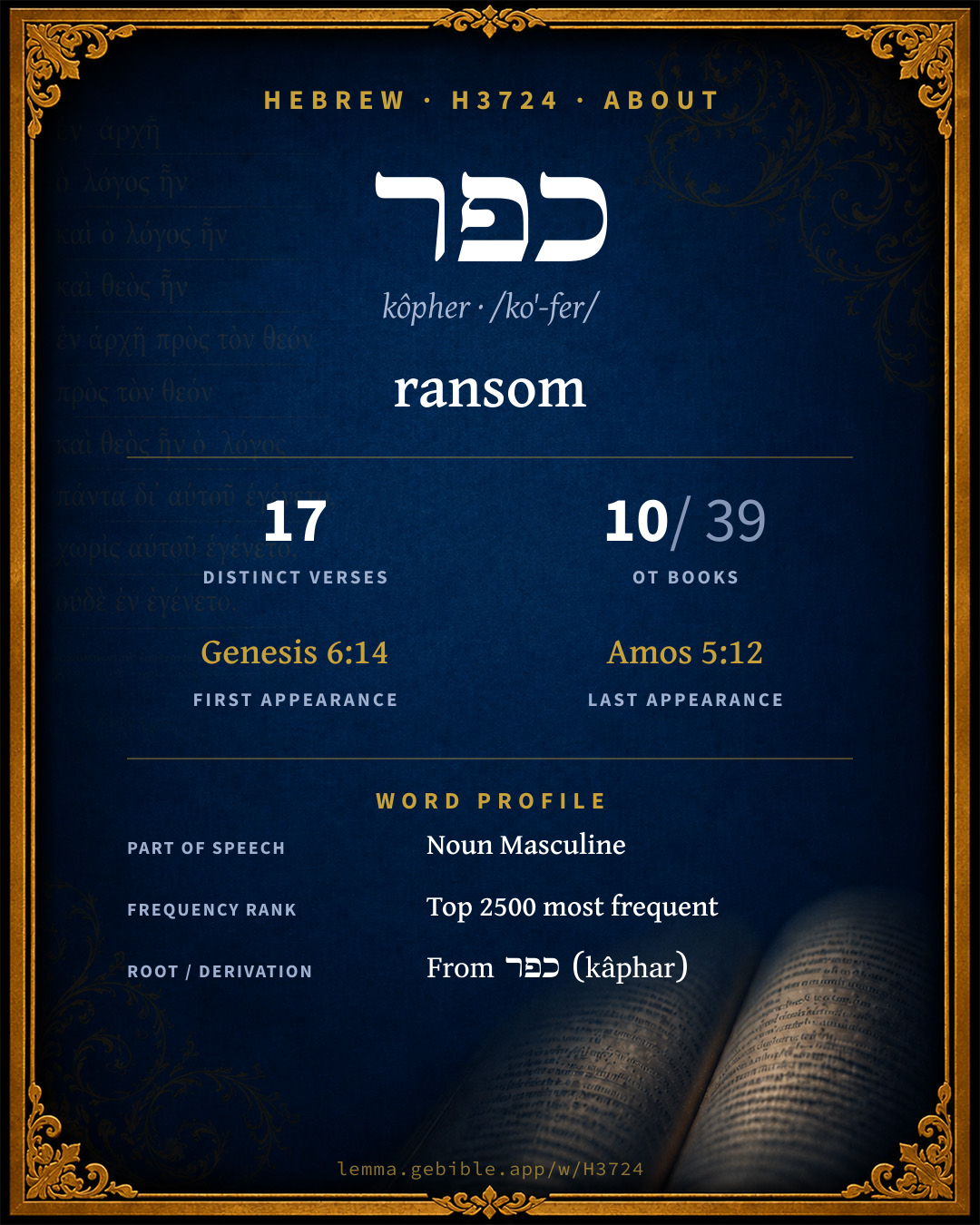
כפר
ransom
‘ransom’ is one of 4 main senses fuller range ↓
Full lexicon entry — Brown-Driver-Briggs (BDB)
From Brown-Driver-Briggs (BDB)
Where this word appears
Grammar key — what these labels mean
Part of speech
- Noun
- A naming word — a person, place, thing, or idea.
Noun type
- Common
- A common noun — a general class of person, place, or thing (“king,” “city,” “water”), not a specific name.
State
- Absolute
- The independent form of a noun, not bound to a following word.
- Construct
- A noun bound to a following noun in a possessive / “of” relationship (the construct chain).
Gender
- Masculine
- Grammatically masculine.
Number
- Singular
- One.
- Plural
- More than one (in Hebrew, generally three or more).
Every verse where H3724 appears in the Book of Job — 2 distinct verses. Click any verse to open its interlinear word-by-word view. Verse text shown in the World English Bible for context — . Each verse’s Hebrew form is shown with its reference; the English is not keyword-highlighted, since the data carries no word-level English alignment. Use “Compare translations” on any verse to read it across multiple English versions. This concordance covers the Hebrew Bible; Septuagint (Greek Old Testament) occurrences are not indexed here.
Job
About this entry
At a glance — auto-summarized from this page’s data, not written by a person. Every figure links to its source below. This summary describes the numbers; it doesn’t interpret them.
כפר (kôpher) is a Hebrew noun most often rendered “ransom.” It is not a single-sense word — see its full sense range. With 17 verses in 10 books, it is an uncommon word in the Hebrew Bible. Debuting at Genesis 6:14, it then recurs through the corpus. From the same root come כפר, כפור and כפיר. The sections below give every sense, occurrence, and version rendering.
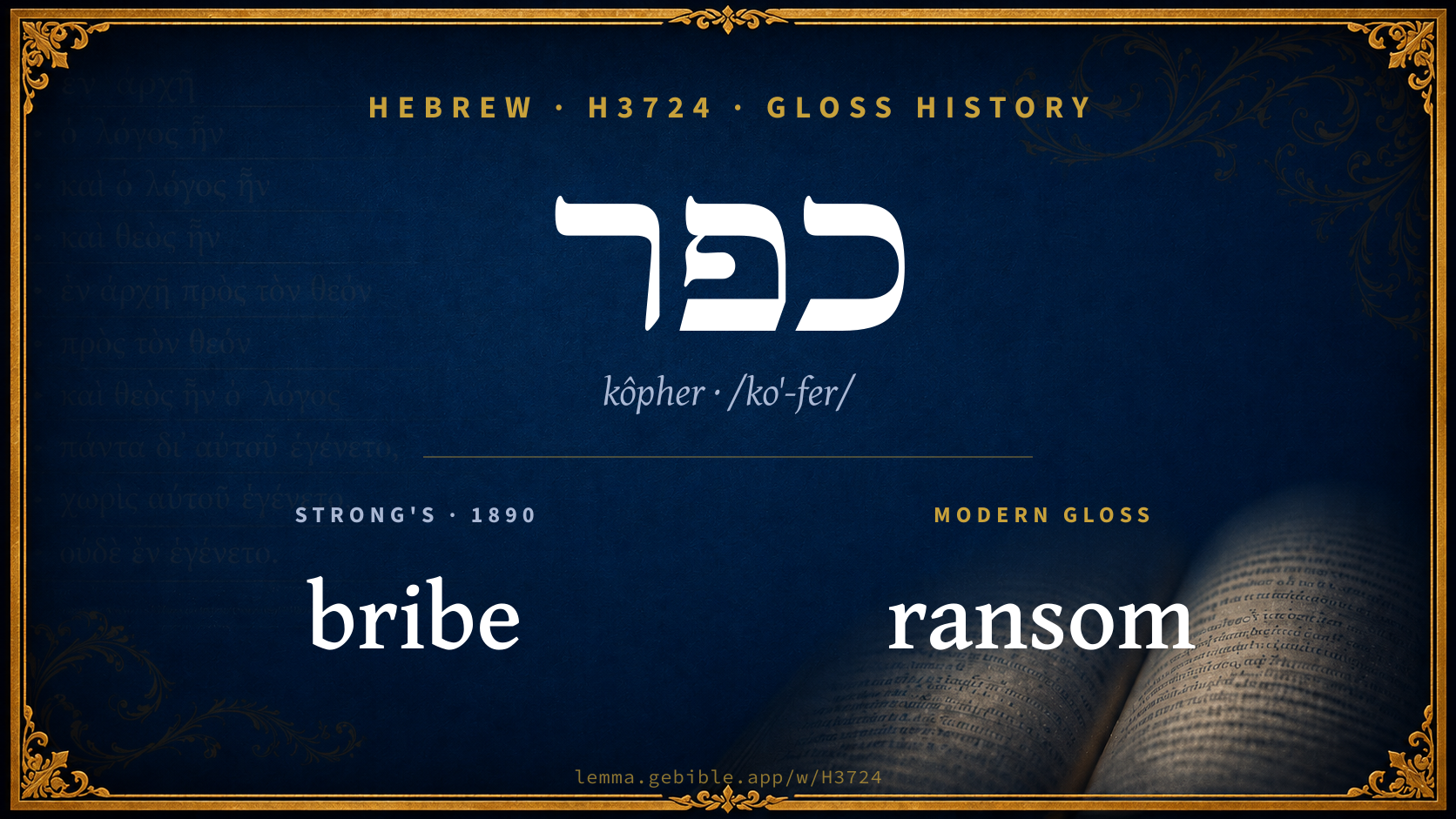
Gloss history
Strong's 1890 vs modern scholarship
About this word
Strong's H3724 catalogs a Hebrew word from the Hebrew Old Testament.
These counts are not copied from any lexicon or concordance. They are computed here, from the morphology-tagged Hebrew Old Testament. What Lemma adds →
- 17
- distinct verses
- The word appears in 17 distinct verses.
- 10 / 39
- OT books
- The word appears in 10 of 39 Old Testament books.
- #1,671
- by frequency
- Top 2500 most frequent Hebrew words (rank 1,671 of 8,640 Hebrew words by occurrence).
View all 17 occurrences in the concordance →
By section of the Old Testament
By traditional corpus
Conventional, traditional groupings — biblical authorship is debated, so this is a traditional corpus grouping, not an authorship claim. Each share is this word’s portion of its verses in that division of the Hebrew canon. Each figure is a share of the word’s 17 distinct verses.
- Writings (Ketuvim) 8 verses · 47%
- Torah (Pentateuch) 5 verses · 29%
- Prophets (Nevi'im) 4 verses · 24%
How translations render this word
Counts come from each version’s own published word-to-Strong’s tagging or interlinear alignment — an approximate guide to how each version renders this word, not a word-level alignment the data otherwise carries. Because each total is that version’s own tagged count, the per-version totals vary from one another and need not match the appearance or distinct-verse counts above. These counts may also differ from a printed concordance because Lemma counts each distinctly tagged rendering and does not collapse phrase taggings into a single head-word total. This is a fixed set of word-tagged versions (KJV, ASV, BSB, ULT) and does not change with the reading translation you choose elsewhere. Each version’s license is shown beside its name below (and on Sources).
BDB lists this Strong’s number as 3 distinct words (homographs). Each count above pools all of them and is not split by sense — see the Senses section below. A low-frequency rendering may belong to a different one of those words, not the primary meaning.
- King James Version†: Ransom 6×, Camphire 2×, Satisfaction 2×
- American Standard Version†: Ransom 8×
- Berean Standard Bible†: Ransom 8×, Bribe 2×
- unfoldingWord Literal Text†: Ransom 9×, Ransom of 2×
King James Version Public Domain
Renders H3724 across 17† tagged occurrences — most commonly:
Plus 7 renderings that appear only once — usually multi-word phrases or single function words the recovered tagging swept in, not distinct renderings.
American Standard Version Public Domain
Renders H3724 across 17† tagged occurrences — most commonly:
Plus 9 renderings that appear only once — usually multi-word phrases or single function words the recovered tagging swept in, not distinct renderings.
Berean Standard Bible Public Domain
Renders H3724 across 17† tagged occurrences — most commonly:
Plus 7 renderings that appear only once — usually multi-word phrases or single function words the recovered tagging swept in, not distinct renderings.
unfoldingWord Literal Text CC BY-SA 4.0
Renders H3724 across 17† tagged occurrences — most commonly:
Plus 6 renderings that appear only once — usually multi-word phrases or single function words the recovered tagging swept in, not distinct renderings.
Senses in the full BDB
What do BDB’s symbols mean?
BDB uses these scholarly abbreviations:
| Symbol | Meaning |
|---|---|
| 𝔊 | the Septuagint (the ancient Greek translation, LXX) |
| 𝔙 | the Vulgate (the Latin translation) |
| 𝔖 | the Syriac version (the Peshitta) |
| 𝔗 | the Targum (the Aramaic translation) |
| ψ | the Psalms |
| √ | root (the underlying root or stem) |
| ‖ | parallel passage (a synonymous or contrasted parallel) |
| † | the dagger: every passage where the word occurs is cited |
The 2 senses and sub-senses the full Brown-Driver-Briggs lexicon distinguishes for this word, in lexicon order (not ranked by frequency), with BDB’s own verbatim wording and sub-sense lettering. Shown in Hebrew script with BDB’s own scholarly abbreviations. The condensed entry is in the Lexicon Entry tab. See also the Forms in the corpus table below.
כפר I the price of a life, a ransom (ποινή, wergeld)
- 1. a price for ransom of a life Jb 33:24; 36:18; כ׳ עַל Ex 21:30 (Covt. code; ‖ פִּדְיֹן נַפְשׁוֹ); כ׳ נפשׁ Pr 13:8; כ׳ לְ ransom for Pr 6:35; 21:18; Nu 35:31, 32 (P); כָּפְרוֹ his ransom ψ 49:8 (‖ פדה); כָּפְרְךָ thy ransom Is 43:3 (‖ תַּחְתֶּיךָ); כֹּ֫פֶר alone 1 S 12:3 Am 5:12. e.g. Job 33:24
- 2. in the ritual of P כ׳ נַפְשׁוֹ Ex 30:12 is a half shekel of the sanctuary paid by each male above twenty years at the census in order that there might be no plague upon them. It was offered to Yahweh, לְכַפֵּר על to atone for them. e.g. Exodus 30:12
כפר II pitch (Arabic كُفْرٌ (loan-wd., cf. Frä150), Syriac ܟܽܘܦܪܳܐ, 𝔗 כּוּפְרָא
כפר III [m.] village
Senses from the full Brown-Driver-Briggs lexicon (Brown, Driver, Briggs; Oxford 1906 — public domain), digitized via Sefaria, supplemented by the OpenScriptures HebrewLexicon (CC BY 4.0). Full attribution on Sources.
Word origin
I. n.m. the price of a life, a ransom (ποινή, wergeld);—כ׳ Ex 21:30 + 10 times; sf. כָּפְרְךָ Is 43:3; כָּפְרוֹ ψ 49:8;—
I. n.m. pitch (Arabic كُفْرٌ (loan-wd., cf. Frä150), Syriac ܟܽܘܦܪܳܐ, 𝔗 כּוּפְרָא; Assyrian kupru, kupur DlHWB 348; cf. גֹּפֶר?)—Gn 6:14 (P).
II. n.[m.] village;—only sg. cstr. כֹּפֶר הַפְּרָזִי 1 S 6:18 villages of the peasantry.
— Brown-Driver-Briggs (Oxford 1906, public domain), digitized via Sefaria, supplemented by the OpenScriptures HebrewLexicon (CC BY 4.0). See Sources.
Derived from כפר (kâphar) (H3722) — to atone.
Jastrow Dictionary
A second Hebrew/Aramaic lexicon for comparison, covering Aramaic and post-biblical (Talmudic, Targumic, Midrashic) usage that the biblical-Hebrew BDB does not. Matched by lemma rather than by Strong’s number, so a lemma may carry more than one Jastrow headword (shown separately below), and the entries cover usage well beyond the Bible.
בְּקִיעִין
- B’kiin, (K’far) P’kiin, modern Fukin, a place in Southern Palestine between Lydda and Jabneh, residence of R. Joshua. Y. Ḥag. I, beg. 75ᵈ. Snh. 32ᵇ; a. fr.
כּוֹפֶר
- (b. h.) cyprus flower (v. Löw Pfl. p. 212). Shebi. VII, 6 והכו׳ Ms. M. (ed. והכפ׳); Nidd. 8ᵃ.—Chald. כְּפוֹרָא.
כָּפַר
- 1. to bend, arch over, cover; v. כְּפוֹר, כּוֹפֶר &c.
- 2. [to pass over with one’s palm &c., to wipe out, rub (cmp. חפף),] to deny, withhold the truth by claiming ignorance; to ignore (mostly with ב of the object). B. Mets. 4ᵃ הכּוֹפֵר במלוה he who denied having received a loan (and was refuted before being sworn, v. הֶיסֵּת). Ib. על מה שכ׳ וכ׳ he is sworn on what he denied. Shebu. IV, 1 עד שיִכְפְּרוּ בהן בב"ד until they declare their ignorance (of the testimony) before court. Ib. 4 כָּפְרוּ שניהן וכ׳ if both witnesses pleaded ignorance at the same time. Ib. כָּפְרָה הראשונה if the first set of witnesses pleaded ignorance. Ib. VI, 3 והודה … וכ׳ בקרקעות and defendant admits the debt concerning vessels, but denies it as to landed estate. Sabb. 116ᵃ מכירין וכוֹפְרִין they know (true religion) and yet are disbelievers. Cant. R. to I, 14 (play on הכפר, ib.) שכ׳ באו"ה He disowned the gentiles (did not assist them), opp. הודה; a. v. fr.—כ׳ בעיקר to deny the principle of religion (unity of God &c.). B. Bath. 16ᵇ; a. fr.—Snh. 39ᵃ א"ל כּוֹפֵר ed. (Ms. M. קיסר) an infidel said &c.
- (v. כַּפָּרָה) to say of a person, ‘May his death be an atonement for his sins!’ euphem. for to be angry at. Pes. 69ᵃ אל תַּכְפִּירֵנִי בשעת הדין ed. (Ms. M. a. Ar. תְּכַפְּרֵנִי) do not make me an atonement (saying תהא מיתתו כפרה) at the time of judgment (differ. in comm.); Ab. Zar. 46ᵇ (some eds. תכפריני).
- [to wipe out,] to forgive, atone; to procure forgiveness. Yoma 5ᵃ כאילו לא כ׳ וכפר as if he (the priest) had not procured atonement (in the proper manner), although he has procured atonement (for the person concerned); Neg. XIV, 10 כ׳ ומעלין עליו כאילו לא כ׳ he has brought atonement, but it is accounted to the officiating priest as if he had not done so. Ber. 55ᵃ … כל זמן מזבח מְכַפֵּר על וכ׳ as long as the Temple existed, the altar was the means of atonement for Israel, but now each man’s table must be the means of atonement (ref. to Ez. XLI, 22). Tanḥ. Vayishl. 6 כשם … מְכַפֶּרֶת וכ׳ as the altar brings atonement, so does she (the chaste wife) atone for her household. Kidd. 57ᵃ, a. e. מכשיר ומכפר, v. כָּשֵׁר I; a. v. fr.—[Ab. Zar. 46ᵇ, v. supra]. e.g. Ezekiel 41:22
- to be expiated; to be forgiven. R. Hash. 18ᵃ; Yeb. 105ᵃ (ref. to I Sam. III, 14) בזבח … מִתְכַּפֵּר וכ׳ through sacrifice … it will not be expiated, but it may be so by the study of the Law. Shebu. 12ᵃ אשם … שנִתְכַּפְּרוּ בעליו an animal dedicated for a guilt-offering … whose owner has otherwise obtained atonement; (Tem. III, 3 שכִּפְּרוּ וכ׳ whose owner has procured atonement &c.). Yoma 50ᵇ, a. e. המִתְכַּפֵּר he for whose atonement the animal is dedicated. Ib. 51ᵇ שאין הצבור מִתְכַּפְּרִין בו as the community is not to obtain forgiveness through it (the bullock); a. fr.—Y. Macc. II, 31ᵈ bot. יעשה … ויִתְכַּפֶּר לו let him repent and he shall be forgiven; Pesik. Shub. p. 158ᵇ; Yalk. Ez. 358; Yalk. Ps. 702. Tanḥ. T’rum. 8 נתכ׳ להם they were forgiven; a. fr. e.g. 1 Samuel 3:14
כְּפַר
- , to deny, renounce. Targ. Jer. II, 27. Targ. Y. Lev. V, 21, sq.; a. fr.—B. Kam. 107ᵃ בכוליה בעי דנִכְפְּרֵיה ed. (Ms. M. דנכפר ליה, v. Rabb. D. S. a. l.) he would have liked to deny the whole of his indebtedness, והאי דלא כָפְרֵיה and the reason why he did not do so. Ib. 105ᵇ ממונא קא כ׳ ליה through his denial he withholds from him value. M. Kat. 18ᵇ כַּפְרַת בה Ms. M. thou growest a disbeliever through it (when thy prayer is not answered; ed. כ׳ בה׳ thou renouncest the Lord); a. fr.
- 1. to wipe out, efface. Targ. Prov. XXX, 20.—B. Bath. 167ᵃ כ׳ ליה וכ׳ Ms. M. (ed. מחקיה) he erased the horizontal lines of the Beth (v. כַּכָּא). Ḥull. 8ᵇ למִיכַפְּרֵיה with which to wipe the knife off. Yeb. 115ᵇ מיכַפַּר הוה כַפֵּר he would have obliterated the mark. Gitt. 56ᵃ ואתי לכַפּוּרֵי וכ׳ and wants to wipe his hands off on this man (me), i.e. desires to put the responsibility on me; a. e.
- 2. to forgive, atone, procure forgiveness. Targ. Lev. XVI, 17; a. fr.—Zeb. 6ᵃ מקיבעא לא מְכַפְּרָא וכ׳ as a specially appointed offering it has no atoning effect, by implication it has; a. fr.
- 1. to be wiped out, obliterated. Targ. II Esth. III, 8.
- 2. to be forgiven, to be expiated. Ib. Targ. Deut. XXI, 8; a. fr.—Yoma 50ᵇ בקביעותא מִתְכַּפְּרֵי וכ׳ (Ms. M. 2 מִיכַּ׳) do they (the high priest’s kindred and fellow priests) obtain forgiveness by special appointment (so as to be considered fellow owners of the sacrifice) or by implication? Kerith. 24ᵃ מִיכַּפַּרְנָא באידך חבריה my atonement shall be effected through the other animal; a. e.
כֹּפֶר
- , v. כּוֹפֶר
כָּפָר
- כפר to be round, [circle,] village, country town. Meg. I, 3 פחות מכאן הרי זה כ׳ if a place has less (than ten persons of leisure), it is considered a country place, opp. עיר גדולה. Ḥag. 13ᵇ v. יְחֶזְקְאֵל. Eduy. II, 3; a. fr.—Pl. כְּפָרִים. Meg. I, 1, sq.; a. fr. [In compounds:… כְּפַר pr. n. pl., v. respective determinants.]
נִבּוּר
- (K’far) Nibbur Ḥayil, v. next w.
A Dictionary of the Targumim, the Talmud Babli and Yerushalmi, and the Midrashic Literature (Marcus Jastrow; London, Luzac, 1903) — Public Domain. Digitized via Sefaria. Digitized via Sefaria. Full attribution on Sources.
Forms in the corpus
The 13 distinct written forms H3724 takes in the Hebrew Bible, most frequent first — each parse links to that state’s occurrences in the concordance. Hebrew forms include their vowel points and cantillation, so a single lemma takes many written forms.
| Form | Parsing | Example | Uses |
|---|---|---|---|
| כֹּ֣פֶר | Noun, Common, Masculine, Singular, Construct | 1 Samuel 6:18 | 3 |
| כֹ֔פֶר | Noun, Common, Masculine, Singular, Absolute | Amos 5:12 | 3 |
| בַּ/כֹּֽפֶר | Noun, Common, Masculine, Singular, Absolute | Genesis 6:14 | 1 |
| הַ/כֹּ֤פֶר | Noun, Common, Masculine, Singular, Absolute | Song of Solomon 1:14 | 1 |
| כָפְרְ/ךָ֙ | Noun, Common, Masculine, Singular, Construct | Isaiah 43:3 | 1 |
| כֹ֨פֶר֙ | Noun, Common, Masculine, Singular, Absolute | Numbers 35:31 | 1 |
| כֹֽפֶר | Noun, Common, Masculine, Singular, Absolute | Job 33:24 | 1 |
| כְּפָרִ֖ים | Noun, Common, Masculine, Plural, Absolute | Song of Solomon 4:13 | 1 |
| כָּפְרֽ/וֹ | Noun, Common, Masculine, Singular, Construct | Psalms 49:7 | 1 |
| כֹּ֑פֶר | Noun, Common, Masculine, Singular, Absolute | Proverbs 6:35 | 1 |
| כֹּ֖פֶר | Noun, Common, Masculine, Singular, Absolute | Exodus 21:30 | 1 |
| כֹּ֝֗פֶר | Noun, Common, Masculine, Singular, Absolute | Job 36:18 | 1 |
| כֹּ֧פֶר | Noun, Common, Masculine, Singular, Construct | Exodus 30:12 | 1 |
Same root — word family
Other BDB entries built from the same root as H3724, grouped by Strong’s listed origin. These share a root / origin per the lexicon — not necessarily a shared meaning. Each links to that word’s own entry.
Derives from
Shares the same root
- כפור kᵉphôwr H3713 bowl
- כפיר kᵉphîyr H3715 young lion
- כפר kâphâr H3723 village
- כפר kippur H3725 atonement
- כפרת kappôreth H3727 mercy seat
Compare all same-root words → Showing 4 of 7 — not the complete family. They share a root, not necessarily a meaning.
Septuagint verse parallels
This word appears in 17 verses that also exist in the Greek Old Testament (Septuagint), out of the 17 Hebrew verses it occurs in. You can read those verses in Greek by switching the Old Testament edition to the Septuagint.
Read these verses in the Septuagint
- Genesis 6:14
- Exodus 21:30
- Numbers 35:31
- 1 Samuel 6:18
- Job 33:24
- Psalms 49:7
- Proverbs 6:35
- Song of Solomon 1:14
- Isaiah 43:3
- Amos 5:12
This is a verse-level parallel only — the same verses exist in both the Hebrew and Greek Old Testaments. No word-level Hebrew↔Greek correspondence is claimed: the data carries no such alignment, so no Greek word is shown as this Hebrew word’s translation. Coverage is not total — the Septuagint omits the deuterocanon and renumbers the Psalms, so some Hebrew verses have no direct Greek parallel.