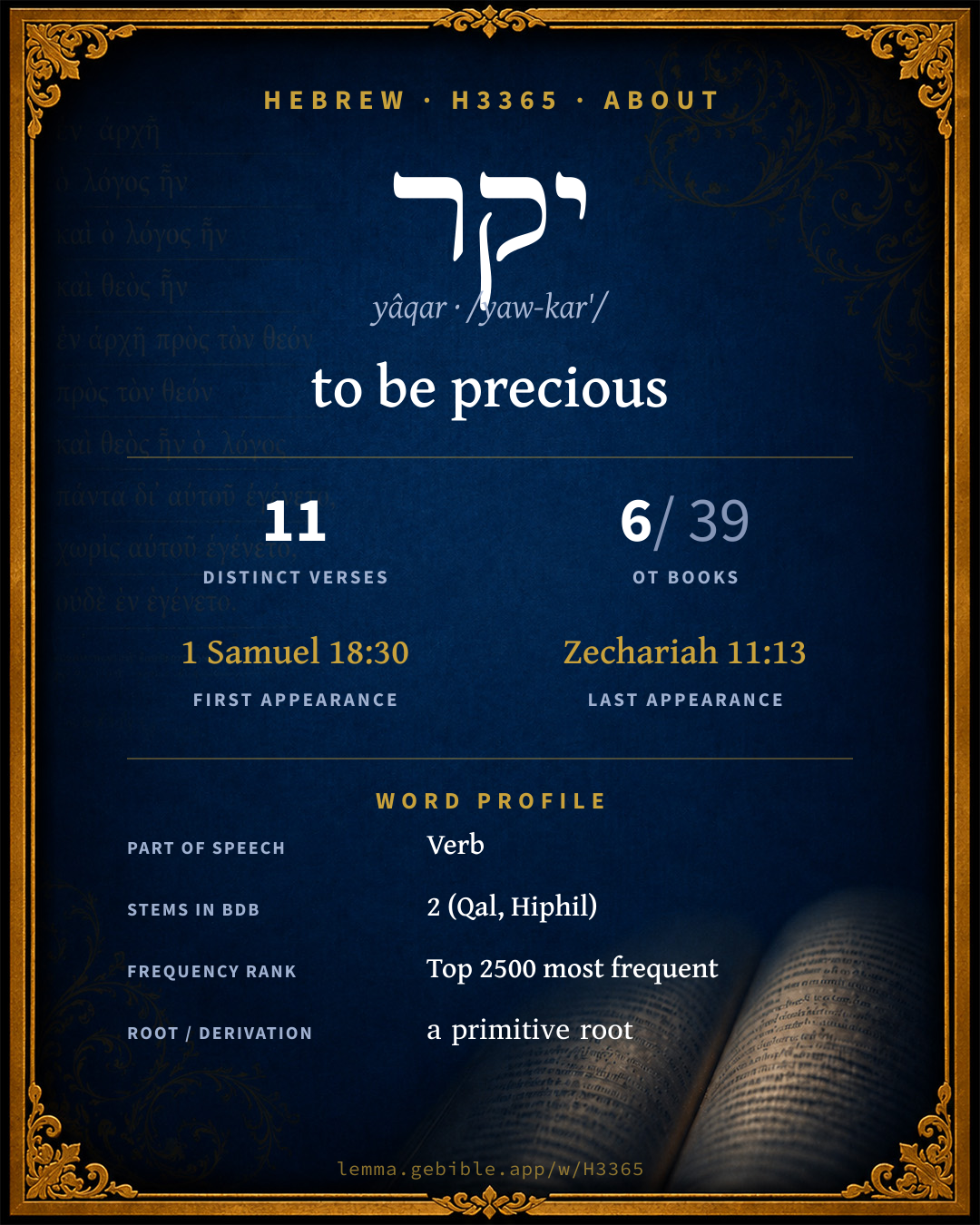
יָקַר
to be precious
‘to be precious’ is one of 2 main senses fuller range ↓
Full lexicon entry — Brown-Driver-Briggs (BDB)
From Brown-Driver-Briggs (BDB)
Where this word appears
Grammar key — what these labels mean
Part of speech
- Verb
- An action or state-of-being word.
Stem
- Qal
- The basic, simple active stem — the plain form of the verb (“he wrote”). Here: ‘be precious’
- Hiphil
- The causative active stem (“he caused / brought about”).
Form
- Imperfect
- An incomplete, ongoing, or future action (“he will / would write”).
- Sequential Imperfect
- An imperfect with prefixed waw — the standard past-narrative form (waw-consecutive imperfect).
- Imperative
- A direct command (“write!”).
- Jussive
- A third- or second-person volitional form expressing wish or command (“let him write”).
- Perfect
- A completed action or state — Hebrew marks aspect (completeness) more than strict tense (“he wrote”).
Person
- 3rd Person
- The one spoken about (“he / she / it / they”).
- 1st Person
- The speaker (“I / we”).
- 2nd Person
- The one addressed (“you”).
Gender
- Masculine
- Grammatically masculine.
- Common
- Either gender — not distinguished for this form.
- Feminine
- Grammatically feminine.
Number
- Singular
- One.
- Plural
- More than one (in Hebrew, generally three or more).
Every verse where H3365 appears in the Book of 2 Kings — 2 distinct verses. Click any verse to open its interlinear word-by-word view. Verse text shown in the World English Bible for context — . Each verse’s Hebrew form is shown with its reference; the English is not keyword-highlighted, since the data carries no word-level English alignment. Use “Compare translations” on any verse to read it across multiple English versions. This concordance covers the Hebrew Bible; Septuagint (Greek Old Testament) occurrences are not indexed here.
2 Kings
- 2 Kings 1:13 תִּֽיקַר Qal juss 3fs Again he sent the captain of a third fifty with his fifty. The third captain of fifty went up, and came and fell on his knees before Elijah, and begged him, and said to him, man of God, please let my life, and the life of these fifty your servants, be precious in your sight.
- 2 Kings 1:14 תִּיקַ֥ר Qal impf 3fs Behold, fire came down from the sky, and consumed the two former captains of fifty with their fifties; but now let my life be precious in your sight.
About this entry
At a glance — auto-summarized from this page’s data, not written by a person. Every figure links to its source below. This summary describes the numbers; it doesn’t interpret them.
יקר — transliterated yâqar — is a Hebrew verb carrying the sense “to be precious.” It first appears in 1 Samuel 18:30. With 11 verses in 6 books, it is an uncommon word in the Hebrew Bible. Its uses concentrate in Psalms (27% of all occurrences). The verb spans 2 stems, from Qal to Hiphil. Each statement above links to its evidence; the full detail follows below.
Gloss history
Strong's 1890 vs modern scholarship
About this word
Strong's H3365 catalogs a Hebrew word from the Hebrew Old Testament.
These counts are not copied from any lexicon or concordance. They are computed here, from the morphology-tagged Hebrew Old Testament. What Lemma adds →
- 11
- distinct verses
- The word appears in 11 distinct verses.
- 6 / 39
- OT books
- The word appears in 6 of 39 Old Testament books.
- #2,210
- by frequency
- Top 2500 most frequent Hebrew words (rank 2,210 of 8,640 Hebrew words by occurrence).
View all 11 occurrences in the concordance →
By section of the Old Testament
By traditional corpus
Conventional, traditional groupings — biblical authorship is debated, so this is a traditional corpus grouping, not an authorship claim. Each share is this word’s portion of its verses in that division of the Hebrew canon. Each figure is a share of the word’s 11 distinct verses.
- Prophets (Nevi'im) 7 verses · 64%
- Writings (Ketuvim) 4 verses · 36%
How translations render this word
Counts come from each version’s own published word-to-Strong’s tagging or interlinear alignment — an approximate guide to how each version renders this word, not a word-level alignment the data otherwise carries. Because each total is that version’s own tagged count, the per-version totals vary from one another and need not match the appearance or distinct-verse counts above. These counts may also differ from a printed concordance because Lemma counts each distinctly tagged rendering and does not collapse phrase taggings into a single head-word total. This is a fixed set of word-tagged versions (KJV, ASV, BSB, ULT) and does not change with the reading translation you choose elsewhere. Each version’s license is shown beside its name below (and on Sources).
- King James Version: Be precious 1×, How precious 1×, I was prised at 1×
- American Standard Version: Be precious 2×
- Berean Standard Bible: Be precious 2×
- unfoldingWord Literal Text: Be valuable 2×, Let 2×
King James Version Public Domain
Renders H3365 across 11 tagged occurrences — most commonly:
American Standard Version Public Domain
Renders H3365 across 11 tagged occurrences — most commonly:
Plus 9 renderings that appear only once — usually multi-word phrases or single function words the recovered tagging swept in, not distinct renderings.
Berean Standard Bible Public Domain
Renders H3365 across 11 tagged occurrences — most commonly:
Plus 9 renderings that appear only once — usually multi-word phrases or single function words the recovered tagging swept in, not distinct renderings.
unfoldingWord Literal Text CC BY-SA 4.0
Renders H3365 across 18 tagged occurrences — most commonly:
Plus 14 renderings that appear only once — usually multi-word phrases or single function words the recovered tagging swept in, not distinct renderings.
Senses in the full BDB
Hebrew verbs can shift meaning by stem (binyan): Qal is the basic action, Niphal is often passive or reflexive, Piel often intensifies or makes it factitive, and Hiphil is typically causative. The senses below are grouped under the stem BDB assigns to each.
What do BDB’s symbols mean?
BDB uses these scholarly abbreviations:
| Symbol | Meaning |
|---|---|
| 𝔊 | the Septuagint (the ancient Greek translation, LXX) |
| 𝔙 | the Vulgate (the Latin translation) |
| 𝔖 | the Syriac version (the Peshitta) |
| 𝔗 | the Targum (the Aramaic translation) |
| ψ | the Psalms |
| √ | root (the underlying root or stem) |
| ‖ | parallel passage (a synonymous or contrasted parallel) |
| † | the dagger: every passage where the word occurs is cited |
The 3 senses and sub-senses the full Brown-Driver-Briggs lexicon distinguishes for this word, in lexicon order (not ranked by frequency), with BDB’s own verbatim wording and sub-sense lettering. Shown in Hebrew script with BDB’s own scholarly abbreviations. The condensed entry is in the Lexicon Entry tab. See also the Forms in the corpus table below.
Qal
- 1. be precious
- 2. be appraised
Hiphil
- . I will make men more rare (lit. precious) than fine gold
Senses from the full Brown-Driver-Briggs lexicon (Brown, Driver, Briggs; Oxford 1906 — public domain), digitized via Sefaria, supplemented by the OpenScriptures HebrewLexicon (CC BY 4.0). Full attribution on Sources.
Word origin
[ יָקַר ] vb. be precious, prized, appraised
— Brown-Driver-Briggs (Oxford 1906, public domain), digitized via Sefaria, supplemented by the OpenScriptures HebrewLexicon (CC BY 4.0). See Sources.
Origin: a primitive root
Jastrow Dictionary
A second Hebrew/Aramaic lexicon for comparison, covering Aramaic and post-biblical (Talmudic, Targumic, Midrashic) usage that the biblical-Hebrew BDB does not. Matched by lemma rather than by Strong’s number, so a lemma may carry more than one Jastrow headword (shown separately below), and the entries cover usage well beyond the Bible.
יָקַר
- (b. h.) to be heavy; (cmp. כָּבֵד, חוּמְרָא &c.) to be weighty, important, honored; [to be dear, precious; to hold dear, v. infra.] Tanḥ. B’shall. 27 יָקְרוּ ידיו של משה וכ׳ Moses’ hands grew as heavy as &c.; Mekh. B’shall., Amalek, s. 1. Ib. י׳ חטא על וכ׳ sin weighed heavily on Moses’ hands.
- to hold dear, honor. Deut. R. s. 7, end אני מגדול ומְיַיקֵּר אתכם וכ׳ I shall make you great and honored &c. Num. R. s. 23, end (ref. to a citation כי הנני משלחך כגבירה, found nowhere in the Bible—probably a reference to Jer. XXII, 26 a. XXIX, 2) מה הגבירה הזו אדם מְיַקּר אותה וכ׳ (or מֵיקַי Kal) as one (surely) holds in honor the g’birah (king’s mother), so did he (Nebucadnezar) to him (Jehoiachin); Tanḥ. Massé 13; ib. ed. Bub. 10 אדם מיקר לה. (Gen. R. s. 18 מיקרת ראשה she bears her head proudly; Yalk. Gen. 24; Yalk. Is. 265 מקלת, v. קָלַל).—Part. pass. מְיוּקָּר. Num. R. l. c. קשר אותו בקורכין שלו מי׳ he tied (and seated) him in his most honored (state) carriage; Tanḥ. l. c. … בקורנין וכ׳; ib. ed. Bub. l. c. קשר אותו בקרובין ומוֹקֵר לו (Ms. M. בקרונין) he tied … and paid him honor. e.g. Jeremiah 22:26
- 1. to grow dear, scarce; to rise in value. Y. Keth. XI, 34ᵇ bot. ה׳ המקח the price of the field was higher (than the amount due her for alimentation). Ib. XII, beg. 34ᵈ היו בזול והוֹקִירוּ, v. זוֹל. B. Mets. V, 9 שמא יוֹקִירוּ חטים wheat may rise in value; a. fr.
- 2. to honor. Tanḥ. ed. Bub. l. c., v. supra.
- as Hif. 1.—B. Bath. V, 8 והוּקְרוּ; B. Mets. V, 8 הוקרו (Y. ed. הוקירו). Gen. R. s. 35 ה׳ השמן oil became scarce (Yalk. Kings 228 הוקיר); a. fr.
יְקַר
- 1. to be heavy. Targ. Ps. XXXVIII, 5 יְקַרוּ (Ms. יקירו). Targ. Job XXXIII, 7 (some ed. אַיְקַר Af.). Targ. Gen. XLVIII, 10; Targ. O. Ex. XVII, 12 יְקָרָן, ed. Berl. יְקָרָא, v. Berl. Targ. O. II, p. 17); a. e.
- 2. to be dear, precious. Targ. I Sam. XXVI, 21. Targ. II Kings I, 13, sq.; a. fr.—B. Mets. 64ᵃ אי יַקְרָא וכ׳, v. זוּל I, ch.
- 1. to make heavy. Targ. Lam. III, 7 (ed. Amst. יְקַר, corr. acc.). Targ. Zech. VII, 11; a. fr.
- 2. to honor, hold dear. Targ. Is. V, 2. Ib. LVIII, 13; a. fr. Targ. Prov. XXV, 27 מילי מְיַקְּרָתָא honoring words (flatteries).—Koh. R. to II, 20; Lev. R. s. 25 תְּיַקְּרִינֵיה, v. מוֹקְרָא I; a. e.—[Gen. R. s. 17 מיקרך, v. יְקָרָא.]
- 3. to offer, present. Targ. Is. XLIII, 23 (not יְקרְתָּא). Targ. Prov. III, 9; a. e.
- 1. to honor, treat with regard. Targ. Ps. XV, 4. Targ. I Sam. II, 30; a. e.—B. Mets. 59ᵃ אוֹקִירוּ לנשייכו וכ׳ honor your wives (in dress &c.), in order that you may be blessed with wealth. Ber. 48ᵃ לא את קא מוֹקְרַת קָא מוֹקְרָא לי … Ms. M. (ed. היא דמְיַקְּרָא לי …) it is not thou that honorest me, but it is the Law that honors me. Y. Kidd. I, 61ᵇ הלואי … דאוֹקְרִינוּן ואירת ג"ע Oh, that I had father and mother (alive) that I might honor them and inherit paradise; Y. Peah I, 15ᶜ bot. דאַיְקְרִינְהון ונירת וכ׳; a. fr.
- 2. to offer. Y. Bets. V, end 63ᵇ אוֹקְרֵיה חד סרקיי כמהין a Saracen sent him mushrooms as a present (on a Holy Day). Y. B. Bath. II, end, 13ᶜ אוֹקְרַת תאנין וכ׳ brought R. … figs as a present; a. fr.—[
- 3. to be heavy. Targ. Job XXXIII, 17, v. supra.]
- 1. to become heavy, burdensome. Targ. Lam. I, 14. Targ. O. Ex. VII, 14 (h. text כבד); a. e.—[Ab. Zar. 46ᵇ אייקר ליה תלמודא ed., Ms. M. איעקר גמריה, v. עֲקַר.]
- 2. to be honored, to honor one’s self. Targ. II Sam. VI, 20. Targ. Ex. XIV, 17, sq.; a. fr.—Snh. 46ᵇ כי היכי דמִיַּיקַּר וכ׳ (Ms. M. מִתְיַי׳, לִיתְיַי׳ &c.) that Abraham be honored through her (at her funeral). Ib. לִיַּיקְּרוּ בך … דמִתְיַיקְּרֵי וכ׳ Israel will be honored through thee (at thy funeral), as they were honored at the funerals of thy ancestors. Meg. 28ᵃ אִתְיַיקּוּרֵי דמתייקרי בי they desire to be honored by me (by inviting me); a. e.
- 3. to rise in value. B. Kam. 103ᵃ איי׳ כיתנא flax grew dearer. Ber. 5ᵇ; a. e.
יָקָר
- preced. wds.)
- 1. heavy; dear, precious, worthy; honored. Tosef. B. Kam. IX, 12 המתבייש מן הי׳ who is put to shame by a person of high dignity (opp. פגום).—Pl. יְקָרִים, יְקָרִין. B. Bath. 100ᵇ; Meg. 23ᵇ (address to mourners) עמדו י׳ עמודו וכ׳ stand up, dear friends, stand up &c. Men. 44ᵃ דמיו י׳ its price is high; a. fr.—Tosef. Kel. B. Kam. III, 2 היְקָרִין R. S. to Kel. III, 5 (ed. היקירן, הייקרין) the heavy earthen vessels used for boiling pitch.—Fem. יְקָרָה, pl. יְקָרוֹת. Keth. 106ᵃ; Snh. 43ᵃ נשים י׳ וכ׳ worthy women in Jerusalem.—V. יַקִּיר.
- 2. (noun) precious object, prize; choice. Gen. R. s. 67 (ref. to Prov. XII, 27) כדי … שהוא יְקָרוֹ של עולם וכ׳ in order that Jacob might come who is the choice of the world &c.; ib. שאינם נוטלים מן יְקָרָם שלעתיד לכוא וכ׳ that they shall receive in this world nothing of their prize reserved for the hereafter; Yalk. ib. 115, v. חָרַץ.—Pl. יְקָרוֹת. Ib. כדי … ויטול את הברכות שהן י׳ של עולם חרוצות לו in order that Jacob might come and take the blessings, which are the choice of the world, decreed to him (Gen. R. l. c. שמעיקר העולם חרוצות לו). e.g. Proverbs 12:27
יְקָר
- preced. wds.)
- 1. gravity, dignity, honor. Meg. 16ᵇ (ref. to Esth. VIII, 17) וִי׳ אלו תפלין ‘and dignity (distinction)’ that means the T’fillin. e.g. Esther 8:17
- 2. heavy fog, mist. Yalk. Ps. 730 כי׳ של מדבר (ref. to כיקר, Ps. XXXVII, 20) like the mist of the desert.—Pl. יְקָרִים Ib. e.g. Psalms 37:20
יְקָר ²
- 1. honor, dignity. Targ. Ex. XVI, 7. Targ. Ps. LXXXVII, 3. Ib. VIII, 6 Ms. (ed. אַיְקָרָא, v. אִיקָר); a. fr.—Ber. 28ᵃ top מַן י׳ Ms. M. (ed. כסא דמוקרא, Ms. F. דִּיקָרָא) a vessel of honor (precious vessel). Snh. 46ᵇ הספידא י׳ וכ׳ are funeral ceremonies (eulogies, wailings &c.) for the honor of the deceased or of the survivors? Ib. הנהו בני י׳ נינהו were those (the survivors of the house of Jeroboam) worthy of honors?—Lev. R. s. 34 לית היא עבדא לִיקָרָךְ she acts (treats thee) not according to thy dignity; Gen. R. s. 17 לִיקַרְתָּךְ. Ib. דליתה מִיְּקָרָךְ for she is not (part) of thy dignity, i.e. not worthy of thee; Yalk. Lev. 665 דלית היא יקרך, a. דיקרך; Yalk. Is. 352 דיק׳; Y. Keth. XI, 34ᵇ bot. דאִיקְרָךְ.—Ber. 19ᵃ הקב"ה תבע בִּיקָרֵיה the Lord takes up the cause of his offended dignity; a. fr.—Pl. יִקְרַיָּא. B. Kam. 102ᵇ bot. יִקְרַיְיכוּ, v. זִילוּתָא.
- 2. value, price. Targ. Ps. XLIX, 9 אילו יהיב יקר וכ׳ Ms. (ed. Lag. ויהיב יקר; ed. ויהי יקיר) were he to pay the price for their redemption.—Y. Sabb. VI, 8ᵃ bot. (in a prob. corrupted sentence) וי׳ אוף ציבחר הוה סידרה יקיר though the value (of the sandal) was but a trifle, yet order (consistency in decisions) is precious; Y. Yeb. XII, 12ᵈ top (corr. acc.).
יַקִּר
- , v. יַקִּיר ch.
A Dictionary of the Targumim, the Talmud Babli and Yerushalmi, and the Midrashic Literature (Marcus Jastrow; London, Luzac, 1903) — Public Domain. Digitized via Sefaria. Digitized via Sefaria. Full attribution on Sources.
Forms in the corpus
The 11 distinct written forms H3365 takes in the Hebrew Bible, most frequent first — each parse links to that stem’s occurrences in the concordance. Hebrew forms include their vowel points and cantillation, so a single lemma takes many written forms.
Same root — word family
Other BDB entries built from the same root as H3365, grouped by Strong’s listed origin. These share a root / origin per the lexicon — not necessarily a shared meaning. Each links to that word’s own entry.
Derived from this word
Compare all same-root words → They share a root, not necessarily a meaning.
Septuagint verse parallels
This word appears in 9 verses that also exist in the Greek Old Testament (Septuagint), out of the 11 Hebrew verses it occurs in. You can read those verses in Greek by switching the Old Testament edition to the Septuagint.
Read these verses in the Septuagint
This is a verse-level parallel only — the same verses exist in both the Hebrew and Greek Old Testaments. No word-level Hebrew↔Greek correspondence is claimed: the data carries no such alignment, so no Greek word is shown as this Hebrew word’s translation. Coverage is not total — the Septuagint omits the deuterocanon and renumbers the Psalms, so some Hebrew verses have no direct Greek parallel.