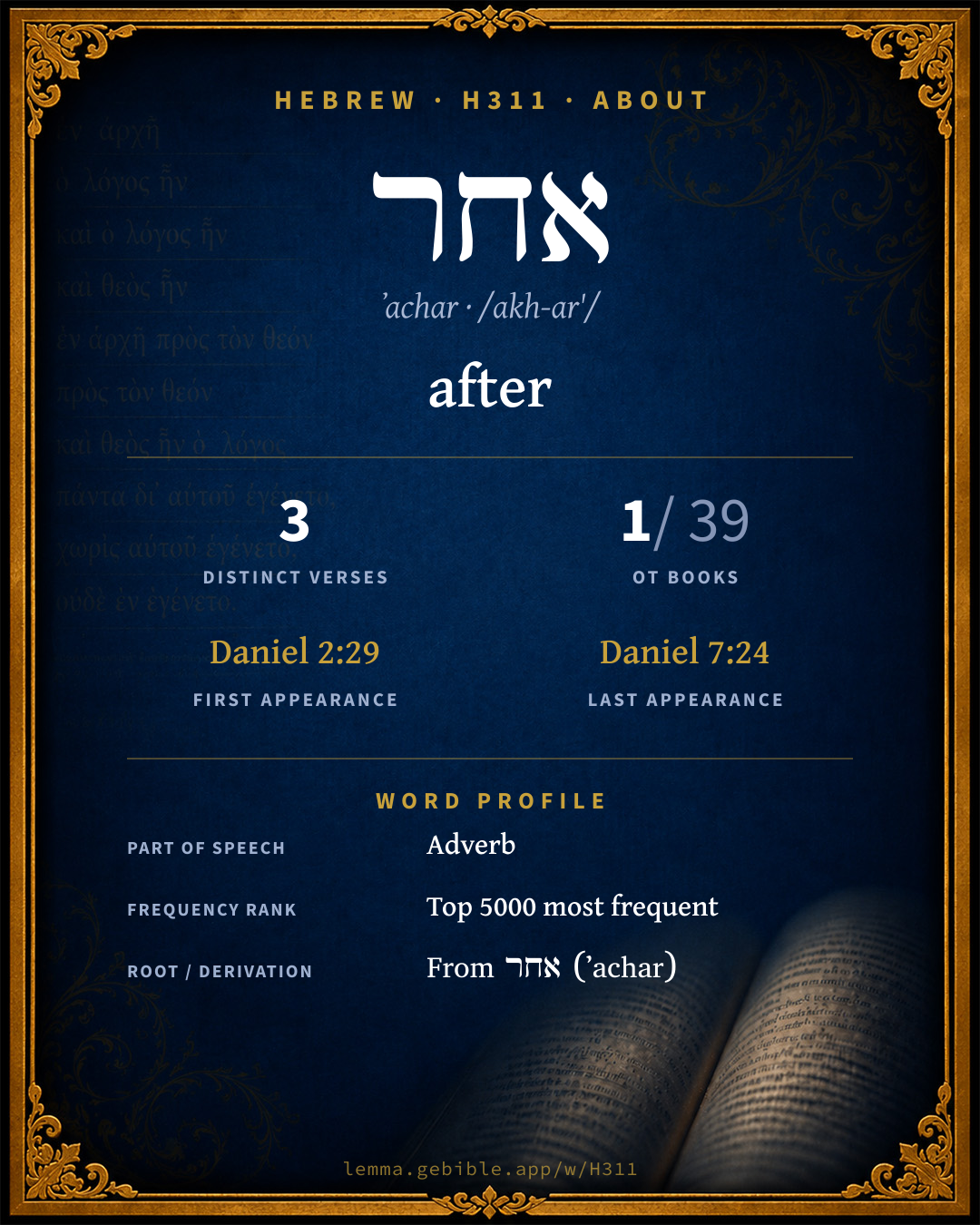
אַחַר
after
Full lexicon entry — Brown-Driver-Briggs (BDB)
From Brown-Driver-Briggs (BDB)
Where this word appears
Grammar key — what these labels mean
Part of speech
- Preposition
- A relational word (e.g. “in,” “to,” “from”) governing a noun.
Every verse where H311 appears — 3 distinct verses across 1 book. Click any verse to open its interlinear word-by-word view. Verse text shown in the World English Bible for context — . Each verse’s Hebrew form is shown with its reference; the English is not keyword-highlighted, since the data carries no word-level English alignment. Use “Compare translations” on any verse to read it across multiple English versions. This concordance covers the Hebrew Bible; Septuagint (Greek Old Testament) occurrences are not indexed here.
Daniel 3 verses
- Daniel 2:29 אַחֲרֵ֣י prep as for you, O king, your thoughts came [into your mind] on your bed, what should happen hereafter; and he who reveals secrets has made known to you what shall happen.
- Daniel 2:45 אַחֲרֵ֣י prep Because you saw that a stone was cut out of the mountain without hands, and that it broke in pieces the iron, the brass, the clay, the silver, and the gold; the great God has made known to the king what shall happen hereafter: and the dream is certain, and the interpretation of it sure.
- Daniel 7:24 אַחֲרֵי/ה֗וֹן prep + sfx pers 3mp As for the ten horns, out of this kingdom shall ten kings arise: and another shall arise after them; and he shall be diverse from the former, and he shall put down three kings.
About this entry
At a glance — auto-summarized from this page’s data, not written by a person. Every figure links to its source below. This summary describes the numbers; it doesn’t interpret them.
At its core, אחר (ʼachar) means “after.” With only 3 verses it sits in the long tail of Hebrew Bible vocabulary. Its uses cluster heavily in Daniel (100% of all occurrences). First canonically at Daniel 2:29, it enters the text early. From the same root come אחר, אחרית and אחרי. Each statement above links to its evidence; the full detail follows below.
Gloss history
Strong's 1890 vs modern scholarship

About this word
Strong's H311 catalogs a Hebrew word from the Hebrew Old Testament.
These counts are not copied from any lexicon or concordance. They are computed here, from the morphology-tagged Hebrew Old Testament. What Lemma adds →
- 3
- distinct verses
- The word appears in 3 distinct verses.
- 1 / 39
- OT books
- The word appears in 1 of 39 Old Testament books.
- #4,179
- by frequency
- Top 5000 most frequent Hebrew words (rank 4,179 of 8,640 Hebrew words by occurrence).
View all 3 occurrences in the concordance →
Most concentrated in
- Daniel 3 verses 100%
By section of the Old Testament
By traditional corpus
Conventional, traditional groupings — biblical authorship is debated, so this is a traditional corpus grouping, not an authorship claim. Each share is this word’s portion of its verses in that division of the Hebrew canon. Each figure is a share of the word’s 3 distinct verses.
- Writings (Ketuvim) 3 verses · 100%
How translations render this word
Counts come from each version’s own published word-to-Strong’s tagging or interlinear alignment — an approximate guide to how each version renders this word, not a word-level alignment the data otherwise carries. Because each total is that version’s own tagged count, the per-version totals vary from one another and need not match the appearance or distinct-verse counts above. These counts may also differ from a printed concordance because Lemma counts each distinctly tagged rendering and does not collapse phrase taggings into a single head-word total. This is a fixed set of word-tagged versions (KJV, ASV, BSB, ULT) and does not change with the reading translation you choose elsewhere. Each version’s license is shown beside its name below (and on Sources).
- King James Version: Hereafter 2×
- American Standard Version: Hereafter 2×
- Berean Standard Bible: Future 2×
- unfoldingWord Literal Text: After 2×
King James Version Public Domain
Renders H311 across 3 tagged occurrences — most commonly:
Plus 1 rendering that appears only once — usually multi-word phrases or single function words the recovered tagging swept in, not distinct renderings.
American Standard Version Public Domain
Renders H311 across 3 tagged occurrences — most commonly:
Plus 1 rendering that appears only once — usually multi-word phrases or single function words the recovered tagging swept in, not distinct renderings.
Berean Standard Bible Public Domain
Renders H311 across 3 tagged occurrences — most commonly:
Plus 1 rendering that appears only once — usually multi-word phrases or single function words the recovered tagging swept in, not distinct renderings.
unfoldingWord Literal Text CC BY-SA 4.0
Renders H311 across 3 tagged occurrences — most commonly:
Plus 1 rendering that appears only once — usually multi-word phrases or single function words the recovered tagging swept in, not distinct renderings.
18 senses and sub-senses in the full BDB
What do BDB’s symbols mean?
BDB uses these scholarly abbreviations:
| Symbol | Meaning |
|---|---|
| 𝔊 | the Septuagint (the ancient Greek translation, LXX) |
| 𝔙 | the Vulgate (the Latin translation) |
| 𝔖 | the Syriac version (the Peshitta) |
| 𝔗 | the Targum (the Aramaic translation) |
| ψ | the Psalms |
| √ | root (the underlying root or stem) |
| ‖ | parallel passage (a synonymous or contrasted parallel) |
| † | the dagger: every passage where the word occurs is cited |
The 18 senses and sub-senses the full Brown-Driver-Briggs lexicon distinguishes for this word, in lexicon order (not ranked by frequency), with BDB’s own verbatim wording and sub-sense lettering. Shown in Hebrew script with BDB’s own scholarly abbreviations. The condensed entry is in the Lexicon Entry tab. See also the Forms in the corpus table below.
- 1. adv.
- a. of place, behind, twice Gn 22:13 (many MSS. Sam. 𝔊 𝔖 Ol Ew read אֶחָד v. Di) ψ 68:26. e.g. Genesis 22:13
- b. of time, afterwards Gn 10:18; 18:5; 24:55; 30:21 Ju 19:5 +; וְאַחַר in laws of P, as Lv 14:8, 19; 15:28; 22:7 Nu 5:26 al. e.g. Genesis 10:18
- 2. prep.
- a. of place, behind, after Ex 3:1; 11:5 2 K 11:6 Ct 2:9 Is 57:8: הָלַךְ אַחַר to go after, follow Gn 37:17 2 K 13:2; 23:3 Is 65:2 Ez 13:3 Jb 31:7; הָיָה אַחַר 1 S 12:14; מֵאַחַר from after †2 S 7:8 ψ 78:71 Is 59:13. e.g. Exodus 3:1
- b. of time, after Gn 9:28 Lv 25:15 al; אַחַר הַדְּבָרִים הָאֵלֶּה after these things †Gn 15:1; 22:1; 39:7; 40:1 1 K 17:17; 21:1 Ezr 7:1 Est 2:1; 3:1; אַחַר כֵּן †Lv 14:36 Dt 21:13 1 S 10:5; אַחַר זֶה (late) 2 Ch 32:9: sq. inf. †Nu 6:19 Je 40:1 1 Ch 2:24 Jb 21:3; עַד אַחַר till after †Ne 13:19. e.g. Genesis 9:28
- c. Ne 5:15 strangely: Ew RV besides; but text prob. corrupt, v. BeRy. e.g. Nehemiah 5:15
- 3. †conj. אַחַר אֲשֶׁר after that Ez 40:1; and without אשׁר Lv 14:43 Je 41:16 Jb 42:7. As prep. & conj. the pl. אַחֲרֵי is much more freq., which in any case must be used before suffixes. e.g. Ezekiel 40:1
Plur
- only cstr. אַחֲרֵי with sf. אַחֲרַי, אַחֲרֶיךָ, etc.
- 1. subst. hinder part †2 S 2:23 בְּאַחֲרֵי הַחֲנִית with the hinder end of the spear. e.g. 2 Samuel 2:23
- 2. prep.
- a. of place, behind, after, Gn 18:10 וְהוּא אַחֲרָיו and it behind him Dt 11:30 Ju 5:14 1 S 14:13; 21:10; Ho 5:8 אַחֲרֶיךָ Behind thee! (sc. Look or The foe is); with a vb. as הִבִּיט to look Gn 19:17 1 S 24:9, הֵנִיעַ רֹאשׁ to shake the head 2 K 19:21 (= Is 37:22), especially verbs expressing or implying motion, as בָּא to enter in (v. Dr 2 S 20:14), בִּעֵר, דָּבֵק, דָּלַק, הָיָה, הָלַךְ, מִלֵּא, פָּנָה, רָדַף, הִשְׁלִיךְ (see these words). e.g. Genesis 18:10
- b. of time, after Gn 9:9 זַרְעֲכֶם אַחֲרֵיכֶם your seed after you; similarly 17:7–10, 19; 35:12; 48:4 Ex 28:43 Nu 25:13 all P (also Dt 1:8; 4:37; 10:15 1 S 24:22 2 S 7:12 ‖), & with בָּנָיו Gn 18:19 J (+ בֵּיתוֹ) Ex 29:29 P Lv 25:46 H Dt 4:40; 12:25, 28 Je 32:18, 39 1 Ch 28:8 Pr 20:7, דּוֹרוֹתֵינוּ Jos 22:27, בֵּיתוֹ Jb 21:21; Ex 10:14 Ju 10:3 etc.; with inf. Gn 5:4 אַחֲרֵי הוֹלִידוֹ after his begetting Sheth, 13:14; 14:17; 18:12; 25:11 + often; אַחֲרֵי־כֵן afterwards Gn 6:4 (אחרי כן אשׁר = afterwards, when, cf. 2 Ch 35:20) 15:14; 23:19; 25:26; 32:21; 41:31; 45:15 etc.; ויהי אחרי־כן as a formula of transition chiefly in 2 S (2:1; 8:1 ‖ 10:1 ‖ 13:1; 21:18 ‖) cf. 1 S 24:6 Ju 16:4 2 K 6:24 2 Ch 20:1 24:4†; in late Heb. אַחֲרֵי זֹאת †Jb 42:16 Ezr 9:10 2 Ch 21:18 (+ כָּלִ־) 35:20 (do.); cf. Aramaic אַחֲרִי דְנָה Dn 2:29, 45, and בָּאתַר דְּנָה Dn 7:6, 7.—The local (metaph.) and temporal senses blend ψ 49:14 וְאַחֲרֵיהֶם בְּפִיהֶם יִרְצוּ & after them (i.e. following, imitating them) men applaud their speech, cf. Jb 21:33. e.g. Genesis 9:9
- 3. conj. אַחֲרֵי אֲשֶׁר after that, with the finite vb. Dt 24:4 Jos 7:8; 9:16; 23:1; 24:20 +; without אשׁר †Lv 25:48; 1 S 5:9†. (The most common constr. of אחרי is as a prep. with the inf. cstr.) Jos 2:7 אַהֲרֵי כַּאֲשֶׁר יָצְֽאוּ must be an error, either for אחרי אשׁר or for כאשׁר alone (notice אחריהם twice in the same verse); 2 S 24:10 read אַחֲרֵי סָפַר vid. Dr e.g. Deuteronomy 24:4
- 4. with other preps.:—
- a. מֵאַחֲרֵי57, 1 Ch 17:7 מִן־אַחֲרֵי (‖ 2 S 7:8 מֵאַחַר); (α) from behind Gn 19:26 2 S 2:23; from after i.e. from following after, usually with שׁוּב or סוּר 1 S 24:2 2 S 2:22, 26, 30; 11:15; often with God as obj. as Nu 14:43; 32:15 Dt 7:4 Jos 22:16, 18, 23, 29 1 S 15:11 +; with other vbs. of motion, as עָלָה 1 S 14:46 2 S 20:2, נַעֲלָה 2 S 2:27, לָקַח Am 7:15 1 Ch 17:7, זָנָה Ho 1:2; pregn. Is 30:21 thy ears shall hear a word מֵאַחֲרֶיךָ coming from behind thee, Je 9:21 (sc. נָפַל, see v a) 1 S 13:7 𝔊L We Dr חָֽרְדוּ מֵאַחֲרָיו. (β) denoting position (מן = off, on the side of; see מן) behind Ex 14:19(×2) Jos 8:2, 4, 14 1 K 10:19 Ne 4:7 (מֵאַחֲרֵי לְ) 2 Ch 13:13, b. (γ) of time (rare) †Dt 29:21 Ec 10:14; מֵאַחֲרֵי כֵן †2 S 3:28; 15:1; 2 Ch 32:23. e.g. 1 Chronicles 17:7
- b. †אֶל־אַחֲרֵי 2 S 5:23 2 K 9:18 סֹב אֶל־אַחֲרַי v 19 Zc 6:6. e.g. 2 Samuel 5:23
- c. †עַל־אַחֲרֵי Ez 41:5 beside, at the back of. e.g. Ezekiel 41:5
Senses from the full Brown-Driver-Briggs lexicon (Brown, Driver, Briggs; Oxford 1906 — public domain), digitized via Sefaria, supplemented by the OpenScriptures HebrewLexicon (CC BY 4.0). Full attribution on Sources.
Word origin
proposes subst. the hinder or following part (cf. the pl.)
— Brown-Driver-Briggs (Oxford 1906, public domain), digitized via Sefaria, supplemented by the OpenScriptures HebrewLexicon (CC BY 4.0). See Sources.
Derived from אחר (ʼachar) (H310) — after.
Jastrow Dictionary
A second Hebrew/Aramaic lexicon for comparison, covering Aramaic and post-biblical (Talmudic, Targumic, Midrashic) usage that the biblical-Hebrew BDB does not. Matched by lemma rather than by Strong’s number, so a lemma may carry more than one Jastrow headword (shown separately below), and the entries cover usage well beyond the Bible.
אָחַר
- 1. to be behind, v. Pi.
- 2. (euphem.) to cover (of camels). B. Bath. 93ᵃ; Shebu. 34ᵃ; Snh. 37ᵇ (Ms. M. B. Bath. l. c. יהיר). Tosef. B. Kam. III, 6 אוֹחֵיר.
- to tarry, hesitate; to set behind. Pes. IX, 9 אם אֵחַרְתִּי if I should be late. Y. Yoma III, 40ᶜ top א׳ בו מעשה the text orders a later action after it. Y. Ned. X, 42ᵃ; 42ᵇ א׳ בעמידה he tarried in standing, i.e. was the last to sit down. Gen. R. s. 81, beg. א׳ אדם את נדרו if one procrastinates the fulfillment of his vow; a. fr.
- to be postponed, be done late, be placed later. Y. Yoma III, 40ᶜ top בכלל מְאוּחָר היה would belong to things to be done later. Ib. יוּאֲחַר וכ׳ let it be done later than &c.—אין מוקדם ומאוחר בתורה there is no ‘earlier’ or ‘later’ (no chronological order) in the events or laws of the Scripture. Pes. 6ᵇ; a. e.; Y. Sot. VIII, 22ᵈ מוּאֲחַר.—Shebi. X, 5, a. fr. מאוחר (a document) postdated, opp. מוקדם antedated. B. Mets. V, 10 רבית מְאוּחֶרֶת postpaid interests.
אֲחַר
- 1. to be behind.
- 2. *to cover. Targ. Jer. V, 8 (of steeds, h. text מוזנים; some ed. ד for. ר).
- take ye a later meal (on Sabbaths).
- same. Targ. II Sam. XX, 5; a. fr.—[Targ. Prov. XXIII, 30 מַוְחֲרִין, מְוַוחֲרִין Part. Af. or Pa. of יחר = מוֹחר׳, מאחר׳.]
- , contr. אִתְחַר to be delayed. Targ. Y. I Deut. I, 2; cmp. however ib. v. 6, v. אֲרַח.
אַחַר
- v. foreg.), pl. constr. אַחֲרֵי after, behind. Gen. R. s. 44 wherever the Bible uses the preposition aḥaré סמוך, it means in connection with, אחר מופלג while aḥar means without connection (later on). Yoma 6ᵃ אחר א׳ after ‘after’, i.e. some time after the act, opp. חד אחר one ‘after’, immediately, v. אֶוְתִּיוֹס.—לְאַחֲרָיו, לְאַחֲרֶיהָ, מֵאַחֲרָיו, מֵאַחֲרֶיהָ after it, as concluding, opp. לפניה, לפניו introductory (prayer).—Ber. I, 4 אחת לא׳ one benediction after the Sh’ma. Ib. III, 4 לאחריו (prayer) after meal; a. fr.—כִּלְאַחַר יד as if doing a thing with the back of the hand, i.e. in a manner different from the usual way of doing it. Sabb. 153ᵇ; a. fr.—מֵאַחַר
- 1. (conj. followed by ש־ or ד־) after, since, whereas, because. Ḥull. 29ᵃ מא׳ ששנינו after it has once been stated in the Mishnah … why was it necessary (?) &c. Ib.ᵇ ומאחר דאפי׳ וכ׳ and since it is not even rabbinically unfit, why &c.; a. fr.
- 2. a legal term, meaḥar, the presumption of the truth of one’s statement, because he might have pleaded more profitably, if he had been inclined to lie. Y. Shebu. VI, 36ᵈ bot. אין אומרים בממון מא׳ מאחר וכ׳ in money matters we do not apply the principle of meaḥer, so as to say that because he might have said ‘thou hast not lent me anything’, he may say, ‘thou didst lend me, but I paid half of it’ (and his plea must be accepted without an oath); v. מִיגּוֹ s. v. גּוֹ.—אַחֲרֶיךָ thy successor. Y. Kil. IX, 32ᶜ top יהודה בני א׳ וכ׳ my son Judah shall succeed thee, none else (is worthy). Keth. 95ᵇ my property I bequeath to thee ואַחֲרַיִיךְ לפ׳ and after thee it shall go over to …—אַחַר כָּךְ (abbrev. אח"כ) afterwards, subsequently. Pes. X, 2; a. v. fr.
אַחֵר
- v. foreg. a. [back of,] another, the other, stranger. דבר א׳ (abbr. ד"א)
- 1. another thing, another explanation. Snh. IV, 5; a. v. fr. in Midr.
- 2. euphem. for idolatry, swine &c., v. דָּבָר.
- 3. Aḥer, [apostate,] byname of Elisha ben Abuyah. Ḥag. 14ᵇ; a. e.—Pl. אֲחֵרִים others; 1) freq. in Mishn. for anonymous authorities differing in opinion, א׳ אומרים, v. Hor. 13ᵇ אסיקו לר׳ מאיר א׳ R. Meïr is quoted under the word aḥerim.—2) freq. for strangers, gentiles. Snh. 52ᵇ אשת א׳ the wife of a non-Israelite. B. Mets. 111ᵇ; a. fr.—Fem. אֲחֶרֶת. Yoma I, 1 אשה א׳ a second (additional) wife; a. fr.—Snh. 104ᵃ זאת ועוד א׳ this and something besides (shall happen).
A Dictionary of the Targumim, the Talmud Babli and Yerushalmi, and the Midrashic Literature (Marcus Jastrow; London, Luzac, 1903) — Public Domain. Digitized via Sefaria. Digitized via Sefaria. Full attribution on Sources.
Forms in the corpus
The 2 distinct written forms H311 takes in the Hebrew Bible, most frequent first — each parse links to that state’s occurrences in the concordance. Hebrew forms include their vowel points and cantillation, so a single lemma takes many written forms.
| Form | Parsing | Example | Uses |
|---|---|---|---|
| אַחֲרֵ֣י | Preposition | Daniel 2:29 | 2 |
| אַחֲרֵי/ה֗וֹן | Preposition | Daniel 7:24 | 1 |
Same root — word family
Other BDB entries built from the same root as H311, grouped by Strong’s listed origin. These share a root / origin per the lexicon — not necessarily a shared meaning. Each links to that word’s own entry.
Derives from
Shares the same root
Derived from this word
Proper names from this root
People and places named from this root — a name, not an additional meaning of the word.
Compare all same-root words → Showing 4 of 8 — not the complete family. 2 of the same-root words are proper names (people or places). They share a root, not necessarily a meaning.
Septuagint verse parallels
This word appears in 3 verses that also exist in the Greek Old Testament (Septuagint), out of the 3 Hebrew verses it occurs in. You can read those verses in Greek by switching the Old Testament edition to the Septuagint.
Read these verses in the Septuagint
This is a verse-level parallel only — the same verses exist in both the Hebrew and Greek Old Testaments. No word-level Hebrew↔Greek correspondence is claimed: the data carries no such alignment, so no Greek word is shown as this Hebrew word’s translation. Coverage is not total — the Septuagint omits the deuterocanon and renumbers the Psalms, so some Hebrew verses have no direct Greek parallel.