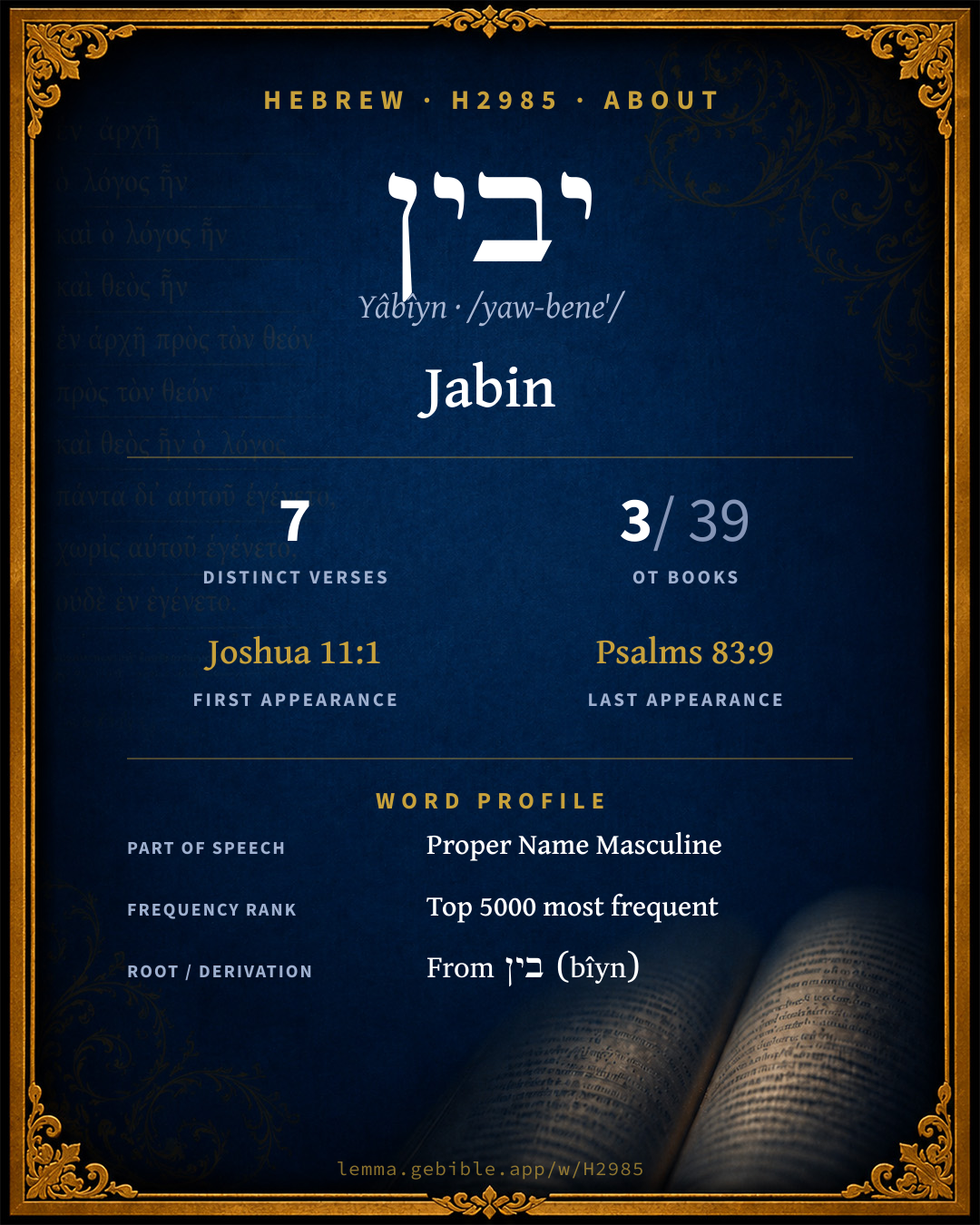
יָבִין
Jabin
BDB lists 3 entries for ‘Jabin’ fuller range ↓
Full lexicon entry — Brown-Driver-Briggs (BDB)
From Brown-Driver-Briggs (BDB)
Where this word appears
Grammar key — what these labels mean
Part of speech
- Noun
- A naming word — a person, place, thing, or idea.
Noun type
- Proper
- A name of a specific person, place, or people (e.g. Abraham, Zion, Israel).
Every verse where H2985 appears in the Book of Judges — 5 distinct verses. Click any verse to open its interlinear word-by-word view. Verse text shown in the World English Bible for context — . Each verse’s Hebrew form is shown with its reference; the English is not keyword-highlighted, since the data carries no word-level English alignment. Use “Compare translations” on any verse to read it across multiple English versions. This concordance covers the Hebrew Bible; Septuagint (Greek Old Testament) occurrences are not indexed here.
Judges
- Judges 4:2 יָבִ֣ין n Proper Yahweh sold them into the hand of Jabin king of Canaan, who reigned in Hazor; the captain of whose host was Sisera, who lived in Harosheth of the Gentiles.
- Judges 4:7 יָבִ֔ין n Proper I will draw to you, to the river Kishon, Sisera, the captain of Jabin's army, with his chariots and his multitude; and I will deliver him into your hand.
- Judges 4:17 יָבִ֣ין n Proper However Sisera fled away on his feet to the tent of Jael the wife of Heber the Kenite; for there was peace between Jabin the king of Hazor and the house of Heber the Kenite.
- Judges 4:23 יָבִ֣ין n Proper So God subdued on that day Jabin the king of Canaan before the children of Israel.
- Judges 4:24 יָבִ֣ין יָבִ֥ין n Proper n Proper The hand of the children of Israel prevailed more and more against Jabin the king of Canaan, until they had destroyed Jabin king of Canaan.
About this entry
At a glance — auto-summarized from this page’s data, not written by a person. Every figure links to its source below. This summary describes the numbers; it doesn’t interpret them.
יבין (Yâbîyn) is a Hebrew name most often rendered “Jabin.” Judges dominates its distribution — 5 of 7 verses. The Hebrew Bible uses it across 7 verses — uncommon. It first appears in Joshua 11:1. The sections below give every occurrence and version rendering.
Gloss history
Strong's 1890 vs modern scholarship
About this word
Strong's H2985 catalogs a Hebrew word from the Hebrew Old Testament.
These counts are not copied from any lexicon or concordance. They are computed here, from the morphology-tagged Hebrew Old Testament. What Lemma adds →
- 7
- distinct verses
- The word appears in 7 distinct verses.
- 3 / 39
- OT books
- The word appears in 3 of 39 Old Testament books.
- #2,625
- by frequency
- Top 5000 most frequent Hebrew words (rank 2,625 of 8,640 Hebrew words by occurrence).
View all 7 occurrences in the concordance →
By section of the Old Testament
By traditional corpus
Conventional, traditional groupings — biblical authorship is debated, so this is a traditional corpus grouping, not an authorship claim. Each share is this word’s portion of its verses in that division of the Hebrew canon. Each figure is a share of the word’s 7 distinct verses.
- Prophets (Nevi'im) 6 verses · 86%
- Writings (Ketuvim) 1 verse · 14%
How translations render this word
Counts come from each version’s own published word-to-Strong’s tagging or interlinear alignment — an approximate guide to how each version renders this word, not a word-level alignment the data otherwise carries. Because each total is that version’s own tagged count, the per-version totals vary from one another and need not match the appearance or distinct-verse counts above. These counts may also differ from a printed concordance because Lemma counts each distinctly tagged rendering and does not collapse phrase taggings into a single head-word total. This is a fixed set of word-tagged versions (KJV, ASV, BSB, ULT) and does not change with the reading translation you choose elsewhere. Each version’s license is shown beside its name below (and on Sources).
BDB lists this Strong’s number as 2 distinct words (homographs). Each count above pools all of them and is not split by sense — see the Senses section below. A low-frequency rendering may belong to a different one of those words, not the primary meaning.
- King James Version†: Jabin 4×
- American Standard Version†: Jabin 5×
- Berean Standard Bible†: Jabin 6×
- unfoldingWord Literal Text†: Jabin 8×
King James Version Public Domain
Renders H2985 across 8† tagged occurrences — most commonly:
Plus 4 renderings that appear only once — usually multi-word phrases or single function words the recovered tagging swept in, not distinct renderings.
American Standard Version Public Domain
Renders H2985 across 8† tagged occurrences — most commonly:
Plus 3 renderings that appear only once — usually multi-word phrases or single function words the recovered tagging swept in, not distinct renderings.
Berean Standard Bible Public Domain
Renders H2985 across 8† tagged occurrences — most commonly:
Plus 2 renderings that appear only once — usually multi-word phrases or single function words the recovered tagging swept in, not distinct renderings.
unfoldingWord Literal Text CC BY-SA 4.0
Renders H2985 across 9† tagged occurrences — most commonly:
Plus 1 rendering that appears only once — usually multi-word phrases or single function words the recovered tagging swept in, not distinct renderings.
Senses in the full BDB
What do BDB’s symbols mean?
BDB uses these scholarly abbreviations:
| Symbol | Meaning |
|---|---|
| 𝔊 | the Septuagint (the ancient Greek translation, LXX) |
| 𝔙 | the Vulgate (the Latin translation) |
| 𝔖 | the Syriac version (the Peshitta) |
| 𝔗 | the Targum (the Aramaic translation) |
| ψ | the Psalms |
| √ | root (the underlying root or stem) |
| ‖ | parallel passage (a synonymous or contrasted parallel) |
| † | the dagger: every passage where the word occurs is cited |
The 2 senses and sub-senses the full Brown-Driver-Briggs lexicon distinguishes for this word, in lexicon order (not ranked by frequency), with BDB’s own verbatim wording and sub-sense lettering. Shown in Hebrew script with BDB’s own scholarly abbreviations. The condensed entry is in the Lexicon Entry tab. See also the Forms in the corpus table below.
- 1. Jos 11:1. e.g. Joshua 11:1
- 2. Ju 4:2, 7, 17, 23, 24(×2) ψ 83:10. (But cf. Be Ju 4:2 BuRS 66 ff.) e.g. Judges 4:2
Senses from the full Brown-Driver-Briggs lexicon (Brown, Driver, Briggs; Oxford 1906 — public domain), digitized via Sefaria, supplemented by the OpenScriptures HebrewLexicon (CC BY 4.0). Full attribution on Sources.
Word origin
I. n.pr.m. (one who is intelligent, discerning) two Canaanite kings of Hazor;—
II. v. sub בין p. 108a supr.
— Brown-Driver-Briggs (Oxford 1906, public domain), digitized via Sefaria, supplemented by the OpenScriptures HebrewLexicon (CC BY 4.0). See Sources.
Derived from בין (bîyn) (H995) — to understand.
Forms in the corpus
The 4 distinct written forms H2985 takes in the Hebrew Bible, most frequent first — each parse links to that state’s occurrences in the concordance. Hebrew forms include their vowel points and cantillation, so a single lemma takes many written forms.
| Form | Parsing | Example | Uses |
|---|---|---|---|
| יָבִ֣ין | Noun, Proper | Joshua 11:1 | 5 |
| יָבִ֔ין | Noun, Proper | Judges 4:7 | 1 |
| יָבִ֥ין | Noun, Proper | Judges 4:24 | 1 |
| כְ֝/יָבִ֗ין | Noun, Proper | Psalms 83:9 | 1 |
Same root — word family
Other BDB entries built from the same root as H2985, grouped by Strong’s listed origin. These share a root / origin per the lexicon — not necessarily a shared meaning. Each links to that word’s own entry.
Derives from
Shares the same root
- בין bêyn H996 between
- בינה bîynâh H998 understanding
- מבון mâbôwn H4000 ones who taught, ones who gave
- תבון tâbûwn H8394 understanding
Proper names from this root
People and places named from this root — a name, not an additional meaning of the word.
Compare all same-root words → Showing 4 of 7 — not the complete family. 1 of the same-root words is a proper name (a person or place). They share a root, not necessarily a meaning.
Bible dictionary
Public-domain dictionary articles matched to this entry by name (Jabin). A biblical name can be shared by more than one person or place, so an article may treat several.
Easton's Bible Dictionary · M. G. Easton, 1897
Discerner; the wise. (1.) A king of Hazor, at the time of the entrance of Israel into Canaan (Josh. 11:1-14), whose overthrow and that of the northern chief with whom he had entered into a confederacy against Joshua was the crowning act in the conquest of the land (11:21-23; comp. 14:6-15). This great battle, fought at Lake Merom, was the last of Joshua's battles of which we have any record. Here for the first time the Israelites encountered the iron chariots and horses of the Canaanites.
(2.) Another king of Hazor, called "the king of Canaan," who overpowered the Israelites of the north one hundred and sixty years after Joshua's death, and for twenty years held them in painful subjection. The whole population were paralyzed with fear, and gave way to hopeless despondency (Judg. 5:6-11), till Deborah and Barak aroused the national spirit, and gathering together ten thousand men, gained a great and decisive victory over Jabin in the plain of Esdraelon (Judg. 4:10-16; comp. Ps. 83:9). This was the first great victory Israel had gained since the days of Joshua. They never needed to fight another battle with the Canaanites (Judg. 5:31).
Smith's Bible Dictionary · William Smith, 1863
(whom God observes).
+ King of Hazor, who organized a confederacy of the northern princes against the Israelites. (Joshua 11:1-3) Joshua surprised the allied forces by the waters of Merom, ver. 7, and utterly routed them. (B.C. 1448.) During the ensuing wars Joshua again attacked Jabin, and burnt his city. (Joshua 11:1-14) + A king of Hazor, whose general, Sisera, was defeated by Barak. (Judges 4:2,13) (B.C. 1316.)
Hitchcock's Bible Names Dictionary · Roswell D. Hitchcock, 1869
Jabneh, he that understands; building
Classic public-domain reference works; full attribution on Sources.
Septuagint verse parallels
This word appears in 7 verses that also exist in the Greek Old Testament (Septuagint), out of the 7 Hebrew verses it occurs in. You can read those verses in Greek by switching the Old Testament edition to the Septuagint.
Read these verses in the Septuagint
This is a verse-level parallel only — the same verses exist in both the Hebrew and Greek Old Testaments. No word-level Hebrew↔Greek correspondence is claimed: the data carries no such alignment, so no Greek word is shown as this Hebrew word’s translation. Coverage is not total — the Septuagint omits the deuterocanon and renumbers the Psalms, so some Hebrew verses have no direct Greek parallel.