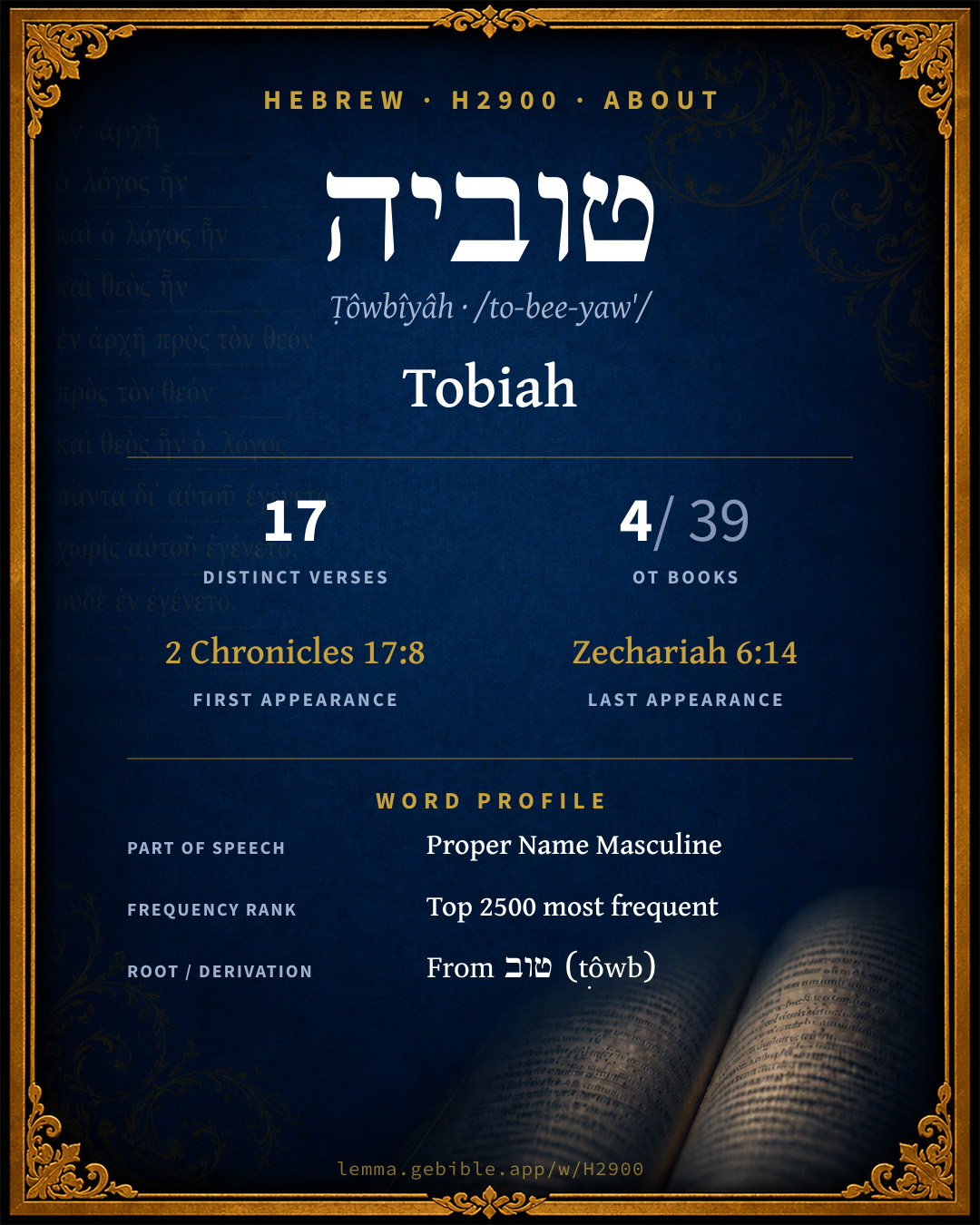
טוֹבִיָּ֫הוּ
Tobiah
BDB lists 5 entries for ‘Tobiah’ fuller range ↓
Full lexicon entry — Brown-Driver-Briggs (BDB)
From Brown-Driver-Briggs (BDB)
Where this word appears
Grammar key — what these labels mean
Part of speech
- Noun
- A naming word — a person, place, thing, or idea.
Noun type
- Proper
- A name of a specific person, place, or people (e.g. Abraham, Zion, Israel).
Every verse where H2900 appears in the Book of Zechariah — 2 distinct verses. Click any verse to open its interlinear word-by-word view. Verse text shown in the World English Bible for context — . Each verse’s Hebrew form is shown with its reference; the English is not keyword-highlighted, since the data carries no word-level English alignment. Use “Compare translations” on any verse to read it across multiple English versions. This concordance covers the Hebrew Bible; Septuagint (Greek Old Testament) occurrences are not indexed here.
Zechariah
- Zechariah 6:10 טוֹבִיָּ֖ה n Proper "Take of them of the captivity, even of Heldai, of Tobijah, and of Jedaiah; and come the same day, and go into the house of Josiah the son of Zephaniah, where they have come from Babylon.
- Zechariah 6:14 וּ/לְ/טוֹבִיָּ֣ה conj + prep + n Proper The crowns shall be to Helem, and to Tobijah, and to Jedaiah, and to Hen the son of Zephaniah, for a memorial in the temple of Yahweh.
About this entry
At a glance — auto-summarized from this page’s data, not written by a person. Every figure links to its source below. This summary describes the numbers; it doesn’t interpret them.
טוביה — transliterated Ṭôwbîyâh — is a Hebrew name carrying the sense “Tobiah.” More than three-quarters of its appearances fall in Nehemiah. The Hebrew Bible uses it across 17 verses — uncommon. It first appears in 2 Chronicles 17:8. See 17-verse concordance and the renderings breakdown below.
Gloss history
Strong's 1890 vs modern scholarship
About this word
Strong's H2900 catalogs a Hebrew word from the Hebrew Old Testament.
These counts are not copied from any lexicon or concordance. They are computed here, from the morphology-tagged Hebrew Old Testament. What Lemma adds →
- 17
- distinct verses
- The word appears in 17 distinct verses.
- 4 / 39
- OT books
- The word appears in 4 of 39 Old Testament books.
- #1,612
- by frequency
- Top 2500 most frequent Hebrew words (rank 1,612 of 8,640 Hebrew words by occurrence).
View all 17 occurrences in the concordance →
Most concentrated in
- Nehemiah 13 verses 76%
- Zechariah 2 verses 12%
- 2 Chronicles 1 verse 6%
By section of the Old Testament
By traditional corpus
Conventional, traditional groupings — biblical authorship is debated, so this is a traditional corpus grouping, not an authorship claim. Each share is this word’s portion of its verses in that division of the Hebrew canon. Each figure is a share of the word’s 17 distinct verses.
- Writings (Ketuvim) 15 verses · 88%
- Prophets (Nevi'im) 2 verses · 12%
How translations render this word
Counts come from each version’s own published word-to-Strong’s tagging or interlinear alignment — an approximate guide to how each version renders this word, not a word-level alignment the data otherwise carries. Because each total is that version’s own tagged count, the per-version totals vary from one another and need not match the appearance or distinct-verse counts above. These counts may also differ from a printed concordance because Lemma counts each distinctly tagged rendering and does not collapse phrase taggings into a single head-word total. This is a fixed set of word-tagged versions (KJV, ASV, BSB, ULT) and does not change with the reading translation you choose elsewhere. Each version’s license is shown beside its name below (and on Sources).
- King James Version: Tobiah 11×, Tobijah 3×
- American Standard Version: Tobiah 10×, Tobijah 3×
- Berean Standard Bible: Tobiah 12×, Tobijah 3×, Tobiah’s 2×
- unfoldingWord Literal Text: Tobiah 14×, Tobijah 3×
King James Version Public Domain
Renders H2900 across 18 tagged occurrences — most commonly:
Plus 4 renderings that appear only once — usually multi-word phrases or single function words the recovered tagging swept in, not distinct renderings.
American Standard Version Public Domain
Renders H2900 across 18 tagged occurrences — most commonly:
Plus 5 renderings that appear only once — usually multi-word phrases or single function words the recovered tagging swept in, not distinct renderings.
Berean Standard Bible Public Domain
Renders H2900 across 18 tagged occurrences — most commonly:
Plus 1 rendering that appears only once — usually multi-word phrases or single function words the recovered tagging swept in, not distinct renderings.
unfoldingWord Literal Text CC BY-SA 4.0
Renders H2900 across 18 tagged occurrences — most commonly:
Plus 1 rendering that appears only once — usually multi-word phrases or single function words the recovered tagging swept in, not distinct renderings.
Senses in the full BDB
What do BDB’s symbols mean?
BDB uses these scholarly abbreviations:
| Symbol | Meaning |
|---|---|
| 𝔊 | the Septuagint (the ancient Greek translation, LXX) |
| 𝔙 | the Vulgate (the Latin translation) |
| 𝔖 | the Syriac version (the Peshitta) |
| 𝔗 | the Targum (the Aramaic translation) |
| ψ | the Psalms |
| √ | root (the underlying root or stem) |
| ‖ | parallel passage (a synonymous or contrasted parallel) |
| † | the dagger: every passage where the word occurs is cited |
The 4 senses and sub-senses the full Brown-Driver-Briggs lexicon distinguishes for this word, in lexicon order (not ranked by frequency), with BDB’s own verbatim wording and sub-sense lettering. Shown in Hebrew script with BDB’s own scholarly abbreviations. The condensed entry is in the Lexicon Entry tab. See also the Forms in the corpus table below.
- 1. טוֹבִיָּהוּ a Levite, assigned to reign of Jehoshaphat 2 Ch 17:8, not 𝔊; 𝔊L Τωβιας, elsewhere טוֹבִיָּה 𝔊 Τωβια(ς). e.g. 2 Chronicles 17:8
- 2. Ammonite adversary of Nehem. Ne 2:10, 19; 3:35; 4:1; 6:1, 12, 14, 17(×2), 19; 13:4, 7, 8. e.g. Nehemiah 2:10
- 3. head of a family of returning exiles of doubtful lineage Ezr 2:60 = Ne 7:62. e.g. Ezra 2:60
- 4. a chief of returning exiles Zc 6:10, 14, 𝔊 χρησίμων (-μοις) αὐτῆς, i.e. טוֹבֶיהָ. e.g. Zechariah 6:10
Senses from the full Brown-Driver-Briggs lexicon (Brown, Driver, Briggs; Oxford 1906 — public domain), digitized via Sefaria, supplemented by the OpenScriptures HebrewLexicon (CC BY 4.0). Full attribution on Sources.
Word origin
n.pr.m. (Yah(u) is my good)—
— Brown-Driver-Briggs (Oxford 1906, public domain), digitized via Sefaria, supplemented by the OpenScriptures HebrewLexicon (CC BY 4.0). See Sources.
Derived from טוב (ṭôwb) (H2896) — good.
Jastrow Dictionary
A second Hebrew/Aramaic lexicon for comparison, covering Aramaic and post-biblical (Talmudic, Targumic, Midrashic) usage that the biblical-Hebrew BDB does not. Matched by lemma rather than by Strong’s number, so a lemma may carry more than one Jastrow headword (shown separately below), and the entries cover usage well beyond the Bible.
טוֹבִיָּה
- (b. h.) pr. n. m. Tobijah, Tobias. Kidd. 70ᵇ בטי בר ט׳, a slave. Keth. 85ᵇ שני ט׳ two by the name of T.—Pes. 113ᵇ, a. e., v. זִיגָּד.—Lev. R. s. 1, beg.; Sot. 12ᵃ (one of the names of Moses).
A Dictionary of the Targumim, the Talmud Babli and Yerushalmi, and the Midrashic Literature (Marcus Jastrow; London, Luzac, 1903) — Public Domain. Digitized via Sefaria. Digitized via Sefaria. Full attribution on Sources.
Forms in the corpus
The 13 distinct written forms H2900 takes in the Hebrew Bible, most frequent first — each parse links to that state’s occurrences in the concordance. Hebrew forms include their vowel points and cantillation, so a single lemma takes many written forms.
| Form | Parsing | Example | Uses |
|---|---|---|---|
| טוֹבִיָּ֖ה | Noun, Proper | Ezra 2:60 | 4 |
| וְ/טוֹבִיָּ֥ה | Noun, Proper | Nehemiah 4:3 | 2 |
| וְ֠/טוֹבִיָּה | Noun, Proper | Nehemiah 4:7 | 2 |
| וְ/טֹבִיָּ֣ה | Noun, Proper | Nehemiah 2:19 | 1 |
| וְ/טֽוֹבִיָּ֛הוּ | Noun, Proper | 2 Chronicles 17:8 | 1 |
| וְ/טֽוֹבִיָּה֙ | Noun, Proper | Nehemiah 2:10 | 1 |
| וּ/לְ/טוֹבִיָּ֣ה | Noun, Proper | Zechariah 6:14 | 1 |
| טוֹבִיָּ֑ה | Noun, Proper | Nehemiah 6:17 | 1 |
| טוֹבִיָּ֛ה | Noun, Proper | Nehemiah 13:8 | 1 |
| לְ/ט֣וֹבִיָּ֔ה | Noun, Proper | Nehemiah 13:7 | 1 |
| לְ/טוֹבִיָּ֖ה | Noun, Proper | Nehemiah 6:17 | 1 |
| לְ/טוֹבִיָּ֥ה | Noun, Proper | Nehemiah 6:14 | 1 |
| לְ/טוֹבִיָּֽה | Noun, Proper | Nehemiah 13:4 | 1 |
Same root — word family
Other BDB entries built from the same root as H2900, grouped by Strong’s listed origin. These share a root / origin per the lexicon — not necessarily a shared meaning. Each links to that word’s own entry.
Derives from
Proper names from this root
People and places named from this root — a name, not an additional meaning of the word.
Compare all same-root words → 2 of the same-root words are proper names (people or places). They share a root, not necessarily a meaning.
Bible dictionary
Public-domain dictionary articles matched to this entry by name (Tobiah). A biblical name can be shared by more than one person or place, so an article may treat several.
Easton's Bible Dictionary · M. G. Easton, 1897
Pleasing to Jehovah, the "servant," the "Ammonite," who joined with those who opposed the rebuilding of Jerusalem after the Exile (Neh. 2:10). He was a man of great influence, which he exerted in opposition to the Jews, and "sent letters" to Nehemiah "to put him in fear" (Neh. 6:17-19). "Eliashib the priest" prepared for him during Nehemiah's absence "a chamber in the courts of the house of God," which on his return grieved Nehemiah sore, and therefore he "cast forth all the household stuff of Tobiah out of the chamber" (13:7, 8).
Smith's Bible Dictionary · William Smith, 1863
(goodness of Jehovah).
+ "The children of Tobiah" were a family who returned with Zerubbabel, but were unable to prove their connection with Israel-- (Ezra 2:60; Nehemiah 7:62) (B.C. before 536.) + "Tobiah the slave, the Ammonite," played a conspicuous part in the rancorous position made by Sanballat the Moabite and his adherents to the rebuilding of Jerusalem. (B.C. 446.) The two races of Moab and Ammon found in these men fit representatives of that hereditary hatred to the Israelites which began before the entrance into Caanan, and was not extinct when the Hebrews had ceased to exist as a nation. But Tobiah, though a slave, (Nehemiah 2:10,19)--unless, this is a title of opprobrium--and an Ammonite, found means to ally himself with a priestly family, and his son Johanan married the daughter of Meshullam the son of Berechiah. (Nehemiah 6:18) He himself was the son-in-law of Shechaniah the son of Arah, (Nehemiah 6:17) and these family relations created for him a strong faction among the Jews.
Hitchcock's Bible Names Dictionary · Roswell D. Hitchcock, 1869
Tobijah, the Lord is good
Classic public-domain reference works; full attribution on Sources.
Septuagint verse parallels
This word appears in 4 verses that also exist in the Greek Old Testament (Septuagint), out of the 17 Hebrew verses it occurs in. You can read those verses in Greek by switching the Old Testament edition to the Septuagint.
Read these verses in the Septuagint
This is a verse-level parallel only — the same verses exist in both the Hebrew and Greek Old Testaments. No word-level Hebrew↔Greek correspondence is claimed: the data carries no such alignment, so no Greek word is shown as this Hebrew word’s translation. Coverage is not total — the Septuagint omits the deuterocanon and renumbers the Psalms, so some Hebrew verses have no direct Greek parallel.