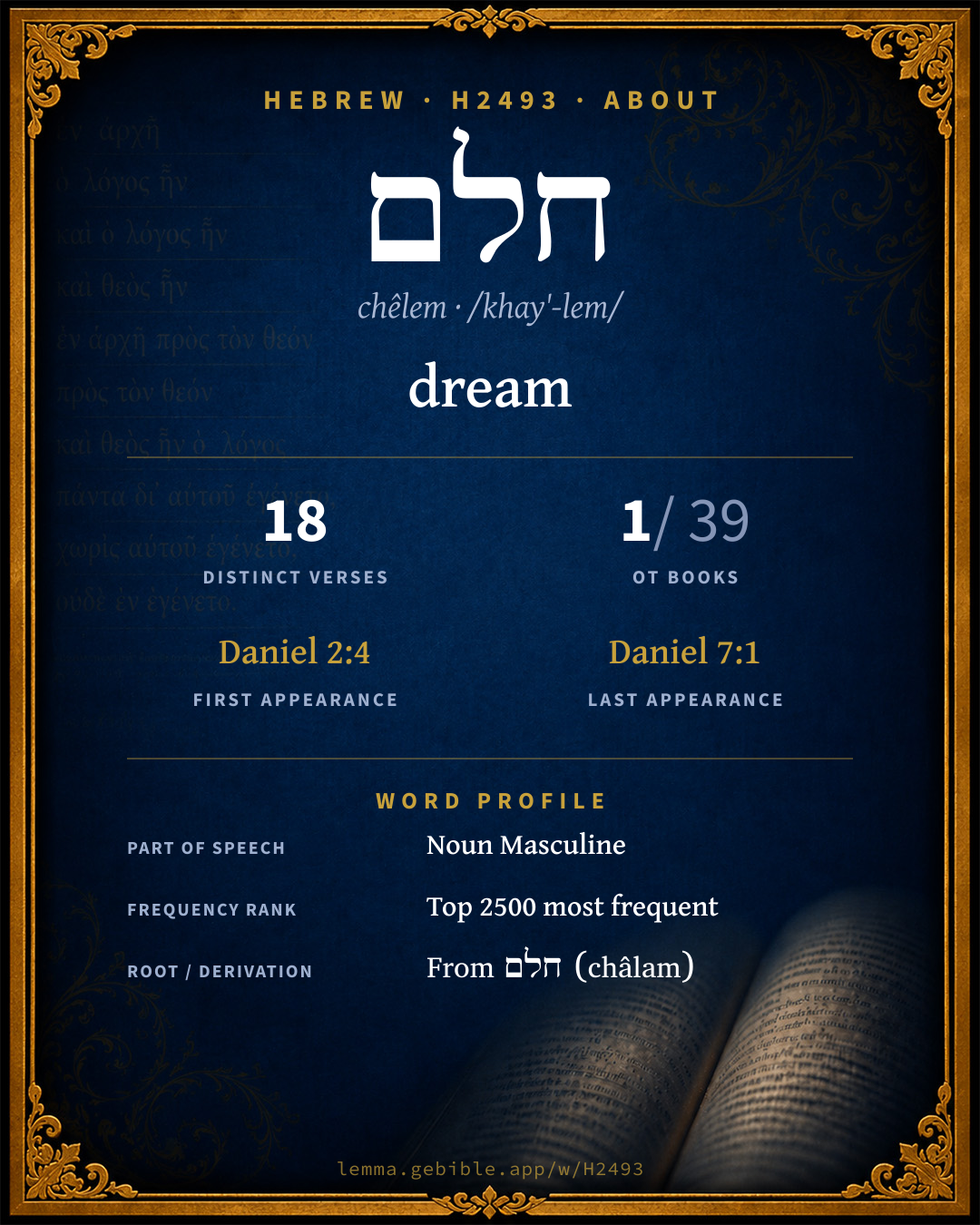
חֵ֫לֶם
dream
Full lexicon entry — Brown-Driver-Briggs (BDB)
From Brown-Driver-Briggs (BDB)
Where this word appears
See every Absolute-state word in the Hebrew Bible →
Grammar key — what these labels mean
Part of speech
- Noun
- A naming word — a person, place, thing, or idea.
Noun type
- Common
- A common noun — a general class of person, place, or thing (“king,” “city,” “water”), not a specific name.
State
- Absolute
- The independent form of a noun, not bound to a following word.
- Construct
- A noun bound to a following noun in a possessive / “of” relationship (the construct chain).
Gender
- Masculine
- Grammatically masculine.
Number
- Singular
- One.
- Plural
- More than one (in Hebrew, generally three or more).
Grammatical forms
- Particle, Definite Article 17 times (77%)
- Noun, Common, Masculine, Singular, Absolute 2 times (9%)
- Noun, Common, Masculine, Singular, Construct 2 times (9%)
- Noun, Common, Masculine, Plural, Absolute 1 time (5%)
Parsed forms decoded from the imported morphology (morphhb / Westminster Leningrad Codex — WLC text public domain, morphhb tagging CC BY 4.0), counted across 22 parsed occurrences — not distinct verses.
Every verse where H2493 appears — 18 distinct verses across 1 book. Click any verse to open its interlinear word-by-word view. Verse text shown in the World English Bible for context — . Each verse’s Hebrew form is shown with its reference; the English is not keyword-highlighted, since the data carries no word-level English alignment. Use “Compare translations” on any verse to read it across multiple English versions. This concordance covers the Hebrew Bible; Septuagint (Greek Old Testament) occurrences are not indexed here.
Daniel 18 verses
- Daniel 2:4 חֶלְמָ֛/א n c ms det + ptcl def.art Then spoke the Chaldeans to the king in the Syrian language, O king, live forever: tell your servants the dream, and we will show the interpretation.
- Daniel 2:5 חֶלְמָ֣/א n c ms det + ptcl def.art The king answered the Chaldeans, The thing is gone from me: if you don't make known to me the dream and the interpretation of it, you shall be cut in pieces, and your houses shall be made a dunghill.
- Daniel 2:6 חֶלְמָ֤/א חֶלְמָ֥/א n c ms det + ptcl def.art n c ms det + ptcl def.art But if you show the dream and the interpretation of it, you shall receive of me gifts and rewards and great honor: therefore show me the dream and the interpretation of it.
- Daniel 2:7 חֶלְמָ֛/א n c ms det + ptcl def.art They answered the second time and said, Let the king tell his servants the dream, and we will show the interpretation.
- Daniel 2:9 חֶלְמָ/א֩ חֶלְמָ/א֙ n c ms det + ptcl def.art n c ms det + ptcl def.art But if you don't make known to me the dream, there is but one law for you; for you have prepared lying and corrupt words to speak before me, until the time be changed: therefore tell me the dream, and I shall know that you can show me the interpretation of it.
- Daniel 2:26 חֶלְמָ֥/א n c ms det + ptcl def.art The king answered Daniel, whose name was Belteshazzar, Are you able to make known to me the dream which I have seen, and the interpretation of it?
- Daniel 2:28 חֶלְמָ֨/ךְ n c ms cs + sfx pers 2ms but there is a God in heaven who reveals secrets, and he has made known to the king Nebuchadnezzar what shall be in the latter days. Your dream, and the visions of your head on your bed, are these:
- Daniel 2:36 חֶלְמָ֔/א n c ms det + ptcl def.art This is the dream; and we will tell the interpretation of it before the king.
- Daniel 2:45 חֶלְמָ֖/א n c ms det + ptcl def.art Because you saw that a stone was cut out of the mountain without hands, and that it broke in pieces the iron, the brass, the clay, the silver, and the gold; the great God has made known to the king what shall happen hereafter: and the dream is certain, and the interpretation of it sure.
- Daniel 4:5 חֵ֥לֶם n c ms I saw a dream which made me afraid; and the thoughts on my bed and the visions of my head troubled me.
- Daniel 4:6 חֶלְמָ֖/א n c ms det + ptcl def.art Therefore made I a decree to bring in all the wise men of Babylon before me, that they might make known to me the interpretation of the dream.
- Daniel 4:7 וְ/חֶלְמָ֗/א conj + n c ms det + ptcl def.art Then came in the magicians, the enchanters, the Chaldeans, and the soothsayers; and I told the dream before them; but they did not make known to me the interpretation of it.
- Daniel 4:8 וְ/חֶלְמָ֖/א conj + n c ms det + ptcl def.art But at the last Daniel came in before me, whose name was Belteshazzar, according to the name of my god, and in whom is the spirit of the holy gods: and I told the dream before him, [saying],
- Daniel 4:9 חֶלְמִ֧/י n c ms cs + sfx pers 1cs Belteshazzar, master of the magicians, because I know that the spirit of the holy gods is in you, and no secret troubles you, tell me the visions of my dream that I have seen, and the interpretation of it.
- Daniel 4:18 חֶלְמָ֣/א n c ms det + ptcl def.art This dream I, king Nebuchadnezzar, have seen; and you, Belteshazzar, declare the interpretation, because all the wise men of my kingdom are not able to make known to me the interpretation; but you are able; for the spirit of the holy gods is in you.
- Daniel 4:19 חֶלְמָ֤/א חֶלְמָ֥/א n c ms det + ptcl def.art n c ms det + ptcl def.art Then Daniel, whose name was Belteshazzar, was stricken mute for a while, and his thoughts troubled him. The king answered, Belteshazzar, don't let the dream, or the interpretation, trouble you. Belteshazzar answered, My lord, the dream be to those who hate you, and the interpretation of it to your adversaries.
- Daniel 5:12 חֶלְמִין֩ n c mp because an excellent spirit, and knowledge, and understanding, interpreting of dreams, and showing of dark sentences, and dissolving of doubts, were found in the same Daniel, whom the king named Belteshazzar. Now let Daniel be called, and he will show the interpretation.
- Daniel 7:1 חֵ֣לֶם חֶלְמָ֣/א n c ms n c ms det + ptcl def.art In the first year of Belshazzar king of Babylon Daniel had a dream and visions of his head on his bed: then he wrote the dream and told the sum of the matters.
About this entry
At a glance — auto-summarized from this page’s data, not written by a person. Every figure links to its source below. This summary describes the numbers; it doesn’t interpret them.
At its core, חלם (chêlem) means “dream.” Its uses cluster heavily in Daniel (100% of all occurrences). Spanning 18 verses in 1 book, it ranks among the uncommon words of the Hebrew Bible. Scripture first uses it in Daniel 2:4. From the same root come חלם, אחלמה and חלום. Dig into 18-verse concordance and the renderings breakdown below.
Gloss history
Strong's 1890 vs modern scholarship
About this word
Strong's H2493 catalogs a Hebrew word from the Hebrew Old Testament.
These counts are not copied from any lexicon or concordance. They are computed here, from the morphology-tagged Hebrew Old Testament. What Lemma adds →
- 18
- distinct verses
- The word appears in 18 distinct verses.
- 1 / 39
- OT books
- The word appears in 1 of 39 Old Testament books.
- #1,412
- by frequency
- Top 2500 most frequent Hebrew words (rank 1,412 of 8,640 Hebrew words by occurrence).
View all 18 occurrences in the concordance →
Most concentrated in
- Daniel 18 verses 100%
By section of the Old Testament
By traditional corpus
Conventional, traditional groupings — biblical authorship is debated, so this is a traditional corpus grouping, not an authorship claim. Each share is this word’s portion of its verses in that division of the Hebrew canon. Each figure is a share of the word’s 18 distinct verses.
- Writings (Ketuvim) 18 verses · 100%
How translations render this word
Counts come from each version’s own published word-to-Strong’s tagging or interlinear alignment — an approximate guide to how each version renders this word, not a word-level alignment the data otherwise carries. Because each total is that version’s own tagged count, the per-version totals vary from one another and need not match the appearance or distinct-verse counts above. These counts may also differ from a printed concordance because Lemma counts each distinctly tagged rendering and does not collapse phrase taggings into a single head-word total. This is a fixed set of word-tagged versions (KJV, ASV, BSB, ULT) and does not change with the reading translation you choose elsewhere. Each version’s license is shown beside its name below (and on Sources).
- King James Version: Dream 20×
- American Standard Version: Dream 20×
- Berean Standard Bible: Dream 17×
- unfoldingWord Literal Text: Dream 20×, And 2×
King James Version Public Domain
Renders H2493 across 22 tagged occurrences — most commonly:
Plus 2 renderings that appear only once — usually multi-word phrases or single function words the recovered tagging swept in, not distinct renderings.
American Standard Version Public Domain
Renders H2493 across 22 tagged occurrences — most commonly:
Plus 2 renderings that appear only once — usually multi-word phrases or single function words the recovered tagging swept in, not distinct renderings.
Berean Standard Bible Public Domain
Renders H2493 across 22 tagged occurrences — most commonly:
Plus 5 renderings that appear only once — usually multi-word phrases or single function words the recovered tagging swept in, not distinct renderings.
unfoldingWord Literal Text CC BY-SA 4.0
Renders H2493 across 24 tagged occurrences — most commonly:
Plus 2 renderings that appear only once — usually multi-word phrases or single function words the recovered tagging swept in, not distinct renderings.
Senses in BDB
The 1 sense BDB distinguishes for this word, in lexicon order (not ranked by frequency or importance). The full entry — with sub-senses — is in the Lexicon Entry tab.
- dream
Word origin
n.pr.m. (strength)—a returned exile Zc 6:14 = חֶלְדַּי v 10.
— Brown-Driver-Briggs (Oxford 1906, public domain), digitized via Sefaria, supplemented by the OpenScriptures HebrewLexicon (CC BY 4.0). See Sources.
Derived from חלם (châlam) (H2492) — to dream.
Jastrow Dictionary
A second Hebrew/Aramaic lexicon for comparison, covering Aramaic and post-biblical (Talmudic, Targumic, Midrashic) usage that the biblical-Hebrew BDB does not. Matched by lemma rather than by Strong’s number, so a lemma may carry more than one Jastrow headword (shown separately below), and the entries cover usage well beyond the Bible.
חָלַם I
- [to be soft, moist, viscous,] to have good humors, to be well. Part. pass. חָלוּם, f. חֲלוּמָה sane, opp. to שוטה; well, opp. to חולה. Tosef. Ter. I, 3 פעמים … ח׳ if one is at times insane, at times sane; R. Hash. 28ᵃ חַלִּים (Ch. form).—Y. Gitt. VII, beg. 48ᶜ.—Pes. 78ᵇ.—Fem. חֲלוּמָה. Y. Yeb. XIV, beg. 14ᵇ
חֲלַם
- v. חַלִּים
- to join closely. Kidd. 25ᵃ זמנין דח׳ שפוותיה Ar. (ed. שפתיה) sometimes a man closes his lips firmly.
חָלַם II
- v. preced. wds.) [to gather humors, to sleep well (cmp. יָשַׁן).—Denom. חֲלוֹם (cmp. ἐνύπνιος, somnium) dream; from which חָלַם] to dream. Ber. 55ᵇ חלום חָלַמְתִּי I had a dream. Ib. חלום שׁח׳ לו חבירו a dream which his neighbor had about him. Tosef. Sabb. VI (VII), 7 שתהא חוֹלֵם חלומות that you may have dreams; a. fr.
חֲלַם ²
- Targ. Gen. XXXVII, 5. Ib. XLI, 1; a. fr.
- to consult an interpreter of dreams or a dreamer. Targ. Jer. XXIX, 8, v. חָלְמָא.
חֲלֹם
- , v. חֲלוֹם
A Dictionary of the Targumim, the Talmud Babli and Yerushalmi, and the Midrashic Literature (Marcus Jastrow; London, Luzac, 1903) — Public Domain. Digitized via Sefaria. Digitized via Sefaria. Full attribution on Sources.
Forms in the corpus
The 15 distinct written forms H2493 takes in the Hebrew Bible, most frequent first — each parse links to that state’s occurrences in the concordance. Hebrew forms include their vowel points and cantillation, so a single lemma takes many written forms.
| Form | Parsing | Example | Uses |
|---|---|---|---|
| חֶלְמָ֣/א | Particle, Definite Article | Daniel 2:5 | 3 |
| חֶלְמָ֥/א | Particle, Definite Article | Daniel 2:6 | 3 |
| חֶלְמָ֖/א | Particle, Definite Article | Daniel 2:45 | 2 |
| חֶלְמָ֛/א | Particle, Definite Article | Daniel 2:4 | 2 |
| חֶלְמָ֤/א | Particle, Definite Article | Daniel 2:6 | 2 |
| וְ/חֶלְמָ֖/א | Particle, Definite Article | Daniel 4:8 | 1 |
| וְ/חֶלְמָ֗/א | Particle, Definite Article | Daniel 4:7 | 1 |
| חֵ֣לֶם | Noun, Common, Masculine, Singular, Absolute | Daniel 7:1 | 1 |
| חֵ֥לֶם | Noun, Common, Masculine, Singular, Absolute | Daniel 4:5 | 1 |
| חֶלְמִ֧/י | Noun, Common, Masculine, Singular, Construct | Daniel 4:9 | 1 |
| חֶלְמִין֩ | Noun, Common, Masculine, Plural, Absolute | Daniel 5:12 | 1 |
| חֶלְמָ/א֙ | Particle, Definite Article | Daniel 2:9 | 1 |
| חֶלְמָ/א֩ | Particle, Definite Article | Daniel 2:9 | 1 |
| חֶלְמָ֔/א | Particle, Definite Article | Daniel 2:36 | 1 |
| חֶלְמָ֨/ךְ | Noun, Common, Masculine, Singular, Construct | Daniel 2:28 | 1 |
Same root — word family
Other BDB entries built from the same root as H2493, grouped by Strong’s listed origin. These share a root / origin per the lexicon — not necessarily a shared meaning. Each links to that word’s own entry.
Derives from
Shares the same root
- אחלמה ʼachlâmâh H306 amethyst
- חלום chălôwm H2472 dream
- חלמות challâmûwth H2495 purslane
- חלמיש challâmîysh H2496 flint
Proper names from this root
People and places named from this root — a name, not an additional meaning of the word.
Compare all same-root words → Showing 4 of 8 — not the complete family. 2 of the same-root words are proper names (people or places). They share a root, not necessarily a meaning.
Septuagint verse parallels
This word appears in 18 verses that also exist in the Greek Old Testament (Septuagint), out of the 18 Hebrew verses it occurs in. You can read those verses in Greek by switching the Old Testament edition to the Septuagint.
Read these verses in the Septuagint
This is a verse-level parallel only — the same verses exist in both the Hebrew and Greek Old Testaments. No word-level Hebrew↔Greek correspondence is claimed: the data carries no such alignment, so no Greek word is shown as this Hebrew word’s translation. Coverage is not total — the Septuagint omits the deuterocanon and renumbers the Psalms, so some Hebrew verses have no direct Greek parallel.