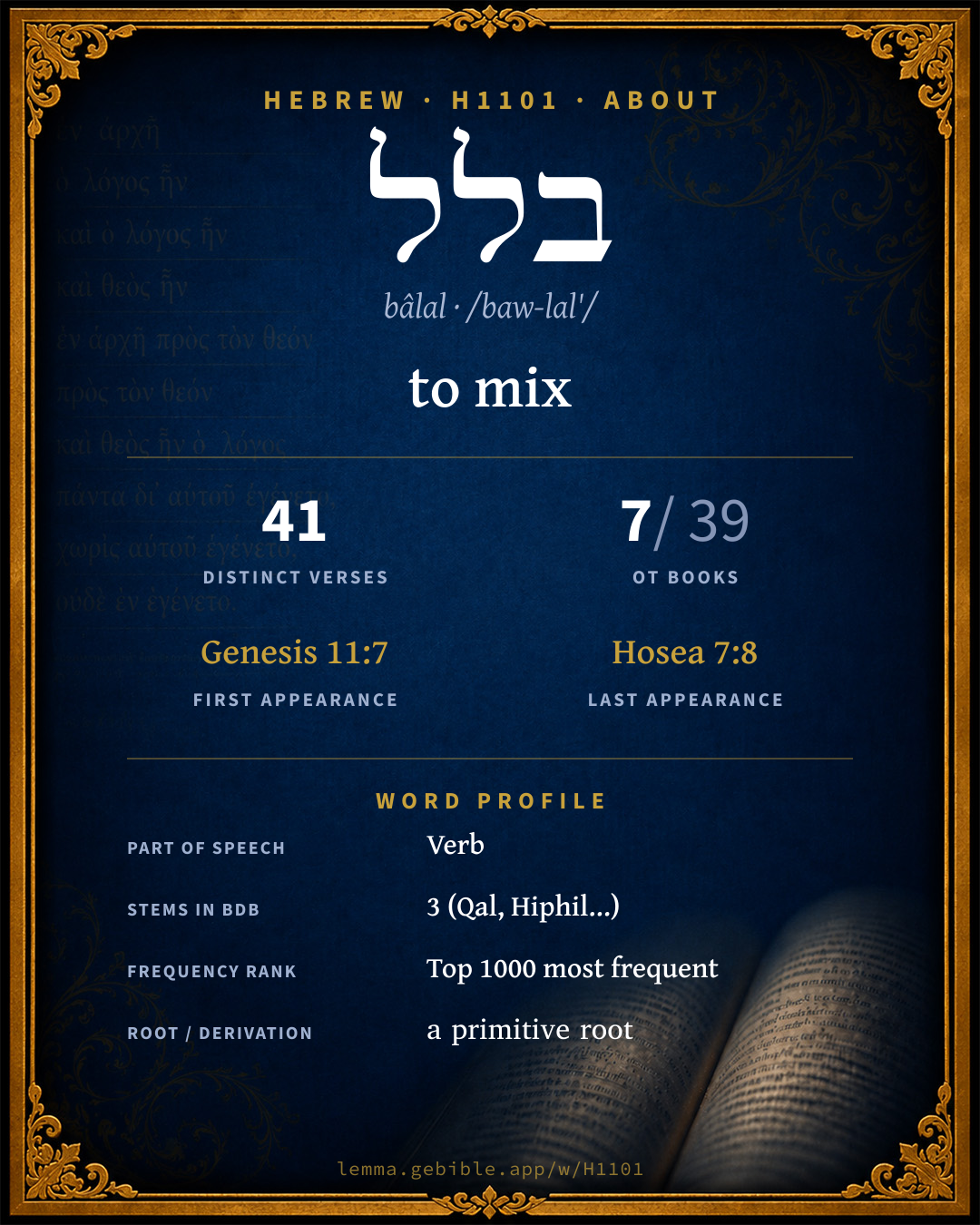
בָּלַל
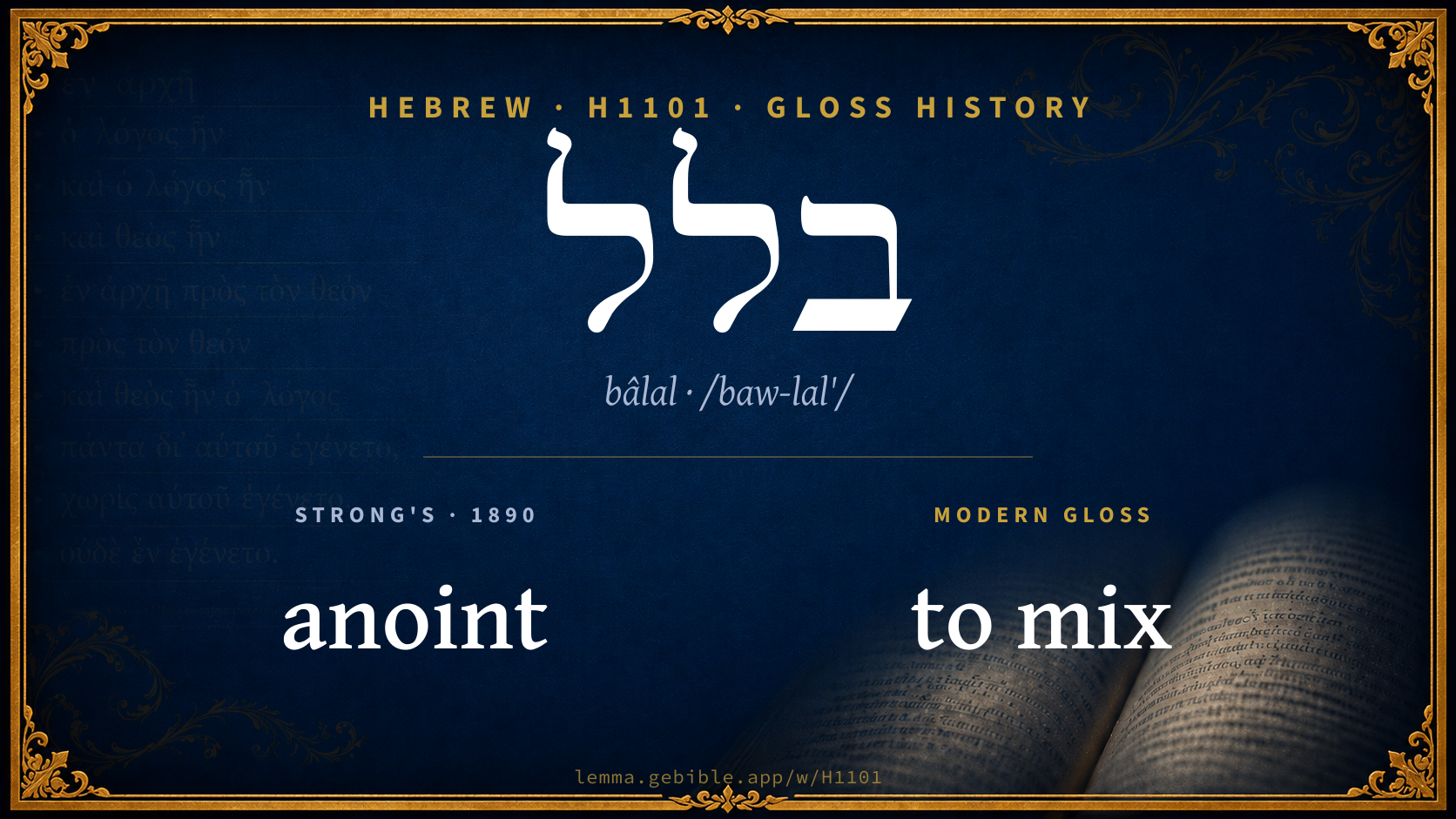
to mix
also: mingle, confuse, confound fuller range ↓
Full lexicon entry — Brown-Driver-Briggs (BDB)
From Brown-Driver-Briggs (BDB)
Where this word appears
Grammar key — what these labels mean
Part of speech
- Verb
- An action or state-of-being word.
Stem
- Qal
- The basic, simple active stem — the plain form of the verb (“he wrote”). Here: ‘mingle’
- Hithpolel
- The reflexive counterpart of the Polel.
Form
- Participle Passive
- A verbal adjective expressing action received (“written”).
- Cohortative
- A first-person volitional form expressing wish or resolve (“let me / let us write”).
- Sequential Imperfect
- An imperfect with prefixed waw — the standard past-narrative form (waw-consecutive imperfect).
- Perfect
- A completed action or state — Hebrew marks aspect (completeness) more than strict tense (“he wrote”).
- Imperfect
- An incomplete, ongoing, or future action (“he will / would write”).
State
- Absolute
- The independent form of a noun, not bound to a following word.
Person
- 1st Person
- The speaker (“I / we”).
- 3rd Person
- The one spoken about (“he / she / it / they”).
Gender
- Feminine
- Grammatically feminine.
- Masculine
- Grammatically masculine.
- Common
- Either gender — not distinguished for this form.
Number
- Singular
- One.
- Plural
- More than one (in Hebrew, generally three or more).
Every verse where H1101 appears in the Book of Hosea — 1 distinct verse. Click any verse to open its interlinear word-by-word view. Verse text shown in the World English Bible for context — . Each verse’s Hebrew form is shown with its reference; the English is not keyword-highlighted, since the data carries no word-level English alignment. Use “Compare translations” on any verse to read it across multiple English versions. This concordance covers the Hebrew Bible; Septuagint (Greek Old Testament) occurrences are not indexed here.
Hosea
About this entry
At a glance — auto-summarized from this page’s data, not written by a person. Every figure links to its source below. This summary describes the numbers; it doesn’t interpret them.
At its core, בלל (bâlal) means “to mix.” Its uses cluster heavily in Numbers (63% of all occurrences). With 41 verses in 7 books, it is a moderately common word in the Hebrew Bible. Different stems carry different senses — BDB groups them under 3 stems, among them Qal and Hiphil. The King James Version usually renders it “mingled,” while modern versions prefer “mixed” (Berean Standard Bible) — see the renderings breakdown. Each statement above links to its evidence; the full detail follows below.
Gloss history
Strong's 1890 vs modern scholarship
About this word
Strong's H1101 catalogs a Hebrew word from the Hebrew Old Testament.
These counts are not copied from any lexicon or concordance. They are computed here, from the morphology-tagged Hebrew Old Testament. What Lemma adds →
- 41
- distinct verses
- The word appears in 41 distinct verses.
- 7 / 39
- OT books
- The word appears in 7 of 39 Old Testament books.
- #837
- by frequency
- Top 1000 most frequent Hebrew words (rank 837 of 8,640 Hebrew words by occurrence).
View all 41 occurrences in the concordance →
By section of the Old Testament
By traditional corpus
Conventional, traditional groupings — biblical authorship is debated, so this is a traditional corpus grouping, not an authorship claim. Each share is this word’s portion of its verses in that division of the Hebrew canon. Each figure is a share of the word’s 41 distinct verses.
- Torah (Pentateuch) 38 verses · 93%
- Prophets (Nevi'im) 2 verses · 5%
- Writings (Ketuvim) 1 verse · 2%
How translations render this word
Counts come from each version’s own published word-to-Strong’s tagging or interlinear alignment — an approximate guide to how each version renders this word, not a word-level alignment the data otherwise carries. Because each total is that version’s own tagged count, the per-version totals vary from one another and need not match the appearance or distinct-verse counts above. These counts may also differ from a printed concordance because Lemma counts each distinctly tagged rendering and does not collapse phrase taggings into a single head-word total. This is a fixed set of word-tagged versions (KJV, ASV, BSB, ULT) and does not change with the reading translation you choose elsewhere. Each version’s license is shown beside its name below (and on Sources).
BDB lists this Strong’s number as 2 distinct words (homographs). Each count above pools all of them and is not split by sense — see the Senses section below. A low-frequency rendering may belong to a different one of those words, not the primary meaning.
- King James Version†: Mingled 37×
- American Standard Version†: Mingled 38×
- Berean Standard Bible†: Mixed 37×
- unfoldingWord Literal Text†: Mixed 37×
King James Version Public Domain
Renders H1101 across 43† tagged occurrences — most commonly:
Plus 6 renderings that appear only once — usually multi-word phrases or single function words the recovered tagging swept in, not distinct renderings. Not rendered by a distinct English word in 1 further occurrence.
American Standard Version Public Domain
Renders H1101 across 43† tagged occurrences — most commonly:
Plus 5 renderings that appear only once — usually multi-word phrases or single function words the recovered tagging swept in, not distinct renderings.
Berean Standard Bible Public Domain
Renders H1101 across 43† tagged occurrences — most commonly:
Plus 6 renderings that appear only once — usually multi-word phrases or single function words the recovered tagging swept in, not distinct renderings.
unfoldingWord Literal Text CC BY-SA 4.0
Renders H1101 across 44† tagged occurrences — most commonly:
Plus 7 renderings that appear only once — usually multi-word phrases or single function words the recovered tagging swept in, not distinct renderings.
Senses in the full BDB
Hebrew verbs can shift meaning by stem (binyan): Qal is the basic action, Niphal is often passive or reflexive, Piel often intensifies or makes it factitive, and Hiphil is typically causative. The senses below are grouped under the stem BDB assigns to each. This entry also uses one or more reduplicated stems (the Pōlēl/Pilpēl type), which for hollow or geminate roots behave much like Piel — often intensive or iterative.
What do BDB’s symbols mean?
BDB uses these scholarly abbreviations:
| Symbol | Meaning |
|---|---|
| 𝔊 | the Septuagint (the ancient Greek translation, LXX) |
| 𝔙 | the Vulgate (the Latin translation) |
| 𝔖 | the Syriac version (the Peshitta) |
| 𝔗 | the Targum (the Aramaic translation) |
| ψ | the Psalms |
| √ | root (the underlying root or stem) |
| ‖ | parallel passage (a synonymous or contrasted parallel) |
| † | the dagger: every passage where the word occurs is cited |
The 6 senses and sub-senses the full Brown-Driver-Briggs lexicon distinguishes for this word, in lexicon order (not ranked by frequency), with BDB’s own verbatim wording and sub-sense lettering. Shown in Hebrew script with BDB’s own scholarly abbreviations. The condensed entry is in the Lexicon Entry tab. See also the Forms in the corpus table below.
בלל I mingle, mix, confuse, confound (Arabic بَلَّ moisten (with water), cf. بَلَلٌ moisture, Assyrian balâlu, DlPr 70
Qal
- Pf. בָּלַל Gn 11:9, בַּ֜לֹּתִ֗י ψ 92:11 (but cf. infr.); Impf. 1 pl. נָֽבְלָה = נָבֹ֫לָּה Gn 11:7, cf. Köi. 325; Pt. pass. בָּלוּל Ex 29:40 + 3 times, בְּלוּלָה Lv 2:5 + 28 times, בְּלוּלֹת Ex 29:2 + 4 times;— e.g. Genesis 11:9
- 1. mingle, confuse (obj. שָׂפָה = speech, language, q.v.) Gn 11:7, 9 (J). e.g. Genesis 11:7
- 2. mix (cakes or flour, etc. always with oil) sacrificial techn. term, only P, cf. Di on Lv 2:4; usually as מנחה, סֹלֶת בּ׳ בַּשֶּׁמֵן Ex 29:40; Lv 2:5; 14:10, 21; 23:13; Nu 7:13, 19, 25, 31, 37, 43, 49, 55, 61, 67, 73, 79; Nu 8:8; 15:4, 6, 9; 28:5, 9, 12(×2), 13, 20, 28; 29:3, 9, 14, מנחה ב׳ בשׁ׳ Lv 7:10 (opp. חֲרֵבָה) 9:4, חַלּוֹת מַצוֹת ב׳ בשׁ׳ Ex 29:2; Lv 7:12(×2), i.e. made by mixing with oil; סלת חלות מצות ב׳ בשׁ׳ Lv 2:4, סלת חלות ב׳ בשׁ׳ Nu 6:15, i.e. fine flour (in the form) of cakes so made. בַּ֜לֹּתִ֗י בְּשֶׁמֶן רַעֲנָן ψ 92:11 I shall be (am) anointed with fresh oil AV RV; vb. not elsewhere in this sense; 𝔊 𝔙 Hup Che read בְּלֹתִי from בלה, Inf. cstr. sf., abstr. for concrete, my wasting = my wasting strength, of declining age; Israel under figure of old man; this however is not favoured by context. The passage is therefore doubtful. e.g. Leviticus 2:4
Hithpo
- Impf. יִתְבּוֹלָ֑ל Ho 7:8; אפרים בעמים הוא י׳ Ephraim, among the peoples doth he mix himself; but Ew Now derive here from בלל = בלה (or נבל) waste away, cf. Hiph. e.g. Hosea 7:8
Hiphil
- Impf. וַנָּ֫בֶל Is 64:5 and we faded away, but read perhaps וַנִּבֹּל from נבל cf. Di (De, less probably, derives from בלל—cf. Ew Now Ho 7:8—or בול = נבל). e.g. Isaiah 64:5
בלל II denom. to give provender
Qal
- Impf. וַיָּ֑בָל Ju 19:21 Qr (Kt ויבול) sq. לְ give provender to the asses. e.g. Judges 19:21
Senses from the full Brown-Driver-Briggs lexicon (Brown, Driver, Briggs; Oxford 1906 — public domain), digitized via Sefaria, supplemented by the OpenScriptures HebrewLexicon (CC BY 4.0). Full attribution on Sources.
Word origin
I. vb. mingle, mix, confuse, confound (Arabic بَلَّ moisten (with water), cf. بَلَلٌ moisture, Assyrian balâlu, DlPr 70; cf. Ph. בלל name of a sacrifice, & NH בִּלְבֵּל; Aramaic בַּלְבֵּל ܒܰܠܒܶܠ )—
II. vb. denom. to give provender—
— Brown-Driver-Briggs (Oxford 1906, public domain), digitized via Sefaria, supplemented by the OpenScriptures HebrewLexicon (CC BY 4.0). See Sources.
Origin: a primitive root
Jastrow Dictionary
A second Hebrew/Aramaic lexicon for comparison, covering Aramaic and post-biblical (Talmudic, Targumic, Midrashic) usage that the biblical-Hebrew BDB does not. Matched by lemma rather than by Strong’s number, so a lemma may carry more than one Jastrow headword (shown separately below), and the entries cover usage well beyond the Bible.
בָּלַל
- sec. r. of בול, ביל; √בו, בה, cmp. בִּין, to penetrate, break through, v. בלט; b) √בל to crumble, soften, cmp. √מל; v. בלי, נבל, בלט in בולטיתא) to mix (with oil), knead, stir; to mix fodder. Zeb. XIV, 3 (112ᵇ) הבּוֹלֵל the priest who kneads the meat-offering with oil, v. בְּלִילָה. Dem. V, 5 בולל ונוטל (strike out ואוכל in Bab. ed., Ar. Var. בורר) he mixes the fruits and takes the tithe. Y. B. Kam. IV, beg. 4ᵃ לִבְלוֹל to mix up (coins in a bag.) Y. R. Hash. I, 56ᵈ bot.; Tanḥ. Noah 11, v. בּוּל III; a. fr.—Part. pass. בָּלוּל, f. בְּלוּלָה. Snh. 24ᵃ (play on בבל) ב׳ במקרא וכ׳ mixed up (confused) in Bible study &c. [Y. Yeb. VIII, end, 9ᵈ קריבה בבלל, read בכָלִיל.] V. בָּלוּל.
- , Hof. הוּבְלָל to be mixed. Y. Maas. Sh. II, 53ᶜ, v. חָפַן. Men. XII, 4 (103ᵇ; 18ᵇ) ששים נבללין sixty measures of flour can be thoroughly mixed; v. בִּילָה. Ib. יכולים לְהִבָּלֵל.—Y. Shek. VI, 49ᵈ bot. אש מוּבְלָלָה באש fire mixed with fire.—[Y. Taan. III, 66ᵈ bot. עד שיִבָּלֲלוּ וכ׳ until your speech shall become confounded from repeatedly saying, Enough; v. בלי.] Y. Ber. VI, 10ᵃ top (play on בַּל) יִבָּלֲלוּ וכ׳ all blessings shall be kneaded thogether—Pilp. בִּלְבֵּל.
A Dictionary of the Targumim, the Talmud Babli and Yerushalmi, and the Midrashic Literature (Marcus Jastrow; London, Luzac, 1903) — Public Domain. Digitized via Sefaria. Digitized via Sefaria. Full attribution on Sources.
Forms in the corpus
The 14 distinct written forms H1101 takes in the Hebrew Bible, most frequent first — each parse links to that stem’s occurrences in the concordance. Hebrew forms include their vowel points and cantillation, so a single lemma takes many written forms.
Same root — word family
Other BDB entries built from the same root as H1101, grouped by Strong’s listed origin. These share a root / origin per the lexicon — not necessarily a shared meaning. Each links to that word’s own entry.
Derived from this word
Proper names from this root
People and places named from this root — a name, not an additional meaning of the word.
Compare all same-root words → Showing 4 of 5 — not the complete family. 1 of the same-root words is a proper name (a person or place). They share a root, not necessarily a meaning.
Septuagint verse parallels
This word appears in 40 verses that also exist in the Greek Old Testament (Septuagint), out of the 41 Hebrew verses it occurs in. You can read those verses in Greek by switching the Old Testament edition to the Septuagint.
Read these verses in the Septuagint
This is a verse-level parallel only — the same verses exist in both the Hebrew and Greek Old Testaments. No word-level Hebrew↔Greek correspondence is claimed: the data carries no such alignment, so no Greek word is shown as this Hebrew word’s translation. Coverage is not total — the Septuagint omits the deuterocanon and renumbers the Psalms, so some Hebrew verses have no direct Greek parallel.