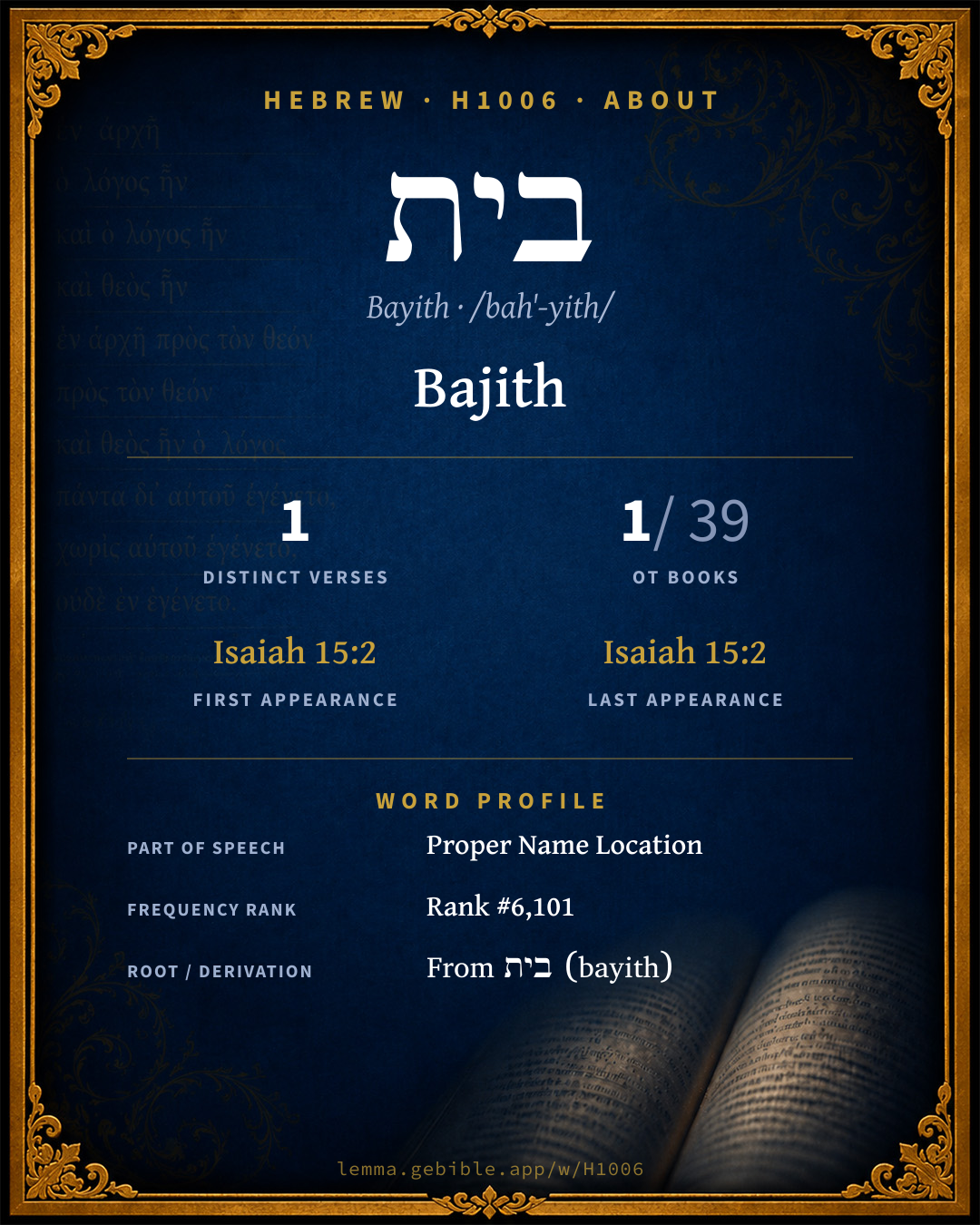
בַּ֫יִת
Bajith
BDB lists 2 entries for ‘Bajith’ fuller range ↓
Full lexicon entry — Brown-Driver-Briggs (BDB)
From Brown-Driver-Briggs (BDB)
Where this word appears
Grammar key — what these labels mean
Noun type
- Common
- A common noun — a general class of person, place, or thing (“king,” “city,” “water”), not a specific name.
State
- Absolute
- The independent form of a noun, not bound to a following word.
Gender
- Masculine
- Grammatically masculine.
Number
- Singular
- One.
Every verse where H1006 appears — 1 distinct verse across 1 book. Click any verse to open its interlinear word-by-word view. Verse text shown in the World English Bible for context — . Each verse’s Hebrew form is shown with its reference; the English is not keyword-highlighted, since the data carries no word-level English alignment. Use “Compare translations” on any verse to read it across multiple English versions. This concordance covers the Hebrew Bible; Septuagint (Greek Old Testament) occurrences are not indexed here.
Isaiah 1 verse
About this entry
At a glance — auto-summarized from this page’s data, not written by a person. Every figure links to its source below. This summary describes the numbers; it doesn’t interpret them.
At its core, בית (Bayith) means “Bajith.” With only 1 verse it sits in the long tail of Hebrew Bible vocabulary. The word gravitates to Isaiah (100%). Found nowhere else but Isaiah 15:2. Dig into 1-verse concordance and the renderings breakdown below.
Gloss history
Strong's 1890 vs modern scholarship
About this word
Strong's H1006 catalogs a Hebrew word from the Hebrew Old Testament.
These counts are not copied from any lexicon or concordance. They are computed here, from the morphology-tagged Hebrew Old Testament. What Lemma adds →
- 1
- distinct verses
- The word appears in 1 distinct verse.
- 1 / 39
- OT books
- The word appears in 1 of 39 Old Testament books.
- #6,101
- by frequency
- Rank #6,101 (rank 6,101 of 8,640 Hebrew words by occurrence).
View all 1 occurrence in the concordance →
Most concentrated in
- Isaiah 1 verse 100%
By section of the Old Testament
By traditional corpus
Conventional, traditional groupings — biblical authorship is debated, so this is a traditional corpus grouping, not an authorship claim. Each share is this word’s portion of its verses in that division of the Hebrew canon. Each figure is a share of the word’s 1 distinct verse.
- Prophets (Nevi'im) 1 verse · 100%
How translations render this word
Counts come from each version’s own published word-to-Strong’s tagging or interlinear alignment — an approximate guide to how each version renders this word, not a word-level alignment the data otherwise carries. Because each total is that version’s own tagged count, the per-version totals vary from one another and need not match the appearance or distinct-verse counts above. These counts may also differ from a printed concordance because Lemma counts each distinctly tagged rendering and does not collapse phrase taggings into a single head-word total. This is a fixed set of word-tagged versions (KJV, ASV, BSB, ULT) and does not change with the reading translation you choose elsewhere. Each version’s license is shown beside its name below (and on Sources).
BDB lists this Strong’s number as 2 distinct words (homographs). Each count above pools all of them and is not split by sense — see the Senses section below. A low-frequency rendering may belong to a different one of those words, not the primary meaning.
- King James Version†: Bajith 1×
- American Standard Version†: Bayith 1×
- unfoldingWord Literal Text†: House 1×
King James Version Public Domain
Renders H1006 across 1† tagged occurrence — most commonly:
American Standard Version Public Domain
Renders H1006 across 1† tagged occurrence — most commonly:
unfoldingWord Literal Text CC BY-SA 4.0
Renders H1006 across 1† tagged occurrence — most commonly:
21 senses and sub-senses in the full BDB
What do BDB’s symbols mean?
BDB uses these scholarly abbreviations:
| Symbol | Meaning |
|---|---|
| 𝔊 | the Septuagint (the ancient Greek translation, LXX) |
| 𝔙 | the Vulgate (the Latin translation) |
| 𝔖 | the Syriac version (the Peshitta) |
| 𝔗 | the Targum (the Aramaic translation) |
| ψ | the Psalms |
| √ | root (the underlying root or stem) |
| ‖ | parallel passage (a synonymous or contrasted parallel) |
| † | the dagger: every passage where the word occurs is cited |
The 21 senses and sub-senses the full Brown-Driver-Briggs lexicon distinguishes for this word, in lexicon order (not ranked by frequency), with BDB’s own verbatim wording and sub-sense lettering. Shown in Hebrew script with BDB’s own scholarly abbreviations. The condensed entry is in the Lexicon Entry tab.
בית I
- 1. house,
- a. as dwelling, habitation Gn 19:2, 3, 4, 11; 27:15 33:17 (obj. of בָּנָה) Ex 12:7 + often; בּ׳ מוֹשַׁב Lv 25:29 (cf. בַּיִת לְשִׁבְתִּי 2 S 7:5); בֵּית = in the house of, when modifying word follows, cf. DrSm 29, n. 2 (after st. cstr. מוֹלֶדֶת בַּיִת אוֹ מוֹלֶדֶת הוּץ Lv 19:9); e.g. בּ׳ אָבִיךָ Gn 24:23; בּ׳ אִישָׁהּ Nu 30:11; בּ׳ יהוה 2 K 23:24; so in n.pr. ביתאל Am 7:13; (ה)בַּ֫יְתָה into the house, home Ex 9:19 (of man & beast) cf. Ju 19:18 1 S 6:7 (cf. v 10) 1 K 13:7, 15 ψ 68:7 Is 14:17 etc.; cf. sub 7 infr.; partic. (α) in J occasionally of tent Gn 27:15 cf. 33:17 c.בנה; here of nomad’s hut); usually (β) house of solid materials, with doorposts, etc. Ex 12:7 Dt 6:9; 11:20, walls Lv 14:37, 39, of stones, timber & mortar v 45 (cf. v 40, 42, 43); so also Jos 2:15; supported by pillars Ju 16:26 f.; with roof on which one could walk 2 S 11:12 etc.; v. especially temple and king’s house in Jerusalem 1 K 5–7 etc.; cf. Ct 1:17 Je 22:14; of Ezekiel’s temple Ez 40f.; בָּֽתֵּכֶם סְפוּנִים of luxurious houses Hg 1:4; בנה בָּֽתִּים טֹבִים Dt 8:12; בּנה בַּיִת־חָדָשׁ Dt 20:5 cf. 22:8; also c. בנה Dt 28:30 + often; (γ) cstr. before word of material, בּ׳ אֲרָזִים 2 S 7:2, 7 = 1 Ch 17:1 (בּ׳ הָא׳) v 6; בּ׳ הַשֵׁן 1 K 22:39 cf. Am 3:15; בּ׳ גָּזִית house of hewn stone Am 5:11; cf. בֵּית יַעַר הַלְּבָנוֹן 1 K 7:2 2 Ch 9:20, בֵּית הַיַּעַר Is 22:8; (δ) also before word of quality or characteristic, בֵּית אֵבֶל Ec 7:2 ‖ בּ׳ מִשְׁתֶּה; v 4 ‖ בּ׳ שִׂמְחָה; בּ׳ מַרְזֵחַ Je 16:5; בּ׳ מִשְׁתֶּה Je 16:8; בָּֽתֵּי חֶמְדָּתֵךְ Ez 26:12; בֵּית תַּעֲנֻנֶי֑הָ Mi 2:9; cf. בּ׳ מְרִי rebellious house sub 5. d infr.; (ε) in combinations, of structures for various purposes:—(1) בֵּית הַמֶּלֶךְ = palace 1 K 9:1, 10; 10:12 +, etc.; בֵּית מַמְלָכָה Am 7:13 cf. sub 2 infr.; בּ׳ הַמַּלְכוּת Est 5:1 cf. 2:16; בּ׳ לְמַלְכוּתוֹ 2 Ch 1:18; (2) בֵּית הַסֹּהַר = the prison Gn 39:20(×2), 21, 22(×2), 23(×2); 40:3, 5; cf. בּ׳ מִשְׁמַרְכֶם Gn 42:19; בּ׳ מִשְׁמֶרֶת 2 S 20:3; בּ׳ הָאָסוּר Je 37:15; בּ׳ הָאֲסיּרים Ju 16:21, 25; בּ׳ הָסֿוּרִים Ec 4:14; בּ׳ הַכֶּלֶא 1 K 22:27 2 K 17:4 2 Ch 18:26 Je 37:15, 18 cf. Is 42:7; בּ׳ כֶּלֶא 2 K 25:27; בּ׳ הַמַּהְפֶּכֶת 2 Ch 16:10; בּ׳ הַכְּליּ֯א Je 37:4; 52:31; בָּֽתֵּי כְלָאִים Is 42:22; בֵּית־הַבּוֹר Je 37:16; בּ׳ הַפְּקֻדּוֹת Je 52:31; (3) בֵּית הַנָּשִׁים house of the women, harem Est 2:9, 11, 13, 14; (4) בּ׳ מִשְׁתֵּה הַיַּיִן Est 7:8; בּ׳ הַיָּ֑ין Ct 2:4; cf. מָשׂוֹשׂ בָּֽתֵּי Is 32:13; (5) בֵּית הַחֹרֶף Am 3:15 Je 36:22; בּ׳ הַקָּ֑יִץ Am 3:15; (6) בֵּית נְכֹתֹה & בֵּית כֵּלָיו 2 K 20:13 = Is 39:2; (7) בֵּית הַגָּן garden-h. (or n.pr.? cf. p. 111) 2 K 9:27; (8) בֵּית־עֵקֶד binding-h. (or n.pr.?) 2 K 10:12, 14; (9) בֵּיתעֲבָדִים h. of slaves (where slaves live), only fig. of Egypt Ex 13:3, 14; 20:2 Dt 5:6; 6:12; 7:8; 8:14; 13:6, 11 Jos 24:17 Ju 6:8 Mi 6:4 Je 34:13;—on בּ׳ הַחָפְשִׁית 2 K 15:5 = 2 Ch 26:21 cf. חפשׁית; especially (10) בֵּית י׳ = temple 1 K 7:12, 40, 45, 51 & very often; also (mostly late) בֵּית הָאֱלֹהִים 1 Ch 9:11, 13, 26 + often; but also of earlier tent of worship Ju 18:31; v. also בּ׳ הָאֹהֶל 1 Ch 9:23; cf. בּ׳ אֱלֹהִים of local shrine 17:5; & also in mouth of Jacob, as explanation of name of Bethel Gn 28:17 (cf. v 19), & as name of stone, or Mac̦c̦eba v 22 (all E); also ב׳ י׳ of earlier tent of worship Ju 19:18 1 S 1:7, 24 2 S 12:20 (cf. further אֱלֹהִים, יהוה); בּ׳ הָאוֹצָר Mal 3:10; cf. הֵיכַל הַבַּיִת 1 K 6:3, & בּ׳ alone in same sense, especially 1 K 6 cf. 2 Ch 1:18; 2:3, 11 +; v. 1 Ch 28:2 בּ׳ מְנוּחָה לַאֲרוֹן בְּרִית־י׳ וְלַהֲדֹם רַגְלֵי אֱלֹהֵינוּ; also בֵּית הַקֹּדֶשׁ 29:3; בּ׳ קֹדֶשׁ הַקֳּדָשִׁים 2 Ch 3:8, 10; בּ׳ קָדְשֵׁנוּ וְתִפְאַרְתֵּנוּ Is 64:10; בֵּית־זְבֻל 2 Ch 6:2; בֵּית זָ֑בַח 2 Ch 7:12; בֵּית מִקְדָּשָׁם 2 Ch 36:17; בּ׳ תְּפִלָּה Is 56:7(×2); בּ׳ תִּפְאַרְתִּי 60:7; also of heathen temples ב׳ בַּעַל־בְּרִית Ju 9:4; ב׳־דָּגוֹן 1 S 5:5; ב׳ עַשְׁתָּרוֹת 1 S 31:10; ב׳ רִמּוֹן 2 K 5:18(×3); ב׳ הַבַּעַל 2 K 10:21(×2), 23, 25, 26, 27; 11:18; בּ׳ עֲצַבֵּיהֶם 1 S 31:9 (but read rather את־עצביהם as in ‖ 1 Ch 10:9 so 𝔊 We Dr); בֵּית בָּמוֹת 1 K 12:31 (cf. MI בת במת), v. also 13:32 2 K 17:29, 32; בֵּית אוֹצַר אֱלֹהָיו Dn 1:2, etc.; made of woven material 2 K 23:7; אֲשֶׁד הַנָּשִׁים אֹרְגוֹת שָׁם בָּֽתִּים לָאֲשֵׁרָה perhaps = tent-shrines but textdub. 𝔊 χεττιεῖν (כתנות?); 𝔊L στολάς; cf. EwH iii. 718 & Klo; (ζ) of portion of larger building (late), so pl. בָּֽתָּיו 1 Ch 28:11 i.e. of the temple (‖ גַּנְזַכָּיו, עֲלִיֹּתָיו, חֲדָרָיו); cf. בּ׳ הַכַּפֹּרֶת ib.; בּ׳ הַמְֿבַשְּׁלִים Ez 46:24. e.g. Genesis 19:2
- b. as shelter or abode of animals 1 S 6:7, 10 cf. Ex 9:19; בֵּית עַכָּבִישׁ Jb 8:14 spider’s web (cf. בָּנָה כָעָשׁ בֵּיתוֹ 27:18); of wild ass Jb 39:6 שַׂמְתִּי עֲרָבָה בֵיתוֹ; צִפּוֹר מָֽצְאָה בַּיִת ψ 84:4 (‖ קֵן); חֲסִידָה בְּרוֹשִׁים בֵּיתָהּ ψ 104:17 (cf. ‖ & Che); Pr 30:26 (of the שְׁפַנִּים ‘conies’). e.g. 1 Samuel 6:7
- c. fig. of human bodies בָּֽתֵּי־חֹמֶר Jb 4:19 houses of clay, cf. in phr. שֹׁמְרֵי הַבַּיִת Ec 12:3 keepers of the house, i.e. the arms; v. further בֵּית מְגוּרָ֑י ψ 119:54. e.g. Job 4:19
- d. of She’ôl, שְׁאוֹל בֵּיתִי Jb 17:13, cf. בֵּית מוֹעֵד לְכָל־חָ֑י 30:23 (‖ מָוֶת); בֵּית עוֹלָמוֹ Ec 12:5 (perhaps = tomb, v. De). e.g. Job 17:13
- e. of abode of light & darkness Jb 38:20. e.g. Job 38:20
- f. Ephraim as בּ׳ יהוה Ho 8:1; 9:15 (cf. אֶרֶץ י׳ 9:3); cf. Zc 9:8. e.g. Hosea 8:1
- 2. place, of Jerusalem בֵית קִבְרוֹת אֲבֹתַי Ne 2:3 (‖ עִיר v 5), cf. also n.pr. cpd. with בֵּית, infr., & בֵּית מַמְלָכָה Am 7:13 (pred. of Bethel); בֵּית נְתִיבוֹת Pr 8:2 i.e. where paths meet RV; בּ׳ אֲבָנִים Jb 8:17; on both these v. בֵּית sub [בַּיִן] בֵּין p. 108. e.g. Nehemiah 2:3
- 3. receptacle, תְּעָלָה כְּבֵית סָאתַיִם 1 K 18:32 a trench like a receptacle of two seahs; בָּֽתֵּי נֶפֶשׁ Is 3:20 i.e. vials of perfume; especially בָּֽתִּים לְבַדִּים Ex 25:27 holders for the staves, i.e. rings, טַבָּעֹת ib.; so 37:14, 27; 38:5; cf. בָּֽתִּים לַבְּרִיחִם 26:29; 36:34 holders for the bars (all P, & all expl. by טבעת); בֵּית־לָהּ סָבִיב Ez 1:27 (si vera l.) its [cstr. as ψ 58:5] house (= enclosing cage) was round about (del. BHi Co). e.g. 1 Kings 18:32
- 4. of house as containing a family, hence in phr. of slaves belonging to household יְלִידֵי בֵיתוֹ Gn 14:14 cf. 17:12 (opp. מִקְנַת־כֶּסֶף) v 13 (all ‖ id.); fig. of Israel Je 2:14 (‖ עֶבֶד); cf. בֶּן־בֵּיתִי Gn 15:3; בְּנֵי־בַיִת הָיָה לִי Ec 2:7 (as token of wealth & prosperity); also of one’s sister מוֹלֶדֶת בַּיִת Lv 18:19 (‖ מ׳ חוּץ cf. infr.); אַנְשֵׁי בֵיתוֹ Gn 17:27; נַפְשׁוֹת בּ׳ Gn 36:6; כָּל־הַנֶּפֶשׁ לְבֵית־יַעֲקֹב Gn 46:27. Hence e.g. Genesis 14:14
- 5. household, family (592 times)
- a. ordinary sense, those belonging to the same household Gn 7:1; 12:1, 17 +, Dt 6:22; 11:6 +; Hex mostly JD; E Gn 35:2; 42:33; 50:22 cf. Ex 1:21 infr.; P Gn 36:6 Ex 1:1; 12:4 Lv 16:6, 11, 17 Nu 16:32; 18:31 Jos 22:15; even where expressly said to inhabit tents Nu 16:32 Dt 11:6 אֶת־בָּֽתֵּיהֶם וְאֶת־אָהֳלֵיהֶם; specif. זְקַן־בּ׳ Gn 24:2 cf. 50:7 (of rank & dignity in household); of a family of handicraftsmen מִשְׁפְּחוֹת בֵּית־עֲבֹדַת הַבֻּץ 1 Ch 4:21 (v. בוץ); also, with fig. of house clearly in mind מִשְׁקֹלֶת בּ׳ 2 K 21:13; מַפְתֵּחַ בּ׳ Is 22:22. e.g. Genesis 7:1
- b. family of descendants, descendants as organized body Gn 18:19 (J ‖ בָּנִים) +, & so c. בָּנָה (q.v.) יִבְנֶה בּ׳ אחיו Dt 25:9 cf. Ru 4:11 &, subj. י׳, בָּנָה בּ׳ לְ 2 S 7:27 = 1 Ch 17:10, 25; also 1 S 2:35 1 K 11:38 (both בּ׳ נֶאֱמָן), so עשׂה בּ׳ לְ 2 S 7:11 1 K 2:24; also pl. וַיַּעַשׂ לָהֶם בָּֽתִּים Ex 1:21; עשׂה ב׳ נֶאֱמָן לְ 1 S 25:28; cf. especially c. n.pr., e.g. e.g. Genesis 18:19
- c. †בֵּית שָׁאוּל 2 S 3:1(×2), 6(×2), 8, 10; 9:1, 2, 3, 9; 16:5 (משׁפחת בּ׳ שׁ׳), v 8; 19:18 (cf. 21:1 where read וְאֶל־בֵּיתֹה דָמִים, so 𝔊 We Dr) 1 Ch 12:29; †בֵּית דָּוִד 2 S 3:1, 6; 7:26 = 1 Ch 17:24 (cf. context in both), 1 K 12:19 = 2 Ch 10:19, v 20, 26; 13:2; 14:8 2 K 17:21 Is 7:2, 13; 22:22 Je 21:12 Zc 12:7, 8, 10, 12 (משׁפחת בּ׳ דּ׳) 2 Ch 21:7 ψ 122:5; †בּ׳ יָרָבְעָם 1 K 13:34; 14:10(×2), 13, 14; 15:29; 16:3 21:22 2 K 9:9; 13:6; †בּ׳ אַחְאָב 2 K 8:18, 27(×3) (of Ahaziah חֲתַן בּ׳ א׳), 9:7, 8, 9; 10:10, 11; 21:13 Mi 6:16 2 Ch 21:6, 13; 22:3, 4, 7, 8; etc. e.g. 2 Samuel 3:1
- d. especially of Hebrew people & subdivisions: (α) †בֵּית יִשְׂחָ֑ק Am 7:16; (β) †בּ׳ עֵשָׂו Ob 18(×2); (γ) †בֵּית יַעֲקֹב Gn 46:27 (P) Ex 19:3 (E) Am 3:13; 9:8 Mi 2:7; 3:9 Ob 17, 18 Is 8:17; 10:20; 14:1; 29:22; 46:3; 48:1; 58:1 Je 2:4; 5:20 ψ 114:1; also זֶרַע בּ׳ יעקב Ez 20:5 (del. Co); most frequently (δ) בֵּית יִשְׂרָאֵל (Vrss & var. sometimes בני v. בֵּן) †Hex Ex 16:31; 40:38 Lv 10:6 Nu 20:29 (all P) Lv 17:3, 8, 10; 22:18 (H) Jos 21:43 (D) †; 1 S 7:2 + 8 times S K; Ho 1:4, 6; 5:1; 6:10; 12:1; Am 5:1 + 7 times Am; † Mi 1:5; 3:1, 9 Is 5:7; 14:2, also 46:3; 63:7 Zc 8:13†; but especially Je 2:4, 26 + 17 times Je; Ez 3:1, 4, 5, 7(×2), 17 + 75 times Ez; also זֶרַע בּ׳ יִשְׂרָאֵל Je 23:8 Ez 44:22 (Co del. בּ׳); +שְׁנֵי בָֽתֵּי יִשְׂרָאֵל Is 8:14; בֵּית יִשְׂרָאֵל וִיהוּדָה Ez 9:9 + 25:8 Co; further בֵּית מְרִי rebellious house (of Isr.) Ez 2:5, 6; 3:9, 26, 27; 12:2, 3, & בּ׳ הַמֶּ֑רִי Ez 2:8; 12:2, 9, 25; 17:12; 24:3 [+ 44:6 Co]; (ε) בֵּית יְהוּדָה 2 S 2:4, 7, 10, 11 1 K 12:21 = 2 Ch 11:1, 2 K 19:30 = Is 37:31, Is 22:21 Ho 1:7; 5:12, 14 Zp 2:7 Zc 8:13, 15, 19; 10:3, 6; 12:4, & especially Je 3:18 + 9 times Je; Ez 4:6 + 4 times Ez + 9:9 supr. also †בּ׳ יְהוּדָה וּבִנְיָמִן 1 K 12:23; †בּ׳ מֶלֶךְ יְהוּדָה Je 21:11; 22:6; (ζ) †בּ׳ יוֹסֵף Gn 50:8 Jos 17:17; 18:5 (all JE) Ju 1:22, 23, 35 2 S 19:21 1 K 11:28 Am 5:6 Ob 18 Zc 10:6; (η) †בּ׳ אֶפְרַיִם Ju 10:9; (θ) בּ׳ בִּנְיָמִן 2 S 3:19 cf. 1 K 12:23 supr.; (ι) †בּ׳ יִּשָּׂשכָר 1 K 15:27; (κ) †בּ׳ לֵוִי Ex 2:1 (E) Nu 17:23 (P) Zc 12:13 (משׁפחת ב׳ ל׳), ψ 135:20; & (λ) בּ׳ אַהֲרֹן ψ 115:10, 12; 118:3; 135:19. e.g. Amos 7:16
- e. technically, yet with some looseness of usage, בֵּית אָב father’s house, of family or clan, pl. בֵּית אָבוֹת father-houses, families (e.g. Nu 1:2) (79 times; only P & Chr) Ex 6:14; 12:3 Nu 1:2, 4, 18 + 41 times Nu; Jos 22:14(×2) 1 Ch 4:38; 5:13 + 25 times Ch; Ezr 2:59; 10:16 Ne 7:61; 10:35; = tribe Nu 17:17(×2), 18, 21; = main division of tribe Nu 3:20, 24 +, cf. 34:14(×2) etc.; further subdivision Ex 12:3 1 Ch 7:2, 7 +; cf. especially 1 Ch 23:11 Jeush and Beriah had not many sons, therefore they became לְבֵית אָב לִפְקֻדָּה אֶחָ֑ת (cf. ראשׁי אבות, sub אב). e.g. Numbers 1:2
- 6. house, including household affairs, persons, property, etc. וַיַּפְקִדֵהוּ עַל־בֵּיתוֹ Gn 39:4 cf. בְּבֵיתוֹ v 5; אֲשֶׁר עַל־בֵּיתוֹ Gn 44:1, 4; hence אשׁר על הבית as title of governor of the palace (EwH iii. 269) Is 22:15; 36:3 cf. 1 K 4:6 2 K 15:5; in Israel 1 K 16:9; 18:3 2 K 10:5: further 2 S 17:23 2 K 20:1 = Is 38:1; hence of personal property 1 K 13:8 אִם־תִּתֶּן־לִי אֶת־חֲצִי בֵּיהֶ֑ךָ; family and property (everything on which one depends) Jb 8:15. e.g. Genesis 39:4
- 7. בַּ֫יְתָה, בָּ֑יְתָה, lit. housewards, hence metaph. inwards, †Ex 28:26 = 39:19 (sc. of the ephod), 1 K 7:25 = 2 Ch 4:4 (sc. of the circle of oxen supporting the molten sea); 2 S 5:9 מִן־הַמִּלּוֹא וָבָ֑יְתָה from the Millo and inward, Ez 44:17. e.g. Exodus 28:26
- 8. מִבַּיִת
- a. adv. on the inside (of a building, chest, etc.: opp. מִחוּץ) †Gn 6:14 Ex 25:11 = 37:2 Lv 14:41 1 K 6:15, 16; 7:9 2 K 6:30 (of a person’s clothes), Ez 7:15; so with ה loc. מִבַּ֫יְתָה †1 K 6:15. e.g. Genesis 6:14
- b. †מִבֵּית לְ (cstr. Ges§ 130, 1 n.) prep. within (opp. מִחוּץ לְ), מִבֵּית לַפָּרֹכֶת within the veil Ex 26:33 Lv 16:2, 12 Nu 18:7 לְכָל־דְּבַר הַמִּזִבֵּחַ וּלְמִבֵּית לַפָּרֹכֶת for everything of the altar, and for (that) within the veil; 1 K 7:8, 31 (read לַכְּתֵפֹת; see VB & StaZAW 1883, 165); אֶל־מִבֵּית לְ (after a verb of motion) in within Lv 16:15 2 K 11:15 = 2 Ch 23:14. Note.—בית perhaps occurs abbrev. into בּ in n.pr. בְּעֶשְׁתְּרָה q.v. so Thes al.; cf. also Aramaic בא = בית in like usage LagArmen. Stud. § 339; Se i. 51; GGA 1884, 276. On בְּ as abbrev. בית v. Wetzst Hauran 110 KampffmeyerZPV xv (1892), 111. e.g. Exodus 26:33
בית II c. art. הַבַּיִת Is 15
Senses from the full Brown-Driver-Briggs lexicon (Brown, Driver, Briggs; Oxford 1906 — public domain), digitized via Sefaria, supplemented by the OpenScriptures HebrewLexicon (CC BY 4.0). Full attribution on Sources.
Word origin
I. n.m. Dt 8:12 house (Ph. בת, MI. בת, sf. ביתה, Arabic بَيْتٌ, Aramaic בַּיְתָא, ܒܰܝܬܳܐ, Assyrian bîtu, COTGloss., Sab. בית, בת, fortress DHMZMG 1883, 387; temple Hal257 DHMZMG 1876, 697, Ethiopic ቤት: Palm. in בת עלמא, בת מקברתא sepulchre Vog32, 64 al.; etym. dub.; Thes √ בות, Aramaic בּוּת, ܒܳܬ spend the night, Arabic بَاتَ, Ethiopic ቤተ: but this perhaps denom., & בית from √ ל״י c. ת afform. cf. Sta§ 187 a)—abs. בַּיִת Ex 12:30 +; בָּ֑יִת Gn 33:17 +; בַּ֫יְתָה (ָה loc.) ψ 68:7 +; cstr. בֵּית Gn 12:15 +; sf. בֵּיתִי Gn 15:2 +; בֵּיתְךָ Gn 7:1 +, etc.; הַבַּ֫יְתָה, בַּיְתָה (in) to the house, homeward, Gn 19:10 ψ 68:7 +; also בֵּ֫יתָה (in) to the house of …; pl. בָּֽתִּים Ex 1:21 + (i.e. bâttîm, v. Nö in MeArchaeology i. 456 f., cf. Ges§ 96); cstr. בָּתֵּי Ex 8:17 +; sf. בָּתֶּיךָ Ex 10:6; בָּֽתָּיו 1 Ch 28:11; בָּתֵּינוּ Ex 12:27 +; בָּֽתֵּיכֶם Gn 42:19; בָּתֵּיהֶם Nu 16:32 +; (בָּֽתֵּ֫ימוֹ ψ 49:12), etc.;—
II. c. art. הַבַּיִת Is 15:2 according to Ew Brd Di al. n.pr.loc. but abbrev.; perhaps for בֵּית דִּבְלָתַיִם Je 48:22 (so Ew al.) or בֵּית בָּמוֹת cf. MI27 (cf. De Di); others (Ges De Che Or) take הַבּ׳ here = the house, i.e. temple or shrine.
— Brown-Driver-Briggs (Oxford 1906, public domain), digitized via Sefaria, supplemented by the OpenScriptures HebrewLexicon (CC BY 4.0). See Sources.
Derived from בית (bayith) (H1004) — house.
Jastrow Dictionary
A second Hebrew/Aramaic lexicon for comparison, covering Aramaic and post-biblical (Talmudic, Targumic, Midrashic) usage that the biblical-Hebrew BDB does not. Matched by lemma rather than by Strong’s number, so a lemma may carry more than one Jastrow headword (shown separately below), and the entries cover usage well beyond the Bible.
בִּית
- , inf. בּוּת (sec. r. of בוא) to go in, lodge, pass the night. Dan. VI, 19. Targ. Gen. XXXII, 22; a. fr.—Pes. 107ᵃ בת טוות (Dan. l. c.) he went to bed without tasting food. Snh. 95ᵃ (prov.) בת דינא וכ׳ if punishment is procrastinated, punishment is gone. Taan. 24ᵇ ביתו כולי וכ׳ go ye all to bed fasting. Pes. 42ᵃ מיא דביתו (Chald. transl. of the ambiguous מים שֶׁלָּנוּ) water kept in vessels over night. Ber. 60ᵇ בת בדברא he slept in the open field. Snh. 63ᵇ.—Ib. 109ᵃ top בעי למֵיבַת he wanted to stay over night; a. e.—Part. בָּאֵית. Targ. Is. LVIII, 5. e.g. Daniel 6:19
- same. Erub. 73ᵃ (opp. to taking meals).
- to keep over night, postpone burial. Snh. 47ᵃ מֵבִית ליה למת dare one postpone the burial of the dead?
בַּיִת
- cmp. preced.; v. Ges. H. Dict. s. v. as to various etymological attempts), constr. בֵּית, pl. בָּתִּים.
- 1. house, household, home. Yoma 11ᵇ ב׳ מיוחד לדירה bayith means a building intended for a dwelling. Ib. מי שמייחד ביתו לו (Var. v. Rabb. D. S. a. l. note) he who devotes his house (its contents) to himself exclusively (unaccommodating); Arakh. 16ᵃ מי שמיוחד וכ׳.—בעל הב׳ (abbrev. בע"ה) owner, landlord; host; private man, opp. to trader, artisan &c. Ber. 46ᵃ בע"ה בוצע וכ׳ the host breaks the bread, and the guest says the blessing. Tosef. ib. IV, 14 של בע"ה home-made (bread), opp. גלוסקין; Y. ib. VI, 10ᵇ bot.—Sabb. I, 1 בע"ה the donor, opp. עני the recipient. Gen. R. s. 22; a. v. fr.—בן ב׳ inmate, attendant. Ab. I, 5; a. fr.—פסול הב׳ the degraded (slave) of the house. Gen. R. s. 70.
- 2. Esp. (הַ)בַּ׳ the Temple. בפני הב׳ in days when the Temple exists, שלא בפני הב׳ when it does not exist. Ḥull. V, 1; a. fr.—ב׳ שני or ב׳ אחרון the Second Temple. Cant. R. to VIII, 9; a. fr.—הר הב׳ Temple Mount, v. הַר.
- 3. school, college, (collect.) disciples; בֵּית הלל Hillelites &c. Bets. I, 1; a. fr. Treat. Sof’rim IV, 1 של ב׳ וכ׳ those of the house of &c. [Y. Shebi. II, 33ᵈ bot., a. e. דבית … ר׳, usu. דבי, v. בֵּי].
- 4. body. Ber. 44ᵇ אוי לו לב׳ וכ׳ that human body (Rashi: stomach) is to be pitied where vegetables are a constant guest (being the only food).
- 5. wife. Yoma I, 1 ביתו זו וכ׳ ‘his house’—that means his wife. Ib. 13ᵃ והך לאו ביתו היא but this one (designated for him in case of his wife’s death) cannot be called ‘his house’. Sabb. 118ᵇ; a. fr.
- 6. Euphem. pudenda; marital intercourse. Y. Sabb. IX, 12ᵃ top; Mikv. VIII, 4 שמשה את בֵּיתָהּ she had intercourse. Ib. כבדה את הב׳ she washed &c. Y. Sot. I, 16ᶜ bot. אסורה לביתה is forbidden to her husband. Nidd. 5ᵃ מהומת לביתה she hastens to perform her marital duty. Y. ib. I, beg. 48ᵈ. Cmp. חֶדֶר.
- 7. store-house, store-room. בֵּית העצים wood-room; ב׳ התבן straw-magazine; ב׳ הבקר stable; &c. Yoma 11ᵃ; a. fr.
- 8. (geogr.) place, town, in compounds (for which see the respective determinants), e.g. ב׳ בוקיא Beth-Bukya &c.
- 9. (anat.) limb, organ, in compounds (v. supra 8)), e.g. ב׳ הבליעה œsophagus, &c.
- 10. shed for plants, covering. Shebi. II, 4 (pl.). Y. ib. 33ᵈ.—Y. Sabb. VII, 10ᵃ.—1
- receptacle, cover &c., e.g. ב׳ הדיו inkstand. Tosef. Kel. B. Mets. IV, 11; ב׳ יד sleeve, v. אוּנְקְלַי II, &c.—Men. 34ᵇ, a. e. cases of the T’fillin
- , pl. בָּתֵּי אָבוֹת
- 1. paternal home, family. Snh. 38ᵃ שני ב׳ א׳ two families (dynasties); a. fr.—Tosef. Ter. II, 11 בתי אבות = אריסי ב׳ א׳ hereditary land-tenants; B. Bath. 46ᵇ
- 2. priest’s division. Taan. II, 6; a. fr.; v. אֱנוֹשׁ pl.
- 3. origin of a law, rule &c.; cmp. אָב II. Cant. R. to II, 4 ב׳ א׳ של הלכה the origin (principle) of a legal rule. Midr. Till. to Ps. CIV, 29 wherever the root רעש is used, it means cessation of government, ואיזהו ב׳ א׳ שלהם וכ׳ and where is the origin (determining the meaning) of all of them? (Answ. Jer. LI, 29). Lev. R. s. 1, beg. מב׳ א׳ שלהן וכ׳ from the chief passage (Hag. I, 13 ‘Haggai, the messenger’ &c.) we learn that prophets are called messengers (or angels).—בֵּית דִּין (abbr. ב"ד) court.—ב"ד של שבעים ואחד or ב"ד הגדול the Great Sanedrin of seventy one members. Snh. I, 5. Y. ib. 19ᵃ bot.; a. fr.—ב"ד נוטה court of an odd number of judges. ב"ד שקול of an even number of judges. Snh. 3ᵇ.—ב"ד שריא a permitting court, opprobrious name of a court too lax in religious affairs. Y. Gitt. VII, 48ᵈ top; Y. Nidd. III, 50ᵈ bot.—[For all other compounds not self-evident, v. respective determinants.] [בית תר, v. בִּיתֵּר.—Gen. R. s. 12 בית שלו, בית של עולם, v. בִּיָּא.] e.g. Jeremiah 51:29
A Dictionary of the Targumim, the Talmud Babli and Yerushalmi, and the Midrashic Literature (Marcus Jastrow; London, Luzac, 1903) — Public Domain. Digitized via Sefaria. Digitized via Sefaria. Full attribution on Sources.
Same root — word family
Other BDB entries built from the same root as H1006, grouped by Strong’s listed origin. These share a root / origin per the lexicon — not necessarily a shared meaning. Each links to that word’s own entry.
Derives from
Shares the same root
Proper names from this root
People and places named from this root — a name, not an additional meaning of the word.
- Βηθαβαρα Bēthabará G962 Bethabara
- בית און Bêyth ʼÂven H1007 Beth-aven
- ביתאל Bêyth-ʼÊl H1008 Bethel
- בית ארבאל Bêyth ʼArbêʼl H1009 Beth-Arbel
- בית בעל מעון Bêyth Baʻal Mᵉʻôwn H1010 Beth-baal-meon
- בית בראי Bêyth Birʼîy H1011 Beth-birei
- בית ברה Bêyth Bârâh H1012 Beth-barah
- ביתגדר Bêyth-Gâdêr H1013 Beth-gader
- בית גמול Bêyth Gâmûwl H1014 Beth-gamul
- בית דבלתים Bêyth Diblâthayim H1015 Beth-diblathaim
- ביתדגון Bêyth-Dâgôwn H1016 Beth-dagon
- בית האצל Bêyth hâʼêtsel H1018 Beth-ezel
- בית הגלגל Bêyth hag-Gilgâl H1019 Beth-gilgal
- בית הישימות Bêyth ha-Yshîy-môwth H1020 Beth-jesimoth
- בית הכרם Bêyth hak-Kerem H1021 Beth-haccerem
- בית המרחק Bêyth ham-Merchâq H1023 Beth Ham-merchaq
- בית המרכבות Bêyth ham-Markâbôwth H1024 Beth-marcaboth
- בית העמק Bêyth hâ-ʻÊmeq H1025 Beth-emek
- בית הערבה Bêyth hâ-ʻĂrâbâh H1026 Beth-arabah
- בית הרם Bêyth hâ-Râm H1027 Beth-aram
- בית השטה Bêyth hash-Shiṭṭâh H1029 Beth-shittah
- בית חגלה Bêyth Choglâh H1031 Beth-hoglah
- בית חורון Bêyth Chôwrôwn H1032 Beth-horon
- בית כר Bêyth Kar H1033 Beth-car
+20 more proper names from this root (not shown).
Compare all same-root words → Showing 4 of 48 — not the complete family. 44 of the same-root words are proper names (people or places). They share a root, not necessarily a meaning.
Bible dictionary
Public-domain dictionary articles matched to this entry by name (Bajith). A biblical name can be shared by more than one person or place, so an article may treat several.
Easton's Bible Dictionary · M. G. Easton, 1897
House, probably a city of Moab, which had a celebrated idol-temple (Isa. 15:2). It has also been regarded as denoting simply the temple of the idol of Moab as opposed to the "high place."
Smith's Bible Dictionary · William Smith, 1863
(the horse), referring to the "temple" of the false gods of Moab, as opposed to the "high places" in the same sentence. (Isaiah 15:2) and comp. (Isaiah 16:12)
Hitchcock's Bible Names Dictionary · Roswell D. Hitchcock, 1869
a house
Classic public-domain reference works; full attribution on Sources.
Septuagint verse parallels
This word appears in 1 verse that also exists in the Greek Old Testament (Septuagint), out of the 1 Hebrew verse it occurs in. You can read those verses in Greek by switching the Old Testament edition to the Septuagint.
Read these verses in the Septuagint
This is a verse-level parallel only — the same verses exist in both the Hebrew and Greek Old Testaments. No word-level Hebrew↔Greek correspondence is claimed: the data carries no such alignment, so no Greek word is shown as this Hebrew word’s translation. Coverage is not total — the Septuagint omits the deuterocanon and renumbers the Psalms, so some Hebrew verses have no direct Greek parallel.