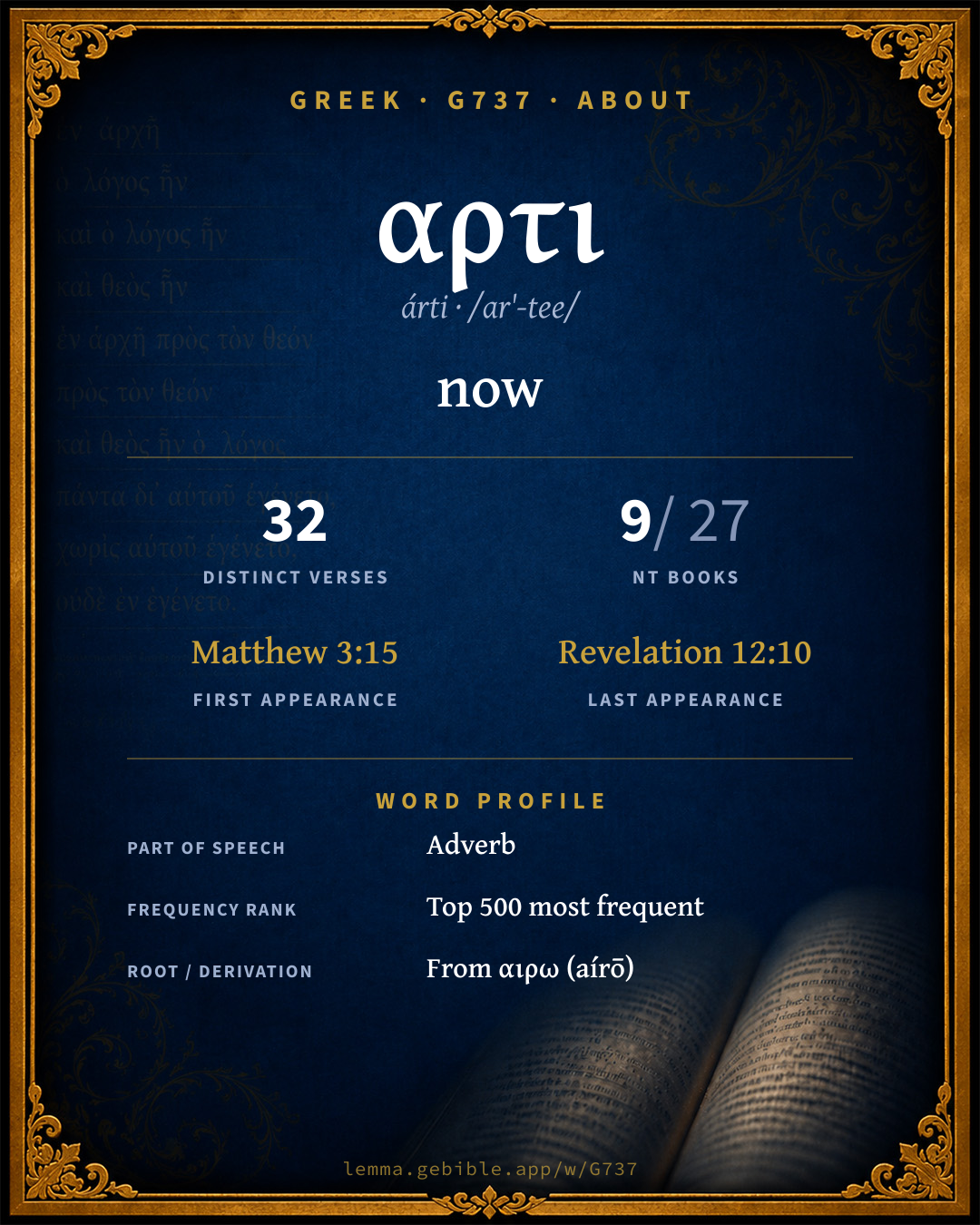
ἄρτι
now
‘now’ is one of 2 main senses fuller range ↓
Full lexicon entry — Thayer's Greek Lexicon
From Thayer's Greek Lexicon
Where this word appears
Grammar key — what these labels mean
Part of speech
- Adverb
- A word that modifies a verb, adjective, or other adverb.
Every verse where G737 appears in the Book of 1 Corinthians — 6 distinct verses. Click any verse to open its interlinear word-by-word view. Verse text shown in the World English Bible for context — . Each verse’s Greek form is shown with its reference; the English is not keyword-highlighted, since the data carries no word-level English alignment. Use “Compare translations” on any verse to read it across multiple English versions. This concordance covers the Greek New Testament; Septuagint (Greek Old Testament) occurrences of this word are not indexed here.
1 Corinthians
- 1 Corinthians 4:11 ἄρτι adv Even to this present hour we hunger, thirst, are naked, are beaten, and have no certain dwelling place.
- 1 Corinthians 4:13 ἄρτι adv Being defamed, we entreat. We are made as the filth of the world, the dirt wiped off by all, even until now.
- 1 Corinthians 8:7 ἄρτι adv However, that knowledge isn't in all men. But some, with consciousness of the idol until now, eat as of a thing sacrificed to an idol, and their conscience, being weak, is defiled.
- 1 Corinthians 13:12 ἄρτι ἄρτι adv adv For now we see in a mirror, dimly, but then face to face. Now I know in part, but then I will know fully, even as I was also fully known.
- 1 Corinthians 15:6 ἄρτι adv Then he appeared to over five hundred brothers at once, most of whom remain until now, but some have also fallen asleep.
- 1 Corinthians 16:7 ἄρτι adv For I do not wish to see you now in passing, but I hope to stay a while with you, if the Lord permits.
About this entry
At a glance — auto-summarized from this page’s data, not written by a person. Every figure links to its source below. This summary describes the numbers; it doesn’t interpret them.
αρτι — transliterated árti — is a Greek verb carrying the sense “now.” Its earliest occurrence is Matthew 3:15. It appears 32 verses across 9 books of the Greek New Testament, among its moderately common vocabulary. More than a quarter of its appearances fall in John. Thayer's distinguishes 2 senses for it. See the sense tree, 32-verse concordance, and the renderings breakdown below.
Gloss history
Strong's 1890 vs modern scholarship

About this word
Strong's G737 catalogs a Greek word from the Greek New Testament.
These counts are not copied from any lexicon or concordance. They are computed here, from the morphology-tagged Greek New Testament. What Lemma adds →
- 32
- distinct verses
- The word appears in 32 distinct verses.
- 9 / 27
- NT books
- The word appears in 9 of 27 New Testament books.
- #433
- by frequency
- Top 500 most frequent Greek words (rank 433 of 5,347 Greek words by occurrence).
View all 32 occurrences in the concordance →
Most concentrated in
- John 10 verses 31%
- Matthew 7 verses 22%
- 1 Corinthians 6 verses 19%
By section of the New Testament
By traditional corpus
Conventional, traditional groupings — biblical authorship is debated, so this is a traditional corpus grouping, not an authorship claim. Some books belong to more than one corpus (Luke is in both the Gospels and the Lukan corpus, and so on), so these shares overlap and need not total 100%. Each figure is a share of the word’s 32 distinct verses.
- Gospels 17 verses · 53%
- Johannine 12 verses · 38%
- Pauline corpus 11 verses · 34%
- General (Catholic) Epistles 3 verses · 9%
- Revelation 1 verse · 3%
How translations render this word
Counts come from each version’s own published word-to-Strong’s tagging or interlinear alignment — an approximate guide to how each version renders this word, not a word-level alignment the data otherwise carries. Because each total is that version’s own tagged count, the per-version totals vary from one another and need not match the appearance or distinct-verse counts above. These counts may also differ from a printed concordance because Lemma counts each distinctly tagged rendering and does not collapse phrase taggings into a single head-word total. This is a fixed set of word-tagged versions (KJV, ASV, BSB, ULT) and does not change with the reading translation you choose elsewhere. Each version’s license is shown beside its name below (and on Sources).
- King James Version: Now 21×, Hereafter 2×, Present 2×
- American Standard Version: Now 26×, Henceforth 5×
- Berean Standard Bible: Now 18×, Now on 3×
- unfoldingWord Literal Text: Now 29×, Just now 3×, Now on 2×
King James Version Public Domain
Renders G737 across 31 tagged occurrences — most commonly:
Plus 6 renderings that appear only once — usually multi-word phrases or single function words the recovered tagging swept in, not distinct renderings. Not rendered by a distinct English word in 5 further occurrences.
American Standard Version Public Domain
Renders G737 across 34 tagged occurrences — most commonly:
Plus 3 renderings that appear only once — usually multi-word phrases or single function words the recovered tagging swept in, not distinct renderings.
Berean Standard Bible Public Domain
Renders G737 across 28 tagged occurrences — most commonly:
Plus 7 renderings that appear only once — usually multi-word phrases or single function words the recovered tagging swept in, not distinct renderings. Not rendered by a distinct English word in 6 further occurrences.
unfoldingWord Literal Text CC BY-SA 4.0
Renders G737 across 36 tagged occurrences — most commonly:
Plus 2 renderings that appear only once — usually multi-word phrases or single function words the recovered tagging swept in, not distinct renderings.
Senses in Thayer's
The 2 senses Thayer's distinguishes for this word, in lexicon order (not ranked by frequency or importance). The full entry — with sub-senses — is in the Lexicon Entry tab.
- just now, this moment
- now at this time, at this very time, this moment
Word origin
Derived from αιρω (aírō) (G142) — to raise up.
Forms in the corpus
The 2 distinct written forms G737 takes in the Greek New Testament, most frequent first — each parse links to that case’s occurrences in the concordance.
| Form | Parsing | Example | Uses |
|---|---|---|---|
| ἄρτι árti | Adverb | Matthew 3:15 | 32 |
| Ἄρτι Árti | Adverb | 1 Thessalonians 3:6 | 1 |
Same root — word family
Other Thayer's entries built from the same root as G737, grouped by Strong’s listed origin. These share a root / origin per the lexicon — not necessarily a shared meaning. Each links to that word’s own entry.
Derives from
Shares the same root
- αιρεομαι hairéomai G138 to choose
- αρα ará G685 curse
- αρα ára G686 therefore
- αρεσκω aréskō G700 to please
- αριθμος arithmós G706 number
- αρκεω arkéō G714 to ward off
- αρρην árrhēn G730 male
- αρτος ártos G740 bread
- αρτυω artýō G741 to season
- αρωμα árōma G759 spice
- ορος óros G3735 mountain
Derived from this word
Compare all same-root words → Showing 4 of 16 — not the complete family. They share a root, not necessarily a meaning.
Septuagint usage
The same Greek word αρτι appears 2 times in the Greek Old Testament (Septuagint), across 2 verses in 1 book.
- 2
- LXX occurrences
- Tagged occurrences of this Greek word in the Septuagint.
- 2
- verses
- Distinct Septuagint verses containing this word.
- 1 / 39
- OT books
- The word appears in 1 of the 39 Old Testament books.
Sample Septuagint occurrences
- Daniel 9:22 ἄρτι
Septuagint occurrences (same lexeme)
Every verse where the same Strong’s number (G737) appears in the Greek Septuagint. Verse text shown in the World English Bible for context; the Greek form is the matched word — the English is not keyword-highlighted.
- Daniel 9:22 ἄρτι He instructed me, and talked with me, and said, Daniel, I am now come forth to give you wisdom and understanding.
- Daniel 10:11 ἄρτι He said to me, Daniel, you man greatly beloved, understand the words that I speak to you, and stand upright; for to you am I now sent. When he had spoken this word to me, I stood trembling.
These are occurrences of the same Greek lexeme (G737) in the Septuagint — not a translation of any one Hebrew word. The store carries no word-level Hebrew↔Greek alignment, so no Hebrew original is asserted here. Counts come from the recovered LXX Strong's tagging — high-frequency vocabulary is well covered, while rare or late forms may be untagged — so they reflect tagged occurrences and may slightly undercount.